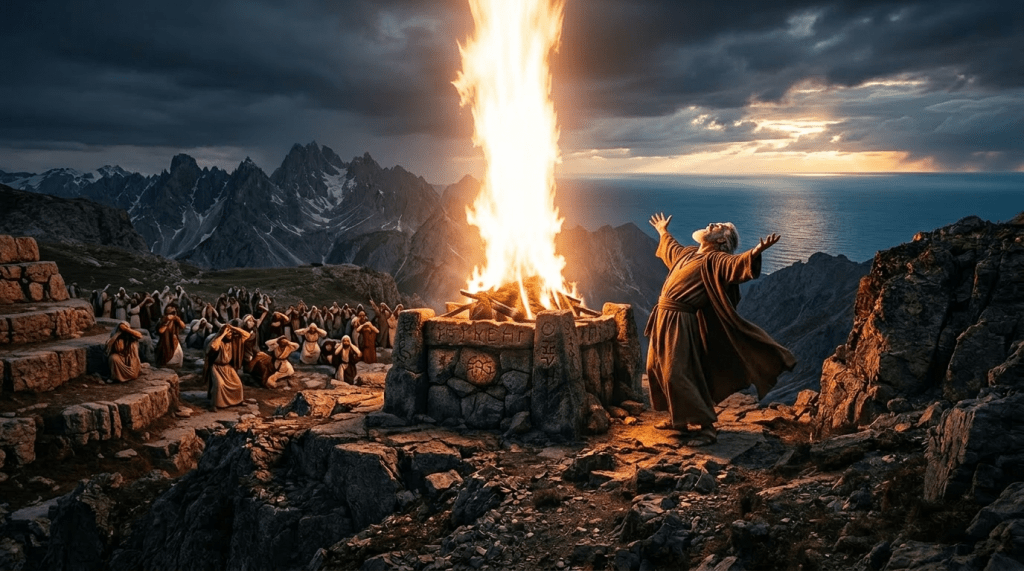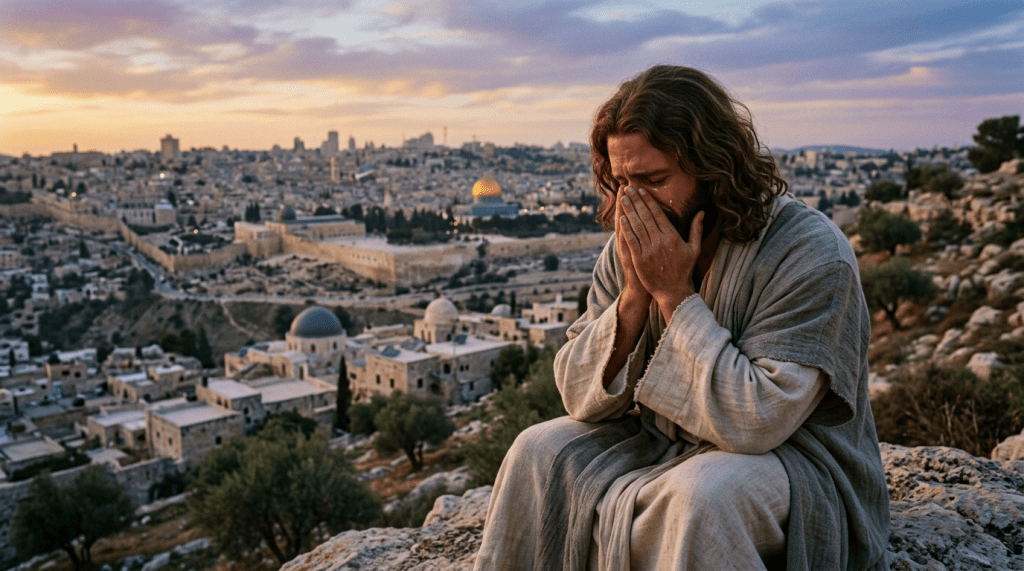
They Thought God Was Like Them

Examine yourselves to be sure you are in the faith.

Smiling man with dark shadow holding a knife behind him

But to the wicked person, God says:

What right have you to recite my laws or take my covenant on your lips? You hate my instruction and cast my words behind you. When you see a thief, you join with him; you throw in your lot with adulterers. You use your mouth for evil and harness your tongue to deceit. You sit and testify against your brother and slander your own mother’s son. When you did these things and I kept silent, you thought I was exactly like you. But I now arraign you and set my accusations before you.'”

Psalm 50:16-21


God’s Word is full of warnings to the wise. Take heed. God does not desire that anyone perish, but a day is coming when your life will end. A day is coming when this world as we know it will cease to exist. There will be a day of judgment for all of us.

God does not force us to love Him. He doesn’t require that we submit to Him. He gives us the terrible choice of determining how we will live. He will give us over to our desires on that day when we die, on that day when the earth ceases to be as we know it, and we will face the consequences of our choices – the way we chose to live – whether it be with Him or with our own selves at the center of our orbit.

These verses indicate that even a wicked person can recite God’s laws and claim to be in covenant relationship with God. Even a wicked person can claim to know Him. Jesus echoed the words of the Psalmist when he said,


Not everyone who says to me, ‘Lord, Lord,’ will enter the kingdom of heaven, but only the one who does the will of my Father who is in heaven. Many will say to me on that day, ‘Lord, Lord, did we not prophesy in your name and in your name drive out demons and in your name perform many miracles?’ Then I will tell them plainly, ‘I never knew you. Away from me, you evildoers.'”

Matthew 7:7:21-23


This word of warning applied to the religious. We can prophesy in God’s name. We can even drive out demons and perform miracles in God’s name. These signs do not make the person who performs them a child of God. Even false prophets are able to perform great signs and wonders. (Matt. 24:4; Mark 13:22)

Only the one who actually does the will of the Father is a child of God. (Matt. 7:21) Jesus said, “Everyone who hears these words of mine and puts them into practice is like a wise man who built his house on the rock.” (Matt. 7:24) Any other way to live is like “sinking sand” as the hymn goes.

The danger we all face is our own self deception. Perhaps, this is why the Prophet said, “The heart is deceitful above all things and beyond cure.” (Jeremiah 17:9) We cannot trust our own hearts.

Skeptics say that people have created God in their own image. That is true of the person who thinks God is just like them.

According to the writer of Psalm 50, wicked people who act wickedly can feel justified in their wicked actions, and God allows them to be deluded.


When you did these things and I kept silent, you thought I was exactly like you.”

Psalm 50:21


They are encouraged by God’s silence that they are right in in what they think and do, but God’s silence is not a sign of acquiescence. God’s arraignment and accusations hang over their heads.

I am struck by the need to know God, to know His character, and to yield our assumptions about God to the truth of who God really is. God’s silence in our lives is not approval. God often remains silent. God is often hidden. He is like a treasure to be found. God urges us to seek Him because in seeking Him, we must set aside ourselves to learn who He is.

These verses remind me of Hebrews 4:12: “The word of God is sharper than a double-edged sword.” It pierces. It divides. It discerns the thoughts and intents of the heart. If the word of God is doing its job, it cuts, it penetrates, it divides. If we yield ourselves to the word of God, it does its surgical work in us. Bur, only if we truly yield ourselves to that process.

I have often thought that Scripture does this kind of work. I felt it when I first began reading scripture before I was even a believer. I recognized in that time that scripture was exposing me to myself, and that I had a choice. I could allow it to do its surgical work, or I could harden my heart and choose to see in Scripture what I wanted to see.

Many people have said in derision of Scripture that people can make it say whatever they want. They are right, of course. Like the wicked person who acts wickedly and embraces wicked thoughts, while thinking that God is just like them.

The height of pride is to think God is like us. God opposes the proud, but He gives grace to the humble.

My prayer today is that God would rebuke me as He needs to; that He would soften my heart and do His surgical work in me; that I would not be deceived by my own thoughts and think that God is like me. I pray that God would reveal Himself to me and that I would know God for who He actually is.


so that Christ may dwell in your hearts through faith. And I pray that you, being rooted and established in love

Ephesians 3:17

From Jubilee to Kingdom: How God Transforms Ownership, Identity, and Belonging

From promised land to God’s kingdom is a journey from flesh to spirit


I am increasingly impressed by the importance of understanding the arc and sweep of Scripture from Genesis to Revelation. Though the Bible is a collection of many writings by many authors compiled over many centuries, it is a single, finely woven tapestry rich and brilliant in its nuance and theme.


Of course, a tapestry makes no sense if we do not view it from the right perspective. From the back side of the tapestry it appears like a jumbled mess of tangled threads.


The full beauty and design of the tapestry remains a mystery until it is viewed from the right perspective. Only then can we understand and appreciate it.


We would have no sense of the beauty or theme of the tapestry if we only saw it from the back side. Because the tapestry of thole Bible is so grand, we can also miss the big picture if we study it only as through a microscope or a magnifying glass.

We need to step back often and consider the trajectory, arc, and sweep of Scripture – from beginning to end – to make sense of the individual threads that may not appear to make sense in isolation.

From the time of Abraham, Isaac, and Jacob onward, the Bible seems to be all about these patriarchs and their descendants to whom God promised a land. For over 400 years Abraham’s descendants looked forward to taking possession of this land. That time was spent in captivity in Egypt, where the prospects of God’s promise grew dim and seemed unlikely until God sent Moses.

Led by Joshua, the people finally enter into the land after another 40 years of wandering in the wilderness with Moses. They drive out the inhabitants, settle in, and live there almost a millennia through cycles of judges and kings. It seems all about this land and its people. The theme of God’s covenant to give his people the promised land and the people’s covenant to keep God’s law dominates the portion of Scripture we call the Old Testament.

The land, the great leaders, the Law seem to define their destination. Again and again, however, those things prove to be provisional. The leaders fail. The Law fails because they seem wholly incapable of keeping it. The very land, itself, seems to fail them.

When we step back, we see that these things that seem to be the main point of the whole story actually point beyond themselves. They expose something deeper. They give way to something infinitely greater.

One of those themes that gets buried and lost in the jumble of threads is Jubilee. The Jubilee instructions are embedded in the middle of the Law in Leviticus 25. They are God’s specific instructions on how Israel was to live in the land into which God was leading them. That they never actually carried out the Jubilee instructions may account for us failing to  recognize their importance in the tapestry of God’s Word.

The Radical Vision of Jubilee

In Leviticus 25, God established the Year of Jubilee—a societal reset unlike anything in the ancient world. The Year of Jubilee was to be observed after seven periods of seven years. In the 50th year, the Year of Jubilee, the land was to be returned to its original owners. Debts were to be released. Indentured servants were to be set free.

The Year of Jubilee was to be observed every 50 years. Every fifty years was to be a reset.These were God’s instructions and the reason for these instructions was clearly laid out:


The land is mine” sayeth the LORD, “and you are strangers and sojourners in it.

(Leviticus 25:23)


Let that sink in….. God never intended Israel to own the land.

Even today many people consider Israel to be the land God promised his people for eternity. Even today we think it is all about the land.

Jubilee appears to us to be an economic policy. A cringeworthy redistribution of wealth that might offend modern, conservative sensibilities. But underneath it lies a theological theme – God’s design – that reshapes everything when we see it:

God wanted them to live in the land, to work the land, to benefit from the land, but only and always as temporary dwellers – as foreigners. They were not to call the land home. They were never meant to treat the land as their own – as owners.


The write of Hebrews understood this, and commended Abraham for living in the land of promise “as in a foreign land, living in tents.” (Hebrews 11:9)


We can understand why, the writer of Hebrews commended the people of faith who “acknowledged that they were strangers and exiles on the earth.” (Heb. 11:13) They were “seeking a homeland … a better country … a heavenly one.” (Hebrews 11:15-16) Why? Because they understood the promised land wasn’t their final destination!

Jubilee is not about fairness, or economics, or socialism—it is about something much more transcendent. It is about God’s eternal plan for the heavens and the earth and all the people in it. It is a reminder to Israel (and us) of who they (we) are in relation to God. It is a reminder that to them (and to us) this world is not all there is. God has bigger plans!

A People Shaped by identity

Though God promised His covenant people a land, their identity as God’s people was the most important thing. God’s vision for them extends beyond land into identity as His people. The Israelites were not meant to identify with the land, but with God.

They were to identity as God’s people living temporarily in a land God gave them, and they were to be a light to the nations. From the days of Abraham, God planned “to bless all the nations” through his descendants. (Gen. 12:3; 18:18; 22:18; 26:4; & 28:14) They were to be a people God called out from among the nations to covenant with Him. These people were intended to identify with God’s greater purpose in the world – which was for all the nations.

Israel is commanded to care for the stranger, the poor, and the landless in the land of God’s promise—not merely as an act of generosity, but as an expression of memory and identity:

“You were strangers in Egypt.”

God wanted them to remember who (and whose) they were. God rescued and redeemed them for Himself and for His purposes. Their story was always meant to shape their community and society into what God wanted them to be. God wanted to establish His people in His land to carry out His eternal plans for all the nations – for all people in the world.

They were not to be a people defined by power, dominance or possession, but by dependence, deliverance, provision, and protection of others – just as God delivered them, provided for them, and protected them. God’s instructions were structured to prevent them from becoming the kind of nation under which they once suffered – a nation like all the other nations around them. They were to be different, holy, and set apart for God’s greater purpose

Continue reading “From Jubilee to Kingdom: How God Transforms Ownership, Identity, and Belonging”

The Under-Emphasized Significance of Leviticus 25 in the Ministry of Jesus and Its Importance for Us

The Israelites did not follow the Jubilee instructions


For at least 7 years, I have been drawn to the passage in Luke 4 where Jesus gives perhaps the earliest description of his public ministry. Jesus introduced his intentions by reading a select passage from the Isaiah scroll, rolled it up, sat down, and announced, “Today this scripture is fulfilled in your hearing.” (Luke 4:21) These were the words that he read:


The Spirit of the Lord is on me,
    because he has anointed me
    to proclaim good news to the poor.
He has sent me to proclaim freedom for the prisoners
    and recovery of sight for the blind,
to set the oppressed free,
    to proclaim the year of the Lord’s favor
.

Luke 4:18-19


Immediately after this announcement, Jesus began demonstrating in Galilee what he came to do – teaching with authority (Luke 4:31-32); setting people free from demonic spirits (Luke 4:33-35); and healing the sick (Luke 4:36-40). At the end of this flurry of divine action, Jesus said, “I must proclaim the good news of the kingdom of God to the other towns also, because that is why I was sent.” (Luke 4:43) In this statement, he clarified that the good news he came to proclaim is the coming of the “kingdom of God.”

This short passage from Isaiah 61 that recalls the Year of the Lord’s Favor (Jubilee) focuses our attention back on Leviticus 25, which is the framework for the communal life God desired His people to embrace when they settled into the land of God’s promise.

The context of these words in Isaiah 61 remind of us the significance of these words that defined the ministry of Jesus and the Jubilee principles that characterized his life and message. When Jesus quoted from Isaiah 61 in the synagogue, he was incorporating God’s great plan and purpose into the announcement of his ministry.

Isaiah 61 cannot be understood apart from Isaiah 59, which recalls the iniquities of the people that separated them from God and the blood that was on their hands. (Is. 59:1-2) They abandoned the way of peace and justice. (Is 59:8-9) They walked in darkness. (Is. 59:10) No one was available to intervene. (Is. 59:15-16), so God said He would step in (Is. 59:17) with a Redeemer for those who would repent. (Is. 59:20)

Isaiah 60 announces God’s plan of redemption: “arise, shine, for your light has come.” It presages that “nations will come to your light.” (Is 60:1:3) Isaiah 60:4-16 announces God’s intention that all the nations will come to Israel “bringing your [Israel’s] children from afar” (v.9), and “foreigners will rebuild your walls” (v.10) , and “you will drink the milk of nations and be nursed….” (v.16) Isaiah 60:17-22 promises peace, no more violence, everlasting light, and righteousness.

In that context, Jesus read the opening verses of Isaiah 61 – announcing that the time had come for proclaiming good news to the poor, binding up the brokenhearted, proclaiming freedom to captives and release from darkness for prisoners, and proclaiming the year of the Lord’s favor.

Significantly, the Jesus left out the concluding words: “and the day of vengeance of our God….”

In doing that, Jesus signaled that he did not come for judgment. “For God did not send his Son into the world to condemn the world, but to save the world through him.” (John 3:17) Jesus came to proclaim the good news of the coming of the kingdom of God predicted in Isaiah 61 – healing, freedom, release, and blessing – because God’s people had failed to live into and live up to the plan God had for them.

The words Jesus read culminate with a proclamation of the “year of the Lord’s favor” from Leviticus 25. This is where it gets interesting to me. I have not focused on this part of what Jesus said before, so let’s dive in.

Continue reading “The Under-Emphasized Significance of Leviticus 25 in the Ministry of Jesus and Its Importance for Us”

Embracing Our Identity as Citizens of Heaven

created with Chat GPT*

A very good friend and sister in Christ recently gave a devotional presentation to a faith-based non-profit Board of which I am a member. She reflected on her experience of being a minority as a Christian growing up in India, where less than two percent (2%) of the population is “Christian” (including Catholics, Jehovah Witnesses, and Mormons).

Her poignant story of personal struggle with minority status and finding blessing in it, hits home with me. I have never felt like a minority in the visceral way that she experienced it. The blessing she found through Scripture in embracing her minority status is a lesson for all believers.

Being a Christian in a Non-Christian World

My friend struggled with her minority status as a Christian in India. She was ridiculed, teased, and looked down upon. By God’s grace, she felt her divine calling as a child of God, but her identity as a Christian came with consequences.

The consequences proved even more difficult for her sister, who applied to medical school. The admissions officer said she must recant her faith to be approved for assignment to any med school. She refused, and she gave up her dream of becoming a physician. Minority status in a majority world as consequences.

Being a Foreigner in the United States

When she emigrated to the United States she felt the joy of being a part of the Christian majority. Over time, however, the struggle with minority status began to resurface again. She stood out because of her ethnicity, accent, and cultural differences. She realized, “I am a minority within my Christian majority realm.”

This was a very personal struggle for her because of her childhood experience in India. She thought that moving to American where Christians are in the majority would be different. Instead, she felt the sting of minority status. Though she was a Christian in an ostensibly Christian country, she was still an outsider and a foreigner because of her nationality, ethnicity, and cultural differences.

Being a Foreigner in the World

She shared that God met her in the struggle and confronted her with His Word. What she learned through this process was sobering for her, and it is a lesson for those of us who have always lived in majority status in a majority Christian nation. 

She began to realize what a privilege it is to be a minority because we are called as believers out of the world where wide is the path that leads to destruction. We are set apart by God from the world, which means we are called to minority status in the world.

Narrow is the path that leads to life. Minority status is the Christian experience.

The Privilege of Minority Status

As she focused on these things God was showing her in His Word, she became grateful for her experience as a Christian in a majority non-Christian country. This experience gave her perspective that American Christians lack.

Continue reading “Embracing Our Identity as Citizens of Heaven”

Making Sense of Science and Theism: Evolution, Engineers, and Category Errors

As the engineer is to a clock so is ___________ to the natural world?


The first episode of the Uncommon Ground podcast with Justin Brierley is titled “What is Behind the Poetry of Reality?” The podcast features a conversation with Richard Dawkins and the former Archbishop of Canterbury, Rowan Williams. Dawkins of New Atheist fame has a purely materialist view of reality – maintaining that reality is comprised only of materials things that operate on their own without the aid of God or any immaterial thing.

The discussion is amicable and informative, if not predictable. Rowan Williams accepts the evolutionary paradigm, but believes in God – an immaterial, personal creator of the universe. They seemed to agree on the science. The only difference is that Williams believes there is a God behind the science and the universe.


When Brierley asked Williams to summarize Richard Dawkins’ view of reality, Dawkins graciously conceded, “Rowan… understands so well that he can summarize what I think better than I can.”


Dawkins should be given credit for reading Williams’ recent book that was the backdrop for the discussion, but Dawkins admitted to being “baffled” by it.


Dawkins was unable to provide a cogent summary of Williams’ view of reality. He succeeded only in criticizing Rowan’s view, and Dawkins conceded, “I think Rowan understands where I’m coming from much better than I understand where he’s coming from.”

This reminds me of C.S. Lewis, who says that the Christian worldview can take in science into account, but a view of the world limited to the constructs of science cannot take into account Christianity. One is robust enough to hold the other, but the other is not sufficiently robust to do the same. (I have provided the whole quotation in its context below.)

I will admit that the robustness of Christianity to be able to make sense of science does not necessarily make it true. Conversely, the limited scope of science that is unable to account for Christianity does not necessarily make it untrue. If reality truly consists of nothing but matter and natural processes, then the limitations of science are the limitations of reality itself.

I think that reality is not sufficiently explained by science, which is limited to natural explanations. I am also fascinated with Dawkins’ attempt to explain his own worldview as follows:


I see the world as a very complex thing, like a clock or like a car or like a computer, and, and in the case of a clock or a computer or a car, I know how it’s made. It’s made by engineers with drawing boards and they… put together the parts and, and those parts all work together. [T]he equivalent of the engineer in the world of nature is evolution by natural selection.


I am an English literature major and an attorney. In both disciplines, the ability to draw connections, and distinctions, and juxtapositions between and among word meanings and concepts is essential. Attorneys are professionals in comparing and contrasting facts and circumstances to be to argue (consistent with clients’ interests) that laws either apply in the same way or do not apply in the same way to similar but different sets of facts and circumstances. Perhaps, this why I noticed that Richard Dawkins made a category error. Or did he?

Continue reading “Making Sense of Science and Theism: Evolution, Engineers, and Category Errors”