5 Things About the Current State of Immigration Detention

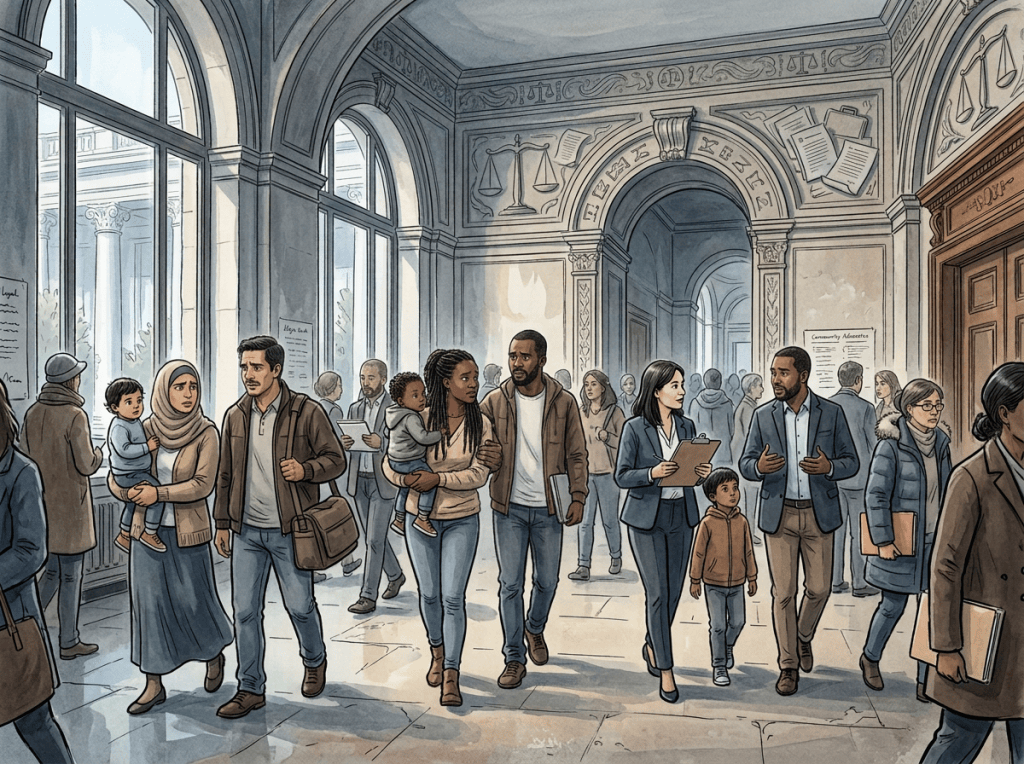
Diverse people walking through an ornate courthouse hallway

Matt Soerens with World Relief was asked to comment about the current state of immigration detention in July of 2026. Although immigrant detention is not as much in the news right now as it was months earlier, it is still happening. Tactics and policies have not changed, but ICE has stopped being so public about it.


Was that part of the plan? Did they purposefully introduce a new era of immigration enforcement with tanks, heavy equipment, masks, fatigues, violence, cruelty, and disregard for 4th amendment protections with a public show of fanfare and force to scare immigrants and desensitize the rest of us?

If ICE was previously “in your face,” they have shrunk back into the shadows, though the pace of immigration has actually increased, according to Soerens. In fact, the federal government reports that 46,000 people were detained in the month of July, which is more immigrant detainees in a single month in the history of the United States.

Some things have not changed. The vast majority of people being detained have not committed any crime. The most recent data available at the Department of Homeland Security indicates that approximately 65,000 people were detained as of July 20th, and 71% of them had not been convicted of any crime.

Of course, this means that approximately 29% of the immigrant detainees have been convicted of a crime. What qualifies as a crime, however, is a very broad spectrum of activity that extends from murder down to traffic violations.

Soerens cautions that we should not minimize the importance of locating and detaining immigrants (or anyone, for that matter) who has committed a heinous crime. At the same time, we should not lump in people whose only crime is a misdemeanor traffic offense with hardened criminals.

Soerens, a Chicago area resident, observes that traveling 81 miles per hour on I-294 in the Chicago area is a crime, but it doesn’t get anyone detained, thrown in prison, or worse. If you live in Chicago, you know the speed limit on I-294 is 60 miles per hour, but you will be run over if you are not flowing with the traffic, which often runs 75 miles per hour or more, with people passing you doing 80, 90, or faster.

A significant percentage of the 29% of detainees who have criminal convictions have been convicted of nothing other than a misdemeanor traffic offense – like doing 81 on I-294 or similar offenses. The fine for a traffic ticket is nothing more than an inconvenience for most people, but detention and deportation can be a life sentence for people who have left danger in their home countries.

Some immigrants who are currently being detained have lawful status that was taken away by the current administration. They came here legally under a program that was established for them. In fact, they entered the country precisely because the program was created for them, but now it has been terminated, and they are being deported like people who entered the country without permission.

Soerens says, we don’t know how many people have been detained in this category. We do know that 1.8 million people were present in the United States in January of 2025 with lawful status that has been revoked by the current administration. Many of the people in this category have come from countries with the worst humanitarian crises in the world – places like Haiti and Venezuela. The people who came in through these programs have been vetted. They have had criminal background checks to ensure that they do not have criminal backgrounds, and they are escaping real and present danger.  They cannot return safely to their country of origin – especially now that being returned puts a target on their backs.

With their lawful status withdrawn, these people go into the category of immigration violators, though they did nothing wrong. They become immediately eligible for deportation through no fault of their own.

Reasonable minds can differ about the wisdom and propriety of the programs that were created for these people. But revoking status that was granted that induced them to immigrate to the United States isn’t just immoral; it’s a clear violation of biblical mandates to “let your yes be yes and our no be no.”

In the context of contracts, which is similar to a covenant, we have laws that protect people from that kind of behavior. If one person breaks a contract, the other person has a remedy in the law. In this case, our government broke the contract, and there is no recourse.

In the context of local governmental law (with which I am familiar, having practiced in that area for 35 years),governments can pass new laws that end protections or privileges, but they cannot be applied retroactively to people who relied on them. It isn’t fair to pull the rug from underneath someone who depended on the rug. 

This is such a fundamental rule of law, that it hardly needs any explanation. If a person acts in reliance of the current rules, even if government changes the rules, the change can only apply going forward. It cannot apply back in time for people who relied on the old rules.

In a sense, the fundamental rule of law goes back to the idea of letting our yes be yes and our no be no. That’s the way God works with us. He is not arbitrary and capricious. He makes a promise and keeps it, and he expects us to do the same. We can disagree with the programs that were created and end those programs, but we should not, in good conscience before God, remove the protections that were once given.

Ironically, the people whose lawful status was removed by the present administration become some of the easiest people to detain because the Department of Homeland Security and ICE have all of their information. They have gone through official channels, and they are sitting ducks.

Another thing to know about the status of immigration enforcement in this country is that families are being separated. World Belief participated in a study together with the National Association of Evangelicals to determine the effect of the administration deporting 1 million people each year of the current administration, which is the stated goal. The study shows that 270,000 spouses would be separated because of detainment and deportment, and 900,000 and a million children would lose at least one parent.

Another thing to know about the current immigration enforcement operation is the effect it has on the church. World Belief participated in a separate study with the National Association of Evangelicals and the  Center for Global Christianity at Gordon-Conwell Seminary. They found that 80% of people vulnerable to deportation are Christian of one stripe or another. If the administration was successful in deporting everyone who is vulnerable to deportation, deportation will affect 1 in 12 households in this country.

The final thing to know about current immigration policy is the great cost.  In 2024, the ICE budget for detention was 3.4 billion dollars.  The big, beautiful bill passed a year ago budgeted 45 billion dollars just for detention.  That figure does not include other operations of immigration enforcement, including the deportation process,  border security, or administrative operations. On top of that, the administration seeks even more money for detention since the budget was passed!

Matt Soerens says that World Relief has never taken the position that no one should be detained or deported.  The border should be secure, and anyone who poses a threat or has engaged in criminal activity of a type that is not consistent with good citizenship should be eligible for deportation, according to Soerens.

The issue isn’t stepping up immigration enforcement against immigrants who have committed serious crimes. The issue is that over 70% of immigrants currently detained have no criminal record. Not even a traffic violation. Yet, we are spending over 10 times the amount of money to detain them, and the administration is asking for more. Even people who agree with the effort to deport people who entered without permission recognize that the cost is unreasonable compared to what is being accomplished.

Regardless of the financial cost or even policy considerations, Christians should be speaking up and petitioning legislative representatives for more humane treatment of immigrants, who are people made in the image of God.  Christians can disagree over the priorities for immigration: enforcement, the kinds of crimes or actions that should warrant detainment and deportation, and the programs that should be offered, but Christians should have no disagreement over the humane treatment of immigrants.

We do not detain hardened criminals, including murderers and rapists, in the conditions that currently exist for the detention of immigrants. Immigrants should not be treated like hardened criminals, and they should not be treated worse than hardened criminals – unless we don’t really believe that all people are made in the image of God.

It isn’t the degree of criminal activity that should warrant humane treatment; and it isn’t whether a person is a citizen or a legally documented alien that should warrant humane treatment. All human beings are made in God’s image – whether murderers, rapists, speeders, or immigrants. If we really believe that, then immigrants should be treated accordingly, and not rounded up, herded, and detained in unsanitary and overcrowded conditions with little or no medical attention for those who need it.

The current state of immigration enforcement and detention in the United States does not reflect God’s righteousness and justice, the foundation of God’s throne. They do not reflect the most basic of biblical principals: that all people are created in God’s image. As Christians, we need to advocate for God’s justice and righteousness, regardless of what we feel about immigration issues politically.


Absurdity in a World Without God

I am reading A World Without God by Chris Palmer. In Chapter 7, in the section titled, “The Indifferent Universe,” the protagonist describes the death of a five-year-old boy from a mysterious plague.


The section opens, saying, “The death of a child has a way of undoing everything…. [including t]he scaffolding we use to make sense of the world.” The protagonist wandering through fictional Novemberton recalls Albert Camus and his “stubborn refusal to look away from the raw edge of things,” and he finds comfort in Camus’ refusal to rescue meaning from chaos.


A strange comfort it seems to be that humans like things we can understand. We want to understand the world and to reduce it to terms we can grasp. We have an innate desire in us for meaning and understanding, and we are unsettled when meaning and understanding elude us.

Some things are obvious but we don’t want to see them. Camus was willing to acknowledge what most of us can’t seem to grasp: that the universe is utterly indifferent to us. He was not just willing to acknowledge it; he was willing to resign himself unreservedly to it.

Most people can’t or are not willing to do that. The death of a child for no reason is absurd, says the protagonist. Most of us are inclined to agree, but why?

Children sometimes die. We all know that it happens, yet it shocks us each time. The death of a child, the sudden death of a husband, father, and provider for his children, and the mass casualties of an earthquake or a flood evoke the same shocked response.

We cannot help but think the world has gone mad. The world has become absurd.

The protagonist in A World Without God praises Camus for exposing “the mismatch between the human heart and the mute mechanics of the universe.” The human heart longs for meaning – or for a particular king of meaning – but the universe seems to defy that meaning in things like the death of a child.

It seems clear to me that perspective is crucial to meaning. If I do not know English, I could not read the book I am reading that is written in English. I have to approach the book from the perspective of the English language to understand it.

From our perspective, the world makes no sense. We want the world to correspond to us but it doesn’t. If we are at the center of the world, it makes no sense. The world seems “utterly indifferent,” indeed, when we consider the death of a 5-year old child to plague, the death of a father and provider for his family, or the mass casualties of an earthquake or a flood.

It seems tragically factual that the world is utterly indifferent to us, but we are not indifferent to that fact. Thus, it seems “absurd” to us.

The problem is our perspective. We seem to expect (or at least desire) that the world should embrace us, coddle us, tend to us. We find it shocking – absurd – that the world is so indifferent. Because the world does not exist the way we want it to exist, we call it absurd and fail to find the meaning in it.

If I see myself in the world at its center, and the world makes no sense to me, perhaps I am not at the center of the world. If I find it absurd because it doesn’t bend toward me, perhaps I am looking at the world from the wrong perspective.

By what metric do we declare the world absurd?

I think all people have some sense that Camus is right about the absurdity of pain and death from our shared perspective as people seeking meaning with ourselves at the center. From that perspective, the world is absurd because it does not bow to the way we desire the world to be.

People praise Camus for being brutally honest and willing to accept the stark truth of that reality. But it seems to me that the absurdity lies in thinking that the world should bend to my desires and that the world should have the meaning I ascribe to it. Perhaps, the absurdity lies in my thinking it is so.

A human being recognizing the great tragedy of the death of a five-year-old just beginning to blossom in the world means something. Why do we find that so unsettling? Frankly, so absurd. That fact – the fact that we are disturbed by it – is the clue to the meaning we long for.

If the world just is, if the world is simply and utterly indifferent, why do we care? Why do we label it absurd? And why, if we think it absurd, would we resign ourselves to go no further in our thinking, but to accept the absurdity of it?

The very fact that it matters, the very fact that we care, the very fact that we find it absurd, is staring us right in the face.

Of course, we want a world that bends to us. Of course, we want a world that cushions our fall, that soothes our pain, that comforts us in our discomfort. But it ain’t so.

What we want is the world to be our god – a god that is subservient to us. When we (repeatedly) “discover” the world does not bow to our wishes, we protest, we lament, we become undone.

But why?! If that is the way it is, why are we always so undone about it. Why not just accept it – not as absurd – but as the way it is. Why do we not simply shrug?

The fact that we are so unsettled by the fact that world does not bow to us, does not comfort us, does not yield the meaning we desire out of it, should suggest to us that we are missing something. To come to the brink of that realization, to come to the very edge of it—and go no further—is the absurdity.

If life seems absurd from the perspective of human beings at the center, perhaps, we need a new paradigm.

Continue reading “Absurdity in a World Without God”

You Have Been Warned! (In the best way possible)

The Warning, three sisters from Mexico who dared to dream big.


I love and appreciate music. I used to be a classic rock guy but my horizons have been expanded, and I mostly listen to contemporary music these days. I played guitar for a number of years and even led worship, but that was B.C. (before children). I was also a board member for a music foundation that built out and operates a venue for live music. I even booked the venue for about a year before COVID.

In the process of booking the music venue, I was constantly searching out new music. I focused on people writing and performing their own music. I looked for artists with a good enough following to fill a 200-seat venue but not so big that they were priced out of our range. I booked many, many acts, some of which have outgrown our space. At least one musician I booked went on to play for crowds of tens of thousands.

I tend to gravitate toward new folk, “new grass,” Americana, and indie rock, but I appreciate good music of all kinds. I go to live shows outside of my listening sweet spot to support young artists and appreciate their music. I like people who are not what I expect them to be, musicians who are authentic and who defy stereotypes. I also like a good story

All of these characteristics define a young group out of Monterrey, Mexico called “The Warning.” I will say now, “You have been warned!” which became their catchy promotional phrase when they were young – and not without reason. I can relate from experience that their rabbit hole is deep and winding!

The Warning is comprised of the three Villarreal Velez sisters who were raised by good parents who love music and introduced them to classical piano lessons, music of all genres, and Rock Band (the video game) when they were young. Daniela and Paulina began playing Rock Band when they were 8 and 6. They played it for hours and were driven to get perfect scores. Daniela (Dany) always played guitar and Paulina (Pau) insisted on the drums. Their little sister Alejandra (Ale) was “just a baby” (3) as she watched her older sisters play.

The girls became rockers and begged their father to buy them the real instruments they were playing on the video game. He obliged, signed them up for music lessons, and told them they had to give it at least 6 months. He had difficulty finding someone willing to give a 6-year-old drum lessons – a very small 6-year-old at that. The parents, Monica and Luis, captured their journey on video, part of which is the source material for a short documentary, Mayday in the Making, embedded below.


The girls took to that challenge their father gave them in the same way they were driven to achieve a perfect score in Rock Band. They shifted from piano lessons to guitar and drum lessons, and they practiced constantly.

Ale developed the same love of music as her older sisters, watching them play rock band and taking classical piano lessons herself. Though she was originally drawn to the harp, she fell in love with the bass guitar, and she began bass guitar lessons at 7 or 8 years old.

The sisters didn’t take long before they realized they could start playing music together, and they became a band. In fact, Ale had only been taking bass lessons for two months when they performed together for the first time in front of a live audience at a school Christmas celebration. Their father built them a state-of-the-art studio in the basement, which I imagine was half for sound containment and half to support his blossoming musical prodigies.

This may seem like an odd article on this website, but I do have a page devoted to music with perhaps a dozen articles I have written on music/faith themes. I have been inspired to write about the Warning, but I need to step up the stage first (pun intended) with an introductory article.

Continue reading “You Have Been Warned! (In the best way possible)”

The Kingdom of Heaven and the Kingdoms of This World: A Political Primer

Ornate crown with jewels lying on cracked desert ground

In the episode of the After Class podcast link to above, the theologians who do the podcast continue their discussion of politics and the Bible. Among other things, they talk about how Israel rejected God by wanting a king like all the other nations.

I have read that story many times, but the import of it didn’t hit me until a number of years ago. It must have been 2016-17 when the following words God spoken to the prophet, Samuel, settled into my heart and have continued to hang over me ever since. The people of Israel demanded a king, and Samuel warned them about what they were requesting. Then God said to Samuel:


Listen to all that the people are saying to you; it is not you they have rejected, but they have rejected me as their king.”

1 Samuel 8:7


God gave them a king even though they were rejecting God as their king by their very request. This is a sobering thought, because Paul tells us in Romans 1 that God gives us over to our delusions if we persist in them.

The fact that God gave them the king they requested was not a blessing and it was not what God desired for them. The fact that God used Israeli kingship to establish David and his line, out of which the Messiah would eventually come, is beside the point. God is able to work all things together for the good, but that doesn’t mean that all things are good.

In case there is any doubt in anyone’s mind about these things, God spoke again through the prophet, Hosea, many years later to drive the point home:


Where is your king, that he may save you? … [I]n my anger I gave you a king, and in my wrath I took him away

Hosea 13:10-11


I dare say these words haunt the American church presently. We have put our faith in politics, and in doing so I firmly believe that we have rejected God.

I could easily rail on conservative Christians who have championed and defended Donald Trump as if he could do no wrong. But I could just as easily critique Christians who have rallied in opposition to Donald Trump. We have taken positions on the front lines of a cultural war of political ideologies – on both sides – to our own detriment and the detriment of the global and timeless purposes of God.

Not that we might frustrate God in achieving His purposes any more than the people of Israel did in rejecting God to want a king. God works despite us, perhaps, more often than he works through us. Meanwhile, our distraction and exhaustion with politics keeps us from being salt and light in the world that Jesus meant us be.

The United States of America is not Israel, the covenant people of God. The modern nation of Israel is not the covenant people of God either. Israel, the nation-state that exists today, is a secular nation. The Temple is not the center of Israeli religious life. The modern nation state of Israel is not governed by the law of Moses. It is not a continuation of the covenant relationship that was established under the law of Moses.

Modern Christians have even less provenance than Jewish people to support the notion that a modern nation can replace or continue the former covenant relation established by God through Moses. As Paul says, the law was only a shadow. It was only a tutor.

Jesus is the reality, and He is the fulfillment of the covenant relationship God made with Abraham who did not put stakes down into the promised land. Abraham lived in tents as a sojourner, waiting for the city the architect and maker of which is God. He was still waiting for it when He died, as were all the men and women of faith commended to us in Hebrews 11.

Jesus dispels the notion that infiltrating or overtaking and establishing a nation state on earth is a proper purpose for his followers. Jesus introduced a kingdom that is not of the world. He could have, but he did not, model Christian involvement in secular governmental authority.

God does establish secular nations and authorities under powers and principalities that He allows (and uses) to create order in the world. Though God uses them, the powers and the principalities are not all aligned with God. In fact, they are opposed to Him, and they will all crumble and be no more when Jesus takes the throne as the rightful king when God remakes the world into a new heaven and earth.

The only thing that will remain, then, is the kingdom of God. Nowhere does the Bible suggest or Jesus teach that we should usher in God’s kingdom in through secular political means. As a matter of fact, it’s just the opposite.

Continue reading “The Kingdom of Heaven and the Kingdoms of This World: A Political Primer”

Idolatry, the High Places, and the Modern Believer


As I read through the Bible this year, the phrase, “the high places,” caught my attention because it is used as a kind of litmus test and descriptor of the kings of Israel and Judah in Kings and Chronicles. Like a worn-out refrain, and a tired old drumbeat, king after king in Israel and Judah is identified for failing to remove the high places. Only Hezekiah removed them and only Josiah destroyed them completely.

In case you have not read Kings or Chronicles lately, each king is judged by whether he did what was right in the sight of the Lord and removed the high places. The phrase “the high places were not removed” functions like a spiritual diagnostic in Kings. Even of the kings who were not wholly evil, only two (2) of them did something about the high places that were scattered throughout the region.

I have glossed over the phrase every year that I have read through Kings and Chronicles until now. When I recognized I wasn’t exactly sure what the high places were, I took some time to lay my assumptions aside and look into it. What I found is interesting and surprisingly relevant for us today.

What Were the High Places?

The Hebrew word translated “high places” is bamot. These were worship sites, usually located on hills or mountain tops, on ridges, or sometimes even on raised platforms in cities. A typical high place might include a stone altar for sacrifices, standing stones (masseboth), wooden poles associated with goddess worship (Asherah poles), incense altars, or occasionally a sacred tree or grove.

Ancient Near Eastern people believed that worshiping on elevated places brought them closer to heaven. Thus, “high places” became a term synonymous with worship. I wonder, as I write this, whether our phrase for good worship or a good spiritual experience – a mountaintop experience – comes from the idea of “high places” (knowingly or unknowingly).

The First Reference to a High Place

The first explicit mention of a “high place” is in 1 Samuel 9. When Saul goes looking for his father’s lost donkeys and is told to seek out the prophet, Samuel, who was planning to meet the people “at the high place” for a sacrifice. They were waiting for Samuel to get there to bless the sacrifice before they ate. Saul meets Samuel on his way to the high place, and Samuel instructed Saul to go on ahead of him, to wait for him, and to eat with him. (1 Samuel 9:12–14, 19).

This first mention of a high place is interesting because it seems to carry no negative connotation. Samuel had a good reputation as a prophet who did what was right in the Lord’s eyes, and the sacrifice they enjoyed at the high place seems to have been acceptable.

Older Worship Practice


Although the term “high place” is first used in 1st Samuel, worship on high places by some of the most iconic people of God goes back much earlier. For example: Noah builds an altar after leaving the ark; Abraham builds altars at Shechem, Bethel, and Mt. Moriah; Jacob worships at Bethel, and Moses meets God and receives the Law on Mt. Sinai.

Man placing stones near a wooden ark under a cloudy sunrise in the mountains

The pattern of mountaintop worship and encounter with God is repeated and prominent. Just as noticeable, perhaps, is the absence of a negative comment about these practices. They seem to have occurred in ways that advanced relationship and covenant between God and key figures in the Old Testament. The pattern seems to have been acceptable to God, and those older mountaintop places of worship are not called “high places” (bamot).

A Change in the Worship of God

The early encounters of people with God were organic and free-flowing, but that way of relating to God changed with Moses and the Exodus. Although, Moses met with God on the top of Mt. Sinai, God changed the way people would relate to Him and worship Him going forward.

After Moses provided the blueprints from God, the Tent of Meeting (Tabernacle) was constructed to provide a place for the the Ark of the Covenant, for offering sacrifices to God, and for Moses to meet with God. The presence of God came to reside among the people over the Tent of Meeting with a visceral demonstration of fire by night and cloud by day.

Moses was instructed to consecrate the Levites, alone, to care for the Tabernacle and Ark of the Covenant, to carry, assemble, and to tear down the structures when they moved, and to conduct all of the ritual sacrifices that were very carefully prescribed.

Anyone who dared to approach God, offer sacrifices, or worship in a way that was not prescribed incurred the consequence of that transgression. No one but a Levite (and Moses) could enter the Tent of Meeting or offer sacrifices, and the Levites had to follow the the detailed instructions prescribed by God or pay the price.

The Problem with High Places

When Israel entered the Promised Land of Canaan, hilltop shrines devoted to gods like Baal and Asherah were scattered throughout the area. At that time, God specifically commanded Israel to destroy the high places (bamot), saying, “You must not worship the  Lord your God in their way.” Instead, the people were instructed to “seek the place the Lord your God will choose from among all your tribes to put his Name there for his dwelling.” (Deuteronomy 12:1-7).

They were warned, “You are not to do as we do here today, everyone doing as they see fit, since you have not yet reached the resting place and the inheritance the Lord your God is giving you.” (Deut. 12:8-9) Yet, all they had was the mobile Tabernacle and the Ark of the Covenant, and they moved around until the Temple was built by Solomon. They were not always even in the same location.

The Transitionary Period

It was during this time frame that Samuel met Saul at “the high place.” Other people also offered sacrificed on high places during this period, despite the instruction from Moses. For instance, Joshua builds an altar on Mount Ebel after the conquest of Ai and offered sacrifices as Moses instructed them to do after crossing the Jordan into the Promised Land. (Deuteronomy 27; Joshua 8:30–35)


Stone firepit with smoldering ashes near river in natural valley landscape

Sometime later, the tribes that took the land east of the Jordan built an altar. Joshua and the western tribes prepared to go to war with their brothers, assuming that it was an unauthorized rival worship location. They relented when eastern tribes explained it was not an altar for performing sacrifices; it was a ceremonial altar meant to be a witness that they belong to Israel. (Joshua 22)


God specifically instructed Gideon to build an altar to the LORD and offer sacrifices on it after tearing down an altar his family constructed for Baal. (Judges 6) Samson’s parents built an altar and offered sacrifices in thanks to God that seems to have been acceptable, because the Angel of the LORD ascends in the flame. (Judges 13)

Samuel repeatedly participated in offering sacrifices away from the Tabernacle at Mizpah (1 Samuel 7), Bethlehem (1 Samuel 16), the high place at Ramah (1 Samuel 9) during the period when the priesthood centered at Shiloh had collapsed and the Ark and Tabernacle were no longer together. David also built several altars during this time, including an altar on the threshing floor of Araunah (2 Samuel 24) where Solomon would later build the Temple.

Finally, Solomon offered sacrifices at the high place of Gibeon. In Solomon’s case the text seems to excuse the practice by stating, “[T]here was no house built for the name of the Lord.” (1 Kings 3) This seems to suggest that it was a transitional time.

Not a Hard and Fast Rule

Though God had told them to “seek the place the Lord your God will choose from among all your tribes to put his Name there for his dwelling,” it didn’t seem to be a hard and fast rule after they entered the Promised Land the Temple was built.

Perhaps, this is because the issue wasn’t locational, but a matter of the heart. With “high places” for pagan worship scattered throughout the land, it was too tempting for God’s people to mix worship of Yahweh with pagan practices or outright idolatry.

After the Temple was built in Jerusalem, continuing to worship at local high places was usually viewed as disobedience to God’s command. That is why the books of Kings repeatedly evaluate rulers with statements like: “Nevertheless, the high places were not removed.” Even kings who were otherwise faithful often failed this test. Once the Temple was dedicated, the transitional period ended. From then on, the high places became symbols of covenant unfaithfulness.

The clearest passage on this theme is Deuteronomy 12, which does not merely forbid worshiping other gods on the high places—it forbids Israel from worshiping the LORD wherever they choose. They were to worship only at the place God chooses.

Notice the contrast:

  • First, Israel is commanded to destroy the Canaanite places of worship: “You shall surely destroy all the places where the nations… served their gods, on the high mountains and on the hills and under every green tree.” (Deut. 12:2)
  • Then comes the key command: “You shall not worship the LORD your God in that way.” (Deut. 12:4)
  • We are to approach God on His terms: “But you shall seek the place that the LORD your God will choose… there you shall bring your burnt offerings and your sacrifices…” (Deut. 12:5–14)

This theme is repeated. Deuteronomy 16:21–22 forbids setting up sacred poles or standing stones alongside the LORD’s altar, practices commonly associated with high places. Deuteronomy 17:3–9 requires sacrifices to be brought to the tabernacle rather than offered wherever people wish. Deuteronomy 17:9–11 condemns Israel because they “built for themselves high places… and there they burned incense on all the high places.”

The point is not merely, “Don’t worship idols.” It is, “Don’t worship the LORD according to the pattern of the nations or at places you choose yourself.” In other words: the people can only worship and honor God properly on God’s terms – not on their own terms. God is God, and we are not.

The Spirit of the Law

This is the interesting part. Before the temple was built, there were periods when Israel lacked a single permanent sanctuary. During the days of Samuel and even early in the reign of Solomon, sacrifices at places like Gibeon were tolerated because that was where the tabernacle and bronze altar were located (1 Kings 3:2–4). The author of Kings even explains:, “The people were sacrificing at the high places because no house had yet been built for the name of the LORD.”


Once the Temple in Jerusalem was established as the place God had chosen, however, continuing to worship at local high places became an act of disobedience. That is why the historian repeatedly criticizes otherwise good kings by saying, “The high places were not removed.”

King kneeling on a prayer rug in front of an ancient temple altar with rising smoke

Deuteronomy is teaching that true worship is defined not by human sincerity or convenience, but by God’s initiative. The temptation of the high places was to approach God on one’s own terms—at a place of one’s own choosing, often borrowing from the belief systems and practices of the surrounding culture.

The prophets continually call Israel back to worship that is shaped by God’s word rather than by human preference. This theme reaches its fulfillment in the New Testament, where worship is no longer centered on a geographic sanctuary but on Jesus, through the Holy Spirit, who becomes the true meeting “place” between God and humanity (see John 2:19–21 and 4:21–24).

Continue reading “Idolatry, the High Places, and the Modern Believer”