Blaise Pascal on True Jews and True Christians

Blaise Pascal on true religion and true believers

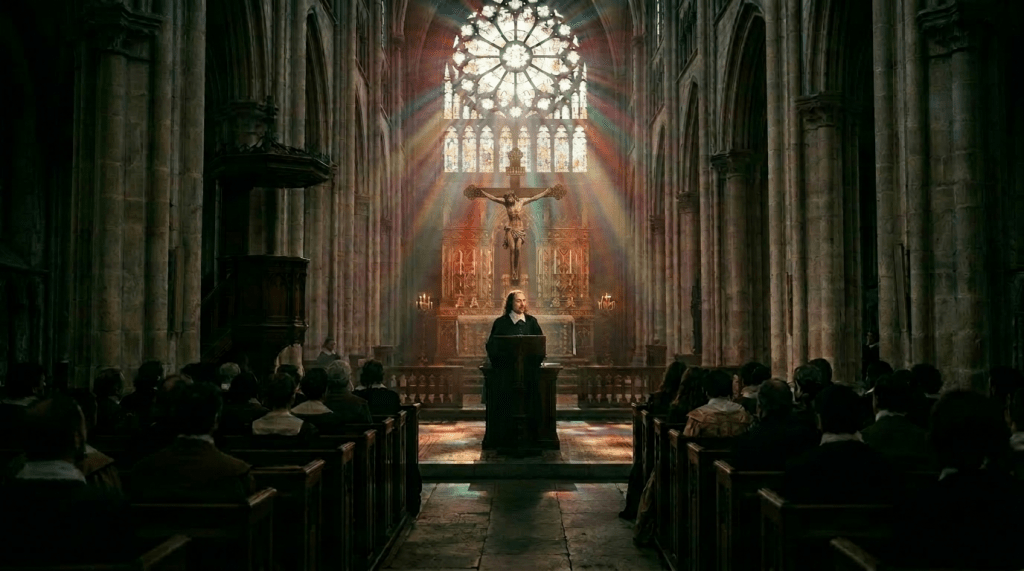
Clergyman preaching in historic church with sunlight streaming through stained glass windows

I have been listening to Pensées, by Blaise Pascal on Audible Chapter 45, Section 610 has given me some food for thought that inspires this blog post. Pascal’s analysis may not be politically correct in the 21st Century, but he makes a sound point when we give him some grace.

Leading up to Section 610, Pascal makes the claim that anyone who understands the Jewish religion by its “course of forms” will misunderstand it. He interprets the Law by the prophets who “made it plain enough that they did not interpret the Law according to the letter.”

This distinction is not novel. Paul makes the same point in all of his writings. The Law was temporary. (Galatians 3:19) It was a tutor. (Gal. 3:24) Paul says the Law is just a shadow – specifically that the religious rules about food, drink, festivals, etc. are a shadow of the substance which is in Christ. (Colossians 2:16-17) Jesus, himself, said the religious leaders search Scripture for clues about eternal life, but Scripture bears witness to him. (John 5:39-40; see also Luke 24:27)

Pascal says the Messiah according to “carnal Jews” was to be “a great temporal prince.” They expected a good fortune for them in this life when the Messiah came. In the same vein, Pascal says, “Jesus Christ according to carnal Christians has come to dispense us the love of God and to give us sacraments that should do everything to benefit us without our help.” In other words, “carnal Christians” are also just looking for benefits from God.

Pascal concludes, “Such is not the Christian religion, nor the Jewish.” He says, “True Christians and true Jews have always expected a Messiah that would make them love God and, by that love, triumph over their enemies.” (607) He puts “true Christians” and “true Jews” on the same level. They desire and seek to know and love God for who He is – and not for what He can provide them.

Pascal says, “The carnal Jews hold a midway place before Christians and heathens. The heathens know not God and love the world only. The Jews know the true God and love the world only. Christians know the true God and love not the world. Jews and heathens love the same good. Jews and Christians know the same God. The Jews were of two kinds: the first had only heathen affections; the other had Christian affections.” (608)

Pascal says, among the Christians, the coarser-minded are the Jews of the new law. The carnal Jews looked for a carnal Messiah. The “coarser Christians” believe that the Messiah has dispensed them the love of God. True Jews and true Christians worship a Messiah who makes them love God.” (609) The difference is in desiring the good things God can give them versus desiring God who is good. In these ways, Pascal claims that true Christians are like true Jews, and “coarser Christians” are like the carnal Jews.

And this is where we get to the point. Pascal says that true Jews and true Christians have the same religion. The religion of the Jews seemed to consist of the fatherhood of Abraham, circumcision, sacrifices, ceremonies, the Ark of the Covenant, the temple, Jerusalem, and the Law of Moses. But, Pascal says the true religion of the Jews “consisted of none of those things, but only in the love of God.”

Continue reading “Blaise Pascal on True Jews and True Christians”

Herod, Mikvehs and the Religion Disconnect

Religion is often disconnected from the spiritual reality of the existence of God and who God is as revealed in Scripture.

Ruins of King Herod’s fortified palace Machaeros, Jordan, Middle East.

A recent article on the discovery in 2016 of the mikveh uncovered at the site of King Herod’s palace at Machaerus on the eastern shore of the Dead Sea in modern Jordan got me thinking about a theme I have been contemplating for some time.[1] That theme is the disconnection between religious ritual and spiritual reality.

21st Century people might call that “disconnect” hypocrisy in the process of dismissing all religions and spiritual truth. That modern tendency to discount all religion in that way, and especially Christianity, reflects a lack of understanding that bothers me when I hear it. The recent discovery reminds why I feel this way.

Digging into the history of King Herod, the palace at Machaerus and the mikveh that was recently discovered there sheds some light on the subject and reminds me that there is much more than meets the modern eye. And, in some fundamental ways, nothing has really changed from then to now, and yet everything has changed at the same time.

Before we get into the meat of the matter, I should explain that a mikveh is a small pool or bath used in ritual purification. Thus, the discovery of a mikveh in King Herod’s palace indicates that the royal inhabitants engaged in the Hebrew purification ritual that was instructed in the Old Testament (the Torah).[2]

Of course, the instructions in the Torah were traditionally understood as religious in nature, though the ritual cleansing in mivka’ot (plural of mikveh) might be seen through the lens of modern science as good hygiene. The purification rite that were instructed would have inhibited the spread of contagious diseases and infection. But for them, with no understanding of modern hygiene, health and medicine, these practices were purely religious in nature.

With that in mind, what then is the significance of the discovery? How does it shed light on the disconnect between religious practice and spiritual reality? What is the nuance that modern people often miss in discounting everything they lump together as “religion”?

Continue reading “Herod, Mikvehs and the Religion Disconnect”

To Those Who Don’t Believe in Religion

Some thoughts from a person whose friends probably consider religious who bristles at the word, religion.


A friend of mine commented recently, “I don’t believe in religion.” I agreed with him, responding, “Religion is man-made.” But part of me flinched a little bit at my own comment.

Religion is what I left when I left the Catholic Church, but religion is what I studied in college. A World Religion class led me forward on a journey that ended in my commitment to Jesus as the Savior and Lord of my life, terminology I realize that smacks of religion.

That commitment made in a particular place and time began a life-long journey of faith, of attempting to know, understand and follow a living God. Not religion, but relationship with God, the creator of heaven and earth Who “knit me together” in my mother’s womb, Who can number the hairs on my head, Who knows the thoughts and intents of my heart.

I bristle at the word, religion, but I realize my friends probably consider me religious. Ironic isn’t it.

These thoughts are triggered by reading Colossians 2:8:

“See to it that no one takes you captive by philosophy and empty deceit, according to human tradition, according to the elemental spirits of the world, and not according to Christ.”

I realize this may seem like so much religious mumbo jumbo. All the more reason to unpack it if I can.

Continue reading “To Those Who Don’t Believe in Religion”

Giving Alms from Within

God knows the thoughts and intents of your heart already. Go ahead and give it to Him. You’ve got nothing to lose.


Jesus didn’t pull any punches, and the religious leaders were often the targets caught in his cross-hairs. One theme of his criticism was that they kept up righteous appearances while they were anything but righteous on the inside.  It’s a bit unnerving, is it not, that Jesus could see the thoughts and intents of the heart!

For those who might be tempted to say that the one person in history you would most like to meet is Jesus, maybe you should rethink that!

But then again, Jesus didn’t do anything more than God, the Father, already does. God “discerns our thoughts from afar”; He even knows every word “on my tongue” before I say them. (Psalm 139)

Think about that. Where can I go that God is not present? There is no use trying to hide from God. It’s futile to think that we can.

So, we might as well be honest. God already knows what’s going on in our heads and hearts!

Continue reading “Giving Alms from Within”