Podcast Episode: Belonging Across Borders

God’s people have always been aliens and strangers in the world

Stone gateway with a dirt path leading through it toward mountains at sunrise

Pip: If you’ve ever wondered whether the Bible has anything to say about the immigration debate, Kevin Drendel has been following the threads of the biblical fabric on the theme of immigration since 2014 — and the answer turns out to be: quite a lot, and none of it comfortable.

Mara: This episode covers three territories: migration and exile in the biblical narrative, what it means to hold citizenship in heaven over any earthly nation, and how the command to love your neighbor keeps expanding past every boundary we try to draw around it.

Pip: Let’s start with the biblical record on refugees — because it turns out the shepherd-king himself was one.

David, Ruth, and the Refugee Thread in Scripture

Mara: The anchor post here traces a thread running from the exile of Adam and Eve all the way to Revelation 7:9 — and one vivid stop along the way is David, a man on the run from a king who wanted him dead.

Pip: David dodging spears, hiding in the wilderness, and eventually crossing into enemy Philistine territory — David was not always the quintessential insider, the golden boy of the faith. He was once a refugee.

Mara: In that dilemma, “David thought to himself, ‘One of these days I will be destroyed by the hand of Saul. The best thing I can do is to escape to the land of the Philistines. Then Saul will give up searching for me anywhere in Israel, and I will slip out of his hand.'”

Pip: Some commentators criticize that David’s move as a failure of faith. They have a point — but what would any of us would do if people in power were hunting us down.

Mara: That’s where the law-versus-grace tension surfaces. David’s asylum claim, by modern legal standards, would likely be denied — his persecution wasn’t tied to race, religion, or membership in a protected group. Many real refugees today face the same wall: fleeing cartels or generalized violence, with no qualifying category under current law – no clear path to safety, security, and a permanent home.

Pip: And the number of refugees in the world are not small. Over 123 million people displaced globally, 1 in every 67 people on earth, with the average refugee spending about 17 years inrefugee camps.

Mara: The post on Ruth develops the same thread from a different angle. Ruth is a Moabite — a foreigner — who embodies every category of vulnerability Scripture pairs together: widow, orphan, and foreigner. And God chose her story, not an Israelite’s, to sit at the center of His redemption narrative.

Pip: Ruth ends up in the royal lineage that runs straight to David and then to Jesus. The foreigner isn’t a footnote; she’s load-bearing.

Mara: The post on Moses and identity adds another layer. Moses names his firstborn son Gershom — meaning “foreigner in a foreign land” — because that is how he understood himself, raised Egyptian but Hebrew by birth. That outsider identity becomes the foundation for the Mosaic law’s repeated command: love the foreigner, because you were foreigners in Egypt.

Pip: And then People from Beyond closes the loop. Abraham himself is called a Hebrew, meaning “one from beyond” — a man who never owned the land he lived in – though it was the land God promised him – because he knew it was not his ultimate destination.

Mara: David says it plainly near the end of his life, in 1 Chronicles: “We are foreigners and strangers in your sight. Our days on earth are like a shadow.” The displacement isn’t incidental to the story. It is the story.

Pip: Which raises the question of what that identity is supposed to do to us — and that’s where citizenship comes in.

Heaven’s Citizens, Earth’s Sojourners

Mara: The post on foreigners, neighbors, and citizens opens with a single line from Leviticus 24: “You are to have the same law for the foreigner and the native-born.” The post observes that Law is not meant to be merely punitive — if the law binds the foreigner, the same law also shields the foreigner.

Pip: Equal protection as a theological claim, not just a civic one.

Mara: Philippians 3:20 puts it plainly: “Our citizenship is in heaven.” The post on Jubilee and kingdom identity traces how that reorientation was built into the Mosaic law from the start — the Jubilee instructions in Leviticus 25 remind Israel they are temporary dwellers – tenants, not owners, because “the land is mine,” says the Lord.

Pip: And the post on the New Testament theme of embracing citizenship in heaven makes it personal — through the story of a woman who grew up a Christian minority in India, felt the sting of foreignness again as an immigrant in the United States, and found in that double displacement a clarifying gift.

Mara: Her experience reframes minority status not as a problem to solve but as the natural condition of anyone whose primary allegiance is to a kingdom not of this world. The danger, as that post frames it, is belonging too comfortably to any earthly nation.

Pip: That’s the tension that keeps appearing in Scripture — and the neighbor question is where it gets practical.

The Boundary That Keeps Moving

Mara: The post on insider logic opens with the backstory to the Good Samaritan. Second Temple Jews read “love your neighbor as yourself” as applying to fellow Hebrews — the qualifying phrase “among your people” in Leviticus 19:18 gave them cover.

Pip: Sixteen verses later, the same chapter extends the same love to foreigners. They just stopped reading.

Mara: Jesus removes any remaining ambiguity in Matthew 5: “You have heard that it was said, ‘Love your neighbor and hate your enemy.’ But I tell you, love your enemies.” The post calls this the perfection of love — a progression that starts with self and family, moves outward to neighbors and strangers, and doesn’t stop until it reaches enemies.

Pip: Our natural inclination is to draw the circle tight. The Bible keeps redrawing it larger.

Mara: And that’s the throughline across everything here — from David in the wilderness to Ruth in the fields to the command to love without limit. The question isn’t whether God cares about the foreigner. The question is whether we’re reading closely enough to notice.


Pip: Displacement, identity, the boundary of neighbor love — these aren’t separate topics. They’re the same argument made from every angle of Scripture.

Mara: And the posts keep returning to the same pressure point: how we treat the vulnerable stranger is a litmus test for who we actually think we are before God. This theme runs throughout the Bible, from Adam and Eve to Revelation.

Pip: More to come from Navigating by Faith — next time, we’ll see where the thread leads.

People from Beyond

Citizens of a kingdom not of this world

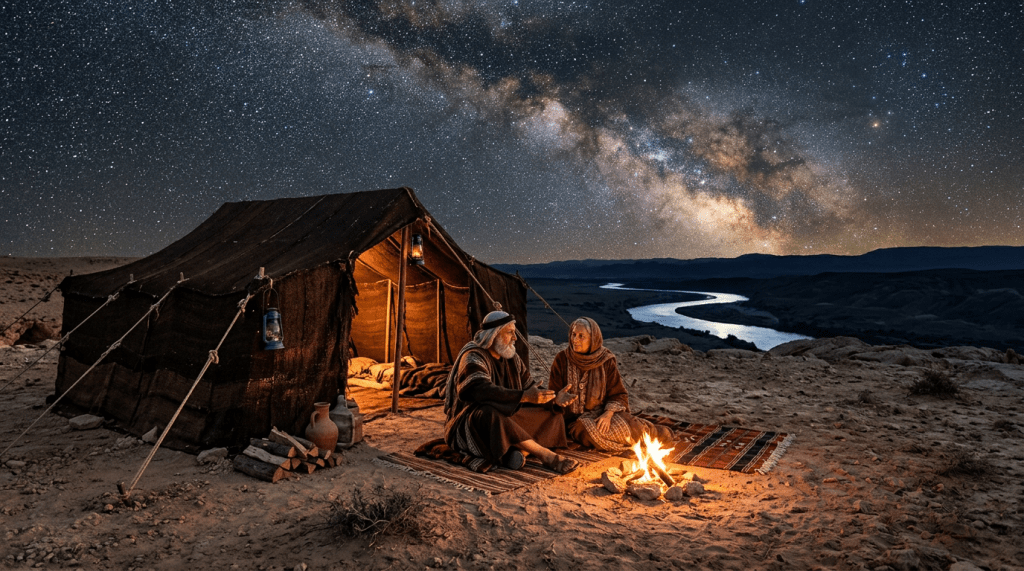
Two people sitting by a campfire outside a tent in a desert with the Milky Way galaxy visible above

Abraham is called a Hebrew in Genesis 14:13, which is the first use of that term. The term means “one from beyond1.” Abraham was a man from beyond; he wasn’t from the land he lived in. God called him from beyond. Abraham was a foreigner, an alien, and a stranger in the land to which God called him.

When four kings in this land rose up and began to fight the people of Sodom and Gomorrah because they refused to give tribute, Abraham did not take sides. This is was the first war recorded in the Bible, and Abraham did not participate in it. (Genesis 14)

That fighting went on for over a decade, but Abraham did not take sides. It wasn’t until his nephew Lot was caught up in those warring factions that Abraham rose up with three hundred and eighteen men and went to battle to rescue Lot.

It wasn’t that Abraham was weak, unable, or unwilling to engage in the battle. The battles were not his to fight. He had a higher purpose and a higher calling. Until one member of his family was caught up in the fighting, Abraham remained on the sidelines.

The king of Sodom misunderstood Abraham’s involvement. He thought Abraham entered the war on the side of the king of Sodom, but when the king offered plunder to Abraham, Abraham refused. Abraham was not, in fact, aligned with the king of Sodom. Rescuing Lot meant effectively fighting on the side of Sodom, but Abraham was not aligned with Sodom. He was only aligned with the purpose of God.

This reminds me of Jacob when he encountered the angel of the Lord before entering the promised land. (Joshua 5:13-15) Joshua asked, “Are you for us or are you for them?” The angel said, “Neither.” Then the angel told him to go in the land and drive the people out.

It was God’s purpose to establish His people in that land at that time. God doesn’t align with our purposes; we must align with His.

In Genesis 15:13-16, God told Abram (later Abraham) that his descendants will be enslaved and oppressed in a foreign land for 400 years. God explains that they will not return to drive out the inhabitants until “the fourth generation,” because “the sin of the Amorites has not yet reached its full measure.”

God had declared it many years before it happened. But God was not aligning with the people of Israel, nor was he aligning against the people in the land. God was accomplishing a much greater plan.

God’s plans and purposes involved not just the descendants of Abraham, but all the nations of the earth. (Genesis 12:3: 18:18; and 22: 18) Three times when God told Abraham that his descendants would be be blessed that Abraham’s descendants would bless all the nations of the earth.

The land was not meant to be a permanent gift of God to a particular people. The earth and all that is in it is passing away. (Matthew 24:35; and 1 John 2:17) Abraham lived in the promised land as an alien and stranger. (Hebrews 11:9) God told Moses and the people that they would be foreigners and temporary residents in the land. (Leviticus 25:23)

Continue reading “People from Beyond”

Trusting God from Beginning to End in 2026

How do trust God in a world that is violent and corrupt?


Jesus is the Alpha and the Omega, the beginning and the end. (Revelation 1:8; 21:6; and 22:13) Jesus was in the beginning with God, the Father, and the universe and all that is in it was made through Jesus. (John 1:1-3)

At this time of year, we celebrate God descending to become man in Jesus of Nazareth, born in Bethlehem into a common family in a far flung place. Jesus was God in his very nature, but he deigned to shed himself of that glory and power to become man, to become a servant to his own creation, and to humble himself to the point of death at the hands of his own creation. (Philippians 2:5-8)

In the end, Jesus will be exalted to the “highest place” with a “name that is above every name.” (Phil. 2:9) Every knee in heaven and on earth will bow to him, and every tongue will acknowledge that “Jesus Christ is Lord,” to the glory of God the Father.” (Phil. 2:10-11)

From the garden of Eden to the new heavens and earth and the New Jerusalem in which God will dwell with His people, God has had a plan from the beginning to the end. God set eternity in the hearts of people, but not so that we would know the beginning from the end. (Ecclesiastes 3:11) We don’t know, but God knows. Do we trust Him?

That is the question in my mind on this 1st day of the New Year in 2026. That is the question with which I challenge myself. Will I trust Him with my life? With the world? With the insanity that seems to characterize the year that just ended in United States of America where I live?

Since God created the universe and populated it with people and animals, God ordained and allowed people to populate the Earth. God didn’t dictate how the history of His creation would unfold. He created Adam and Eve with the capacity to live in sync with God and the universe, but He also gave them the capacity to go their own ways. God had a plan from the beginning, but He allowed the universe and mankind, His crowning creation, to unfold as it would.

I am beginning a new year of reading through the Bible as I have done many years in the past. I have read through the first handful of chapters in Genesis, and my thoughts gather around the question: will I trust God better in the New Year?

Continue reading “Trusting God from Beginning to End in 2026”

Be Like the Sons of Issachar Who Understood the Times

The Kingdom of God is among us and it is yet to come


I recently finished a review of the of history of the blogging on this site: Looking Back at 13 Years of Navigating By Faith. One article stands high above the rest in the sheer number of people who have read/viewed it.

I wrote that article, Who Were the Sons of Issachar? And What Might They Mean for Us Today?, during Donald Trump’s second presidential campaign. Christian support for Donald Trump was characterized by a sense of urgency and high stakes. State COVID restrictions jeopardized religious liberty. BLM aroused woke, liberal, mobs in streets around the country. Christians sounded the alarm that people of faith would be canceled by the most anti-faith Democratic ticket in years if Trump didn’t win.

Prominent Christian leaders like Robert Jeffress and Franklin Graham argued that Trump was a “strongman” needed to protect the nation from “anarchy” and “socialism.” Jeffress excused Trump’s obvious flaws, saying that American Christians didn’t need a “Sunday School teacher” but a “fighter” who would protect Christian interests in a hostile culture. Lance Wallnau framed Trump as a modern King Cyrus—the Persian king used by God to protect His people and restore them to the promised land.

Support for Donald Trump was increasingly framed as a battle against “darkness” and “anti-Christian” forces. While many traditional evangelicals focused on policy, the New Apostolic Reformation (NAR) was mobilized by prophecy, spiritual warfare, and the “Seven Mountain Mandate.” Dozens of self-identified prophets in this network insisted that Trump’s re-election was divinely mandated in a cosmic battle between good and evil controlled by a demonically influenced “deep state.” The current was strong, and a large number of Christians were swept along with it.

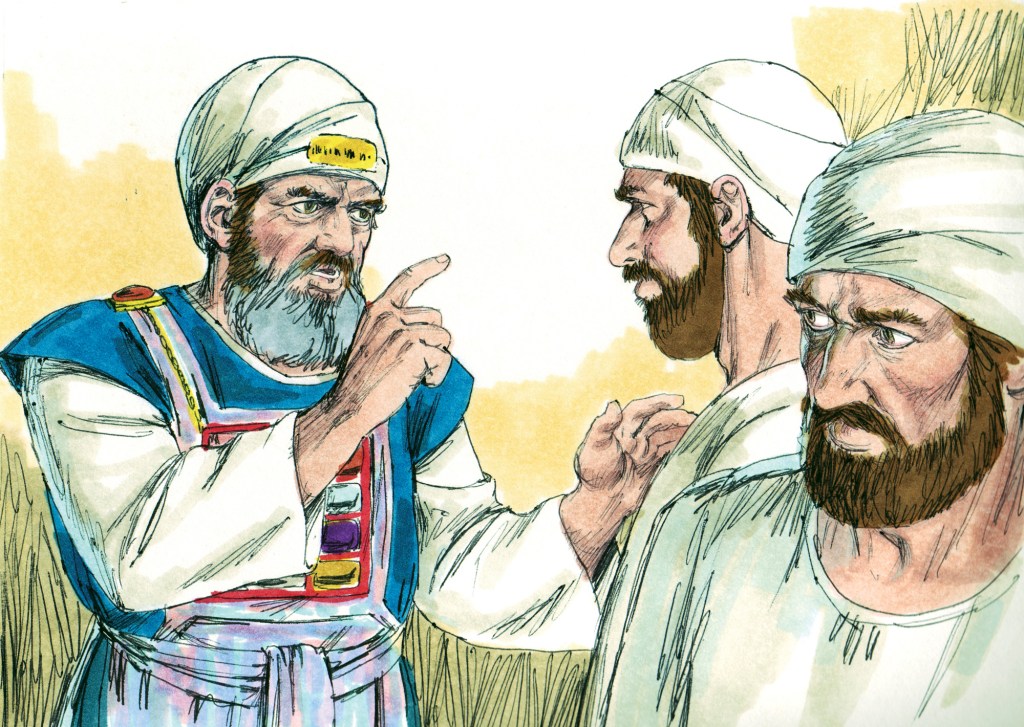
A conversation with my best friend from college, who I loved more than a brother, and who I trusted implicitly, left me in full spiritual crisis mode. He expressed his continued support of Trump on the basis of those prophetic claims predicting another presidential victory and the belief that God ordained Donald Trump for this time. My friend urged my to be like the sons of Issachar “who understood the times and knew what Israel should do.” (1 Chronicles 12:32)

I have a healthy respect for God’s ability to speak through people in what we call prophecy. The Apostle Paul commands us not to despise prophecy, but to test everything, hold fast to what is good, and abstain from every evil. (1 Thessalonians 5:20-22) I resolved to give Donald Trump another look and to reconsider him.

I had written in 2020 about wolves in sheep’s clothing with Donald Trump expressly in mind. Jesus said we would know falsehood by its fruit, and the fruit I saw in Donald Trump belied the claims of God’s providential blessing.

That a president is not a pastor made some sense. God can use anyone, even a donkey, right? Maybe Trump is like the Persian King Cyrus who is divinely appointed to restore the Christian heritage of the United States….

A year earlier, in 2019, I reflected on those claims that Trump is like a King Cyrus, and I came to a different conclusion. Trump seemed to me more like a King Saul, the king God’s people wanted – the king they wanted because they did not trust God. They wanted a king like all the other nations, though the Prophet Samuel warned them against it. God gave them the king His people wanted, even though they were rejecting God to ask for a king:


“[W]hen they said, ‘Give us a king to lead us,’ this displeased Samuel; so he prayed to the Lord. And the Lord told him: ‘Listen to all that the people are saying to you; it is not you they have rejected, but they have rejected me as their king. As they have done from the day I brought them up out of Egypt until this day, forsaking me and serving other gods, so they are doing to you. Now listen to them; but warn them solemnly and let them know what the king who will reign over them will claim as his rights.‘”

1 Samuel 8:6-9


God gave them the king they wanted in the same way that God gives people over “to the sinful desires of their heats.” (Romans 1:24) The people were rejecting God as their king, so God gave them over to the king they wanted.


People of that day might have assumed that God was blessing them to give them the king they wanted, but that was not the case. Samuel warned them against it, but they insisted anyway.


King Saul was rebellious, insecure, self-absorbed, and psychotic. He failed to obey God’s commands. He became obsessed with his power and reputation among the people, and he became jealous of David.

Though Saul remained king, God had already rejected him and anointed David to succeed him. Saul tried to take David’s life multiple times in fits of jealous rage, and David escaped into the wilderness.

This is where the Sons of Issachar entered the picture. Though Saul was still king, they “understood the times.” They could see the proverbial writing on the wall. They knew that David was God’s man, and Saul’s reign was ending.

Many people have argued that Donald Trump is like the foreign king, Cyrus, who protected and funded the nation of Israel to return to the Promised Land. I have argued that Donald Trump is not like the foreign king, Cyrus, but like the Israelite King Saul. Donald Trump is the king that God’s people wanted.

Continue reading “Be Like the Sons of Issachar Who Understood the Times”

Does God Flip Flop? Abraham, Isaac, and Us

What changed from the Old Testament to the New Testament?


I am listening to The Basic Folk podcast episode 316 with Joy Oladokun (an artist I like by the way) Perhaps, that is a strange way to open a blog post on the age old heresy of Marcionism – the belief that the god revealed in the Old Testament is different from God revealed in the New Testament. Hang with me though!

Joy Oladokun (who is a musical artist you should check out) grew up in the church and cut her musical chops on worship music and listening to Phil Collins with her father. She uses biblical themes in her music, which also has a distinctly spiritual character to it.

Though she may have some heretical ideas about God and the Bible, I believe we can appreciate and like music even when the artist doesn’t believe exactly as we do and, in this case, even when she has heretical ideas about God and the Bible. We are all on a journey in our relationship to God, and I appreciate that about people and the music people make on their own journeys.

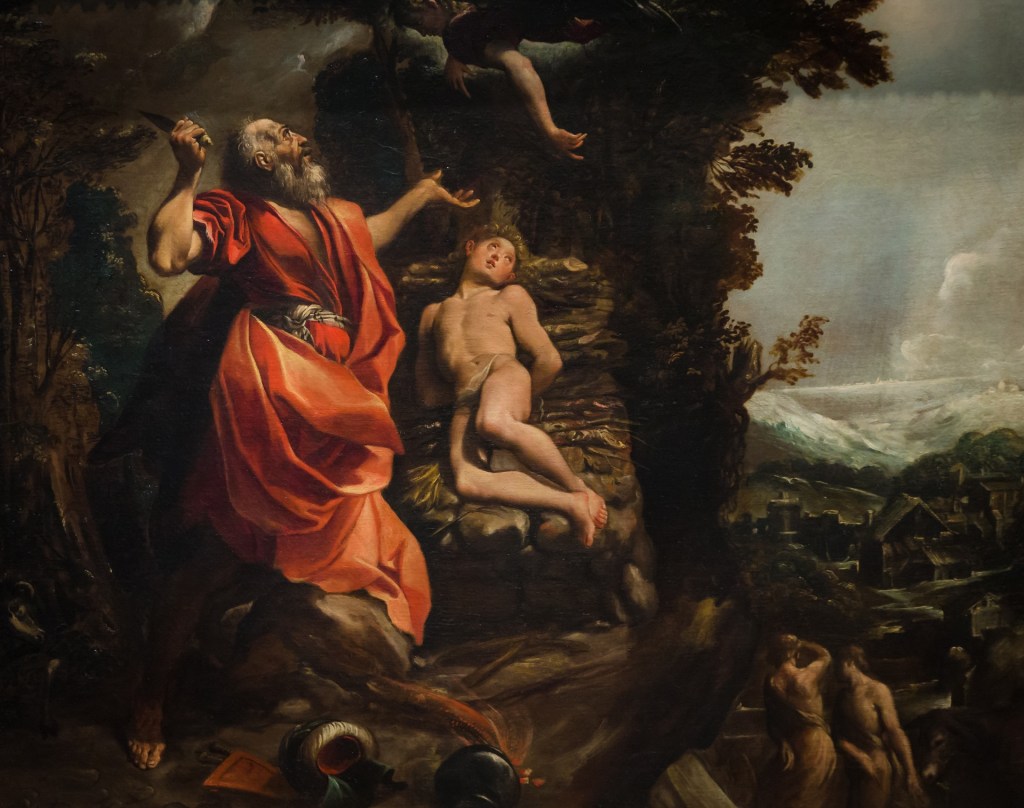
Anyway, around the 15 minute mark in the podcast Joy Oladokun expresses her understanding that God, in the Old Testament flip flops. Then, she provides this short theological synopsis, “It’s like, ‘Sacrifice your son…. Never mind, here’s a goat.” I am chuckling even now, but her thoughts and the example she gives deserves a response.

Many people her age (and all ages, really) have an issue with the story of Abraham sacrificing Isaac. It also opens up a biblical theme that I glimpsed as a young nonbeliever reading the Bible for the first time many years ago that continues to develop as I age.

Perhaps, I am fortunate that I didn’t pay much attention to theology in my formative years, because I didn’t formulate many theological ideas that colored and warped my view of God. When I read the Bible for the first time in college, I came to it with no preconceived ideas and no assumptions (that I recall).

I was raised Catholic, but I didn’t even realize that the readings in the mass were from the Bible (until after I became a Christian). I could not recall anything from the catechism classes I took. I was pretty much too zoned out (and, later, stoned out) to latch onto many theological constructs.

I didn’t know anything about evangelical ideas, like biblical inerrancy, predestination, and eschatological schemes. I came at the Bible like I approached all literature, poetry, and philosophy. I let it speak to me and convey its message to me.

Early on (as I read Genesis), I learned that Abraham heard the voice of God, and he responded in faith (with trust). I learned that the Ancient Near Eastern people from whom Abraham descended and believed in many gods who were more or less arbitrary and capricious. One of those beliefs that was ubiquitous in Abraham’s day was the belief that gods require child sacrifice to be appeased.

I could see that the God who Abraham “heard” was not like those other gods that he and the people around him believed in. I could see that Abraham lived his life on a journey (quite literally) of discovery about this God whose “voice” he heard.

Abraham’s understanding was evolving as he sensed this God and responded in faith to Him. He was learning that God was not like the gods with which he was familiar. This God made promises, and He kept them. This God desired a relationship with Abraham, and He was trustworthy.

I have to admit that the story about Isaac was a bit of a mystery to me then, but I didn’t rush to any conclusions. I understood that child sacrifice was practiced throughout the ancient Levant, but something was different about this story that carried some significance, though I wasn’t quite sure of all that it meant at the time.

There was a lot I didn’t understand. I was on a journey myself, and I realized there was mystery in the stories that belied quick or simple explanations. I, like Abraham perhaps, was willing to explore where a connection to this God might take me (after a brief flirtation with Eastern religion).

I have been on this journey now for over 45 years. I responded to the God of Abraham when I was 19 (the summer after I first read the Bible). I was far from knowing all the answers (though I did go through a period in which I thought I knew much more than I did).

I guess the thought that we know more than we really do is a human trait, and it is one we are well advised to resist. We are finite beings, regardless of the knowledge we collect, and we will never be more than finite beings in these earthly bodies that we will take to our graves.

I can’t tell you how many years I have taken to get to a place of some comfortable understanding on the Abraham and Isaac story. It is more than I might like to admit, but I have always been willing to give God the benefit of the doubt, which is what Abraham did. It is what he was commended for: faith, which is simply trusting in the goodness of God.


The Bible we have says that God told Abraham to go sacrifice his son, Isaac. We cannot escape that is what the Bible says. But, is that what God actually said?


Or is that just what Abraham “heard”? Or is it just what Abraham understood? Or is it just what he felt compelled to do?

I don’t know, and I think it is ok to say, “We don’t really know.” I also think it is ok to ask the question and to assume we may not necessarily have the right answer.

In any event, Abraham clearly believed that God told him to sacrifice his son. That requirement, of course, is antithetical to the promise God had given Abraham – that Abraham’s descendants would fill the earth and become as numerous as the stars in the sky. Yet, Abraham dutifully (if not reluctantly) complied with what he believed he must do.

This is a kind of faith that we don’t understand today, especially in the post Enlightenment age of reason and science driven more recently by post-modern skepticism. We are told in Sunday school (as I have learned) that this story is about Abraham’s faith and willingness to do what he was told, though it didn’t make sense

I think that is partially true, but I have come to see that the story is not only (or maybe even primarily) about faith. The story isn’t primarily about Abraham, either. He is just the vessel through which the story unfolds. The story is about God, and who God is, and the character of God.

Whether God told Abraham to sacrifice his son, or Abraham jumped to that conclusion, doesn’t matter so much. Child sacrifice was demanded by the gods, according to Ancient Near Eastern religious thought that was formative in Abraham’s outlook on the world. He responded according to the custom, practice, and wisdom of his age.

I have written about this a number of times before. (See the Abraham and the Paradigm Shift, Abraham and the Love of God, Abraham and Isaac Revisited: Introduction, Abraham and Isaac Revisited: Here I Am, Abraham, Abraham and Faith and the Hope Deferred, and Abraham and the Blood Path) I am not going to cover all that ground again, but I return to the same theme again because it has roots in my initial revelation of God and my own journey of faith. As I hope to flesh out, it also provides some insight into the God who seems to flip flop.

Continue reading “Does God Flip Flop? Abraham, Isaac, and Us”