People from Beyond

Citizens of a kingdom not of this world

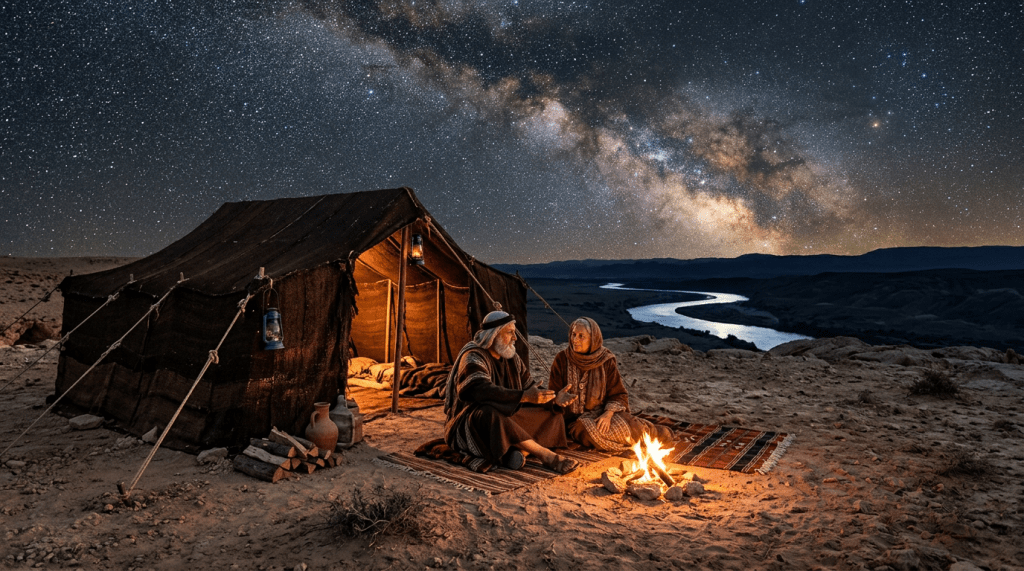
Two people sitting by a campfire outside a tent in a desert with the Milky Way galaxy visible above

Abraham is called a Hebrew in Genesis 14:13, which is the first use of that term. The term means “one from beyond1.” Abraham was a man from beyond; he wasn’t from the land he lived in. God called him from beyond. Abraham was a foreigner, an alien, and a stranger in the land to which God called him.

When four kings in this land rose up and began to fight the people of Sodom and Gomorrah because they refused to give tribute, Abraham did not take sides. This is was the first war recorded in the Bible, and Abraham did not participate in it. (Genesis 14)

That fighting went on for over a decade, but Abraham did not take sides. It wasn’t until his nephew Lot was caught up in those warring factions that Abraham rose up with three hundred and eighteen men and went to battle to rescue Lot.

It wasn’t that Abraham was weak, unable, or unwilling to engage in the battle. The battles were not his to fight. He had a higher purpose and a higher calling. Until one member of his family was caught up in the fighting, Abraham remained on the sidelines.

The king of Sodom misunderstood Abraham’s involvement. He thought Abraham entered the war on the side of the king of Sodom, but when the king offered plunder to Abraham, Abraham refused. Abraham was not, in fact, aligned with the king of Sodom. Rescuing Lot meant effectively fighting on the side of Sodom, but Abraham was not aligned with Sodom. He was only aligned with the purpose of God.

This reminds me of Jacob when he encountered the angel of the Lord before entering the promised land. (Joshua 5:13-15) Joshua asked, “Are you for us or are you for them?” The angel said, “Neither.” Then the angel told him to go in the land and drive the people out.

It was God’s purpose to establish His people in that land at that time. God doesn’t align with our purposes; we must align with His.

In Genesis 15:13-16, God told Abram (later Abraham) that his descendants will be enslaved and oppressed in a foreign land for 400 years. God explains that they will not return to drive out the inhabitants until “the fourth generation,” because “the sin of the Amorites has not yet reached its full measure.”

God had declared it many years before it happened. But God was not aligning with the people of Israel, nor was he aligning against the people in the land. God was accomplishing a much greater plan.

God’s plans and purposes involved not just the descendants of Abraham, but all the nations of the earth. (Genesis 12:3: 18:18; and 22: 18) Three times when God told Abraham that his descendants would be be blessed that Abraham’s descendants would bless all the nations of the earth.

The land was not meant to be a permanent gift of God to a particular people. The earth and all that is in it is passing away. (Matthew 24:35; and 1 John 2:17) Abraham lived in the promised land as an alien and stranger. (Hebrews 11:9) God told Moses and the people that they would be foreigners and temporary residents in the land. (Leviticus 25:23)

Continue reading “People from Beyond”

Enough Is Enough: Entering into God’s Rest

God’s work has been finished since creation, but that doesn’t mean His purposes are accomplished, yet

I am listening to the BEMA Podcast with Marty Solomon and Brent Billings as they work their way through Genesis applying a more Hebrew, eastern approach to understanding and interpreting scripture. I have talked about these things in previous articles, so I will not rehash.

One of the observations made in the story of creation is that God rested on day 7. The theme of God resting can be followed throughout scripture, especially in the law of the Sabbath rest.

The writer of Hebrews says that the nation of Israel would not enter His rest because they hardened their hearts “in the rebellion” in the wilderness when they “tested and tried” God; rather, they went astray in their hearts and did not know God’s way. (Heb. 3:7-11) From these statements, we understand that God withholds His rest to those who harden their hearts, test and try God, go their own ways and do not “know” God’s ways.

In Hebrew thinking, to know God’s ways is not just an intellectual thing. It’s an experiential thing. To know is to connect personally with and to experience. Knowing is not just intellectually grasping, but becoming personally intimate with something.

God promises us that we will enter into His rest if we do not harden our hearts, if we do not test and try Him and do not go astray, but know (experience, become intimate with) God’s ways. (Heb. 4:1-2) God desires for us to enter His rest.

One conclusion a person might draw from the story of creation is that God knew when to stop creating. He knew when to rest. He knew when enough was enough, and He invites us likewise to know when enough is enough: to rest.

God’s work has been finished since creation (Heb. 4:3), but that doesn’t mean His purposes are accomplished, yet. We know, for instance, that He subjected creation to futility (mataiotés – vanity, emptiness, unreality, purposelessness, ineffectiveness, instability, frailty….”) in hope. (Rom. 8:20)

If He subjected creation to futility in hope, He did it with the expectation and purpose that the hope would be fulfilled and accomplished. The hope is that “the creation itself will be liberated from its bondage to decay and brought into the freedom and glory of the children of God”. (Rom. 8:21)

This suggests that God may have been done with His works when he rested, but His purposes were not yet accomplished. Gods rest prior to the ultimate accomplishment of all that He purposed is part of the story. There is more to the story then simply the creation.

The creation was intended for a purpose that is yet to be accomplished, and our freedom and glory is needed to accomplish that purpose and to liberate creation from its bondage to decay! But what is that yet unfulfilled purpose?

Continue reading “Enough Is Enough: Entering into God’s Rest”

10 Fundamental Truths about Creation on which Christians Can Agree

Science and faith have been at odds with each other in the United States since before the Scopes Trial. Rather, should I say that people of science and people of faith have been at odds. I don’t believe there should be (or is) any real tension between science and faith.

Issues arise in the way people integrate or separate the two areas of discipline. Issues arise in the assumptions and presumptions people make about science and faith and how people interact (or don’t interact) with them.

The subject of creation among people of faith has also been fraught with much tension in the last 10-20 years (at least). People separate broadly into young earth and old earth camps. People in the old earth camp separate into groups informed by creationism, theistic evolution or a third way defined as “intelligent design”. The “gap theory” is another way to approach these issues – combining old universe and young earth principles.

Many people just don’t know where to fall on the spectrum of possibilities. Not many of us are so well-informed on the science and expert in our biblical exegesis that we can sort it out confidently for ourselves. We might wonder to God, “Is this going to be on the test?”

Of course, there is no test to get into heaven. Jesus took the test and passed it for all of us! The only test to get into heaven is what we do with Jesus. Do we embrace the gift of salvation that God offered us in Christ? Or do we reject it?

Still, the tension over how we should view creation, evolution, science and faith is real. It can cause quite a bit of consternation and doubt. Some people even wonder if people in different creation can fellowship with each other.

In a recent presentation that Krista Bontrager gave to the Chicago Chapter of Reasons to Believe with which I am affiliated, she reminded us of the call to unity in faith: “In essentials, unity. In non-essentials, liberty. In all things, charity.” I think she is right that we should be mindful of these things, not just i n this area.

More practical and helpful than that, though, she introduced to us ten (10) foundational points on the subject of creation on which all Christians should be able to agree. By focusing on the points of agreement, we can put our differences into better (more manageable) perspective.

Following are the ten (10) fundamental beliefs that unite Christians on the subject of creation:

Continue reading “10 Fundamental Truths about Creation on which Christians Can Agree”

What Was God Doing with Time and Eternity?

Why would God set up the universe so we would be cognizant of time?

The Christian understanding of God is that of “the” ultimate (maximal) Being, the architect and creator of everything (all that is seen and unseen as we say). God is the First and the Last. Reality does not exist outside or apart from God. Space/time (the universe we know) was created by God.

Christians also believe that God is transcendent (other) from the universe He created. When the writer of Hebrews says “the universe was formed at God’s command” and “what is seen is not made out of what is visible”, he is saying that God initiated the material universe from His immaterial, preexisting being by His command (will) out of nothing.

Nothing?

Yes, no material thing.

This is hard for us to grasp. It suggests that God is, in essence, immaterial – like unembodied mind or pure consciousness or something like that. It’s a mystery. We can’t go back prior to the beginning and “see” what reality or God was like, but we understand that the material universe had a beginning, which means that God is something other than material.

The beginning of the universe is confirmed by science. The universe began from the point of singularity that can be calculated with mathematical precision. Before that point, which we can trace to the millisecond, we can go no further. This is a boundary beyond which our exploration of the material universe cannot go.

God, therefore, exists “outside” (transcendent from) the space/time continuum that we know as the universe. He is somehow different and distinct from it. As best as we can determine, He is timeless and immaterial

This concept of God differentiates Christianity from all the Eastern religions and from all forms of pantheism and paganism. God is not part of His creation, though He can be (and is) intimate and present in all of it.

Though we may struggle to know “what God is like”, we can know something of God through the material reality He created in the same way we can know something of an artist from the art he creates. Knowing something about the artist from his works, though, isn’t the same as knowing the artist himself.

We are not left completely in the dark. Paul says that God made Himself evident in the world He created. (Rom. 1:20) The fact that something exists instead of nothing suggests a creator God. We can know something of God by the very fact that He the universe that is separate and “other” than Himself.

In a material world, we have to strain to find mutuality with “others”. It doesn’t come naturally. We are very conscious of our separateness – from each other and our creator – so much so that we have some difficulty connecting (emphasizing) with others, and we are tempted to believe we have no creator.

Not being of the same “substance” as God (timeless and immaterial – what Paul calls “heavenly” or “spiritual”), we know the material world much more intimately than the realm in which God exists (not that He doesn’t also exist in this material realm – though He transcends it). Yet, being made in God’s “image” suggests that we also have some ability to connect with His immateriality in some sense.

I say these things in preface to my thoughts today, which come from the Old Testament: the book of Genesis, and the book of Ecclesiastes. My thoughts begin with the beginning:

“And God said, ‘Let there be lights in the expanse of the heavens to separate the day from the night. And let them be for signs and for seasons, and for days and years….'”

Genesis 1:7

This isn’t the actual beginning, but very close to it. It is the first thing God does after creating “the heavens and the earth” (which is the Hebrew expression that means the universe). His first act of creation after forming the material universe was to call into existence “lights in the expanse of the heavens”, and He did it for a purpose.

(Not that these separate aspects of creation were necessarily a linear progression in the sense of completely separate “acts” of God. We might read these passages that way, but it isn’t the only way to read them.)

What was the purpose for which God established lights in the expanse of the heavens? To separate day from night and for signs, seasons, days and years – to establish measurements of time.

Interesting…. God wouldn’t need those things to measure time. What is time to God? He is timeless! Being all-knowing, God also (presumably) wouldn’t need material objects to be able measure time. So, why did God create ways to measure time?

It seems obvious that He created the tools for us to be able to measure time, and, therefore, God wants us to to be able to measure time.

We don’t really question our need to measure time. We just do it. We take time for granted, and our “need” to measure it.

But why?


It seems God set up the universe that way so that we would be cognizant of time, and we are, in fact, very cognizant of time. It seems to be there must be a purpose for it.

Continue reading “What Was God Doing with Time and Eternity?”

God’s Order for Living Beings, Human Beings and His Grand Design

“Then God said, ‘Let the earth bring forth living creatures after their kind….'”


I am starting a new Bible reading plan for the year, beginning in the beginning: in Genesis. Reading through the rich text of Genesis again I am seeing some things I hadn’t noticed before. Consider the following (with my emphasis added):

“Then God said, ‘Let the earth sprout vegetation, plants yielding seed, and fruit trees on the earth bearing fruit after their kind with seed in them‘; and it was so. The earth brought forth vegetation, plants yielding seed after their kind, and trees bearing fruit with seed in them, after their kind; and God saw that it was good.

Genesis 1:11-12

“God created the great sea monsters and every living creature that moves, with which the waters swarmed after their kind, and every winged bird after its kind; and God saw that it was good. And God blessed them, saying, “Be fruitful and multiply and fill the waters in the seas, and let birds multiply on the earth.’

Genesis 1:21-22

“Then God said, ‘Let the earth bring forth living creatures after their kind: cattle and creeping things and beasts of the earth after their kind‘; and it was so. God made the beasts of the earth after their kind, and the cattle after their kind, and everything that creeps on the ground after its kind; and God saw that it was good.”

Genesis 1:24-25

Then God said, ‘Let us make man in our image, after our likeness. And let them have dominion over the fish of the sea and over the birds of the heavens and over the livestock and over all the earth and over every creeping thing that creeps on the earth.’ So God created man in his own image, in the image of God he created him; male and female he created them. And God blessed them. And God said to them, ‘Be fruitful and multiply and fill the earth and subdue it….'”

I color-coded the various provisions that form the pattern that informs my thinking today. The provisions in each color correspond with the other provisions of the same color.

Now, let me see if I can put all my thoughts together in a coherent whole.

First of all, God ordered (in the sense of designed) all living beings to multiply after they own kind. We see this everywhere in nature: apple trees produce seeds that grow into new apple trees; asparagus plants produce seeds that grow into new asparagus plants; lions beget lions; polar bears beget polar bears; yellow polka dotted salamanders beget yellow polka dotted salamanders; bluefin tuna beget bluefin tuna; and purple finches beget purple finches.

This is the order of living things. Not only that, but we now know that something (call it evolution or something else) works powerfully within living beings to reproduce and even to adapt with changes over time.

Every living thing bears seed or otherwise reproduces more of its kind. Human beings included, but only humans are made in the image of God. (Hold that thought.)

God “blessed” the living things He created, saying, “Be fruitful and multiply” and fill the earth. (Gen. 1:22) He also blessed man who God made in His own image, and gave similar blessing/order: “Be fruitful and multiply and fill the earth and subdue it….” (Gen. 1:28)

Note that God “ordered” (as in designed) the living things He created to reproduce after their kinds and to be fruitful and multiply, but God ordered – as in not only designed, but commanded – man to do the same. The difference is an important key to understanding what God is doing.

Unlike the other living creatures that are designed to reproduce and multiply after their kinds, humans have some agency in the matter. God designed them for the same purpose, but He also commanded them to do it – and gave them agency in doing it – because humans are created in the image of God who has agency – the ability to exercise will and to do (or not do) things.

Humans, of course, had no choice in their creation, but they do have choice in whether to “participate in God’s design” and how they would participate in God’s design. This choice was demonstrated in the one tree in the garden that was forbidden to them.

It was a real choice, and it had real consequences. It had to have real consequences or it wouldn’t have been a real choice. That choice was part of what it meant to be made in the image of God. Without the ability to choose, humans would have been just like the other living things God created. The ability to choose set humans apart.


As the story goes, humans ate the fruit of the one tree that was forbidden.

They exercised the choice God gave them. In eating the fruit of the tree of the knowledge of good and evil, humans opened up their world to all the ways they might choose to go against the order of creation.


Throughout Genesis 1, we read over and over again that what God did “was good” (Gen. 1:4, 10, 12, 18, 21, 25, 31). If what God designed was good, choosing to operate counter to that design would be evil (the opposite of good).

None of this is very revelatory so far, but I am getting there.

Genesis 1 reminds me of 1 Corinthians 15 where Paul says:

God gives [all living things] a body as he has chosen, and to each kind of seed its own body. For not all flesh is the same, but there is one kind for humans, another for animals, another for birds, and another for fish.

1 Corinthians 15:38-39

The order/design of life – of reality – is immutable. Life is ordered the way God created it, though humans have some choice (within limits) of whether to align with God’s design or to buck against it. Indeed, the story of the fall is the story of humans exercising that choice, God built into His design an adaptation (if you will) to accomplish His ultimate plan.

Continue reading “God’s Order for Living Beings, Human Beings and His Grand Design”