They Thought God Was Like Them

Examine yourselves to be sure you are in the faith.

Smiling man with dark shadow holding a knife behind him

But to the wicked person, God says:

What right have you to recite my laws or take my covenant on your lips? You hate my instruction and cast my words behind you. When you see a thief, you join with him; you throw in your lot with adulterers. You use your mouth for evil and harness your tongue to deceit. You sit and testify against your brother and slander your own mother’s son. When you did these things and I kept silent, you thought I was exactly like you. But I now arraign you and set my accusations before you.'”

Psalm 50:16-21


God’s Word is full of warnings to the wise. Take heed. God does not desire that anyone perish, but a day is coming when your life will end. A day is coming when this world as we know it will cease to exist. There will be a day of judgment for all of us.

God does not force us to love Him. He doesn’t require that we submit to Him. He gives us the terrible choice of determining how we will live. He will give us over to our desires on that day when we die, on that day when the earth ceases to be as we know it, and we will face the consequences of our choices – the way we chose to live – whether it be with Him or with our own selves at the center of our orbit.

These verses indicate that even a wicked person can recite God’s laws and claim to be in covenant relationship with God. Even a wicked person can claim to know Him. Jesus echoed the words of the Psalmist when he said,


Not everyone who says to me, ‘Lord, Lord,’ will enter the kingdom of heaven, but only the one who does the will of my Father who is in heaven. Many will say to me on that day, ‘Lord, Lord, did we not prophesy in your name and in your name drive out demons and in your name perform many miracles?’ Then I will tell them plainly, ‘I never knew you. Away from me, you evildoers.'”

Matthew 7:7:21-23


This word of warning applied to the religious. We can prophesy in God’s name. We can even drive out demons and perform miracles in God’s name. These signs do not make the person who performs them a child of God. Even false prophets are able to perform great signs and wonders. (Matt. 24:4; Mark 13:22)

Only the one who actually does the will of the Father is a child of God. (Matt. 7:21) Jesus said, “Everyone who hears these words of mine and puts them into practice is like a wise man who built his house on the rock.” (Matt. 7:24) Any other way to live is like “sinking sand” as the hymn goes.

The danger we all face is our own self deception. Perhaps, this is why the Prophet said, “The heart is deceitful above all things and beyond cure.” (Jeremiah 17:9) We cannot trust our own hearts.

Skeptics say that people have created God in their own image. That is true of the person who thinks God is just like them.

According to the writer of Psalm 50, wicked people who act wickedly can feel justified in their wicked actions, and God allows them to be deluded.


When you did these things and I kept silent, you thought I was exactly like you.”

Psalm 50:21


They are encouraged by God’s silence that they are right in in what they think and do, but God’s silence is not a sign of acquiescence. God’s arraignment and accusations hang over their heads.

I am struck by the need to know God, to know His character, and to yield our assumptions about God to the truth of who God really is. God’s silence in our lives is not approval. God often remains silent. God is often hidden. He is like a treasure to be found. God urges us to seek Him because in seeking Him, we must set aside ourselves to learn who He is.

These verses remind me of Hebrews 4:12: “The word of God is sharper than a double-edged sword.” It pierces. It divides. It discerns the thoughts and intents of the heart. If the word of God is doing its job, it cuts, it penetrates, it divides. If we yield ourselves to the word of God, it does its surgical work in us. Bur, only if we truly yield ourselves to that process.

I have often thought that Scripture does this kind of work. I felt it when I first began reading scripture before I was even a believer. I recognized in that time that scripture was exposing me to myself, and that I had a choice. I could allow it to do its surgical work, or I could harden my heart and choose to see in Scripture what I wanted to see.

Many people have said in derision of Scripture that people can make it say whatever they want. They are right, of course. Like the wicked person who acts wickedly and embraces wicked thoughts, while thinking that God is just like them.

The height of pride is to think God is like us. God opposes the proud, but He gives grace to the humble.

My prayer today is that God would rebuke me as He needs to; that He would soften my heart and do His surgical work in me; that I would not be deceived by my own thoughts and think that God is like me. I pray that God would reveal Himself to me and that I would know God for who He actually is.


so that Christ may dwell in your hearts through faith. And I pray that you, being rooted and established in love

Ephesians 3:17

The Redemption of Korah: the Sons of Korah

I would rather be a doorkeeper in the house of my God than dwell in the tents of the wicked.


Have you ever heard of the rebellion of Korah? How about the Sons of Korah? The rebellion of Korah and the Sons of Korah have a connection with each other, and the connection is fascinating.

The rebellion of Korah occurred during the 40 years Moses led the nation of Israel in the wilderness following God’s miraculous deliverance of the people out of captivity in Egypt. Korah rose up during their time of desert wandering and rallied a group of people to oppose Moses.

Korah was a grandson of one of Levi’s three sons (Kohath). He was a Levite, which meant that he was involved in the Levitical duties of caring for the tent of meeting and the tabernacle where God’s “presence” resided in the midst of the people. The Levitical duties were sacred and honorific.

The Kohathites were specifically in charge of caring for the Ark of the Covenant, the table, lamp stand, altars, articles of the sanctuary and the curtain behind which the priests performed the sacred rituals God passed down to Moses. (Numbers 3) Unlike the other Levites who were allowed to transport their items in carts, the Kohathites were required to hand carry their items.

The Ark of the Covenant was particularly sacred, of course, but the Kohathites may have been jealous of the ease enjoyed by the other priests who didn’t have to hand carry the items for which they were responsible. We don’t know. The text doesn’t tell us.

The text does tell us that Korah and several others rallied 250 other men in public opposition to the authority of Moses. They claimed that all the people of Israel are holy, and they questioned why Moses and Aaron “exalted themselves” above everyone else. (Numbers 16:3) They might as well have said more pointedly, “Who put you in charge?!”

Moses responded by challenging Korah and his followers to put the issue before God. He said, “This is how you will know that the LORD has sent me to do all these things and that it was not my idea.” (Num. 16:28)

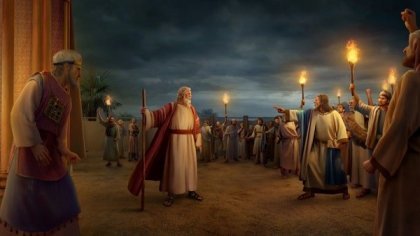
As the story goes, they gathered publicly before all the people in front of the Tent of Meeting, each man with incense burning in censors. This is how Moses and Aaron faced off with the contentious lot led by Korah. I am really not sure of the point of this faceoff. If anyone has any insight, post in the comments below.

In any event, God warned Moses, and Moses warned the crowd to stand back. When he finished talking, the ground opened up and “swallowed” up the 250 men rebels that supported Korah in his opposition to Moses. (Numbers 16)

The story stands as a warning to those who are not content with their place in the world and people who get jealous of others to whom God has given greater responsibility and authority. God chose Moses and Aaron to lead the people. By opposing God’s chosen leaders, Korah and his band of rebels were ultimately opposing God and God’s authority.

From this story, I assumed that Korah and his clan were wiped out. The text seemed to imply that all his family were included in the 250 agitators. It turns out that my assumption was wrong, however, because the “sons of Korah” appear many generations later, and their place in the history of God’s people is truly intriguing.

Now, for the “rest of the story”, as Paul Harvey used to say.

Continue reading “The Redemption of Korah: the Sons of Korah”

Finding Balance in Worship

Are our Sunday worship services more pagan than Christian? That was the claim of a recent article.

© Can Stock Photo Inc. / grace1221

Praise the LORD! Sing to the LORD a new song, and His praise in the congregation of the godly ones. Let Israel be glad[1] in his Maker; let the sons of Zion rejoice[2] in their King. Let them praise His name with dancing; Let them sing praises to Him with timbrel and lyre. For the LORD takes pleasure in His people; He will beautify the afflicted ones with salvation. Let the godly ones exult[3] in glory; let them sing for joy[4] on their beds. (Psalm 149:1-5)

I have been thinking about an article I read recently: Is Your Church Worship More Pagan Than Christian? by Todd Pruitt. He questions the popular Christian music and worship culture on the basis that it exalts music to a sacramental position and musicians to priestly status without biblical foundation for the emphasis. He claims it promotes feelings over doctrinal soundness and experience over preaching the Word of God. These are valid concerns.

I agree with Todd Pruitt on nearly every point, yet the article and the one that followed, (Is Your Worship Christian or Pagan? (7 Tests)), leave me scratching my head a bit. Let me explain. Continue reading “Finding Balance in Worship”

Why My Hope Is In You

Harrison Wright Falls at Ricketts Glen State Park by Chris Fraley


The ephemeral existence of man is a theme to which I keep returning these days. From our general perspective, a lifetime seems to go on forever, though that perspective changes over the years.

When I was young, summer days and blue skies seemed to go on forever. Summers seemed to be endless. I could not wait to be older. Old age was a very distant horizon.

As we get older, the pace of life quickens. We fill up our days to overflowing with busyness and activities. We are constant thinking, planning, worrying, distracted, looking forward, stewing over the past, attending to the needs of spouses and children and clients and customers and neighbors and co-workers and … we hardly notice how time passes. Continue reading “Why My Hope Is In You”

God Understands Us

4654245563_9b45e44ba6_z


“My God, my God, why have You forsaken[i] [ii]me?” (Psalm 22:1)

These are David’s words, and they are words Jesus spoke when he hung on the cross. Many statements in the Old Testament are predictive and point to Christ, including this verse, which anticipates Christ hanging on the cross taking on Himself the sins of the world and being abandoned by the Father in that moment as a result.

While there is a predictive element, clearly, to this statement, I think there is something else going on. Jesus was undoubtedly harkening back to David’s words, but maybe He had another purpose in doing so. We see many times in the Bible that a single phrase has multiple meanings, more than one application, and both or all of them are instructive. Continue reading “God Understands Us”