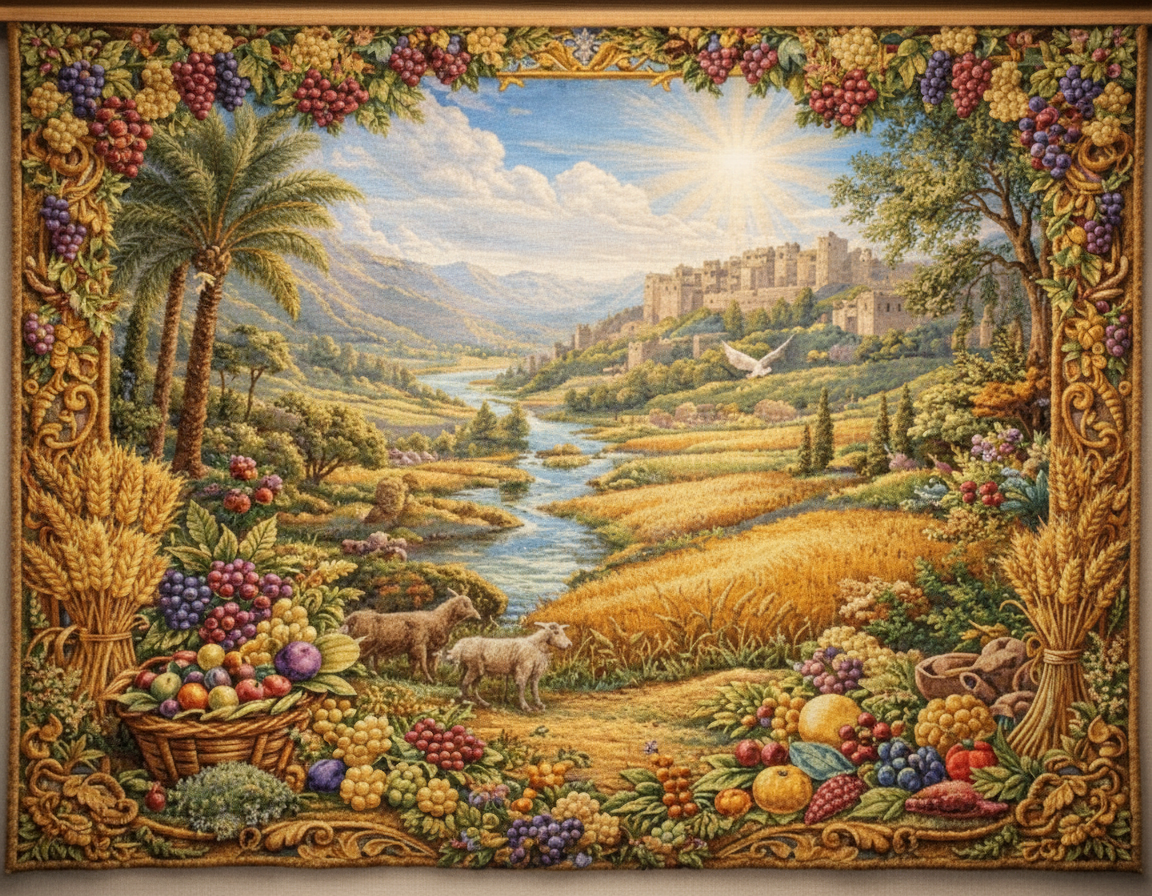
I am increasingly impressed by the importance of understanding the arc and sweep of Scripture from Genesis to Revelation. Though the Bible is a collection of many writings by many authors compiled over many centuries, it is a single, finely woven tapestry rich and brilliant in its nuance and theme.

Of course, a tapestry makes no sense if we do not view it from the right perspective. From the back side of the tapestry it appears like a jumbled mess of tangled threads.
The full beauty and design of the tapestry remains a mystery until it is viewed from the right perspective. Only then can we understand and appreciate it.
We would have no sense of the beauty or theme of the tapestry if we only saw it from the back side. Because the tapestry of thole Bible is so grand, we can also miss the big picture if we study it only as through a microscope or a magnifying glass.
We need to step back often and consider the trajectory, arc, and sweep of Scripture – from beginning to end – to make sense of the individual threads that may not appear to make sense in isolation.
From the time of Abraham, Isaac, and Jacob onward, the Bible seems to be all about these patriarchs and their descendants to whom God promised a land. For over 400 years Abraham’s descendants looked forward to taking possession of this land. That time was spent in captivity in Egypt, where the prospects of God’s promise grew dim and seemed unlikely until God sent Moses.
Led by Joshua, the people finally enter into the land after another 40 years of wandering in the wilderness with Moses. They drive out the inhabitants, settle in, and live there almost a millennia through cycles of judges and kings. It seems all about this land and its people. The theme of God’s covenant to give his people the promised land and the people’s covenant to keep God’s law dominates the portion of Scripture we call the Old Testament.
The land, the great leaders, the Law seem to define their destination. Again and again, however, those things prove to be provisional. The leaders fail. The Law fails because they seem wholly incapable of keeping it. The very land, itself, seems to fail them.
When we step back, we see that these things that seem to be the main point of the whole story actually point beyond themselves. They expose something deeper. They give way to something infinitely greater.
One of those themes that gets buried and lost in the jumble of threads is Jubilee. The Jubilee instructions are embedded in the middle of the Law in Leviticus 25. They are God’s specific instructions on how Israel was to live in the land into which God was leading them. That they never actually carried out the Jubilee instructions may account for us failing to recognize their importance in the tapestry of God’s Word.
The Radical Vision of Jubilee
In Leviticus 25, God established the Year of Jubilee—a societal reset unlike anything in the ancient world. The Year of Jubilee was to be observed after seven periods of seven years. In the 50th year, the Year of Jubilee, the land was to be returned to its original owners. Debts were to be released. Indentured servants were to be set free.
The Year of Jubilee was to be observed every 50 years. Every fifty years was to be a reset.These were God’s instructions and the reason for these instructions was clearly laid out:
“The land is mine” sayeth the LORD, “and you are strangers and sojourners in it.“
(Leviticus 25:23)
Let that sink in….. God never intended Israel to own the land.
Even today many people consider Israel to be the land God promised his people for eternity. Even today we think it is all about the land.
Jubilee appears to us to be an economic policy. A cringeworthy redistribution of wealth that might offend modern, conservative sensibilities. But underneath it lies a theological theme – God’s design – that reshapes everything when we see it:
God wanted them to live in the land, to work the land, to benefit from the land, but only and always as temporary dwellers – as foreigners. They were not to call the land home. They were never meant to treat the land as their own – as owners.
The write of Hebrews understood this, and commended Abraham for living in the land of promise “as in a foreign land, living in tents.” (Hebrews 11:9)
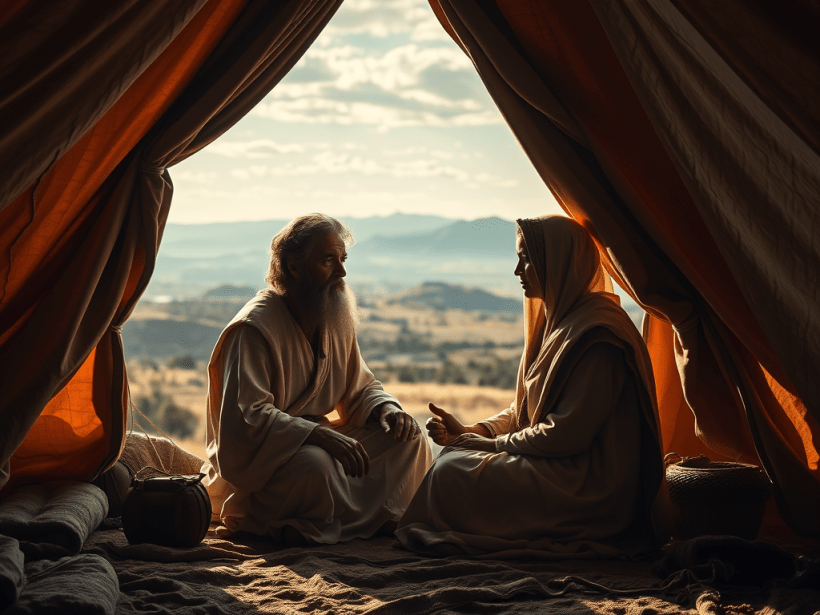
We can understand why, the writer of Hebrews commended the people of faith who “acknowledged that they were strangers and exiles on the earth.” (Heb. 11:13) They were “seeking a homeland … a better country … a heavenly one.” (Hebrews 11:15-16) Why? Because they understood the promised land wasn’t their final destination!
Jubilee is not about fairness, or economics, or socialism—it is about something much more transcendent. It is about God’s eternal plan for the heavens and the earth and all the people in it. It is a reminder to Israel (and us) of who they (we) are in relation to God. It is a reminder that to them (and to us) this world is not all there is. God has bigger plans!
A People Shaped by identity
Though God promised His covenant people a land, their identity as God’s people was the most important thing. God’s vision for them extends beyond land into identity as His people. The Israelites were not meant to identify with the land, but with God.
They were to identity as God’s people living temporarily in a land God gave them, and they were to be a light to the nations. From the days of Abraham, God planned “to bless all the nations” through his descendants. (Gen. 12:3; 18:18; 22:18; 26:4; & 28:14) They were to be a people God called out from among the nations to covenant with Him. These people were intended to identify with God’s greater purpose in the world – which was for all the nations.
Israel is commanded to care for the stranger, the poor, and the landless in the land of God’s promise—not merely as an act of generosity, but as an expression of memory and identity:
“You were strangers in Egypt.”
God wanted them to remember who (and whose) they were. God rescued and redeemed them for Himself and for His purposes. Their story was always meant to shape their community and society into what God wanted them to be. God wanted to establish His people in His land to carry out His eternal plans for all the nations – for all people in the world.
They were not to be a people defined by power, dominance or possession, but by dependence, deliverance, provision, and protection of others – just as God delivered them, provided for them, and protected them. God’s instructions were structured to prevent them from becoming the kind of nation under which they once suffered – a nation like all the other nations around them. They were to be different, holy, and set apart for God’s greater purpose
Continue reading “From Jubilee to Kingdom: How God Transforms Ownership, Identity, and Belonging”