For at least 7 years, I have been drawn to the passage in Luke 4 where Jesus gives perhaps the earliest description of his public ministry. Jesus introduced his intentions by reading a select passage from the Isaiah scroll, rolled it up, sat down, and announced, “Today this scripture is fulfilled in your hearing.” (Luke 4:21) These were the words that he read:
The Spirit of the Lord is on me, because he has anointed me to proclaim good news to the poor. He has sent me to proclaim freedom for the prisoners and recovery of sight for the blind, to set the oppressed free, to proclaim the year of the Lord’s favor.
Luke 4:18-19
Immediately after this announcement, Jesus began demonstrating in Galilee what he came to do – teaching with authority (Luke 4:31-32); setting people free from demonic spirits (Luke 4:33-35); and healing the sick (Luke 4:36-40). At the end of this flurry of divine action, Jesus said, “I must proclaim the good news of the kingdom of God to the other towns also, because that is why I was sent.” (Luke 4:43) In this statement, he clarified that the good news he came to proclaim is the coming of the “kingdom of God.”
This short passage from Isaiah 61 that recalls the Year of the Lord’s Favor (Jubilee) focuses our attention back on Leviticus 25, which is the framework for the communal life God desired His people to embrace when they settled into the land of God’s promise.
The context of these words in Isaiah 61 remind of us the significance of these words that defined the ministry of Jesus and the Jubilee principles that characterized his life and message. When Jesus quoted from Isaiah 61 in the synagogue, he was incorporating God’s great plan and purpose into the announcement of his ministry.
Isaiah 61 cannot be understood apart from Isaiah 59, which recalls the iniquities of the people that separated them from God and the blood that was on their hands. (Is. 59:1-2) They abandoned the way of peace and justice. (Is 59:8-9) They walked in darkness. (Is. 59:10) No one was available to intervene. (Is. 59:15-16), so God said He would step in (Is. 59:17) with a Redeemer for those who would repent. (Is. 59:20)
Isaiah 60 announces God’s plan of redemption: “arise, shine, for your light has come.” It presages that “nations will come to your light.” (Is 60:1:3) Isaiah 60:4-16 announces God’s intention that all the nations will come to Israel “bringing your [Israel’s] children from afar” (v.9), and “foreigners will rebuild your walls” (v.10) , and “you will drink the milk of nations and be nursed….” (v.16) Isaiah 60:17-22 promises peace, no more violence, everlasting light, and righteousness.
In that context, Jesus read the opening verses of Isaiah 61 – announcing that the time had come for proclaiming good news to the poor, binding up the brokenhearted, proclaiming freedom to captives and release from darkness for prisoners, and proclaiming the year of the Lord’s favor.
Significantly, the Jesus left out the concluding words: “and the day of vengeance of our God….”
In doing that, Jesus signaled that he did not come for judgment. “For God did not send his Son into the world to condemn the world, but to save the world through him.” (John 3:17) Jesus came to proclaim the good news of the coming of the kingdom of God predicted in Isaiah 61 – healing, freedom, release, and blessing – because God’s people had failed to live into and live up to the plan God had for them.
The words Jesus read culminate with a proclamation of the “year of the Lord’s favor” from Leviticus 25. This is where it gets interesting to me. I have not focused on this part of what Jesus said before, so let’s dive in.
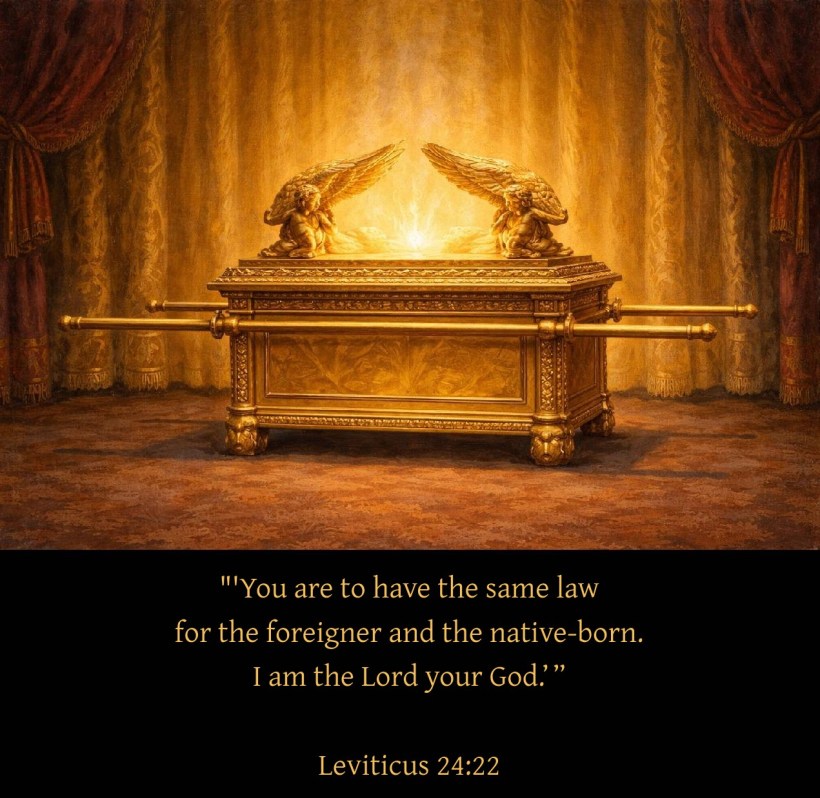
“You are to have the same law for the foreigner and the native-born.”
Leviticus 24:22
That single line, given by the Lord to Moses, is often read narrowly: foreigners are subject to the same penalties as citizens. True—but incomplete. Law is not merely punitive; it is protective. If the same law binds the foreigner, the same law also shields the foreigner. Justice, in the biblical sense, is reciprocal.
The rules that apply to foreigners are embedded in the sacred Law God gave to Moses for His people. The Law even applied specific protections to foreigners:
Leviticus 19:9–10 — Leave gleanings for the poor and the foreigner.
Leviticus 23:22 — Harvest leftovers belong to the foreigner and poor.
Deuteronomy 24:19–21 — Leave grain, olives, and grapes for foreigners.
Deuteronomy 26:12 — Tithes every third year support foreigners.
The Reciprocity Built into God’s Law
Leviticus develops this principle further. In Leviticus 25, the Lord instructs Israel that if a native-born Israelite loses his land and falls into poverty, he is to be treated as a foreigner among them. Why? Because the law already required Israel to provide for foreigners in their midst. By placing impoverished Israelites into the same category as foreigners, God establishes a profound reciprocity:
The protections of the law given to the Israelites apply to the foreigners living among them. The protections given to outsiders become the safety net for insiders when they fall.
This is not accidental. It reveals something essential about God’s character: His justice is inseparable from His mercy.
Other passages reinforce the pattern of concern for foreigners:
Leviticus 19:34 — “The foreigner residing among you must be treated as your native-born. Love them as yourself.”
Deuteronomy 1:16–17 — Judges must hear cases fairly, whether involving Israelites or foreigners.
Deuteronomy 10:18–19 — God “loves the foreigner residing among you, giving them food and clothing.”
Deuteronomy 24:17 — Do not deprive foreigners of justice.
God’s intentions are reinforced over and over:
Exodus 22:21 — “Do not mistreat or oppress a foreigner, for you were foreigners in Egypt.”
Exodus 23:9 — Do not oppress a foreigner; you know their experience
Leviticus 19:33–34 — Do not mistreat; love them as yourself
Deuteronomy 10:19 — Love the foreigner, for you were foreigners
Israel’s memory of its own foreignness was meant to inform Israel’s identity and to shape its ethics. Their past vulnerability became the foundation of their present compassion. They were never to forget who they were and to treat people as they would want to be treated.
Set Apart—But Not Set Against
God was forming a people set apart—a light to the nations (Isaiah 49:6). Yet their distinctiveness was never meant to become isolation or superiority. From the beginning, God’s promise to Abraham was expansive:
“All peoples on earth will be blessed through you.”
Genesis 12:3
Election was never exclusion. The chosen people existed for the sake of the unchosen. We are the benefactors of God’s expansive purpose today.
Jubilee and Land Ownership
Leviticus 25 also introduces the Year of Jubilee – a system of Law that reinforces the design and purpose of God. Under this system, land could not be owned permanently:
“The land must not be sold permanently, because the land is mine and you reside in my land as foreigners and strangers.”
Leviticus 25:23
Even in the Promised Land, Israel was reminded: you are tenants, not owners.
This theme echoes throughout Scripture. Humanity has lived in exile since Eden. Abraham lived in tents (Hebrews 11:9–10), because he was waiting for a city “whose architect and builder is God.” The saints of old lived as “foreigners and strangers on earth.” (Hebrews 11:13) This is the hallmark of God’s people – their ingrained identity.
The New Testament continues the theme:
Philippians 3:20 — “Our citizenship is in heaven.”
1 Peter 2:11 — “I urge you, as foreigners and exiles…”
The Apostle John saw in vivid detail what Abraham and the saints of old only saw from afar:
“Then I saw ‘a new heaven and a new earth,’ for the first heaven and the first earth had passed away, and there was no longer any sea. I saw the Holy City, the new Jerusalem, coming down out of heaven from God.”
Revelation 21:1-2
Our true home is the New Jerusalem – where Jesus has prepared rooms for all of his people. The Kingdom of God is not of this world. The biblical story reframes our identity: no matter where we are born, God’s people live as resident aliens awaiting a better country and a City the architect and builder of which is God.
The American Tension
The United States is not ancient Israel, and the Mosaic Law is not our civil code. Yet the heart of God revealed in Scripture has not changed. The law written on stone has given way to the law written on hearts (Jeremiah 31:33), but its moral trajectory remains.
I have friends who keep me honest, and I am grateful for that. They don’t always agree with me. In fact, they often disagree with me on various things, but they remain my friends, and I remain grateful for them.
Anyone who follows me on social media knows that I am virtually fixated on the issue of immigration right now. It may seem like a new thing—that all of a sudden I have become woke, liberal, or progressive. Some people who don’t know me well, I am sure, think that about me. The truth is more complicated than that.
I am a lifelong Republican and conservative by nature. I’m also a follower of Jesus, though, and I find that Jesus defies modern political categories and stereotypes. If Jesus looks to me like a Republican or Democrat, “my Jesus” probably is not the real Jesus, and my politics have likely influenced my view of Jesus.
Many people might look at my posts on immigration and feel like I have abandoned all sense of patriotism and national pride. They might think I have become a hater of the United States of America. Again, the truth is more complicated than that.
I grew up with a love for my country and a strong sense of patriotism and pride. I was educated, like most people my age, on the goodness of the United States of America, celebrating Christopher Columbus and Thanksgiving this time of year with idyllic depictions of pioneers living in harmony with Native Americans as our forefathers lived out their manifest destiny in keeping with a divine mandate from our creator to form the greatest, freest country on earth.
I still believe we live in the greatest, freest country on earth, but the truth is messier and more complicated than I once believed. I am grateful for a strong sense of the goodness of the United States of America I learned as a child, and I appreciate the positives in that idealized memory of America. But it’s more complicated than that.
Humanity is nothing if not messy. We are fallen, sinful creatures. We know that, but our idyllic, comforting images die hard.
The pioneers displaced the Native Americans who were here long before us. They were pushed out of their ancestral lands. They were marched in a “trail of tears” to godforsaken territories where they have had to scrape out a meager subsistence ever since then in the literal dust of the barren, rocky places to which they were consigned.
Slavery is a pox on our idyllic history. That it was supported, promoted, and defended by Christians who sought comfort in the Bible while they exploited, oppressed, and dehumanized people for the color of their skin (and wealth they could generate) is a testament to the utter bankruptcy of human beings – even religious ones.
Let’s be honest about this, also: religious people who use their religion to justify their unjust ways are not doing anything different than non-religious people who are unjust. It’s just more insidious for the fact that they contort love of neighbor to love of self.
I have learned to be honest and not to look away from these contrary images of our history and our past. God calls for repentance, and repentance requires honesty. Repentance and heart change are the only proper response to the evil of idolatry and injustice.
Honesty does not mean I do not love my country, and it does not mean that I am not thankful for being born here. I still believe that the good we have brought into the world is not any less good. It’s just complicated, and I want us to live up to the ideals we ascribe to.
In case you could not tell, I am not an idealist, though I certainly do have idealistic tendencies. Not that I am any different than anyone else. We are complicated and complex creatures; human beings. Despite the polarized simplicity of social media that pigeon holes us into two-dimensional, stereotypical ideologues, people and societies are complex.
On the issue of immigration, my “awakening” happened more than a decade ago – in 2014. During the Obama administration, as I watched the Syrian refugee crisis unfold in the news, I realized that didn’t have a robust biblical view on the subject of immigration. I have written about this often, so please bear with me if you have read what I have written before.
The Book of Jonah is an important story, but not for its historical significance. Whether the story is historical fact is not what’s important. If that is our only focus as we read and think about Jonah, we are missing the point.
Jonah is the story of a reluctant prophet. When God commands him to go to the wicked City of Nineveh and warn them to repent to avoid judgment, Jonah heads the opposite direction by ship. God stirs up a great storm, and Jonah is swallowed by a whale. After three days, Jonah prays and submits to God, and the whale vomits him up on the shoreline.
Unable to run from God’s command, Jonah heads off to Nineveh where he delivers the warning. The wicked people of Nineveh repent, and God relents from the judgment He planned, but God’s mercy on Nineveh causes Jonah to be bitterly disappointed and angry.
Jonah was disappointed because Jonah wanted what Jonah wanted. He didn’t want what God desired. He was focused on what he thought should happen. He thought Nineveh should pay the price for its wickedness, but God had different plans.
God was patient with him and went to great lengths to show Jonah His heart for a people Jonah despised. We might credit Jonah for his (reluctant) obedience, but Jonah doesn’t understand God’s sovereignty, mercy, and compassion, even at the end.
God’s determination to spare the people of Nineveh “seemed very wrong” to him, “and he became angry.” (Jonah 4:1) If it were up to Jonah, the people of Nineveh would have been destroyed like Sodom and Gomorrah. Jonah identified with God’s judgment, but he didn’t understand God’s compassion.
Jonah reminds me of Elijah, who was known for his boundless faith in (and preoccupation with) God’s power. Elijah is known for calling down fire to consume a sacrificial bull that he soaked with water, showing up the false profits who could not get their gods to consume a dry sacrifice. When Elijah exposed them for the false prophets they were, he agitated the crowd to march the false prophets down the mountain where Elijah slaughtered them.
I imagine Elijah and Jonah would have gotten along well…. Or maybe not. Though they are much alike, Elijah was a loner, and perhaps Jonah was also. Elijah complained that he was the last of God’s prophets, though 100 of God’s prophets remained in the land. Perhaps, Elijah thought he was too good for them.
Jonah and Elijah wanted to see God’s judgment. They wanted the people to burn for their wickedness. They were personally affronted when God showed patience and reluctance to rain judgment down on the people who deserved it.
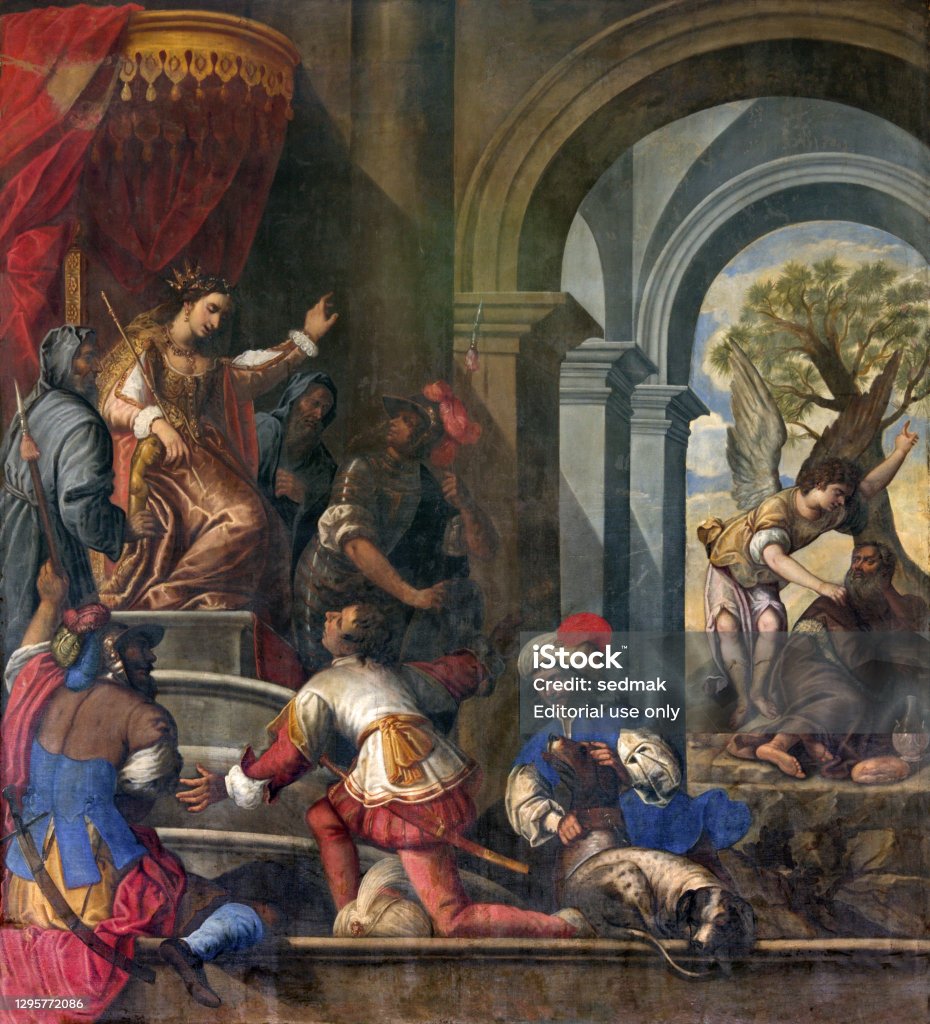
Despite the awesome display of God’s awesome power summoned by Elijah’s undaunting faith before King Ahab and his prophets, the wicked Queen, Jezebel, was not moved. She ordered Elijah to be arrested and killed on sight.
When Elijah heard her decree, he fled into the desert, where he sat down under a broom tree in bitter disappointment and anger at the way things turned out.
Couldn’t Elijah call fire down on Ahab and Jezebel? Why didn’t he do it? Elijah had just slaughtered all the King’s prophets after showing them up with fire from the heavens. When Jezebel wasn’t phased, Elijah fled in fear.
Elijah may have run in a moment of fear, but his fear turned to anger and disappointment, like Jonah. Both of them ended up under a tree that provided them shade. God ministered to both of them in their dejected state.
Elijah kept going south, all the way to the mountain where God met Moses on the Sinai Peninsula. In the cave where he took shelter, God came to him, asking, “Elijah, why are you here?” Then, Elijah let God have the full weight of his disappointment and anger:
“I have been most zealous for the Lord, the God of hosts, but the Israelites have forsaken your covenant. They have destroyed your altars and murdered your prophets by the sword. I alone remain, and they seek to take my life.”
1 Kings 19:10
But, God was patient. He told Elijah to stand at the mouth of the cave so the Lord can “pass by”. “A strong and violent wind rending the mountains and crushing rocks” came, but the Lord wasn’t in the wind. Then an earthquake came, but the Lord wasn’t in the earthquake. After the earthquake, came a fire, but the Lord wasn’t in the fire. (1 Kings 19:11-12)
Finally, “a light silent sound” came, and the Lord said to Elijah, again, “Why are you here?” God was not in the mighty displays of wind, earthquake, and fire. God was in a still, small voice.
Yet still, Elijah was fixated on his own disappointment and anger and responded exactly as he did before:
“I have been most zealous for the Lord, the God of hosts, but the Israelites have forsaken your covenant. They have destroyed your altars and murdered your prophets by the sword. I alone remain, and they seek to take my life.”
1 Kings 19:14
Elijah’s disappointment, anger, and indignation turned toward God. “They destroyed your alters and murdered your prophets!” Elijah said. It’s everyone’s fault but his. It’s ultimately God’s fault, right? Because Elijah knew what God could do. God could have destroyed Ahab and Jezebel in a ball of fire, but He didn’t.
In similar fashion, God asked Jonah twice, “Why are you angry?” (Jonah 4:1 and 4:9) Twice Jonah responds exactly the same way: “It is better for me to die!” (Jonah 4:3 and 4:8) It’s the same pattern for Elijah and Jonah.
At the end of Jonah, God asks the rhetorical question, “Should I not have concern for the great city of Nineveh?” But, Jonah doesn’t respond. (Jonah 4:10) Jonah didn’t want God’s compassion for Nineveh. He wanted them to burn.
We don’t know what became of Jonah, but we do learn the rest of the story of Elijah. God sends him back to Damascus to anoint a new King and pass his prophetic torch to Elisha. (1 Kings 19:15-18) When Elijah pronounced God’s judgment on the wicked King Ahab, the King humbled himself and repented, and God spared him (just like Nineveh). (1 Kings 21:27-29)
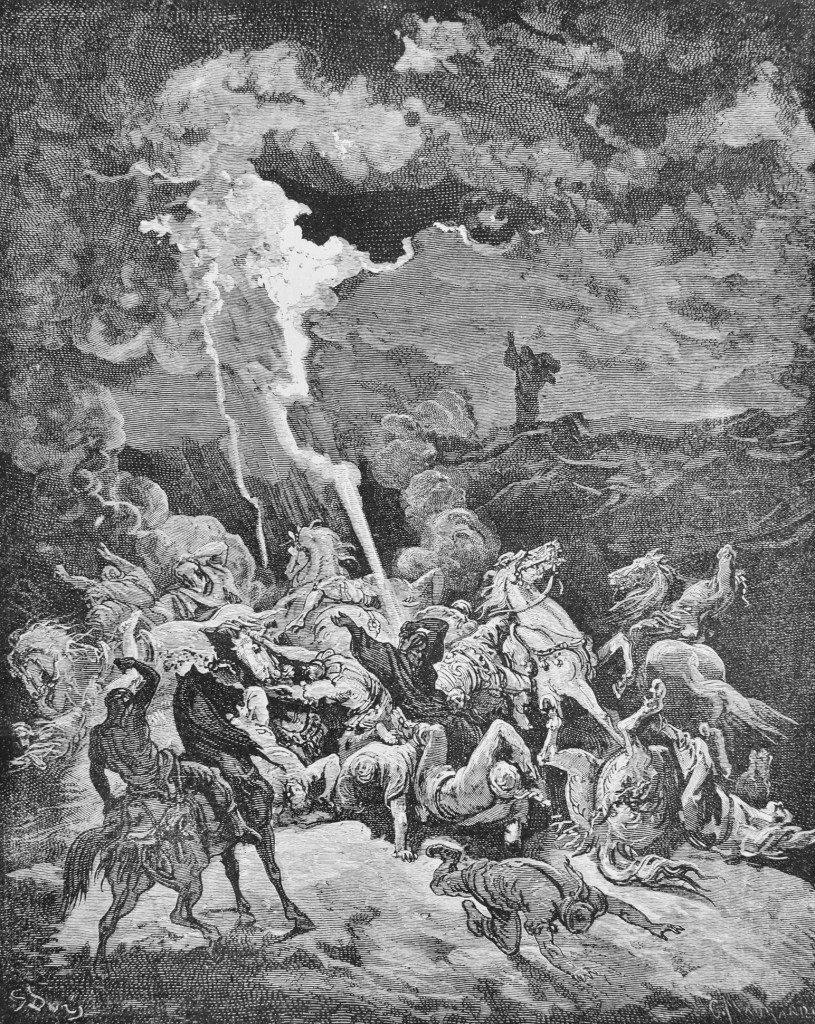
Eventually, Ahab’s son, Ahaziah, took over, and Elijah continued with his righteous taunts. Ahaziah sent fifty men to summon Elijah before him, and Elijah called down fire to destroy them. (2 Kings 1:10) Ahaziah sent another company of fifty men to summon Elijah, and Elijah called down fire again to destroy them. “(2 Kings 1:12)
Elijah is the prophet who called down fire. He was a man of great faith. He had great confidence in God. He was a firebrand, himself, in his sense of God’s righteousness and communication of God’s righteousness to the false prophets, the unrighteous and wicked leaders of his time, and even on the remnant of God’s prophets who escaped the sword only hid away in a cave.
Jonah had similar confidence in God. After the people of Nineveh repented and God relented, Jonah said, “I knew it! That’s what I said! That’s why I went the other way, because they don’t deserve it! Just take my life.” (Jonah 4:2-3)(my paraphrase)
Jonah and Elijah are held out in the Bible as God’s prophets and men of great faith, but they are flawed. They are self-righteous. They have a hard edge. The desire judgment, and they don’t love as God loves.
Their disappointment and anger stems from their desire to see the wicked people destroyed. God’s desire is ever to save, to have compassion, and for people to repent so God can show mercy. God’s great desire is not to judge, but to be gracious:
Truly, the Lord is waiting to be gracious to you, truly, he shall rise to show you mercy; For the Lord is a God of justice: happy are all who wait for him!
(Isaiah 30:18) God’s justice is ultimately to be gracious and to show mercy. Justice and mercy are not divorced from each other; they are intertwined. His judgment is meant to bring us to repentance so that He can have mercy on us.
When we have our act together and have great faith, our temptation is to desire judgment for its own sake, but God is not like that. Jesus, who was the exact representation of God in the flesh, shows us God’s heart when his disciples returned from traveling the countryside to tell people about the kingdom. The disciples wanted to call down fire on the people who rejected them and refused to welcome them, and Jesus rebuked them.
When we find ourselves disappointed and angry at a world full of sinners who deserve judgment, we need to think of Elijah and Jonah and the counterexample of God in dealing with Nineveh and Jesus in rebuking the disciples. God is “merciful and gracious, slow to anger, and abounding in steadfast love.” (Exodus 34:6-7) God takes no pleasure in the death of the wicked. (Ezekiel 18:23 and 33:11)
We can laud Elijah and even Jonah for their faith and (ultimately) their obedience, but we need to recognize that they didn’t understand God’s heart of compassion for people. They didn’t understand God’s desire for mercy and grace. God ultimately wants more than our raw belief and cold obedience; He desires “mercy, not sacrifice.” (Hosea 6:6 and Matthew 9:13)
God wants out hearts, and He wants us to see the world as He sees it. He wants us to love even our enemies (the wicked) and to sacrifice ourselves for the good of others as He sacrificed Himself for us in Christ. Thus, Jesus emphasized forgiving as we have been forgiven and showing mercy as God has shown mercy to us:
“Judgment without mercy will be shown to anyone who has not been merciful. Mercy triumphs over judgment.”
(James 2:13) When we are tempted to be judgmental and righteous, we need to remember that God has been gracious to us, and He desires – above all – to be gracious to the world. When we are bitter and angry at the sin in the world, we need to remember that Jesus came into the world not to condemn it, but to save it, just he saved us.
Bas-relief portraying the emperor Nero at the Certosa di Pavia
One of the most discussed texts in early Christian ethics is 1 Peter 2:13–17, because it calls believers to “submit… to every human institution” and to “honor the emperor,” even in times when those institutions were hostile or unjust. Peter, who penned this admonition, ultimately lost his life to an arbitrary, capricious, and unjust Roman Emperor.
“13 Submit yourselves for the Lord’s sake to every human authority: whether to the emperor, as the supreme authority, 14 or to governors, who are sent by him to punish those who do wrong and to commend those who do right. 15 For it is God’s will that by doing good you should silence the ignorant talk of foolish people. 16 Live as free people, but do not use your freedom as a cover-up for evil; live as God’s slaves. 17 Show proper respect to everyone, love the family of believers, fear God, honor the emperor.”
1 Peter 2:13–17
Paul, who lost his life to the same Roman Emporer, says similarly,
“Let everyone be subject to the governing authorities, for there is no authority except that which God has established. The authorities that exist have been established by God. 2 Consequently, whoever rebels against the authority is rebelling against what God has instituted, and those who do so will bring judgment on themselves.”
Romans 13:1-2
These two passages speak to the way Christians should honor and submit to earthly authorities. They have posed challenges to Christians from the time there were written. In Peter’s and Paul’s time, Nero was the Roman Emperor. Nero was a brutal, harsh, paranoid ruler who had his own wife and children killed to protect himself and to advance his own ends. Peter and Paul were both martyred by his decree.
The great American story is a far cry from the brutality and caprice of Roman history, but we have lived through our own unjust laws, including laws that protected the institution of slavery and the laws that perpetuated Jim Crow after slavery was finally prohibited. In more recent times, American have laws protected the practice of abortion, and we could find other examples of unjust laws and laws that protect unjust practices if we dig deeper.
I doubt I am exaggerating to say that no nation governed by men has ever been perfectly just, and I doubt no nation of men will ever be perfectly just. How then should Christians in any age govern themselves in light of Peter’s and Paul’s admonitions to honor and submit to governing authorities, including unjust ones?
I previously tried to parse these tensions when I published How Should the Church Act Regarding Authority? the day after January 6th, when supporters of Donald Trump, including many people flying banners of Christian faith, stormed the Capitol building in response to what they thought were unjust election results. At that time, I was critiquing the “insurrection” against the election and inauguration of President Biden. Even if the election results were unjust, shouldn’t Christian have submitted to them?
Now, I find myself critiquing the Trump Administration’s unjust enforcement of immigration laws. Some of the people who defended Trump’s complicity with the January 6th insurrection are now defending the current immigration enforcement practices based on the biblical mandate to honor and submit to authority. It seems to be a tangled mess!
We should obviously be consistent, and not selective, about the law and order we submit to, but how we should live that out in the face of injustice may not seem crystal clear. It’s important, though, that we do the work to rightly divide the Word of God









 Navigating by Faith