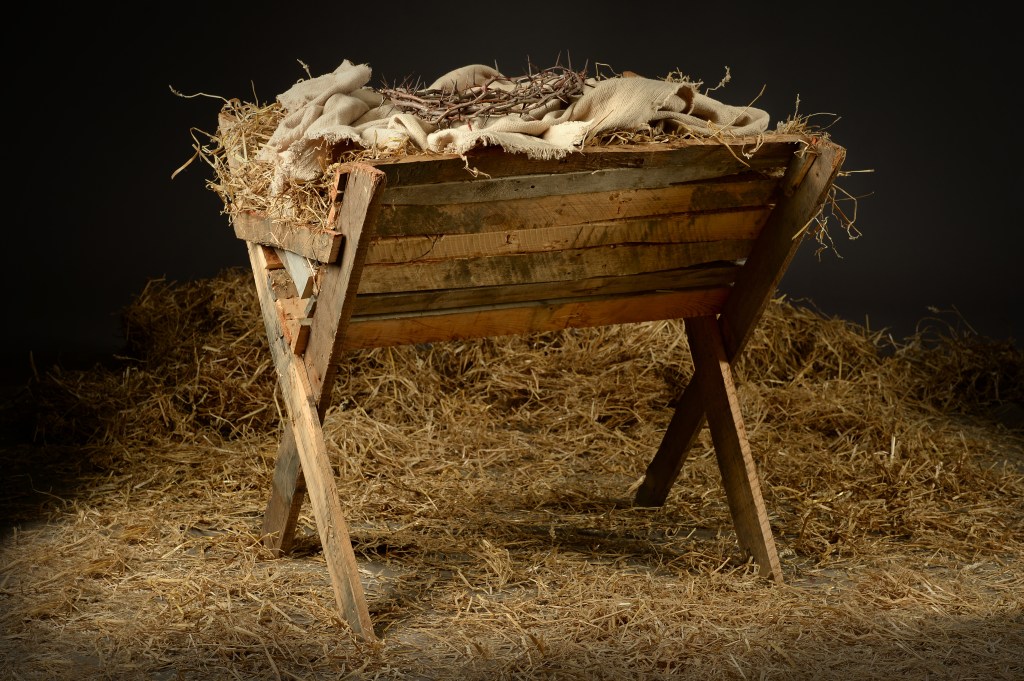
A Message in a Manger


I am going to revisit some of the Christmas articles I have written in previous years in the coming weeks, starting with this one. I may freshen them up a bit as I do so. This was one of the first articles I wrote on this blog, and I think the message still resonates today: A Message in a Manger.

Perspective: As the Heavens Are Higher than the Earth

We can perceive and feel our way to understand that time had a beginning at the point of a quantum vacuum, but we can go no further even to perceive, but for speculation, what lies beyond. We are left to grasp by pure faith that God initiated the universe into being.

Photo from the James Webb Telescope

Perspective can make all the difference in the way we perceive and understand anything. Our view from a position under the canopy of a dense forest will be different than our view from a drone in the same location flying over the same forest canopy. The higher we fly that drone, the more our perspective expands and understanding of our location grows.

From a great height, we see the expanse and contours of the forest, the streams and rivers that run through and beyond it, the mountains in and the oceans in the distance where the forest transitions into the hills, the foothills, the mountains slopes and the peaks in one direction, and the openings, meadow, plains, and coastlands in another direction.

The higher we go and farther out we see, the more we see and understand the forest in relation to other geographical features that surround it and the savannas, valleys, deserts, and coastlands and oceans in the grater world beyond the forest.


“As the heavens are higher than the earth, so are my ways higher than your ways and my thoughts than your thoughts.”

Isaiah 55:9


This verse has become so often quoted that it might seem trite to us. “Yea, yea!” we say. “We need to trust God. I get it.”

It’s hard to grasp and trust in the perspective God has from our place where light filters sparingly through the forest canopy. Our perspective is not much better in the barren expanse of a vast desert or on the waves of a vast ocean as far as the human eye can see. Knowing that the forest canopy, barren desert or vast ocean gives way to a different reality can seem like a small consolation from where we stand.

We have a harder time grasping and appreciating that God sees out over the universe where our planet sits tucked among other planets circling the sun in an opportune place in the Milky Way solar system where we peer out, however tentatively, into an expanse of other solar systems stretching out in all directions beyond our capabilities even to observe.

Ninety five percent of the universe we can see is comprised of dark matter and dark energy that we know exists, but we cannot even observe. Mystery surrounds us in every direction and beyond our capability to go or even to glimpse.

We can perceive and feel our way to understand that time had a beginning at the point of a quantum vacuum, but we can go no further even to perceive, but for speculation, what lies beyond. We are left to grasp by pure faith that God initiated the universe into being by His very Word and expends still into some unknown future and “void”.

Continue reading “Perspective: As the Heavens Are Higher than the Earth”

The Dilemma of God Demanding Justice from Beings Incapable of Meeting God’s Standard

There is one critique of the Christian notion of sin and the justice of God that is troubling on its face. That key critique for anyone who claims that God demands justice for sin is that God is seemingly unjust to require justice of beings who can’t measure up.

Many modern people bristle at the Christian idea of sin, and they bristle even more at the idea that God would punish sinners. Frankly, I think many modern people simply don’t understand what sin is and who God is.

But, that aside, there is one critique of the Christian notion of sin and the justice of God that is troubling on its face. That key critique for anyone who claims that God demands justice for sin is that God is seemingly unjust to require justice of beings who can’t measure up.

Alongside the notion that the God of the Bible and demands judgment for not measuring up to God’s just standard is the notion that all people are sinners who don’t measure up. In fact, the New Testament is fairly read to say that people are incapable of living up to God’s standard.

The doctrine of original sin says that we are all corrupted because the sin of Adam and Eve has been passed down generation after generation. Even if we don’t believe in the doctrine of original sin, however, the Bible is clear from the Old Testament to the New Testament that human beings don’t measure up to God’s standard:


They have all turned aside; together they have become corrupt;
    there is none who does good,
    not even one.

Psalm 14:3


They have all fallen away;
    together they have become corrupt;
there is none who does good,
    not even one.

Isaiah 53:5


as it is written:

“None is righteous, no, not one;
   .
 All have turned aside; together they have become worthless;
    no one does good,
    not even one.”

Romans 1:10-12


Jesus said, “No one is good except God alone.” (Mark 10:18 (NIV)) Yet, he says, “Be perfect … as your heavenly Father is perfect?” (Matthew 5:48)

This is the dilemma: How can we be perfect?! “To err is human” the bard once said, and so it seems we are imperfect by our very nature.

Many people reject the idea that God can be just and demand justice from people incapable of measuring up to the standards God’s justice demands. They say it would be unjust for God to demand justice from beings who have no ability to act other than they do, and so fail to meet God’s standards.

God seems to be acting unfairly to demand that we meet His standards when we are 1) created beings, 2) born into sin, and 3) incapable of living up to the perfection God requires.

Other questions tumble after these thoughts: Why didn’t God create us perfect? If we are born sinful, how can God blame us for being sinful? If we are incapable of being perfect, how can God punish us for our imperfection?

Continue reading “The Dilemma of God Demanding Justice from Beings Incapable of Meeting God’s Standard”

Digging into the Accuracy and Inspiration of the Bible

I wrote recently on the character of Scripture, prompted by a statement made by Marty Solomon in Episode #82 of the BEMA Podcast, picking up on a statement he made that inspiration doesn’t necessarily mean accuracy. (See Does inspiration mean accuracy?) This topic gets into what it means that Scripture is the inspired word (or revelation) of God.

The idea that Scripture is inspired by God comes from 2 Timothy 3:16:

“All Scripture is inspired by God and beneficial for teaching, for rebuke, for correction, for training in righteousness….” 

2 Timothy 3:16 (NASB)

Paul’s statement in his second letter to young Timothy is one of the few comments on the character of Scripture in the Bible. In this article, I want to focus on other comments on Scripture that can be found in the New Testament.

You might be surprised to know that Peter references Paul authoritatively, expressly characterizing Paul’s letters as “scripture” (sacred writings). (2 Peter 3:15-16 ESV) The recognition by Peter that Paul’s writings are scripture is highly significant because Jesus said Peter was the “rock” on which Jesus would build his church. (Matt. 16:18) If Peter considered Paul’s writings “scripture”, we should too.

Paul, likewise, references Luke in his first letter to Timothy. Paul quotes from “the Scripture”, saying: “’Do not keep an ox from eating as it treads out the grain.’ And in another place, ‘Those who work deserve their pay!’” (1 Timothy 5:18 NLT) The first quotation is from Deuteronomy 25:4. The second is from Luke 10:7 (NRSV). Thus, Paul quotes Luke’s Gospel, as scripture in the same vein as the Torah.

This discussion, though, begs the question: what is scripture? Obviously Peter thought Paul’s letters were scripture, and Paul thought Luke was scripture. Most of scripture in that time would have been what we call the Old Testament. There was no “New Testament”, so what else is scripture?

Many misconceptions abound. People claim that books were removed from the Bible. People claim that a group of “church fathers” got together and determined what should be in the New Testament.

These claims are false. They have no basis in the historical record.

The truth is more complicated, and the NT canon developed more organically than what is popularly believed. The writings of the NT developed from the texts that were considered authoritative throughout the scattered regions of the early church, long before the Christianity became the official religion of Rome in the late 4th century and the Holy Roman Empire emerged in the 9th Century (See Encyclopedia Britannica).

We may think of Christianity being controlled centrally from Rome, but that didn’t happen until after the 4th Century. Before that, churches were scattered all over the Roman Empire and beyond. Various centers of influence existed, including Rome, Alexandria (Northern Africa), Jerusalem and Caesarea (the Levant), Antioch (Syria), Lyons (France) and other places. The top down authority of Rome (and Constantinople) developed much later.

The writings that make up the existing New Testament were shared and circulated throughout a wide area, wherever churches took root. Opinions were shared, and a consensus grew based primarily on the authorship (apostolic connection) and message (consistency with the teachings of Jesus).

Many of those writings were accepted very early by a majority of people, and others gained acceptance later by the same organic method of consensus. (See The Formation of the New Testament Canon) Many other writings were considered helpful, but not scriptural, and some writings were considered heretical. Late writings generated after the apostles had all died were categorically excluded. These writings date from the second century and later.

Eusebius of Caesarea was one of the first people to attempt a summary of authoritative writings. The 22 “books” he identified in the 3rd Century are nearly identical to the canon we have today, minus a few and plus a few. The consensus was close to settled at that time.

The first person to name all 27 writings exactly as they are known today was Athanasius in Northern Africa in his Festal Letter written A.D. 367. The same canon was accepted by the rest of Christendom at the African synods of Hippo Regius (A.D. 393) and Carthage (A.D. 397 and 419). (Not the Council of Nicaea as the popular myth goes!)

In between the 1st Century and the early 5th Century when the canon was officially settled, other lists were offered by various sources. Bruce Metzger, the Princeton Theologian, says, “The slowness of determining the final limits of the canon is testimony to the care and vigilance of early Christians in receiving books purporting to be apostolic.”

Metzger notes that “the chief criterion for acceptance of particular writings as sacred, authoritative, and worthy of being read in services of worship was apostolic authorship”. The early church focused on the source or authority – connection to the apostles who knew Jesus. They also measured them by the known message of Jesus, as preserved by those same apostles.

Keep in mind that the apostles lived on after Jesus. Peter died in 64 AD during the reign of Nero in Rome according to contemporary, extra-biblical sources. John, the Apostle, died in approximately 100 AD according to reports preserved from multiple sources.

Thus, the apostles, the closest people to Jesus, lived on 30 to 70 years after Jesus died. They were the standard by which the authority of contemporary writings were judged.

Determining (or accepting) what is Scripture is only a beginning, though. How we view Scripture and interact with it is where the real rubber meets the road. In my last article, I wrestled with what it means that Scripture is inspired, suggesting that accuracy is not necessarily the key component. I will dig a little deeper into that vein in the rest of this article.

Continue reading “Digging into the Accuracy and Inspiration of the Bible”

The Vital Importance of Encounter with God

Job’s questions didn’t matter anymore after God showed up!

Francis Chan said in a recent interview that many people walk away [from Christianity, faith, religion] because they have never really had an encounter with God. They walk away from their belief system or their parent’s belief system because they have had no personal encounter with the divine.

“If you really encounter God”, he says, “You don’t do that.” Moses didn’t walk off Mount Sinai arguing about a belief system. Job didn’t return to his belief system or his parents’ belief system. They had real encounters with God, and those encounters changed them.

I have thought for several years about the odd fact that Job had a million questions for God until God appeared. When God showed up, He didn’t provide a single answer to any of Job’s questions, but Job no longer had any questions!

Job’s questions didn’t matter anymore after God showed up!

When Job demanded answers, he wasn’t looking for a belief system. He was desperately seeking an encounter with God, though he might not have known it at the time. If Job had settled for a belief system (or a systematic theology as we might call it), his questions may have been answered, but his doubts would have continued.

People will argue about belief systems, but we don’t argue about an encounter with God. You might not understand my encounter with God, but you can’t refute it. You might question my experience, but I know what I know.

Belief systems don’t change people. Encounters with God change people. A belief system is not the crux of Christianity. If we think it’s all about having a systematic theology, we are missing the forest for the trees; we are accepting a shadow of the real thing. The real thing is God, Himself!

Francis Chan ended his train of thought with the words of Isaiah in 29:13:

“[T]hese people draw near with their mouth and honor me with their lips, while their hearts are far from me, and their fear of me is a commandment taught by men….” 

Christianity has no life or vitality if it is nothing more than a commandment taught by men. The essence of Christianity is Jesus. Jesus is God who became man. Jesus said,

“Whoever has seen me has seen the Father.” (John 14:0)

We do not know God if we have never encountered Him. Mental ascent is not the same thing as knowing God through encounter with Him!

Jesus urged people to seek God. He didn’t urge people to seek to know about God. He urged people to seek to know God, personally. He urged them to seek God, the Person!

Jesus said, “I am the way, the truth and the life.” He didn’t say, “I can show you the way”; or “I can teach you the truth”; or “I can give you the life”. He said, “I AM the way, the truth and the life!”

The way, the truth and the life resides in the person of Jesus Christ. Jesus is one with the Father, and He left behind the Holy Spirit, who is also one with God the Father and who accessible to us, that we might know God intimately and personally.

We settle far too often for mere knowledge and belief systems. What we need is encounter and relationship with the Living God. What we need is the Living Water and Living Bread, which is God, Himself.