Selfishness to Salvation

Depositphotos Image ID: 69572625 Copyright: Christin_Lola

Today someone spoke about going “from selfishness to salvation”. I have never heard anyone put it that way before, but it’s as accurate a statement as any I have heard.

Jesus said, “Whoever loves his life loses it, and whoever hates his life in this world will keep it for eternal life.” (John 12:25) Loving and holding tightly to my own life, shutting God out, refusing to concede control to my Creator, desiring to go my own way is the life of a person without God. Marked by a desire to control my own destiny, to be captain of my own soul, so that I can say, at the end of the day, “I did it my way”, is a life lived without God.

The terrifying reality is that God will let us go our own way. He didn’t prevent Adam and Eve from eating the forbidden fruit. They were tempted by the desire to “be like God”[a], to define good and evil for themselves, to make their own choices and, ultimately, to usurp God’s place of prominence in their lives.

The fruit they ate was “good”; it was delightful and even desirable.[b] The fruit, itself, wasn’t necessarily bad (the knowledge of good and evil). The decision to go their own ways, to assert their own wills over the will of God, was their downfall.

Without that fateful choice we might live  idyllic lives. We might forever be “perfect” little angels, but God obviously had something else in mind.  God must have known the choice we would make. Right?

That choice doomed us to the imperfection of our humanness, but it also opened the door to something else completely. It opened up the opportunity for us to enter into a relationship with God we could never have known in that “perfect”, idyllic, innocent (and naive) state.

Continue reading “Selfishness to Salvation”

Born Again: the Paradigm Shift

Being born again is the ultimate light bulb moment, and everything changes and is illuminated by it.

Depositphotos Image ID: 26594615 Copyright: west

I listened recently to a talk given by Tim Keller who has a way of reducing “mysterious” ideas to plain English like few are able to do. In this talk, he tackled the Christian concept of being “born again”. People who walk in some Christian circles may take for granted what it means to be “born again” (or maybe not), but anyone who grew up outside the evangelical influence may have very little idea what it means.

“Born again” are buzz words to be sure. They are used ubiquitously to mean a certain “brand” of Christian, sometimes, or even a certain political persuasion, which is really a bastardization of the meaning of the phrase. The phrase has its roots in a particular passage of Scripture and is meant to convey the idea of a paradigm shift of sorts – an ultimate, life changing paradigm shift.

Being “born again” is often assumed to mean a religious experience accompanied by emotions and religious fervor, but that really isn’t quite what the phrase originally meant, or even what it really means at its essence. Being born again might be accompanied by emotions and religious fervor, but not always.

I think of CS Lewis, who I would consider a “born again Christian”, when I say that “being born again” isn’t always accompanied by high, religious emotions. He described his “experience” this way:

“You must picture me alone in that room at Magdalene, night after night, feeling, whenever my mind lifted even for a second from my work, the steady, unrelenting approach of Him whom I so earnestly desired not to meet. That which I greatly feared had at last come upon me. In the Trinity Term of 1929 I gave in, and admitted that God was God, and knelt and prayed: perhaps, that night, the most dejected and reluctant convert in all England” (Surprised By Joy, Ch. 14, p. 266).

Indeed, CS Lewis is not alone in finding the doorway to Christianity being rather more of a cross than a resurrection. Of course, the cross always precedes the resurrection.

Aside from the idea that being born again is primarily an emotional experience, people often think of it as signing onto a set of morally rigid religious principles. The words from CS Lewis might tend to support that idea, but that would be wrong as well. In fact, it really couldn’t be any further from the truth.

Continue reading “Born Again: the Paradigm Shift”

Why Does Goes God Allow Suffering: Eternal Decisions

Sometimes the rational answer doesn’t satisfy the emotional problem, but there is an answer to the emotional problem of suffering.

Depositphotos Image ID: 31692361 Copyright: DesignPicsInc

I often listen to podcasts in the morning as I shave, shower, brush my teeth and get ready for work. Today I was listening to Dr. William Lane Craig respond to some questions about free will and suffering, and his comments prompt this blog piece.

He made the following statement

“Natural suffering forms the arena in which the drama is played out of people being freely called to come into the kingdom of God and find an eternal relationship with God. It is not at all improbable that only in a world infused with natural suffering would an optimal number of people freely respond to God’s gracious initiatives and come to enjoy a relationship with God and eternal salvation.”

Dr. Craig represents the Molinist view of the tension between God’s sovereignty, knowledge and power and man’s free will. On the Molinist view, God knows the future, but he does not determine it. Knowing the future, God chose to set the universe in motion, but he does not determine every aspect of it, including the choices that people make.

Knowing the future, God chose to set the universe in motion, and to that extent, He determines the outcome, because He knows the outcome. He does not determine it, however, to the extent of interfering with the free will He gave humans who are created in His image.

The fact that he knows the outcome, does not mean that He determines the choices each person makes. Each person is free to choose as they will, but God knows how they will choose from the beginning, and so He can be said to have willed it.

This is (my simple version of) the Molinist view. It respects God’s sovereignty, while acknowledging the clear implication of free will and moral responsibility to which God holds us that is reflected from beginning to end in the Bible.

I tend to like the Molinist view, but I am always somewhat cautioned in my own thinking not to be overly concerned with doctrinal nuances on matters that are, frankly, beyond us. I don’t want to die on a Molinist hill, or any other hill than the Gospel.

The Calvinist resurgence in the church today stands in contrast to a more Armenian view of inviolate free will. Many have been the discussions and debates between these two views. I fear we spend too much time and energy on debating when we should spend more time living out the Gospel. I think Paul might lump these debates in the category of vain discussions.

Still, I think it is good to chew on these things as they may be beneficial to our knowledge and understanding of God. As I thought about Dr. Craig’s comment above, I could not help think that this is a kind of divine utilitarianism – what is optimal for generating the most free will responses of love for, relationship with God, and eternal life with God.

Dr. Craig’s thesis is an attempt to explain why suffering exists in the world when God is supposed to be good, all-powerful and sovereign. Why doesn’t God stop suffering if He is all those things? Why does he allow suffering at all?

Continue reading “Why Does Goes God Allow Suffering: Eternal Decisions”

Hope: In My Time of Dying

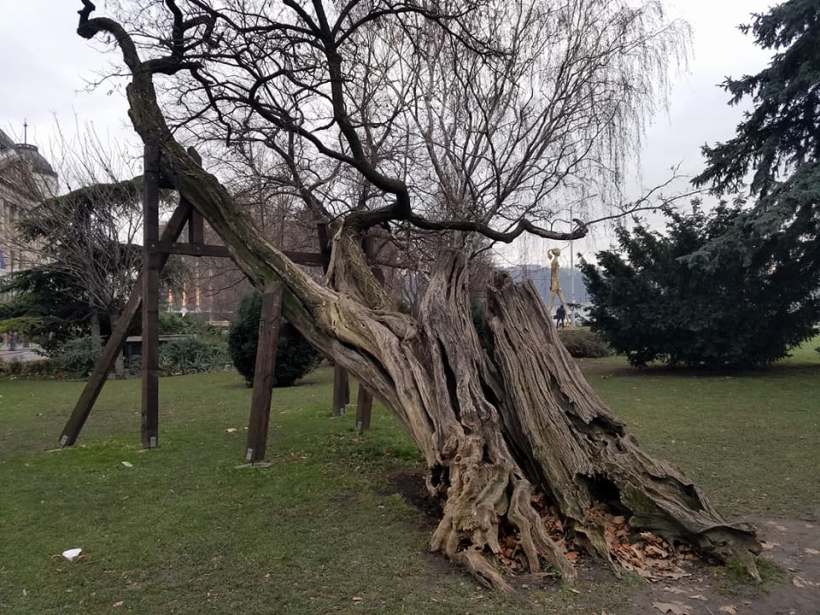
Photo courtesy of yours truly, Budapest Hungary

I have experienced an awful lot of dying in my world recently. People that I know, friends and family of people that I know, one after another, many people in my world are dying lately.

Frankly, from the moment we are born, we begin to die. This isn’t a pleasant thought, but this is where my head is going as I read my Facebook feed, offering condolences, prayers and thoughts, one after another.

Our cells begin to die off from the moment we are born. Sure, they regenerate. Our cells die off and regenerate throughout our lives. As our lives go on, however, the dying process speeds up, it picks up in intensity, the dying outpaces the regeneration and it results, eventually, in our natural deaths… if something doesn’t kill us sooner.

It could be depressing to think about. On the other hand, it is natural. This is the way it is.

Why do we even care?

Really, why does death bother us so much? Does my dog think about dying?

If death is simply a fact, a matter of life, a natural phenomenon, what’s gotten into our heads about it? How do we explain our preoccupation with death?

Continue reading “Hope: In My Time of Dying”

Our Transcendent Hope

Llife is short and tenuous. Whether we live to be a hundred or 80 or only 8, life will end. What, then, is our hope?


A very close friend of mine was expressing concern about the state of the world recently. He expressed concern about Donald Trump the Korean dictator, like a bully provokes a mass murderer. I was not prepared for such an existential discussion, and I did not respond very well.

I recognize, though, the the concerns are real. I was haunted by the specter of nuclear war as a child growing up in the 60’s and 70’s. I even bought a poster of a mushroom cloud to hang on my wall, not because I wanted the world to end in a ball of fire, but because it was a reality I couldn’t ignore.

But we do learn to ignore realities like that. I no longer have a poster of a mushroom cloud, and the threat of nuclear war no longer looms in my psyche like it did in my teenage years. Though it is no less likely to happen. (Maybe even more likely now!)

Maybe we lose our angst over these things because they are hard to live with them. We learn to push them back into the recesses of our consciousness. We displace the angst with busyness, entertainment and other distractions.

The fact is that life is short and tenuous. Whether we live to be a hundred or 80 or only 8, life will end. This is a harsh, but true, reality, though I’m afraid it isn’t very helpful “advice” for someone who is laboring under the burden of the weight of the world. I wish I had said something different (or, at least, more).

I firmly believe this world is not all there is. We thirst, and water exists to quench our thirst. We hunger, and food exists to sate our hunger. It makes sense that, if we yearn for something transcendent, something transcendental exists to satisfy our existential longing.

We all seem to “know” this, but the world is so full of a thousand superficial answers to the ultimate existential question that we hardly have any idea what to believe. We might be tempted to seize on the first or closest one or easiest answer, like responding to that Publishers Clearing House Sweepstakes mailer declaring you might be the winner. For some people, hope springs eternal.

Others are tempted to abandon any hope of an existential answer. The resign ourselves to the material world, trying to squeeze whatever temporal pleasure and benefits while they can out of this myopic existence.

Is there proof of something transcendent? How can we know? These are serious and heartfelt questions.

Continue reading “Our Transcendent Hope”