Finding Hope in Death: Lessons from Ecclesiastes, Shakespeare, Pascal, and C.S. Lewis

What the inevitability of death and our response to its inescapable grasp suggests

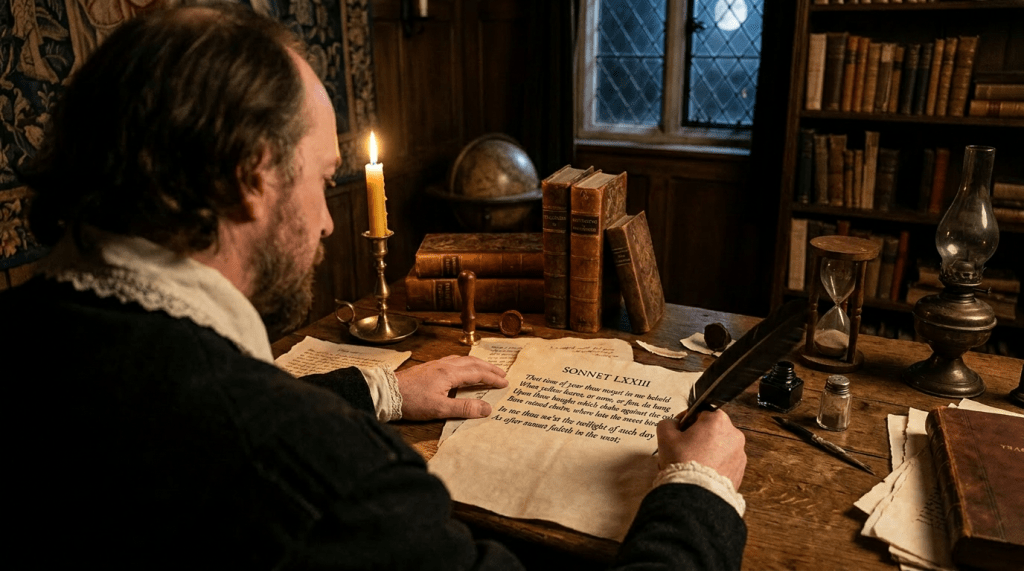
Man in historical attire writing Shakespearean sonnet with quill and candle

I have been listening to Pensées by Blaise Pascal, who has become a favorite philosopher, theologian, and thinker for me. I resonate with his sentiments about reason and intuition in particular. He was brilliant in science, mathematics, and theology – way ahead of his time. He lived during the initial headwind of the Enlightenment. He was a contemporary of René Descartes, yet he was able to remain objective. He wasn’t swept up in the current of the Enlightenment. He managed to remain aloof from it.

I am inspired to think of death today from my reading of Pensées. Death is the great equalizer. It will come to all of us. The longest-lived among human beings may live to be 110. Most of us will not see 100 … or even 90; and many of us will not see 80 or 70 or even 60. Try as we might, we do not control our fate. We will die, and that reality is inescapable.

Pascal talks about the people who distract themselves from the reality of death. I suppose it’s natural to want to ignore something that is as grim as death. We can’t add a day to our lives by worrying and being anxious about it. Yet, anxiety about death is also natural for the same reason – we dread it, but we can’t avoid it.

I imagine that my cat has never thought a day in its life about the fact that it will die, but I have rationality, consciousness, and awareness of myself that my cat does not seem to have, certainly not in the same measure. To the extent that we have that ability, it seems to me that ignoring the reality death that we can certainly grasp is to be something less than human. To ignore the reality of death is, therefore, beneath us. It denies the qualitative difference between us and other animals.

The proverbial deer standing frozen in the headlights of a hurtling vehicle has little idea of the imminent impact those headlights impend. Like the deer we might shut our minds off in the grim headlights of death … but we know better. The deer doesn’t know any better.

Not that we should have any pride in the fact that we have greater capacity than the other animals. It wasn’t anything we did. It simply is what it is.

Thus, to live into our capacity seems only fitting. Our anxiety about death is fitting for creatures with rationality, consciousness, and awareness of themselves.

I was first impressed about this humanly poignant characteristic – preoccupation with death – in college as an English Literature major. Death was the subject of many a novel, sonnet, and other forms of literature. Death is a common theme across the literary ages. The desire to escape the inevitability of death runs strong in creative and artistic minds living into the fullness of what it means to be human.

It was in a class on William Shakespeare, focusing on the sonnets, that the reality of the creative preoccupation about death crept into my own awareness. In that same time period, I must have been reading Ecclesiastes, because I associate Ecclesiastes 3:11 with that time in my life. Indeed, it has become my favorite verse in the Bible:


For God has made everything beautiful in its time, and eternity has been set in the heart of man, but not so that he could see the beginning from the end.”


We do live in a world full of beauty, even if the world is also full of pain, struggle, and anxiety. The contrast between beauty and the ugliness of pain and death does not escape us. Ultimately, these things are painful reminders of our own finitude that we would rather not face.

To put it in biblical fashion, the reality is that we are like a mist. We are like a flower that blooms one day and dies the next. Like the writer of Ecclesiastes said, “Everything is meaningless” in a world like that.

In that sense, we are no better off than the animals. From dust we were born and to dust we will return. We end up in the ground just like they do.

Everything that we accomplish fades into other people’s memories when we die. Most if not all of those memories will long be forgotten in a few generations. The things we accumulate that do not rust or rot while we live will be left to rust or rot for someone else. In more modern, poetic terms, no one tows a Cadillac to the grave.

And yet, the very fact that we wrestle with the poignance of death is something that arouses hope. This was the realization I made in that class on Shakespeare.

Why do we even care? Why does it even enter our mind to be anxious about it? Why aren’t we, like my cat or a deer in the headlights, clueless about it? The fact that we think about it and long for a different reality suggests the possibility of such a reality.

Continue reading “Finding Hope in Death: Lessons from Ecclesiastes, Shakespeare, Pascal, and C.S. Lewis”

Jesus Wept with Mary, Though He Knew the Joy to Come

We live in a world in which Jesus wept at the tomb of Lazarus, knowing that he was going to raise him from the dead.


NT Wright commented to Justin Brierley in the 39th episode of Ask NT Wright Anything, “We live in a world in which Jesus wept at the tomb of Lazarus, knowing that he was going to raise him from the dead.”

Jesus was able to identify with and feel the crushing sorrow and the intense grief that the family and friends of Lazarus felt. When Jesus saw Mary, the sister of Lazarus weeping, he wept too. (John 11:32-33) Jesus felt her grief, and it moved him to tears.

Jesus weeping at the tomb of his friend, Lazarus, of course, reveals his humanity, his empathy and the fact that he felt the range of human emotions that we feel in our own lives. Imagine God taking on our form and experiencing what we experience!

The most remarkable aspect of this story, for me, is that Jesus felt the grief of the loss of a loved one and was moved to tears even though he knew he was going to raise him from the dead. He wept with grief though he know that joy would follow the raising of Lazarus from the dead.

In this way, we see that God doesn’t minimize our grief and suffering. He is able to identify with it because he felt the crush of it as we feel it.

He felt the crush of human grief even though he knew the miracle he was about to perform.

Perhaps, Jesus was weeping for all the people who feel grief without assurance or confidence or hope. Surely, Jesus had more than merely hope. He knew that he was about to raise Lazarus from the dead, but he also realized that his friends, the friends and family of Lazarus, didn’t know or appreciate what he was about to do.

Even though Jesus told the friends of Lazarus that he was doing “to wake him up” (John 11:11), and he told Martha, “Your brother will rise again,” they didn’t fully understand or appreciate what Jesus was saying. (John 11:23) They didn’t feel the assurance or confidence or hope that Jesus had.

I imagine Jesus also thought in those moments of all the people in the world who mourn without assurance, confidence or hope in the face of death. This is the human condition, and Jesus fully embraced it. He fully felt the weight of it, and it caused him to weep with them.

Continue reading “Jesus Wept with Mary, Though He Knew the Joy to Come”

Learning How to Die


Dying is a topic most us would rather avoid, but Jesus didn’t shy away from the subject. In fact, he focused on it – maybe because He came to die for us.

I guess I would probably be a bit fixated on the subject if I knew that was the fate that awaited me…. Wait a minute…. that is the fate that awaits me!

Well, maybe it was different for Jesus because it wasn’t just the fate that awaited him; it was among the primary purposes for which he became a man. Though he existed in the form of God, He didn’t hold on to His superior position. He emptied himself, taking the form of a servant and was born a man. “And being found in human form, he humbled himself by becoming obedient to the point of death, even death on a cross.” (Philippians 2:6-8) Simply put – Jesus came to die – for us.

As Jesus neared the time when He would be betrayed into the hands of the tribunal that would seal His death warrant, He said:

“Now my soul is troubled, and what shall I say? ‘Father, save me from this hour’? No, it was for this very reason I came to this hour. Father, glorify your name!”” (John 12:27-28)

For Jesus, death wasn’t inevitable. He chose to die. This does make him different than us: He chose to become one of us and die for us. And because He chose it, could it have been any different for Him?

Is it really different for us?

Maybe not. If you believe what Jesus said.

Continue reading “Learning How to Die”

Sam Harris Podcast Interview of Bart Ehrman – Part 4 – Setting the Bar Exceedingly High

An exceedingly high bar for the proof of miracles allows Ehrman and Harris to avoid a serious discussion about the evidence of the resurrection.


I have written three articles summarizing some observations I have from an interview of Bart Ehrman, the agnostic New Testament scholar, by Sam Harris, the atheist, about Christianity. In those articles, I cover Bart Ehrman’s story about losing his faith, the fundamentalism that continues to color the way Ehrman reads the Bible and the dangers of social influence as a substitute for a deep, personal relationship with God.

I covered in the first article the rather ironic claim that Harris makes about approaching a familiar subject from a new angle. When an atheist interviews an agnostic on the subject of Christianity, I don’t know what new angle he is talking about! They both come from the same angle of unbelief.

When Sam Harris asks Ehrman to describe what Ehrman, as “an informed believer” would have said was the strongest argument for Christianity, I had to chuckle. When Ehrman replied that the proof of the resurrection would be the strongest argument, I had to agree, though. As Paul said, if Jesus was not raised from the dead, his preaching and faith were useless, and he would have to be pitied.[1]

For the proof, Ehrman states only two facts: the empty tomb, and the followers of Jesus who claimed to see Jesus alive after the resurrection. (They are other “minimal facts” that even skeptics will concede.) Ehrman doesn’t expound on the two facts, other than to note that Paul alludes to a list of people in 1 Corinthians who claimed to see Jesus risen from (including 500 people at one time (see 1 Corinthians 15:3-8)).

These two facts are certainly on the short list of key factors scholars evaluate in considering the historicity of the resurrection, but they are not the only facts to be considered. Even skeptical scholars, like Ehrman, admit a few more. (See Previewing the Minimal Facts Critique of the Resurrection.) But, Ehrman and Harris never really get to a discussion of the facts.

Before any real discussion of the evidence, Sam Harris jumps in to refute the resurrection by reference to David Hume. Hume of course is the 18th century philosopher who urged a standard of proof for miracles that, in Sam Harris’s own words, is “a bar that is exceedingly difficult to get over”. By reference to Hume, Harris says that the proof of a miracle has to be so strong that believing in anything other than a miracle would, itself, would require belief in the miraculous.

This is a type of a priori position that discounts and dismisses miraculous claims without really taking a hard look at the evidence. In essence, the position is that miracles can’t happen. They don’t happen. Therefore it didn’t happen. This “exceedingly” high bar that Sam Harris speaks about is arbitrary. Ehrman acknowledges, but glosses over, that point by saying that “believers have a different standard of proof”. This is entirely true, but it doesn’t really address the issue.

What is a proper or reasonable standard of proof?

Continue reading “Sam Harris Podcast Interview of Bart Ehrman – Part 4 – Setting the Bar Exceedingly High”

Our Transcendent Hope

Llife is short and tenuous. Whether we live to be a hundred or 80 or only 8, life will end. What, then, is our hope?


A very close friend of mine was expressing concern about the state of the world recently. He expressed concern about Donald Trump the Korean dictator, like a bully provokes a mass murderer. I was not prepared for such an existential discussion, and I did not respond very well.

I recognize, though, the the concerns are real. I was haunted by the specter of nuclear war as a child growing up in the 60’s and 70’s. I even bought a poster of a mushroom cloud to hang on my wall, not because I wanted the world to end in a ball of fire, but because it was a reality I couldn’t ignore.

But we do learn to ignore realities like that. I no longer have a poster of a mushroom cloud, and the threat of nuclear war no longer looms in my psyche like it did in my teenage years. Though it is no less likely to happen. (Maybe even more likely now!)

Maybe we lose our angst over these things because they are hard to live with them. We learn to push them back into the recesses of our consciousness. We displace the angst with busyness, entertainment and other distractions.

The fact is that life is short and tenuous. Whether we live to be a hundred or 80 or only 8, life will end. This is a harsh, but true, reality, though I’m afraid it isn’t very helpful “advice” for someone who is laboring under the burden of the weight of the world. I wish I had said something different (or, at least, more).

I firmly believe this world is not all there is. We thirst, and water exists to quench our thirst. We hunger, and food exists to sate our hunger. It makes sense that, if we yearn for something transcendent, something transcendental exists to satisfy our existential longing.

We all seem to “know” this, but the world is so full of a thousand superficial answers to the ultimate existential question that we hardly have any idea what to believe. We might be tempted to seize on the first or closest one or easiest answer, like responding to that Publishers Clearing House Sweepstakes mailer declaring you might be the winner. For some people, hope springs eternal.

Others are tempted to abandon any hope of an existential answer. The resign ourselves to the material world, trying to squeeze whatever temporal pleasure and benefits while they can out of this myopic existence.

Is there proof of something transcendent? How can we know? These are serious and heartfelt questions.

Continue reading “Our Transcendent Hope”