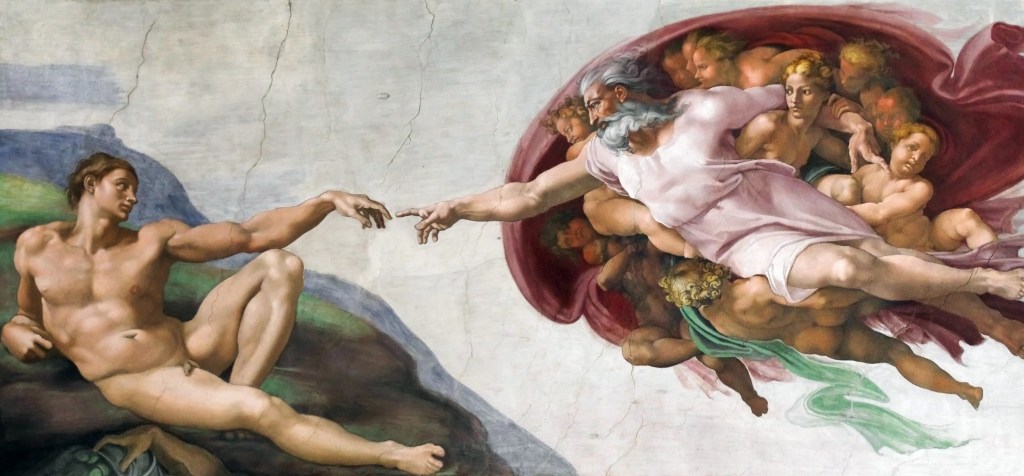
The Surprising Significance of Being Made in God’s Image

The ultimate significance of human beings being made in God’s image is that we are to love (value) our neighbors and even our enemies.

ROME, ITALY – MARCH 08: Michelangelo’s masterpiece: The Creation of Adam in Sistine Chapel

What does it mean that human beings are made in God’s image? What does it mean that God commands us not to take His name in vain? New answers to these interrelated themes might surprise you.

Carmen Imes wrote a book called Bearing God’s Name that explains for common folk like me the conclusions she developed in her doctoral dissertation. She just published a new book called Being God’s Image, a kind of prequel to the first book. I recently listened to her talk about these things with Skye Jathani on the Holy Post podcast that inspires my writing today. (The conversation starts at 54:20 if you want to hear it from her mouth.)

The commandment not to take God’s name in vain is where the conversation started, but being made in God’s image is actually the prequel to that “story”, and the significance of bearing God’s name (in contrast to being God’s image) is central to the story.

I am going to start with the backstory (in the beginning), what it means to be made in God’s image, and what it means to bear God’s name before opening a new understanding of the commandment not to take God’s name in vain, according to Carmen Imes.

Imes says that some theories entertained by the church misperceive the significance of the revelation in Genesis to people in that culture filled with false idols. They miss the mark and fall short of the reality that is expressed in Genesis.

Imes says, “The majority of the views out there through the centuries attached the image of God to some human capacity or function. That view makes the image of God something we do or are qualified to do by having a certain capacity.”

Some say human rationality is what it means to be made in the image of God. They reason that we are intellectually superior to animals; therefore, rationality is what it means to be made in the image of God.

Others have ascribed being made in the image of God to our social and political ability to govern ourselves. Still others believe our morality and conscience are what distinguish us from the animals as being made in God’s image.

These things certainly distinguish human beings from other creatures created by God, but Imes says these human capacities, true as they are, do not accurately convey what the biblical text actually says. Imes says that assuming the differences between humans and the animals is what being made in the image of God means s just “theological speculation” It is eisegesis – imposing our own thinking on the text – rather than exegesis – extracting the meaning from the text, itself.

Th view that special human capabilities are what it means to be made in the image of God is not true to the biblical text, and it is not justified by the text. Exegesis of the text (pulling the meaning from the text, and not from our conceptions applied to the text) reveals a different view for what it means to be made in God’s image.

Imes says we need to pay closer attention to what the text actually says to determine its meaning. She also reads the text in light of its context, the Ancient Near Eastern culture, to determine more precisely what it means that human beings are made in the image of God.

The backstory begins in Genesis 1:27:


God created mankind in his own image,
    in the image of God he created them;
    male and female he created them.


The Hebrew word translated “image” in this passage is tselem, meaning literally an image. Strong’s Concordance describes the word further as “a phantom, i.e. (figuratively) illusion, resemblance; hence, a representative figure, especially an idol — image, vain shew”. (See BibleHub)

We resemble or are representative of God, though we are not (yet) true representations of God. Given the Hebrew meaning of the word, tselem (with overtones of “phantomlikeness” and resemblance – implying something less than the real thing), perhaps we are merely phantom resemblances at this time.

I would note that we may only have the potentiality of being truly like God. In the New Testament, we find that we must be born again to become God’s progeny, His children, his ambassadors (representatives) and to be found “in” Christ, who alone (at this time) is the exact representation of God in the flesh (not merely a resemblance).

Perhaps, we only have the potentiality to be exactly like God, but that doesn’t discount the fact that we are created in His image – as Adam and Eve were created in His image. This understanding sheds new light, perhaps, on the first commandment: “Thou shalt have no other gods before me”; and it sheds new light on the second commandment: “Thou shalt not make unto thee any graven image.”

I am going beyond, now, what Carmen Imes says in the conversation, though I think it follows from her observations. I will also get to the surprising nuance she finds in reading Genesis 1:26-27* that sets this text apart in the Ancient Near Eastern culture.

Continue reading “The Surprising Significance of Being Made in God’s Image”

God Speaks to Each of Us in Our Own Love Language

The poignance of human longing, existential angst, and the intimacy of God with us

Photo credit to Carolyn Weber: author, speaker and professor

Carolyn Weber has always been an academic, but she is no longer an atheist. She has a B.A. Hon. from Huron College at Western University, Canada and a M.Phil. and D.Phil. from Oxford University, England. She has taught at faculty at Oxford University, Seattle University, University of San Francisco, Westmont College, Brescia University College and Heritage College and Seminary, and she was the first female dean of St. Peter’s College, Oxford.

My inspiration today comes from an interview of Carolyn Weber by Jana Harman on the Side B Stories podcast. You can listen to the hour long interview in episode 4, Finding God at Oxford – Carolyn Weber’s story. She turned her personal story into a book, “Surprised by Oxford”, which is being made into a screenplay staring Phyllis Logan from Downton Abbey and Mark Williams from the Harry Potter movies.

In the interview, Carolyn Weber shared that she was drawn to the romantic writers of the 17th and 18th centuries in her college years because they wrote about infinite longing. Carolyn long recognized a similar longing in her own life, and they romantic writers resonated with that longing in her. 

Carolyn was raised in a non-religious home. She had no experience with religion, and she was not familiar with the detail of Christianity or the Bible.

She recalls that she knew nothing of the Bible until she read the Bible for the first time in a college class. As an undergraduate literature major, her first impressions of the Bible included included recognition of how well the story of the Bible holds together in intricate detail, though it was written over many centuries by almost four dozen different writers.

These elements of Carolyn Weber’s story remind me of my own story. I was raised in a religious home. We were Catholic, and we went to church every Sunday, but I had never read the Bible. I knew next to nothing about the Bible before college, and church seemed to have no relevance for me.

I was also an English Literature major. I also read the Bible for the first time in a college class. I wasn’t particularly drawn to the romantic writers, but I did notice the theme of longing, and it intrigued me. (You can read my story here.) Our first impressions of the Bible were also very similar.

I recognize that my resonance with Carolyn Weber’s story may not translate to every reader (and maybe not to any reader). A statement she made in telling her story, however, may. She said, “God speaks to us in our love languages.”

I can identify with that, perhaps, because my “love language” seems to be so similar to hers. The same things that spoke to her, spoke also to me. I will explain below, but I invite you to consider as you read (or go back to listen to her story) what your love language is and how God has spoken intimately to you in your love language.

Continue reading “God Speaks to Each of Us in Our Own Love Language”

A Strategy for Reversing the Decline of Faith in the United States?

Over two-thirds of today’s immigrants to the United States are Christians

Statue at the Recoleta cemetery in Buenos Aires, Argentina

I read an article posted by the Free Press, A Church Grows in Brooklyn. The article draws a line between immigrants working jobs Americans don’t want and immigrants upholding faith traditions that Americans are abandoning. the author says:

“Over two-thirds of today’s immigrants to the United States are Christians, and prominent religious scholars forecast that immigrants will single-handedly reverse Christianity’s decline in America.”

Yet, a large segment of “the American church” monolith seems to be completely disconnected from this reality. Many American Christians are proudly “anti-immigration”. They will say they are in favor of “legal” immigration, but they would turn away hundreds of thousands of refugees and “illegals” – as if grace played no part in the salvation of immigrants.

If the American Church is positioned against generous immigration, we have not only forgotten our American heritage (“give me your huddled masses”); we have forgotten our spiritual roots:

“And you are to love those who are foreigners, for you yourselves were foreigners in Egypt.” (Deut. 10:19)

“‘Cursed is anyone who withholds justice from the foreigner, the fatherless or the widow.’” (Deut. 27:19)

“The alien who resides with you shall be to you as the citizen among you; you shall love the alien as yourself, for you were aliens in the land of Egypt: I am the Lord your God.” (Lev. 19:34)

“You shall not oppress a stranger, since you yourselves know the feelings of a stranger, for you also were strangers in the land of Egypt.” Ex. 23:9)

“For if you truly amend your ways and your doings, if you truly act justly one with another, if you do not oppress the alien, the orphan, and the widow, or shed innocent blood in this place, and if you do not go after other gods to your own hurt, then I will dwell with you in this place, in the land that I gave of old to your ancestors forever and ever.” (Jer. 7:5-7)

“You shall allot it as an inheritance for yourselves and for the aliens who reside among you and have begotten children among you. They shall be to you as citizens of Israel; with you they shall be allotted an inheritance among the tribes of Israel.” (Ezek. 47:22)

“Thus says the Lord of hosts: Render true judgments, show kindness and mercy to one another; do not oppress the widow, the orphan, the alien, or the poor….” (Zech. 7:9-10)

“’Then I will draw near to you for judgment; and I will be a swift witness against … those who turn aside the alien and do not fear Me,’ says the Lord of hosts.” (Mal. 3:5)

These are just a few of the verses that weave like a rich gold thread through the tapestry of Scripture. This thread began with the first step Adam and Eve took out of the Garden of Eden – banished from their home with God and doomed to walk the earth as aliens and strangers. The entire sweep of the Bible is about God’s plan to bring them home – to welcome the stranger back.

When we are home in this world, we are absent from God. when we become born again, we are no longer “of this world.” (John 15:19; 17:16) Our citizenship is in heaven. (Phil. 3:20) We have become strangers and exiles on earth like the great men and women of faith. (Heb. 11:13-16) If, indeed, we are of the faith.

Hebrews 11 urges us to model ourselves after the great people of faith. Those people did not call this earth their home because they were waiting for a city, the architect and maker of which is God. Peter says that we are (or should be) aliens and strangers in this world. (1 Peter 2:11) If we truly believe that, why do we resist sharing our temporary country with real aliens and strangers streaming in from the mission filed God has commissioned us to go into?

Continue reading “A Strategy for Reversing the Decline of Faith in the United States?”

The Elijah Complex and the Whisper of God

We may have an Elijah complex when we think we are the only ones following God.

BRESCIA, ITALY – MAY 23, 2016: The painting Prophet Elijah Receiving Bread and Water from an Angel at Chiesa di San Giovanni Evangelista by Alessandro Bonvicino-Moretto

Do you identify with Elijah? Do you squirm thinking about his zeal? Do you feel guilty about not sharing the Gospel with your neighbor? Then, maybe a new look at Elijah may resonate with you.

We know Elijah for his zeal for Yahweh in a time when the culture and national leaders were rebelling against God. Sound familiar?

Elijah is famous for challenging the Israelite king, Ahab, and his rebellious wife, Jezebel, and all of the prophets of Baal and Asherah that were commissioned by that royal pair. He felt like he was the only one standing for God in a world that wanted him to shut up and go away.

Some of us may feel like Elijah, while many others of us may feel guilty that we are not like Elijah. He is a pillar of the faith, right?

Yes, of course, he is! As I read through these passages, though, I am seeing something I didn’t catch before. For one thing, I get the feeling that Elijah probably wasn’t a fun guy to be around.

He certainly didn’t go along with the crowd. He wasn’t known for his diplomatic tact. (To put it mildly) He said what was on his mind, and he didn’t pull any punches.

These characteristics of Elijah begin to give us an idea of what he is like. They also point toward a more human side of Elijah that I hadn’t noticed before, which is why I want to dive deeper into the story of Elijah and the prophets of Baal.

Elijah is famous for challenging 450 prophets of Baal to an Ancient Near Eastern duel of the gods. It was Elijah against all the prophets of Baal; Yahweh against Baal in a cosmic duel with mortal consequences for the losers.

This is the way Elijah rolled. No holds barred!

Elijah challenged the prophets to sacrifice a bull on an altar without setting fire to it, letting Baal or Yahweh, as the case might be, consume the sacrifice directly. Which one would show up?! The stakes were high. If Yahweh didn’t show, Elijah was toast!!

Elijah offered to let the prophets of Baal go first. (A bit of showmanship?) They cut up the bull; they placed it on the altar; and they did their ritual thing to entice Baal to come out of whatever stone he might live under … but nothing happened.

Elijah taunted them. (He was not a master of subtlety!) He egged them on to shout louder and offered the following “helpful” comments (paraphrased by me):

  • Maybe your god is daydreaming”;
  • Maybe he fell asleep and you need to shout louder; and
  • Maybe he is relieving himself, and he will be back in a minute!

Elijah’s taunting wound those prophets up into a religious frenzy. They cut themselves with knives, and swords, and spears until they bled everywhere … but still nothing happened.

When their time was up, all eyes turned to Elijah.

I imagine the anticipation in the crowd rivaled a Las Vegas audience watching Siegfried and Roy walk a full grown tiger onto the stage. Elijah let the expectation mount as he built his own altar. The atmosphere was electric. The crowd was undoubtedly hoping for more action than the prophets of Baal gave them.

I can imagine the smug look on Elijah’s face and the brash confidence in his demeaner as he instructed volunteers from the crowd to pour water on the offering. Elijah was nothing if not dramatic!


Lest we forget, they were in the middle of a long draught. Elijah didn’t just have them sprinkle water. Three times Elijah instructed his helpers to fill up the jars, and pour them out on the bull, the wood, and the altar until it was soaked and water pooled in the trench around it.

Anticipation hung like a funnel cloud overhead as darkness loomed over the mountaintop stage. The expectant crowd, the exhausted prophets recovering from their failed ordeal, and Ahab sat poised on the edge of their proverbial seats.

In the flash of a moment, fire came down from heaven. Like a galactic flamethrower, the fire was so fierce it completely consumed the bull, the wood, and the altar itself!

Nothing remained but hot, smoldering ash.

Yahweh showed up as Elijah said he would! Elijah was vindicated!

But that wasn’t enough for him. With freshened zeal fueled by the powerful demonstration of God’s power, Elijah provoked the excited crowd to grab the cowering prophets of Baal and march them down the mountain where they were slaughtered in the valley below.

Elijah was at the height of his prophetic career. Elijah may have thought, “Not even Moses presided over such a powerful demonstration of God’s awesome power!” Elijah was on top of the world!


It’s hard to imagine greater faith and boldness or a more decisive display of God’s power. Perhaps, the only thing more amazing than all of that was Jezebel’s response:

She was not… impressed… at all.

When Ahab raced to deliver the news to Jezebel, his haughty audacious wife didn’t even hesitate. She ordered death to Elijah with ice in her veins.

Elijah must have been thinking, “What’s a man of God got to do?!” (Never mind that the crowd seemed properly convinced.) If his greatest act of faith couldn’t turn the hardened hearts of Ahab and Jezebel, nothing would! He had done his absolute best, and it wasn’t enough.

Have you ever felt that way? Have you ever felt like nothing you do, or can do, makes any difference? Have you ever come to the place that you have done your best, and your best wasn’t good enough? Have you ever felt like you are the only one who stands for God?

Have you ever gotten mad at God for not defending you for standing up for Him? Then, read on.

Continue reading “The Elijah Complex and the Whisper of God”

The Importance of Asking Tough Questions and Candidly Seeking Answers

Don’t settle for blind faith. Question and seek answers.


Today, I want to do something a little bit unusual. I find my inspiration in a question posed in a Facebook group, Seekers with Questions about Christianity. You will need to become a member if you want to find the post and the response thread that follows it. This is the question:

Hi can someone please help me understand this: If God doesn’t like the idea of concubines (multiple secondary wives), then why didn’t he tell his holy prophets so? Why did He give rights and laws regarding concubines instead of tell his prophets not to have concubines? He made so many rules and instructions so that people know how to please Him and do his will – so why not also add that he doesn’t like men having concubines? And if someone wants to answer that its a matter of embracing the culture of the time, God never changes, and we are never to conform to the world around us; we are supposed to be different to the world and cultures around us.

It’s a really good question! We should be asking questions like these. The culture in some Christian circles and churches discourages people from asking tough questions. Or worse: people are actually told not to ask these kinds of questions!

I believe God expects us to ask the tough questions, and He invites us to search out the answers. I also don’t believe doubt is the opposite of faith. A lack of trust in God is more like the opposite to faith. Our doubts often drive us to seek answers and to seek God who has those answers.

In some ways, I believe our certainty can be antithetical to faith. When we think we know all the answers, we can begin to trust in our own understanding more than we trust in God. We run the risk of a shallow, intellectual faith that is wooden and stiff when we value certainty over truth.

If we reach a point where questions are no longer important, we are likely to stagnate and grow spiritually cold and distant from the world around us that has questions. If we stop asking questions, we stop growing in our knowledge of God and stop maturing in our walk with Jesus.

Thus, I think we need to encourage questions, allow ample space for questions, and take them seriously. In that vein, I want to commend Daniel Mann, who is the administrator (or one of the administrators) of the Facebook group in which the question above was posed. He is also a fellow blogger. (See Mann’s Word)

Continue reading “The Importance of Asking Tough Questions and Candidly Seeking Answers”