The Curious, Mysterious Nature of the Kingdom of God, Its Effects in the World, and Our Place In It

The coming of the kingdom of God is not something that can be observed


“Once, on being asked by the Pharisees when the kingdom of God would come, Jesus replied, ‘The coming of the kingdom of God is not something that can be observed, nor will people say, ‘Here it is,’ or ‘There it is,’ because the kingdom of God is in your midst.” 

Luke‬ ‭17:20‭-‬21‬ ‭NIV‬

I have been continually impressed by the countercultural and otherworldly nature of the kingdom of God. In response to the question by the Pharisees, Jesus plainly said that the coming of the kingdom of God is nothing we can observe, but it is in our midst.

As I think about his response, I am reminded that the Holy Spirit is like that as well. The Spirit is like the wind: we can’t see it, but we can see the effects of the wind.

The wind, of course, is a bit less of a mystery than the Holy Spirit or the kingdom of God. We can measure the wind, and we can (somewhat) predict the direction and velocity of the wind. (However, imprecise our predictions may be!)

The wind is a natural phenomenon driven by natural forces (no matter how difficult it may be to predict those forces). Natural forces are different than the forces of personal agency. The Holy Spirit (and the kingdom of God) are forces driven by agency – God’s agency. The Holy Spirit is a Person, and the kingdom of God is, presumably, advanced by God in the “form” of the Holy Spirit (and by the agency of believers as well).

We don’t confuse the wind with other effects in nature, though we might be apt to confuse the effects of the kingdom of God with other effects, such as political, cultural, and other worldview effects.

I suspect that volumes could be written on this!

What are the effects of the kingdom of God? We can’t see the kingdom coming, but I assume we can the see effects of the kingdom of God coming just like we can see the effects of the wind (or the Holy Spirit). It seems that we have some confusion about these things, just as the Pharisees were confused in the 1st Century. However, we do have some guidance from Jesus to help us.

Continue reading “The Curious, Mysterious Nature of the Kingdom of God, Its Effects in the World, and Our Place In It”

What Business Do We Have Judging the World?


The title to this blog article is a question that doesn’t come from me. It comes from Paul, the Apostle. The question is rhetorical, meaning that Paul assumed his audience would know the answer, though he doesn’t leave them guessing. He provides the answer.

His audience was the Corinthian church in the 50’s AD. The larger context in which Paul asked this rhetorical question is also instructive. This is that context in which Paul asks the question:

I wrote to you in my letter not to associate with sexually immoral people— not at all meaning the people of this world who are immoral, or the greedy and swindlers, or idolaters. In that case you would have to leave this world. But now I am writing to you that you must not associate with anyone who claims to be a brother or sister but is sexually immoral or greedy, an idolater or slanderer, a drunkard or swindler. Do not even eat with such people.

1 Corintihans 5:9-11 (emphasis added)

Then Paul asks the question,

What business is it of mine to judge those outside the church? Are you not to judge those inside? God will judge those outside.  

1 Corinthians 5:12 (emphasis added)

I am reminded of this passage today because of a comment posted by someone on Facebook about how we should treat people who seem to be “acting against God.” The poster expressed the opinion that something should be done by Christians about the “open immorality … being accepted in society.”

I don’t want to suggest that biblical morality should not instruct how Christians vote and engage politically in the world, but Paul’s question about judging the world should affect how we interact with the world in politics and other ways. At the same time, we need to know how to model Paul’s instruction not to judge those outside the church.

Christians are often accused of “forcing their religion” or morality on others. Simply voting and engaging politically based on biblical values is not forcing religion or morality on others any more than others voting and engaging politically based on their own values is forcing their views on us. We can vote our consciences without judging.

This is where we may need some nuance, however, as some Christians seem to think they have a biblical obligation or mandate to make the world conform to a biblical morality. I have to admit that I have shared this confusion in my past until I began to take seriously what Paul said to the Corinthians in the passage quoted above.

Judging by Paul’s words, I used to view this exactly backward! I judged the world by biblical morality, but I often gave myself and fellow Christians a pass when it came to strict adherence to righteous behavior. After all, we are saved by our faith and not be works, right? If I mess up, I can confess it and be forgiven – even as I demand that the world acknowledge and follow the law.

As I meditate on Paul’s words, I see that Paul’s instruction aligns with what Jesus said about judging. I think you will see that as I unpack what Paul and Jesus said and try to work out why they said it and what it might mean for us in the way we conduct ourselves in the world.

Continue reading “What Business Do We Have Judging the World?”

The Problem of the Intelligibility of the Universe

The Milky Way

The most incomprehensible thing about the universe is that it is comprehensible.” Albert Einstein

I am intrigued by the stories of peoples’ journeys, especially of their thought journeys. Some are more intriguing than others. The story of Pat Flynn fits squarely into the more intriguing category. (See the Side B Stories Podcast – Episode 78 – Science, Philosophy, and Reality – Pat Flynn’s Story)

Patrick Flynn has an educational background in philosophy. He embraced naturalism at an early age, but he encountered philosophical problems with naturalism when he read people like HL Menken and Frederick Nietzsche. These problems led him to seek answers that might provide a more coherent view of reality.

I am not going to try to summarize his whole story. You can listen to him describe his thought journey at the link in the first paragraph. I just want to focus on one aspect of his journey from atheism to theism.

Flynn’s journey took him from atheism to theism through the medium of philosophy. This process was intellectual for him, and not experiential. He became convinced of theism, first, before he even told his spouse, because he knew she was not particularly fond of religion.

He didn’t dive into Christianity after he became convinced of theism. He explored Eastern religions, first, perhaps because he had a good friend who was Indian. When the Eastern religions didn’t solve the philosophical problems posed by naturalism, he reluctantly began to explore Christianity.

One of the big issues Flynn had with atheism was the lack of explanation for the fact the universe is intelligible. Digging further, Patrick Flynn found that the fundamental, core commitments of science fit much better with theism than with atheism.

Continue reading “The Problem of the Intelligibility of the Universe”

Comments on Why God Became Incarnate and Died for Our Sins

Daniel Mann does a good job of explaining Why Christ, as God Incarnate, Had to Die for Our Sins. In reading his explanation, my mind goes to statements like God’s “transcendent love” and “total abhorrence for sin”, God’s “righteousness” and “divine forbearance” for sin, and the price that had to be paid “to satisfy God’s righteous character”.

Daniel describes his own reaction to these concepts formerly, as a non-Christian. He felt God was a “deceiving sadist” until one day he realized that Jesus was God incarnate, that God did not merely sacrifice a created being – God sacrificed Himself in human form!


Indeed, that is the central point of Christian belief, which is described beautifully and poignantly in Paul’s letter to the Philippians (2:5-8):

In your relationships with one another, have the same mindset as Christ Jesus:

Who, being in very nature [form of] God,
    did not consider equality with God something to be used to his own advantage;
rather, he made himself nothing
    by taking the very nature [form] of a servant,
    being made in human likeness.
And being found in appearance as a man,
    he humbled himself
    by becoming obedient to death—
        even death on a cross!

These things would be small consolation, also, if not for the victory on the other side of the cross (Phil. 2:9-11)

Therefore God exalted him to the highest place
    and gave him the name that is above every name,
that at the name of Jesus every knee should bow,
    in heaven and on earth and under the earth,
and every tongue acknowledge that Jesus Christ is Lord,
    to the glory of God the Father.

That Jesus was fully man and fully God incarnated into a man is key to the understanding of Christianity. That God is three “persons” in one is also key, as it provides some explanation how God can incarnate Himself into the form of a man and die (in human flesh), though God remains self-existent and eternal, the Creator (and not a created being).

Not that there is no mystery in this. I concede this is hard for creatures who are limited dimensionally to wrap our heads around these ideas.

Finally, it explains how (and why) death to Jesus in the flesh had no power over him. As God incarnate, death “could not hold him”. (Acts 2:24)

But, I am not writing to clarify these aspects of Christian doctrine. I want to focus on Daniel Mann’s personal revelation that Jesus was God incarnate, and his death was voluntary – God sacrificing Himself, and not God sacrificing some created being.

This realization made all the difference for him. When he really understood this distinction, he began to see the love of God that was demonstrated in that act of self-sacrifice – something God did not have to to, but He did it for us because He loves us.

Other people, I know, are not convinced. Indeed, if a person understands Jesus to be human only, and not God incarnate, the story makes no sense.

Another stumbling block is God’s “abhorrence for sin” and the need to satiate a “righteous” God. These Christian concepts are foreign territory for many people. Why, if God is so loving, does He demand sacrifices for sin?

Continue reading “Comments on Why God Became Incarnate and Died for Our Sins”

What Does It mean that the Kingdom of Heaven Is Subjected to Violence, and Violent People Take It By Force?

Does Jesus authorize violent or forceful behavior in defending Christianity?


I engage in many conversations with people of faith on just about any topic. I remember one conversation (on the topic of guns, I believe) in which a fellow believer cited Mathew 11:12 in support of a Christian defense of gun ownership.


From the days of John the Baptist until now, the kingdom of heaven has been subjected to violence, and violent people have been raiding it.” Matthew 11:12 NIV


My friend also mentioned Jesus turning over tables and instructing his followers to buy swords (Luke 22:36, though he tells them in the same chapter to but them down (Luke 22:49-51); “for all who draw the sword will die by the sword.” (Matthew 26:52)). My friend believes that Jesus was saying that force, and even violence, is ok as long as it is used for a good purpose.

I am reminded of his comments as I read through Matthew 12 in my yearly reading plan. I didn’t follow up on his comment then, but reading this passage in context brings it to mind, and it brings clarity to me at the same time.

Does this passage justify violent or forceful behavior in defending Christianity? That is the question

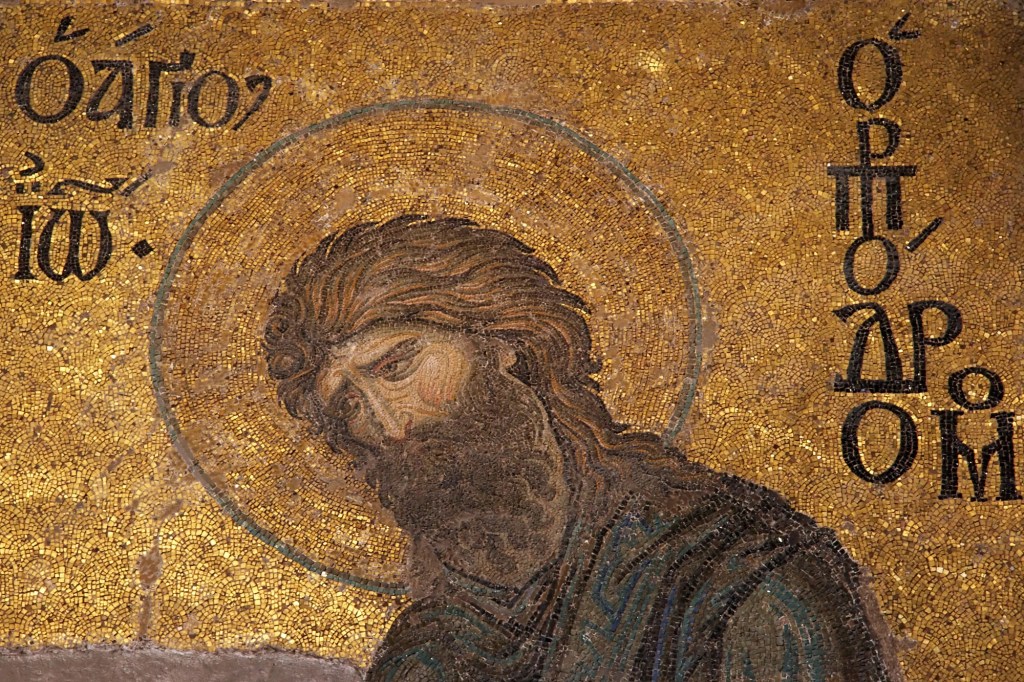
Let’s start with the context. Jesus is preaching in Galilee where John the Baptist has recently been imprisoned for calling out Herod for adultery. John was no shrinking violet. He was bold and forthright, and it landed him behind bars when Herod didn’t take kindly to the criticism.

While in prison, John heard reports of the miraculous things that Jesus was doing. These reports prompted John to send his own followers to ask Jesus, “Are you the one who is to come, or should we expect someone else?” (Matt. 11:3).

I imagine John the Baptist was wrestling with doubt as he languished in prison. In his mind, and in the minds of most Jews at that time, the Messiah was expected to come and take over the world, but it didn’t seem to be happening. The Roman Empire was still very much in charge.

John’s imprisonment must have given him second thoughts about the Messiah stuff. The miraculous signs seemed to mark Jesus as the Messiah, but why was he not wielding the power and the glory of God against the Roman occupation and Roman Empire? John the Baptist may have been hoping that Jesus was just biding his time when he sent for a report.

Jesus sent this message back:


Go back and report to John what you hear and see: The blind receive sight, the lame walk, those who have leprosy are cleansed, the deaf hear, the dead are raised, and the good news is proclaimed to the poor. Blessed is anyone who does not stumble on account of me.” (Matt. 11:4-6) (quoting Isaiah 35:5-6)


Was that the report John was expecting? Jesus didn’t say anything about driving out Rome and restoring King David’s throne. He didn’t pull from the prophetic messages about a conquering messiah. He pulled a different thread from the Prophets.

When John’s followers left, Jesus praised John the Baptist to the disciples. He affirmed that John the Baptist is the one spoken of in Malachi 3:1 – the messenger sent ahead of the Messiah to prepare the way. He affirmed that he is the Messiah, but the response he sent back to John was about healing, cleansing, and proclaiming good news to the poor.

In this context, Jesus said, “the kingdom of heaven has been subjected to violence, and violent people have been raiding it.”

Jesus seems to be confirming only what John was already hearing about the miraculous signs, but John already knew about those things. Therefore, I think Jesus was doing more than confirming what John already knew. Jesus was tying what he was doing to prophetic passages like the language he quoted from Isaiah when he announced his public ministry (Luke 4:18-19):


The Spirit of the Lord is on me,
    because he has anointed me
    to proclaim good news to the poor.
He has sent me to proclaim freedom for the prisoners
    and recovery of sight for the blind,
to set the oppressed free,
     to proclaim the year of the Lord’s favor.”


These words from Isaiah 61:1-2 with overtones from Isaiah 58:6 were read aloud by Jesus in his hometown synagogue in Nazareth before he sat down with all eyes on him and said, “Today this scripture is fulfilled in your hearing.” (Luke 4:21) These are the words Jesus used to to characterize the purpose for which he came.

We know, of course, that Jesus came to die on a cross, but John and his followers didn’t know that and probably could not have imagined it. Jesus’s followers also didn’t get it even when he tried to tell them.

Jesus pulled passages from Isaiah that alluded to the suffering servant motif to affirm his identity. John the Baptist would have immediately recognized the thread Jesus was pulling, but it wasn’t likely what he was expecting or what he was hoping.

First Century Jews were expecting the Messiah to reestablish the Davidic kingdom “here and now”. The Romans were well aware of that Jewish sentiment and had been putting down factions of zealots who took up the sword to attempt to bring it about.

Imagine Pontius Pilate’s confusion that prompted him to ask Jesus, “Are you the king of the Jews? …. Your own nation and the chief priests have delivered you over to me. What have you done?” This is how Jesus responded to Pontius Pilate:


My kingdom is not of this world. If my kingdom were of this world, my servants would have been fighting, that I might not be delivered over to the Jews. But my kingdom is not from the world.” (John 18:36)


With this as the backdrop, let’s turn back to Matthew 12. If we understand the context, and the bigger picture, we see that Jesus is not advocating violence or force: he is doing just the opposite.

Continue reading “What Does It mean that the Kingdom of Heaven Is Subjected to Violence, and Violent People Take It By Force?”