Finding Hope in Death: Lessons from Ecclesiastes, Shakespeare, Pascal, and C.S. Lewis

What the inevitability of death and our response to its inescapable grasp suggests

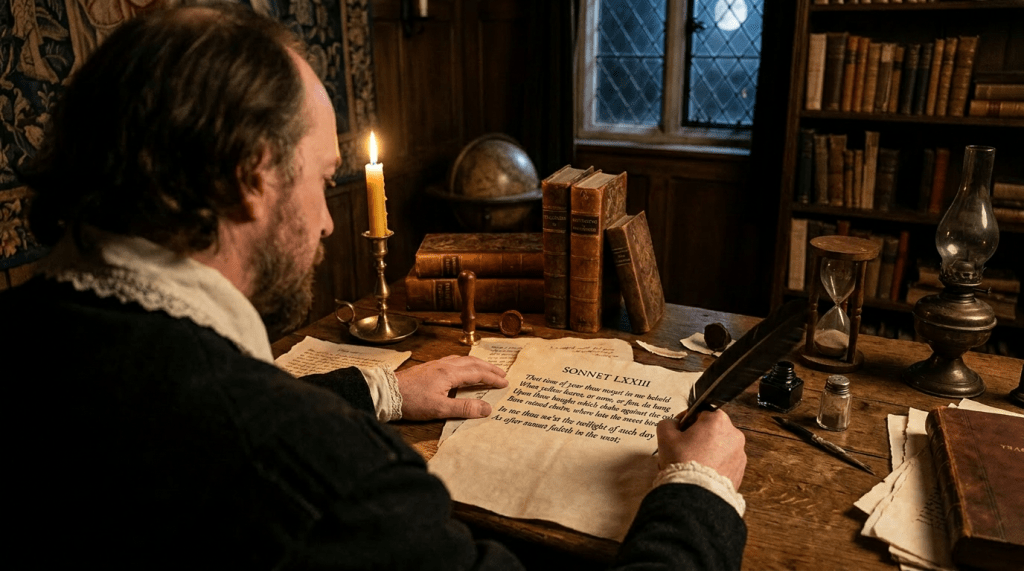
Man in historical attire writing Shakespearean sonnet with quill and candle

I have been listening to Pensées by Blaise Pascal, who has become a favorite philosopher, theologian, and thinker for me. I resonate with his sentiments about reason and intuition in particular. He was brilliant in science, mathematics, and theology – way ahead of his time. He lived during the initial headwind of the Enlightenment. He was a contemporary of René Descartes, yet he was able to remain objective. He wasn’t swept up in the current of the Enlightenment. He managed to remain aloof from it.

I am inspired to think of death today from my reading of Pensées. Death is the great equalizer. It will come to all of us. The longest-lived among human beings may live to be 110. Most of us will not see 100 … or even 90; and many of us will not see 80 or 70 or even 60. Try as we might, we do not control our fate. We will die, and that reality is inescapable.

Pascal talks about the people who distract themselves from the reality of death. I suppose it’s natural to want to ignore something that is as grim as death. We can’t add a day to our lives by worrying and being anxious about it. Yet, anxiety about death is also natural for the same reason – we dread it, but we can’t avoid it.

I imagine that my cat has never thought a day in its life about the fact that it will die, but I have rationality, consciousness, and awareness of myself that my cat does not seem to have, certainly not in the same measure. To the extent that we have that ability, it seems to me that ignoring the reality death that we can certainly grasp is to be something less than human. To ignore the reality of death is, therefore, beneath us. It denies the qualitative difference between us and other animals.

The proverbial deer standing frozen in the headlights of a hurtling vehicle has little idea of the imminent impact those headlights impend. Like the deer we might shut our minds off in the grim headlights of death … but we know better. The deer doesn’t know any better.

Not that we should have any pride in the fact that we have greater capacity than the other animals. It wasn’t anything we did. It simply is what it is.

Thus, to live into our capacity seems only fitting. Our anxiety about death is fitting for creatures with rationality, consciousness, and awareness of themselves.

I was first impressed about this humanly poignant characteristic – preoccupation with death – in college as an English Literature major. Death was the subject of many a novel, sonnet, and other forms of literature. Death is a common theme across the literary ages. The desire to escape the inevitability of death runs strong in creative and artistic minds living into the fullness of what it means to be human.

It was in a class on William Shakespeare, focusing on the sonnets, that the reality of the creative preoccupation about death crept into my own awareness. In that same time period, I must have been reading Ecclesiastes, because I associate Ecclesiastes 3:11 with that time in my life. Indeed, it has become my favorite verse in the Bible:


For God has made everything beautiful in its time, and eternity has been set in the heart of man, but not so that he could see the beginning from the end.”


We do live in a world full of beauty, even if the world is also full of pain, struggle, and anxiety. The contrast between beauty and the ugliness of pain and death does not escape us. Ultimately, these things are painful reminders of our own finitude that we would rather not face.

To put it in biblical fashion, the reality is that we are like a mist. We are like a flower that blooms one day and dies the next. Like the writer of Ecclesiastes said, “Everything is meaningless” in a world like that.

In that sense, we are no better off than the animals. From dust we were born and to dust we will return. We end up in the ground just like they do.

Everything that we accomplish fades into other people’s memories when we die. Most if not all of those memories will long be forgotten in a few generations. The things we accumulate that do not rust or rot while we live will be left to rust or rot for someone else. In more modern, poetic terms, no one tows a Cadillac to the grave.

And yet, the very fact that we wrestle with the poignance of death is something that arouses hope. This was the realization I made in that class on Shakespeare.

Why do we even care? Why does it even enter our mind to be anxious about it? Why aren’t we, like my cat or a deer in the headlights, clueless about it? The fact that we think about it and long for a different reality suggests the possibility of such a reality.

Continue reading “Finding Hope in Death: Lessons from Ecclesiastes, Shakespeare, Pascal, and C.S. Lewis”

God Speaks to Each of Us in Our Own Love Language

The poignance of human longing, existential angst, and the intimacy of God with us

Photo credit to Carolyn Weber: author, speaker and professor

Carolyn Weber has always been an academic, but she is no longer an atheist. She has a B.A. Hon. from Huron College at Western University, Canada and a M.Phil. and D.Phil. from Oxford University, England. She has taught at faculty at Oxford University, Seattle University, University of San Francisco, Westmont College, Brescia University College and Heritage College and Seminary, and she was the first female dean of St. Peter’s College, Oxford.

My inspiration today comes from an interview of Carolyn Weber by Jana Harman on the Side B Stories podcast. You can listen to the hour long interview in episode 4, Finding God at Oxford – Carolyn Weber’s story. She turned her personal story into a book, “Surprised by Oxford”, which is being made into a screenplay staring Phyllis Logan from Downton Abbey and Mark Williams from the Harry Potter movies.

In the interview, Carolyn Weber shared that she was drawn to the romantic writers of the 17th and 18th centuries in her college years because they wrote about infinite longing. Carolyn long recognized a similar longing in her own life, and they romantic writers resonated with that longing in her. 

Carolyn was raised in a non-religious home. She had no experience with religion, and she was not familiar with the detail of Christianity or the Bible.

She recalls that she knew nothing of the Bible until she read the Bible for the first time in a college class. As an undergraduate literature major, her first impressions of the Bible included included recognition of how well the story of the Bible holds together in intricate detail, though it was written over many centuries by almost four dozen different writers.

These elements of Carolyn Weber’s story remind me of my own story. I was raised in a religious home. We were Catholic, and we went to church every Sunday, but I had never read the Bible. I knew next to nothing about the Bible before college, and church seemed to have no relevance for me.

I was also an English Literature major. I also read the Bible for the first time in a college class. I wasn’t particularly drawn to the romantic writers, but I did notice the theme of longing, and it intrigued me. (You can read my story here.) Our first impressions of the Bible were also very similar.

I recognize that my resonance with Carolyn Weber’s story may not translate to every reader (and maybe not to any reader). A statement she made in telling her story, however, may. She said, “God speaks to us in our love languages.”

I can identify with that, perhaps, because my “love language” seems to be so similar to hers. The same things that spoke to her, spoke also to me. I will explain below, but I invite you to consider as you read (or go back to listen to her story) what your love language is and how God has spoken intimately to you in your love language.

Continue reading “God Speaks to Each of Us in Our Own Love Language”

Musings on Shakespeare and One Less God

 (c) Can Stock Photo

(c) Can Stock Photo

Stephen F. Roberts famously said that we are all atheists, he just believes in one less God (or less gods) than others. It is a rather clever statement that many self-described atheists or agnostics have repeated, but it’s more kitsch than substance.

Atheism could be defined as belief in no God, but atheists often object to that because they don’t perceive themselves, or don’t want to perceive themselves, as believing or having faith in anything. That’s absurd, of course. We all believe in something – even if we only believe in the material world and our ability as humans to comprehend it. Continue reading “Musings on Shakespeare and One Less God”

Revisiting King Henry VIII

Henry VIII King of England
Depositphotos Image ID: 5598102 Copyright: georgios

I recently saw Shakespeare’s King Henry VIII at the Chicago Shakespeare Theater. The play, Shakespeare’s last one performed at the Globe Theater approximately 400 years ago, was very well done. The story line is not as compelling as most of Shakespeare’s works, but the interrelationship of church and state theme struck a chord with me, albeit a discordant one.

King Henry the VIII was born into aristocracy. Young Henry was appointed Constable of Dover Castle at age two, Earl Marshal of England and Lord Lieutenant of Ireland at age three, inducted into the Order of the Bath soon after, and a day later he was made the Duke of York. A month or so after that, he was made the Warden of the Scottish Marches. He had the best education available from the best tutors, was fluent in Latin and French and was familiar with Italian.

For all of his privilege, he was not expected to become king. His brother, Arthur, Prince of Wales, was the first born and heir to the throne, but Arthur died only 20 months after marrying Catherine of Aragon (daughter of the King and Queen of Spain). Henry VIII was only 10. (Wikipedia)

Henry became the Duke of Cornwall and assumed other figurehead duties. His father, the King Henry VII, made sure young Henry was strictly supervised, did not appear in public and was insulated from real authority. Henry VII quickly made a treaty with the King of Spain that included the marriage of his daughter, Catherine, to young Henry – yes the widow of recently deceased brother Arthur. (Wikipedia)

From this point begins a history of manipulation, abuse of power, shameless excess and rationalizations twisting biblical and religious notions to serve the king’s self-interest. This is a story that parallels the “marriage” of State and Church. The two are intertwined in an adulterous affair of blasphemous indiscretions.

Continue reading “Revisiting King Henry VIII”