The Kingdom of God is like an Autostereogram

Autostereograms and the inability to see the image within the image remind me of the teaching of Jesus on the kingdom of God


If Jesus was walking the earth today, as he did in the 1st Century, he might have said, “the kingdom of God is like an autostereogram.” Until recently, I didn’t know what an autostereogram is, and I am pretty sure they weren’t invented yet in the 1st Century.

The image above is an autostereogram. It appears like a repeating, two-dimensional, abstract design, but it “hides” a three-dimensional image. It isn’t really hidden, but we must “look beyond” the two dimensional image to see it. Can you see the three-dimensional image? (Look to the end for help.)

Our eyes don’t naturally pick up on the three-dimensional object “hidden” in the abstract image. We have to “strain” to see it, though the image is right there in “plain sight”. In truth, straining isn’t the right way to see it. Relaxing is a better description of the “technique” for deciphering the 3D image the lies “behind” the 2D image.

I usually have to stare and stare at an autostereogram to see the three-dimensional object, and sometimes I give up impatiently. When I finally do see it, the image emerges. More aptly, it pops, out at me!

Some people who have eye conditions that inhibit their ability to see the three-dimensional images. If you can’t see them, you might be one of those people. (Or you might just be impatient, like I am sometimes.)

This web page on autostereograms provides the following instruction:

  1. Concentrate at a point in the middle of the 2D picture. Try not to get distracted by looking around the picture.
  2. Let your eyes relax and look through the picture rather than at it. You want to look at a point behind the picture. You will notice that the picture will go slightly out of focus. This is normal, and in fact, this is what you want to happen. For beginners, a useful way to start would be to look at pictures that have been framed. You can then learn to look beyond the picture by using your reflection as a guide.
  3. Once you notice the 3D image, it gets easier. Try to resist the temptation to refocus onto the 2D picture because you will lose the 3D picture if you do that.

People who have never been able to perceive 3D shapes hidden in an autostereogram find it hard to understand remarks such as, “the 3D image will just pop out of the background, after you stare at the picture long enough”, or “3D objects will just emerge from the background”. Until you see it, you can’t imagine what it is like.

A skeptic who can’t see the 3D image might be tempted to write it off as an illusion or the product of an active imagination. The reality of autostereograms with 3D images embedded into a flat, two-dimensional image, however, is fact. You can even generate your own autostereograms on the Internet.

Autostereograms and the inability to see the image within the image remind me of the teaching of Jesus on the kingdom of God. People who have gone from atheist or agnostic to believer often describe the switch in similar terms. Sy Garte, a highly intellectual bio-chemist by education and profession, described his experience of not being able to understand belief in God this way:

I found myself standing on the shores of a sea of mystery, certain that the waters hid treasures of beauty and goodness, but with no way to see them for myself.

(An excerpt from Sy Garte: Why I Believe in the Resurrection, commenting on his book in Peaceful Science, November 19, 2019) He recalled reading the Gospels when he still subscribed to materialism and atheism. At that point in his life, he read them only “to reinforce my atheistic scorn at the stupidity of Christianity, ” he said.

Back then I was focused on the magic, the contradictions, the naiveté of the ignorant who believed in scientifically impossible events like the resurrection.

Years later, no longer convinced that truth was bounded by the parameters established by materialism and atheism, Sy read the Gospels with an open mind. He “relaxed” his view, and this time, he saw the image within the image:

When I read the Gospels the second time, my mind was open, freed of the ideological certainty of atheism. I still saw the apparent contradictions, but now they appeared as evidence for truth, the kind of differences one would expect in true eyewitness accounts [citation omitted]. I still saw what looked like magic, but now it confirmed for me my new-found conviction that science is not the only pathway to truth. And now I saw the figure of Jesus Christ, and reading His words, I realized that God must have seen me standing on the shore, staring helplessly at the waves. Jesus Christ rose from those waters and held out His hand to me.

Sy Garte uses metaphoric language here. He didn’t actually see Jesus emerge or pop out of the pages like the hidden image in an autostereogram. The metaphor fits, though.

At one point in his life, Sy couldn’t even imagine what it would be like to believe in Jesus. Later, when he had relaxed his embrace of atheism and materialism, Jesus virtually leapt off the pages of the Gospels.

Sy Garte’s experience is far from unique. The lightbulb moment, the dramatic paradigm shift, is common to stories of conversion. The description Jesus gave for conversion, being born again, is beautifully descriptive of the experience many people have had who went from no faith to faith.

I recall one friend of mine who described that she suddenly realized she saw the world differently. As she gazed out over the landscape and told me it was alive in ways she never noticed before. In the most recent article I wrote, I described the conversion of an Afghan Muslim. He said recalled how he saw people differently after his conversion, saying that the difference was that he loved them.

These experiences are similar to suddenly being able to see the image inside the image of an autostereogram. Of course, the experience of “seeing” and understanding God, Jesus and the kingdom of God is much more dramatic, meaningful, and life changing. The autostereogram metaphor also makes some sense of the way Jesus described the kingdom of God.

Continue reading “The Kingdom of God is like an Autostereogram”

A Critique of a Critique of Critical Race Theory: How We Navigate in the World While not of the World

I am borrowing extensively from a fellow blogger today who wrote:

Critical Race Theory (Part 8): My Grand Conclusion! What I’ve Learned in My Reading of CRT and What I Feel the Proper Christian/Gospel Response Should Be

Posted on  by joelando11@yahoo.com

“Earlier this summer, before I decided to take the time to read the three books I have covered in this series on critical race theory, I didn’t feel I really knew enough about it to say anything about it. I had heard a few talking heads on cable news decry it as Marxist and racist in and of itself, but didn’t really know much more than that. After a few people wrote to me and asked me what my view of CRT was and if I’d ever write a few posts on it, though, that is when I decided to read up on it and try to distill what I had learned about it in a short blog series.”

I quote from the 8th blog article in a series written by my blogging friend, Joel Edmond Anderson. He finds much to criticize in CRT, but it comes with some caveats. I believe many of my evangelical brothers and sisters would support his critique, which focuses largely on political, ideological and philosophical points (and, truthfully, not much Scripture, though I know him to be a man of Scripture).

My past concerns about the critics of CRT I echo here: our baseline should be the Word of God, not political, ideological and philosophical standards. If we devolve into non-biblical standards, we loose our saltiness. We lose our distinctiveness as children of God, citizens of the kingdom of God and aliens and strangers in the world.

Because of the unique position of believers in relation to the world – in the world but not of the world – Christians have often staked out claims against injustice, including the abolition movement, while other people ignored the plight of the oppressed. I believe this is (partially) what it means to be salt and light.

Setting captives free was an essential component of the work of Jesus in the world, but it was only a component of his work. Preaching good news to the poor (the first of the things Jesus announced he came to do) is part and parcel of his purpose in the world. (Luke 4:17-20)

Neglect or rejection of the Gospel (the good news) is a chief complaint of critics of the proponents of CRT. Captives are not truly set free without it. Yet, those who would preach the good news cannot ignore the setting of the captives free. Jesus focused on both, and so should we. Thus, I agree with this first caveat of Anderson:

“I think it has to be clearly emphasized that criticism of CRT isn’t a denial of racism in America or a refusal to try to address clear problems in America that stem from our racist past.”

Anderson goes on to state:

Rather, disagreeing with CRT means disagreeing with the claim that the American free market system and constitutional law is inherently racist and that Marxist principles and a Marxist system is what is needed to eradicate racism for good.”

I don’t disagree with him on the point that the American free market system and constitutional law is not inherently racist, or that Marxist principles are a poor substitute for a governmental system that has elevated more people out of poverty and oppression than other system of law in history. At the same time, I am not going to die on that hill. Calvary is where I will take my stand.

The Gospel spreads and the kingdom of God thrives under any system of government, no matter how good or bad, precisely because it is not of this world. The kingdom of God cannot be equated with any system of human government. It transcends them all.

Anderson goes on to criticize CRT, but he comes back to this, which I think we MUST confront, especially in the body of Christ, who came to breach good news and set the oppressed free:

“[T]he reason we even have CRT, and the reason why we have growing calls for Socialism and Marxism, is because, quite frankly, there still is racial healing to be done and there still are issues of racial injustice to be addressed—and too often those instances have been ignored. America has indeed come a long way in healing racial injustices, but America has still nevertheless failed in certain areas—that is undeniable.”

CRT developed as a critique of an American system that has expressly addressed a history of racism with laws that have produced the promised outcomes of equality and fairness and justice for which people have hoped. It developed as a legal tool to address latent racism – racism that lies below the surface and continues on despite laws that prohibit overt racial behavior.

CRT was not proposed as a Marxist ideal designed to achieve Marxist outcomes. It was an attempt to get at pernicious racial disparities that persist despite laws that expressly outlaw it. Thus, I agree with Anderson when he says:

“I believe [CRT proponents] they have a genuine concern for injustice, and they want to address it.”

People are not our enemies. We can’t forget that, even people who advocate systems we don’t believe in. Even if we count them as enemies, Jesus clearly said we should love them. We in the body of Christ need to take that imperative seriously.

We may might fight against principalities and thoughts which hold people captive, but the people who hold them and and who are influenced by them are not (should not be) our enemies. They are the ones for whom Jesus was willing to leave the 99. They are in the field that is ripe unto harvest.

Again, I don’t personally disagree with his assertion:

“The problem is that they honestly think all that is needed is the implementation of a ‘better system’—the Marxist system. But that is simply detached from historical reality. It reflects the naïve wishful thinking of an ideology that has failed miserably, time and time again.”

But these are secondary matters in relation to the kingdom of God, which is not of this world. The Gospel goes forward in communist China and Russia and in theocratic Iran. The Gospel is not deterred by the systems of human government. It thrives despite them. Sometimes it thrives because of them, as people yearn for the eternity that God put in their hearts.

The Kingdom of God is always contrary to the kingdoms of this world, even free market, constitutional, and democratic kingdoms.

I wholeheartedly agree with Anderson when he says:

“CRT certainly highlights the clear racists policies of America’s past, and it sometimes points out clear instances of racial injustice still around today.”

We should not deny these things. Of all people, followers of Jesus, who is the way, the truth and the life, should not ignore the truth of the injustice that survives in our world. Not that we can eradicate injustice in a fallen world. Injustice in a fallen world is inevitable, but we should not be any part of it. We should resist and stand against it.

For this reason, alone, we dare not ignore injustice, even when the majority of the people who seem to be fighting it are advocating systems of government that tend contrary to our political views.

For this reason, therefore, I suggest that we have more in common with fighters of injustice than members of our own political tribe who stand opposed because we serve a God whose throne is built on a foundation of justice and righteousness.

The nuance of that awkward position may seem difficult to navigate, but we should be accustomed to awkward positions – being in the world, but not of the world. God’s thoughts are not our thoughts, and His ways ore not our ways. We can trust Him to lead us through it.

Knowing Our Ultimate Destination, How Should Children of God Live in a Modern World that Is Foreign to Us?

We are part of a great multitude from every nation, from all tribes and peoples and languages….

Followers of Christ are going to end up as part of “a great multitude that no one could number, from every nation, from all tribes and peoples and languages, standing before the throne and before the Lamb… and crying out with a loud voice, ‘Salvation belongs to our God….’” (Rev.7:9) Knowing how our journey ends as children of God, how should we live in this world?

Jesus introduced the kingdom of God to the world and invited the world to “enter” it. Just as the first century Jews were only a portion of the world to whom Jesus extended that invitation, we in the West and in the United States of America are only a portion of the global world Jesus invites to enter God’s kingdom.

Jesus came, not to condemn, but to save the entire world full of people. We might as well get used to the diversity now.

I think it’s easy for us in the US to miss the fact that the global church today doesn’t look like us at all. The “average” Christian in the world today is a 22-year old brown female. Only 12% of the Christians in the world live in North America (including Canada). Only 37.5% of the Christians in the world live in the “west”.

It’s a human tendency to separate from and even to demonize things that are foreign to us. It’s also a human tendency to embrace things that are familiar to us, even to our detriment. Jesus calls us to separate from the world, which is familiar to us, and to embrace God’s kingdom, which is foreign to us in our “flesh” (as Paul calls it).

Jesus calls us to reject the sin that is familiar to us in exchange for His righteousness that is foreign to us. Righteousness is not of us or from us; righteousness is of God and from God.

Thus, Christians are uniquely called to be different from the rest of the world that embraces the familiar (both things of the world, generally, and specific aspects of this worldly specifically, such as gender, race, nationality, etc.). We are called to separate from this world that is familiar to us and to embrace a world that is foreign (the spiritual realm into which we must be born again).

This model of Christian living is demonstrated by Paul and the disciples in carrying out the Great Commission. Paul said that he became all things to all people that he might win some.

Paul quoted pagan poets and philosophers in his address on Mars Hill. (Acts 17) That means he read them and understood them. Thus, he was able to quote them appropriately and use those references that people knew to point them to God. This is because Paul embraced the fact that he was in the world, though he was not of the world.

This is what is means to carry out the Great Commission – to “go into all the world” making disciples. In the case of those disciples, God “encouraged” them with local persecution to scatter to Judea and and beyond. (We don’t always embrace what is foreign and unfamiliar to us willingly!)

We have the same command and challenge in our modern world. We don’t do these things easily or willingly. it takes us way beyond our comfort levels that are defined by what we know and what is familiar to us. When we take up our crosses and follow Jesus, he takes us into foreign territory!

One example of foreign territory is the modern worldview informed by Critical Theory. CRT informs the world on issues of racial injustice. As members of a kingdom comprised of every nation, tribe and tongue, we need to be able to speak into issues of racial injustice, and not just stand aloof.

Continue reading “Knowing Our Ultimate Destination, How Should Children of God Live in a Modern World that Is Foreign to Us?”

How Should Christians Act in Times Like These?

If we aren’t responding to current events in ways that display love and the fruits of the Spirit, we are “doing it wrong”

Tyler Merbler from USA, CC BY 2.0 https://creativecommons.org/licenses/by/2.0, via Wikimedia Commons

The events that are unfolding in the United States are troubling from many angles. Many Christians pinned their immediate and long term hopes on Donald Trump. With Biden as President, the fight against the killing of the unborn has been dealt a significant blow.

But there are many other problems. The racial divide, polarization, political fringe groups, extreme rhetoric, threats of violence, conspiracy theories, fake news, increasing control of popular speech by private monopolies of information, an abandonment of all semblance of non-bias by media, our ability to choose our own tailored news, hatred for people who don’t think like us, an unwillingness to show respect, listen and engage in real dialogue – these are things that are deeply troubling in “the land of the free and the home of the brave”.

To my brothers and sisters in Christ, Jesus said we would have tribulation in this world. He didn’t tell us to take up arms and fight it. He said we should follow him, spread the Gospel and make disciples.

His kingdom is not of this world. Jesus didn’t come to empower the Zealots, but to turn them into self-sacrificing servants of God and His kingdom – spreading the Gospel and making disciples.

Islam spreads by the sword. The Gospel spreads by people who wash others’ feet, turn the other cheek and love God, neighbors and even enemies. The Christian wields not a political flag, but a cross that he carries on his own back.

If we are going to fight for the mission of Jesus, our fight should be “to proclaim good news to the poor… to proclaim liberty to the captives and recovering of sight to the blind, to set at liberty those who are oppressed, to proclaim the year of the Lord’s favor”. (Luke 4:18-19) This was how Jesus described his own purpose on the day when he stood up in the temple and announced his ministry.

Should we not follow him?

Continue reading “How Should Christians Act in Times Like These?”

Heavenly Citizens In These Modern Times

What deserves our ultimate allegiance?

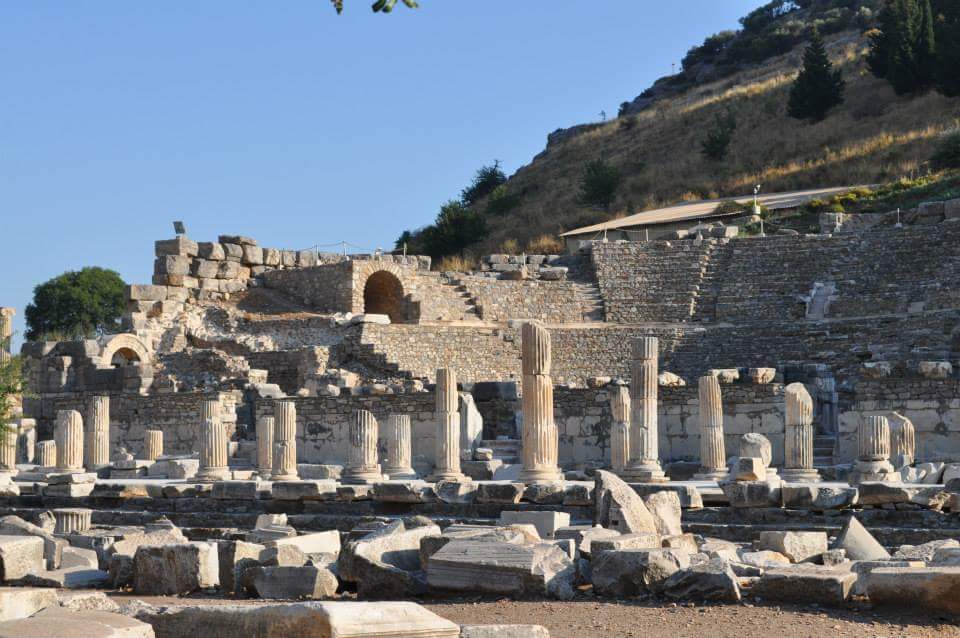
City Hall at Ephesus by Brooke Miller

Peter and Paul, the pillars of the Church, were clear that the only citizenship that counts is our citizenship in heaven. (Phil. 3:20) W are only “sojourners and exiles” in this world. (1 Peter 2:11)

Paul submitted to earthly authorities as though they had been established by God. (Rom. 13:1) He submitted to lashing by Jewish authorities five times! He appealed to his Roman citizenship, but, he clearly saw himself not as a citizen of this world. He was a citizen of the kingdom of heaven that is to come.

He used his Roman citizenship to gain an audience for the gospel among the Romans, to be an ambassador for Christ as he spoke to people in the public squares. He used his credentials as a Hebrew scholar to gain an audience for the Gospel in the synagogues.

Paul submitted to the processes and protocols of Roman and Jewish authorities. He recognized their earthly authority over him. He appealed to that same authority, not for his own advantage, but for the purpose of advancing the kingdom of God.

When we get involved in politics in the 21st century, do we submit to the authorities established by God as Paul did? Paul boasted of his lashings. Paul used his Roman citizenship, not to get out of prison, but to get to Rome to support the followers of Christ there.

Do we count ourselves, first, as citizens of heaven? Paul longed to be with Christ. He used his time on this earth to advance the kingdom of God while he longed for the day when he would put off his perishable body and put on immortality.

Do we use our earthly citizenship not for our own advantage, but to advance the Kingdom of God? When we fight for tougher laws and tighter borders and the right to walk around without masks, are we fighting for the kingdom of God?

Paul said what needed to be said for the sake of the Gospel, but he accepted the earthly consequences of his focus on heavenly things. Paul lived in an earthly world that was hostile to him and everything that he stood for. He submitted to the world’s authority, but he did it in obedience to the authority of God for the advancement of the Gospel, the good news of the coming of the kingdom of God.

Sometimes, I wonder whether we resist authorities that to advance our earthly objectives and appeal to political power and influence to secure our earthly advantage. I wonder how often we have it all wrong.

What are our priorities? To whom do we owe our ultimate allegiance? What are our ultimate goals? Are we seeking to advance the kingdom of God at all costs, including the cost to ourselves and our own position in the world?

Paul used his station in life as a Jewish scholar and a Roman citizen not for his own benefit, but for the benefit of the kingdom of God, to gain audience in front of people, and to spread the gospel. How do we use our station in life, our political power and religious knowledge? To whose benefit are our actions accumulating?

Are we fighting to protect and preserve our own families, communities and country in this world only to lose sight of our citizenship in heaven? Are we striving to save our lives only to lose our souls?

These are questions, not accusations. God knows the heart. I pose these questions in my own heart as write them.