According to Britannica, Blaise Pascal was a french mathematician, physicist, and philosopher who lived in the 17th century (1623-1662). He died young but he accomplished much. He revolutionized multiple scientific and mathematical fields1.
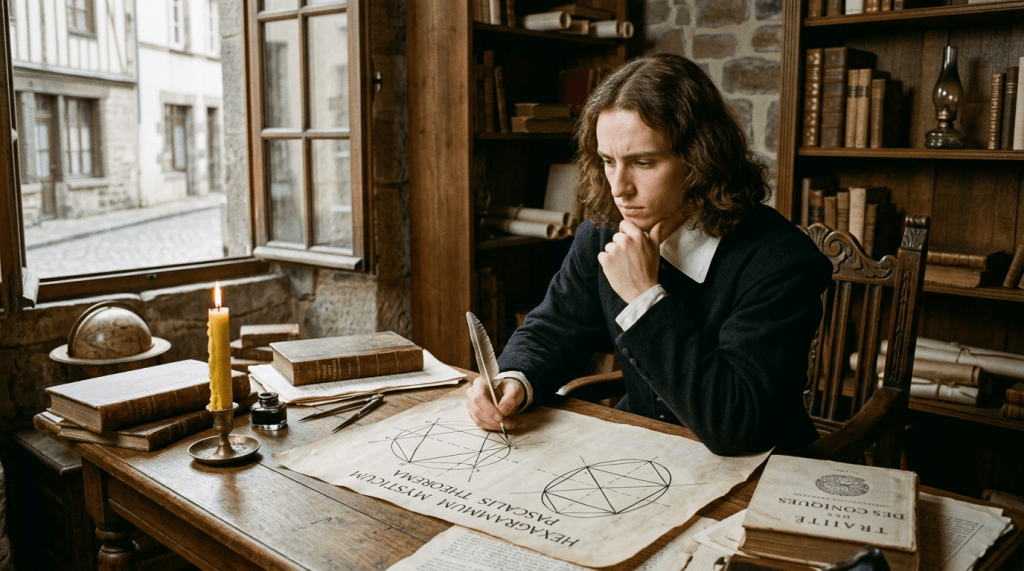
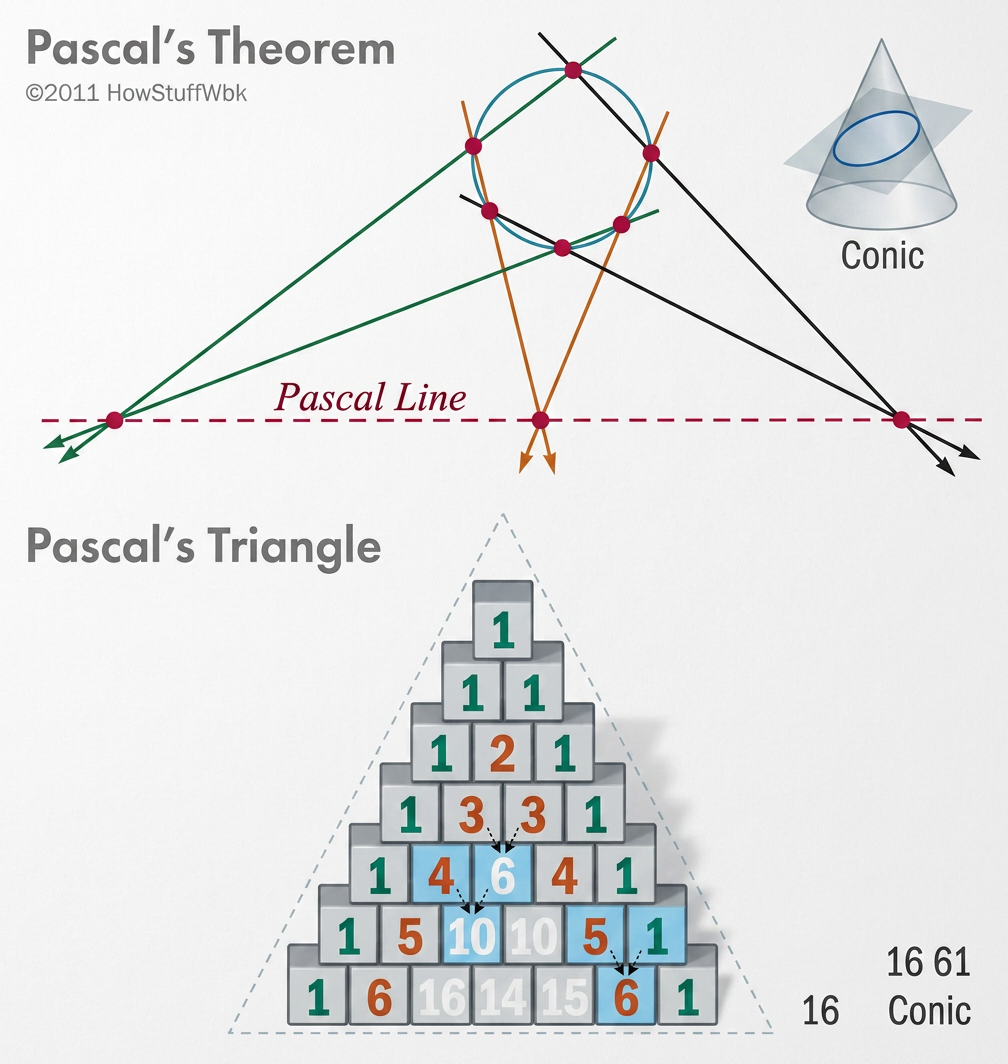
As a teenager, his essay on conic sections became known as Pascal’s Theorem in projective geometry. He invented mechanical calculators. He didn’t invent Pascal’s triangle, a three-sided arrangement of integers such that every number equals the sum of two diagonal numbers above it, but he found novel uses for it, including calculating probabilities. He also laid the groundwork for modern probability theory2.
Pascal did pioneering work in the physical sciences, laying the foundations for hydrodynamics and hydrostatics. Because of this work, a unit of pressure is named after him. Pascal’s Law – that pressure applied to a confined fluid is transmitted undiminished in all directions – underpins modern hydraulics. Experiments with vacuums and fluids led him to develop the syringe and the hydraulic press.
Blaise Pascal is known as much for his philosophy and theology as he is for his mathematics and science. Pascal’s Wager is a brilliant critique of atheism based on probability theory. Many people misunderstood Pascal’s Wager to be an apologetic argument for the existence of God. Pascal believed in God, of course, but he doubted the ability of finite human beings to prove the existence of God with logic and reason.
Pascal maintains that people perceive the existence of God on an intuitive level. He would argue that we use our reason to support or deny that intuition, but the reasoning power of a finite being is insufficient to establish proof.
Pascal did not eschew the reasoning capabilities of human beings. He used his own brilliant mind in the advancement of science, philosophy, mathematics, and theology. Rather, he was mindful of our limitations as finite beings.
All of this is nothing, however, but setting the stage for my own summary of a point Pascal makes in his work Pensees. The fact that Pascal had a brilliant mind is not proof of the existence of God to be inferred from the fact that he believed in God. Pascal would be the first person to deny that kind of proof, yet Pascal had confidence in the existence of God.
Blaise Pascal says that we cannot find happiness within us as the Stoics suggest. Neither can we find happiness outside of ourselves in amusements, nature, or anything else. These things are fleeting – temporal. We can only find true and lasting happiness in God, who is both within us and outside us.
God makes himself available to us in “the inner man” (my words), and He makes himself available to be known in and through the world He created. God is neither part of us nor part of the world. He is not contained in us nor contained in the world. Yet he is present; He is transcendent in everything.
Blaise Pascal talks about the fact that the Bible reveals a God who hides himself. Pascal says we have no obligation to provide proof of such a God, because such a God is revealed as one who hides himself. What proof can we then give? To undertake such proof is to deny such a God, says Pascal. To accept that God is hidden is to affirm Him.
Yet, Pascal spoke about God, as I do. I also have come to the same place Pascal reached in my own thinking, which perhaps is why I resonate with him as much as I do.
He is not completely hidden, of course, to the extent that men like Blaise Pascal – and many other people before him and since him – are convinced that such a God exists. Such a God however cannot be known by proofs that finite beings demand.
As I think about these things, it occurs to me that a hidden God will remain hidden to the man who demands and requires proof. What proof should such a God give? What proof should a finite man require?
The God of the Bible is revealed as not being such a God. Such a God does not reveal himself to a man who makes demands.
Indeed, we make no demands on nature. We seek only to discover, to understand. We don’t make any demands on gravity. We don’t create the natural laws, neither do we control what they should be or how they should prove themselves to us. Such a task would be a fool’s errand, and we would know nothing to undertake it. Why would we then make similar demands of God?
Indeed, if God exists, and I believe He does, we can only undertake to learn who God is on His own terms, just as we learn what nature is on its terms.
Neither should we expect God, who created nature, to be revealed in the same way nature is revealed to us. A God who creates nature is a God who is “other” than nature. Such a God must “stand apart” from nature in order to create it. Such a God must have agency. Such a God must have capacity to determine to create or not to create. Such a God does not exist according to a law like gravity. Such a God may only be known in a way that corresponds to who such a God must be to have created this universe.
Skeptics say that people have created God in their own image. The person of intuition and faith says that we know God because He has created us in His image. He has created us with capacities that are like Him, that allow us to know Him as He is.
Not that we have the same capacities as God. We don’t because we are created beings. We can only have some aspect of God’s capacities and not all of them. We sense, though, that we do have some divine-like aspects because we can think. We can perceive. We can reason. We are self-aware. We understand things like beauty and love, science, philosophy, mathematics, and theology.
These capacities are not the same as the capacity of a thing like gravity. It may be more like a thing like dark matter or dark energy, but only in the sense that we do not understand those things. Yet we know they exist because we see evidence that they exist, and so we may know that God exists because we see evidence that He exists. We know He exists, however, in a way that is different from the way the universe exists – as different as a created thing is from the creator of that thing.
God is hidden to those who set the parameters on where God should be found. God is hidden to those who assume that God is found in the same way that a thing like gravity is found. God is hidden to those who demand that God be known in the way they want to know Him.
As creatures made in the image of God, who have some capacity to know God and be like Him, perhaps, it shouldn’t be surprising that we attempt to be like Him in the way of making such demands. To demand that the world bow down to us, that even God bow down to our demands for proof, is the natural danger of God making a creature in His own image.
And so God hides himself of necessity because such a creature would be a danger to any universe God created. Indeed, if God is true to Himself, He could not allow such a thing. He must, of necessity, be hidden to such a creature so that only a creature who is willing to humble itself, to set aside its desire to be like God, may know Him – a creature who is willing to know God on God’s own terms, and to know God for who He really is and not for what such a creature wishes him to be.
It seems to me it could be no other way: that God would have to hide Himself so that He would be discovered and known by those people willing to know Him on His own terms, to know Him for who He really is and not for who they wish He was – a god they can control.
We cannot anymore demand that our spouse be the person we want them to be and make them to be it, than we can demand that God be the god we want Him to be and make Him dance to the tune of the music we play. It is a fool’s errand even to conceive of it and to entertain it. Such a god that we can manipulate and control would not be the true God.
So the fact that God is hidden is not surprising. The fact that God is hidden is expressly disclosed throughout the Bible. It is not hidden to us that God is a hidden God.
What proof, therefore, should we give of such a God?
Perhaps, the only proof we can give is the hope that such a God can be found, and indeed, that some people have found Him – that He has revealed Himself to people to whom He desires to reveal Himself because they desire to know Him as He truly is.
And so we can offer this proof: that the one who seeks God, the one who seeks to know God as He reveals Himself to be, the one who seeks God with his whole heart and his whole being, yielding all that he wishes to demand to such a God, that such a person can and will know Him, as the Bible says, and that such a God who is approached that way promises to be found.
~~~~~~~~~~~~~~
- Blaise Pascal, Brittanica.com, Lucien Jerphagnon, May 1, 2026 ↩︎
- What were the famous Blaise Pascal inventions? (How Stuff Works, by Nicholas Gerbis) ↩︎