We Prepare for the End Times Simply by Being Faithful and Diligent Daily

Interior of Winchester Cathedral in Hampshire – United Kingdom. Photo taken on 6th of May 2019

In my daily Bible reading today, I read through Luke 17. While I have been reading through the Gospels, the kingdom of God has been the theme that has caught my eye. I have meditated and written on the kingdom of God a few times recently in my latest trip through the Gospels in chronological order.

Today, I read the following:

“When he was asked by the Pharisees when the kingdom of God would come, he answered them, ‘The kingdom of God is not coming with something observable; no one will say, ‘See here!’ or ‘There!’ For you see, the kingdom of God is in your midst.’”

Luke 17:20-22 CSB

The Pharisees asked Jesus about the Kingdom of God. This was their orientation. They looked back on David the king and all the kings of Israel and on a future Messiah who would reestablish the throne of the Davidic Kingdom. They were predisposed to think this way for tens of generations.

The response Jesus gave them wasn’t what they expected or what they hoped for. If Jesus was the Messiah, as some people were claiming, he would certainly reestablish the ancient kingdom in short order. Or so they thought.

What did he mean that the kingdom wasn’t coming with something observable?! What good would a kingdom be that could not be seen? What kind of a kingdom would that be?

At the same time, if they could get past their assumptions driven by their long-awaited expectations and listen to what Jesus was saying, they would focus on the statement: “For you see, the kingdom of God is in your midst!” Present tense!

In many of the parables Jesus spoke about the kingdom, he paints a picture of the kingdom as something like leaven that makes bread rise or a small seed like a mustard seed that grows up into a large bush that can hold many birds.


These parables suggest that the kingdom of God does not come with pomp and circumstance in impressive form. It is more like salt and light, things that we take completely for granted, which we either can’t live without or which enhance or flavor and preserve and sustain us in ways that we might not even appreciate.

“The kingdom of God,” Jesus said, “is in our midst”, but we are apt to miss it if we do not appreciate what he means. Kingdoms have a king, of course, and Jesus is that king, but he is not a king now in the common sense of the word. He has not (yet) established an earthly kingdom, but a “heavenly one”.

Just as God created all that is seen from what is unseen, Jesus has established the kingdom, for now, through what is unseen. He invites us into His kingdom. It’s a gift offered to us. (Eph. 2:8)

The kingdom is nothing we can earn. (Eph. 2:9) We can’t be born into it; we don’t receive it as a privileged offer; we aren’t selected to receive the offer. (John 1:12) The kingdom is offered freely to all who respond by faith and enter into it.

The kingdom of God is experienced through relationship with God, the Father, through the mediation of Jesus, the Son, and the in-dwelling of the Holy Spirit. We live out the kingdom of God in community with other believers and our interactions in the world. If we are true ambassadors of God’s kingdom, people will be attracted to our salt and light – or repelled by it as they who rejected Jesus were repelled.

The kingdom of God is demonstrated on earth now through lives of people who have given themselves over to its king, through the lives of people who follow Jesus, who have taken up their crosses, who have given up their lives, and who have devoted themselves to becoming like their Lord and savior. Where two or more gather to pray in Christ’s name, he is there.

This is the good news of the gospel that Jesus proclaimed to the poor, the freedom he proclaimed to the prisoners, the recovery of sight to the blind and the freedom to the oppressed. The kingdom of God is here and now openly available to all who would submit to Jesus Christ as Lord and King. But, Jesus also spoke of the future.

As Jesus often did with his closest disciples, he shared with them more intimate details that were not shared with the crowds at large:

“Then he told the disciples, ‘The days are coming when you will long to see one of the days of the Son of Man, but you won’t see it. They will say to you, ‘See there!’ or ‘See here!’ Don’t follow or run after them. For as the lightning flashes from horizon to horizon and lights up the sky, so the Son of Man will be in his day. But first it is necessary that he suffer many things and be rejected by this generation.”

Luke 17:22-25

As believers, we can take solace and guidance from these words. The disciples were not prepared for what was to come – the ugly public condemnation, humiliation, and dominance of Roman authority over the Messiah, the king of God’s kingdom. They were not prepared for his suffering and death at the insistence of many of God’s own people.

The darkness of the world threatened to snuff out the light of God’s kingdom in them, and the darkness of today’s world does the same in us. Jesus warned them, and the warning stands for us, that the world would treat them (and us) the same way it treated him.

Jesus knew his followers would mourn for him and long for his return. This is a challenge for all true believers in Jesus Christ. We long for him to be with us, to return to earth. To right the wrongs and wipe away the tears.

We are tempted, therefore, to focus our attention on trying to determine when he will return. We are tempted to speculate and fixate on it. Indeed, people have written books and developed theologies about it. We even have a word for it: eschatology.
Many people over the years have claimed to figure it out and predict when he will return, but Jesus warned against us doing that. Jesus said no one will know the day or hour. Christ will return when he returns. His return will be unmistakable, but first came the business of suffering and dying.


Of course, Jesus suffered and died 2000 years ago now. We are tempted to think that times are different, but I believe Jesus was talking both about the present time and the future. His words to the disciples when he was anticipated his own imminent suffering and death provide us guidance still today.

Continue reading “We Prepare for the End Times Simply by Being Faithful and Diligent Daily”
The Group Affiliations the Apostles Had and What It Might Mean for Us

When I look at American expressions of Christianity today, I wonder if we demonstrate the right way to follow Jesus.

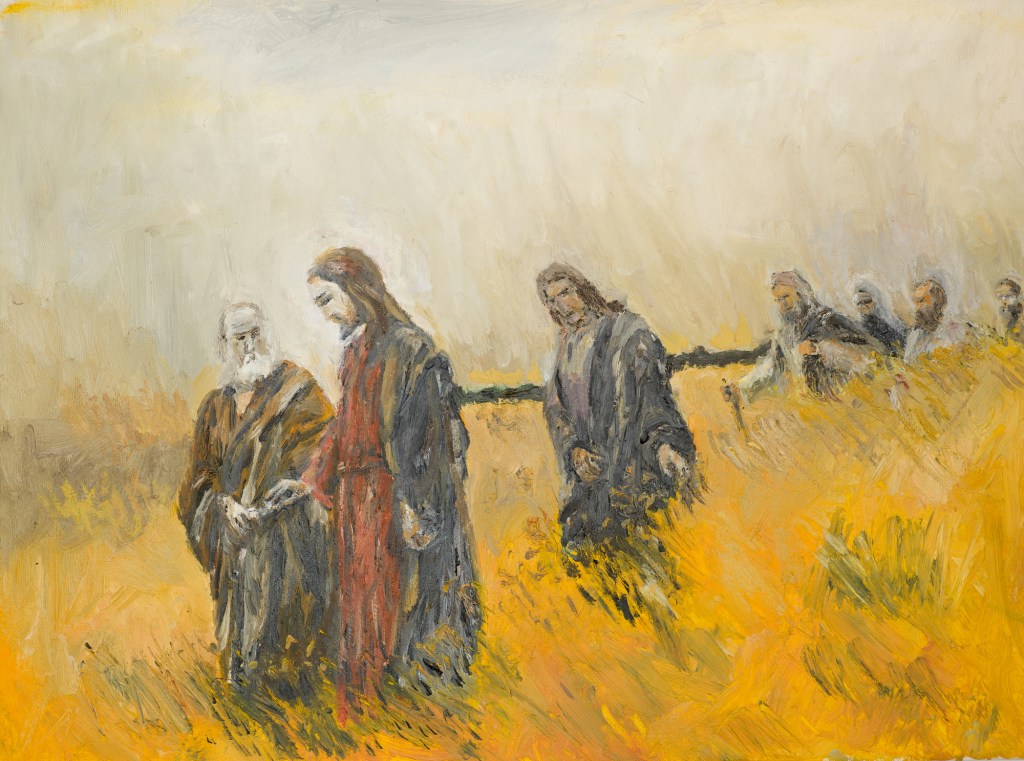
Oil painting illustrating Jesus Christ and his disciples on a meadow

I have spent some time lately considering the various influential groups of people in the time of Jesus and the orientation of those groups toward Jesus. I have wondered why Jesus seemed to pick on the Pharisees more than the other groups, especially since they seemed most aligned with him and had the most in common with him.

As I researched and thought about the various groups of Jewish influencers in the First Century in relation to Jesus, I began to think about the apostles, and their connections to these groups. I am always mining for insight as I read Scripture, and today my mind turns toward the relationship of the twelve apostles to those same groups of First Century, Jewish influencers.

We don’t know much about the background of the twelve disciples, except that most of them were “common” men of generally humble means. One disciple was identified with the Zealots (Simon, the Zealot, also known as Simon the Canaanite). Matthew, the tax collector, might have been Herodian (or may have been viewed as one).

We really don’t know about the group affiliation of the other disciples, at least not from the explicit text. They seem to have been ordinary people with no distinct association with particular groups. They did not seem to be closely associated with any of the five groups Jewish leadership groups in First Century Judea.

Even Simon, who is known as the Zealot, probably left his group behind to follow Jesus. Just as Matthew left behind his livelihood (tax collection) to follow Jesus. Of course, Simon (Peter) and Andrew dropped their fishing nets to follow Jesus, as did the brothers, James and John. It’s no stretch, therefore, to imagine that Simon, the Zealot, would have similarly “dropped” or left behind his affiliation with the Zealots to follow Jesus.

In fact, the theme of leaving behind your group seems to run throughout the teaching and example of Jesus. Jesus said, “[E]veryone who has left houses or brothers or sisters or father or mother or children or lands, for my name’s sake, will receive a hundredfold and will inherit eternal life.” (Matt. 19:29)

He called Peter and Andrew and James and John away from their profession of fishing. He called Matthew, the tax collector, away from his profession of tax collecting. I think it’s fair to assume that Jesus called Simon, the Zealot, away from the Zealots to follow him.

The theme of leaving behind family, livelihood and group identity runs deep in Scripture, all the way back to Abram (as Abraham was originally known) when God called Abram to leave his country, his people, and his father’s household and go to the land God would show him. (Gen. 12:1)

Hebrews 11 commends Abraham for the example of faith demonstrated in responding to God’s call and leaving behind the familiarity of all the things that typically identify people and their place in the world. Abraham and all the people of faith commended in Hebrews 11 demonstrated a kind of faith that made them “aliens and strangers on earth”.

Jesus called the rich young ruler to walk away from his wealth. (Matt. 19:16-30) Jesus told Nicodemus, the Pharisee, that he would have to be born again to see the kingdom of God. (John 3:3) Nicodemus was born into an enviable position in his community and may have winced at the thought of needing to be “born again”.

The kingdom of God is something I have been mulling over for many weeks, and months. It’s a theme I have written about often lately, and it has occupied a prominent place in my meditations lately.

The five main groups of Jewish influencers in the First Century had one thing in common – they were operating on a spectrum of influential relationship to the political structures and religious structures in their world. They were invested and embedded into their positions, and identities, with the people with whom they affiliated – like the partisanship and critical group affiliations we have today.

Along came Jesus, however, and he called people “out of the world”. (John 15:18-19) Jesus called people to leave their lives, and identities, and associations behind to follow him. I believe he is still calling people to the same allegiance today.

We don’t know much about the backgrounds and affiliations of the twelve disciples, perhaps, because they did just that. They left those things behind to follow Jesus. They became known, simply, as disciples of Jesus. They were, simply, Christ followers.

I am interested in these things because of what it means for us. If we would be disciples of Jesus and Christ followers, how do these things translate to our lives in the 21s Century?

Continue reading “The Group Affiliations the Apostles Had and What It Might Mean for Us”

The Temptation of a Kingdom in this World

The kingdoms of this earth cannot be conflated with the Kingdom of God.

Photo Credit to Tim Butterfield

I see so many things in my daily reading of Scripture that are relevant to what is going on in my life, the things that I am talking to people about, and wrestling with myself. Today, is no different, including the following passage from Matthew from a friend who sends daily versus to people on a text list:

“The devil took [Jesus] to the peak of a very high mountain and showed him all the kingdoms of the world and their glory. ‘I will give it all to you,’ he said, ‘if you will kneel down and worship me.’ ‘Get out of here, Satan,’ Jesus told him. ‘For the Scriptures say, ‘You must worship the Lord your God and serve only him.””

Matthew 4:8-10

The relevance of this passage today relates to conversations I have had with people and articles I have written that touch on the popular infamy of so-called “Christian nationalism”. I put the phrase in quotation marks because people mean different things by it. The definition of Christian nationalism aside, I believe that the preoccupation with nationalism by some people who identify as Christians in America is unhealthy and askew.

The American Church has traditionally been very patriotic. Not that patriotism is necessarily wrong, but we have to be careful, as with all things that might compete for our allegiance and devotion to God. I have seen an unhealthy focus on the United States as a new Israel. I also believe we focus too much, sometimes, on protecting our comfortable status quo, when God may be trying to shake things up.

I won’t rehash the many times I have written about the admonition from Jesus to welcome strangers, which would seems like it should be a no-brainer for a Christian nation. The issue of abortion should also have more consensus as well. In truth, we are more a Christian nation in name in the 21st Century, than in practice.

For that reason, I understand the desire and effort to take over the political landscape for Christ.

I was once very much behind that effort. Not that I am necessarily against it now, but my understanding of Scripture and how we should operate in the world has shifted my view.

Ultimately, it doesn’t matter how relatively righteous or just the United States of America is compared to other nations of the world. We can debate whether the United States is the new Israel, but the United States of America is not the Kingdom of God.

The United States is not even like Israel, which God established in the land of His promise for His purpose. His purpose was to grow out of its soil a people and a culture through which, at the right time, He could enter into the world as God incarnate. We should not forget that God “came to His own, and His own did not receive Him”. (John 1:11)

Not even the nation of Israel is the Kingdom of God. The Zealots of the time realized to their chagrin that Jesus did not come to establish God’s kingdom as the nation of Israel. In fact, the Kingdom of God won’t be established on earth (as it is in heaven) in our lifetime, or the lifetime of anyone until the day Christ returns.

The Kingdom of God is present, but the Kingdom of God is growing organically like a mustard seed, affecting the world like leaven, buried like treasure hidden in a field or a pearl hidden in an oyster beneath the sea. The kingdom of God is expressed through the salt and light of believers who are intimate contact with the world, if, indeed, we retain our saltiness and our light can be distinguished from the darkness of the world.

When the time comes for the Kingdom of God to be established as Jesus spoke, God will establish it, and it will be established as a new heavens and a new earth. A new Jerusalem will come down and be established on earth. (Revelation 21:1-5)

Meanwhile, the kingdoms of this earth cannot be conflated with the Kingdom of God, no matter how righteous or just we feel a particular Kingdom might be.

I am reminded of these things in this passage from Matthew where Satan tempted Jesus with all the kingdoms of this world if Jesus would just bow down to him. Jesus flatly refused him, saying that he would only worship God alone. If we had the same mindset in our lives today, I doubt anyone what accuse a Christian of nationalism.

Ultimately, “the kingdom[s] of the world [will] become the kingdom of our Lord and of his Christ, and he shall reign forever and ever.” (Revelation 11:15) That day has not yet come, however. When that day comes, God is the one who will establish it.

Meanwhile, We should not be tempted to conflate any kingdom in this world with the Kingdom to come. A passage from my own daily Bible reading is right on point. Jesus said in the context of the end times:

“Heaven and earth will pass away, but my words will not pass away.”

Matthew 24:35

Caste Systems, Nationalism, and True Christian Faith

The thing about a speck in someone’s eye is that it seems like a plank to the one with the speck.

I’m listening to Unbelievable? | Hinduism, Caste & Christianity: Joseph D’Souza and Kancha Ilaiah Shepherd. The following statement by Anglican, Joseph D’Souza, caught me up: “The caste system in India has poisoned the church in India just as racism poisoned the church in the West.”

Joseph D’Souza is an Indian Christian, but he stands as an outsider in India, which is increasingly being driven by a right wing movement to preserve India’s Hindu heritage and power against the threat of Christianity, in particular. Thus, I find it ironic, and convicting, that he finds a parallel between India’s caste system and racial disparity in “the west.”

Kancha Iliah Shepherd, the other participant on the podcast, was born of the Dalit class in India – one step above the untouchable caste/class. Against all odds, and the rules of the caste system, he became educated, and he wrote a book, Why I am not a Hindu, critiquing the caste system.

On the podcast, he questioned what Hinduism has to offer the lower castes who can not receive the education of the Braham caste, cannot learn to read and write the language of the Hindu gods (Sanskrit) and cannot serve in Hindu temples? Why be a Hindu unless one is born a Braham?

D’Souza observed that many Dalit and untouchables in India are becoming Christian because of Christian doctrines, such as the doctrine that all men and women are made in the image of God; God is Creator of all people; and there is no distinction among people (no Jew or Gentile, no slave or free, no man or woman) in Christ.

Though the Hindu nationals have succeeded in passing a law against “forced conversion”, D’Souza says that no one in India is forced to convert to Christianity. People convert because they want to. The church, in fact, stands against the idea of forced conversion.

The present Hindu nationalist movement seems to be partly to blame for Christian conversions because of its adherence to the caste system. The lower castes find in Christianity a God who does not perpetuate a caste system, who made all people equally in His image, and who makes no distinction between people on the basis of caste, birth rights or nationality.

Shepherd adds that God cannot be a nationalist. If there is one true God, He is God of all people in all places, nations and stations in the Earth. Shepherd said this as an Indian of the Dalit caste in India speaking against the Hindu conservative resurgence that forbids lower castes from becoming priests while maintaining a strong Hindu nationalist position.

If we look at the world through the eyes of these Indian men, we can gain some understanding and insight to be applied to our Christian walk in the United States. We can begin to understand why Christian nationalism is heresy and why Christian tolerance, ambivalence, and apathy for racial disparity in the US is poison in the church.

Continue reading “Caste Systems, Nationalism, and True Christian Faith”

The Government Will Be on His Shoulder, But What Does it Mean that the Kingdom of God Is Now

How should Christians orientate themselves to the world in which we live and conduct ourselves in the political and governmental spheres of present life?

The following passage from the Prophet, Isaiah, isn’t just a platitude to recite at Christmas:

For to us a child is born,
    to us a son is given;
and the government shall be upon his shoulder,
    and his name shall be called
Wonderful Counselor, Mighty God,
    Everlasting Father, Prince of Peace.

Isaiah 9:6

Jesus has many names, but the one used (perhaps) the most is Lord. All authority on heaven and earth has been given to Jesus. (Matt. 28:18) Christians revel in that statement. In the next breath, after Jesus said this, he said:

“Therefore go and make disciples of all nations….”

Matthew 28:19

When we think of the authority and lordship of Jesus, we might jump immediately to the ultimate conclusion – of Jesus ruling and reigning at the right hand of the Father. When Jesus told the disciples that all authority had been given him, however, his instruction to follow does not take us where our minds might be tempted to go. He did command us to take over the government or set up a new government.

His charge to the disciples was to go to all nations and make disciples.

That is still his instruction at this time.

Perhaps, we can be excused for forgetting the last instructions he gave after almost 2000 years. Or maybe not…. He was pretty clear about it. We also have the following reminder from the Apostle, Peter:

“But do not forget this one thing, dear friends: With the Lord a day is like a thousand years, and a thousand years are like a day. The Lord is not slow in keeping his promise, as some understand slowness. Instead he is patient with you, not wanting anyone to perish, but everyone to come to repentance.”

2 Peter 3:8-9)

Of course, the government will ultimately be committed into His hands. (Is. 22:21) He will ultimately make a footstool of all his enemies. (Ps. 110:1) Jesus will ultimately sit on the throne with throngs of people proclaiming, “Holy, holy, holy. Lord God Almighty!” (Rev. 4:2)

Jesus will be seen as the Lion of Judah and the Root of King David (Rev. 5:5) at that time with a sharp sword coming out of his mouth, striking down the the nations, ruling them with an iron scepter, and treading “the winepress with the fury of the wrath of God the Almighty!” (Rev. 19:15)

But, that time is yet to come. We aren’t there yet.

Even in John’s vision of this future time, the most common description of Jesus is as a Lamb (28 times). Jesus is first the Lamb who was slain, and that is the most prominent name he is given, even in the Book of Revelation.


We have yet to experience Jesus, the Lion of Judah, with sword in his mouth, a scepter in his hand, and a winepress at his feet. That time has not yet come.

Meanwhile, Jesus came not to Judge the world, but to save the world. (John 12:47) Jesus came not for the healthy, but the sick; and Jesus presently desires mercy. (Matt. 9:12-13)

Jesus is not yet the Judge, treading a winepress with the fury of the wrath of God Almighty; He is the Good Shepherd searching for the lost sheep. He is not presently in the business of condemning the world; he is currently in the business of seeking and saving the lost. (Luke 9:10)

So, we should be.

The charge that Jesus gave us – to go and make disciples of all the nations – is still our marching orders. It hasn’t changed.

No matter how close we think we are to the end, God is still currently in the mode of being patient, not wanting anyone to perish, but wanting everyone to come to repentance.

We are easily distracted by many things. We can be so obsessed about the past and we can be so forward-thinking that we forget about the present. We can be so focused on the end times that we do not understand the times in which we live.

We may be close to the end times, but we may yet be far off, by human reckoning. To God, a day is like a thousand years, and a thousand years is like a day. (2 Pet. 3:8) Jesus said we would not know the day or the hour. Most importantly, we are still in the times in which Jesus told us to make disciples of all nations.

He didn’t tell us to make enemies of the nations. He didn’t tell us to set up new nations. He didn’t tell us to take over nations. He said, “Go and make disciples of all nations.”

This, so far, is just a preface for talking about politics and government in the 21st Century. Yes, the government will be on the shoulders of Jesus, but what of the Kingdom of God now? How should Christians orientate themselves to the world in which we live and conduct ourselves in the political and governmental spheres of present life?

Continue reading “The Government Will Be on His Shoulder, But What Does it Mean that the Kingdom of God Is Now”