Selfishness to Salvation

Depositphotos Image ID: 69572625 Copyright: Christin_Lola

Today someone spoke about going “from selfishness to salvation”. I have never heard anyone put it that way before, but it’s as accurate a statement as any I have heard.

Jesus said, “Whoever loves his life loses it, and whoever hates his life in this world will keep it for eternal life.” (John 12:25) Loving and holding tightly to my own life, shutting God out, refusing to concede control to my Creator, desiring to go my own way is the life of a person without God. Marked by a desire to control my own destiny, to be captain of my own soul, so that I can say, at the end of the day, “I did it my way”, is a life lived without God.

The terrifying reality is that God will let us go our own way. He didn’t prevent Adam and Eve from eating the forbidden fruit. They were tempted by the desire to “be like God”[a], to define good and evil for themselves, to make their own choices and, ultimately, to usurp God’s place of prominence in their lives.

The fruit they ate was “good”; it was delightful and even desirable.[b] The fruit, itself, wasn’t necessarily bad (the knowledge of good and evil). The decision to go their own ways, to assert their own wills over the will of God, was their downfall.

Without that fateful choice we might live  idyllic lives. We might forever be “perfect” little angels, but God obviously had something else in mind.  God must have known the choice we would make. Right?

That choice doomed us to the imperfection of our humanness, but it also opened the door to something else completely. It opened up the opportunity for us to enter into a relationship with God we could never have known in that “perfect”, idyllic, innocent (and naive) state.

Continue reading “Selfishness to Salvation”

Archaeology that Supports the New Testament Record

Depositphotos Image ID: 139260410 Copyright: vblinov
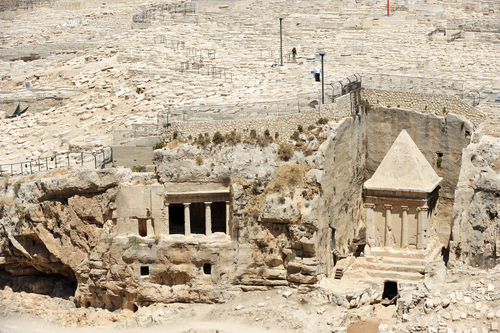
Kidron Valley and the Mount of Olives

This is the second in a two-part blog series inspired by an interview with archaeologist, Dr. Craig Evans. The first article was general in nature, focusing on people in the biblical record who are confirmed by archaeological finds, and noting that modern archaeology continues to affirm the historical reliability of the Bible. In this piece, we focus on the New Testament, which is Dr. Evans’s specialty.

Significantly, when asked whether he is aware of any archaeological finds that contradict the Gospels, Dr. Evans responded, “Where it relates to the Gospels – the Gospels talk certain people, certain places and certain events – and everywhere archaeology has any relevance that touches on it in any way, the archaeology supports what the Gospels say.” Thus, the theme continues: that modern archaeology, far from casting a shadow of doubt on the bible, shines light on it, illuminating the biblical accounts with archaeological discoveries.

Continue reading “Archaeology that Supports the New Testament Record”

Repentance from Dead Works

For it is impossible, in the case of those who have once been enlightened, who have tasted the heavenly gift, and have shared in the Holy Spirit, … and then have fallen away, to restore them again to repentance

depostphotos Image ID: 5379147 Copyright: Iurii

These are some of the most terrifying words in the New Testament:

For it is impossible, in the case of those who have once been enlightened, who have tasted the heavenly gift, and have shared in the Holy Spirit, and have tasted the goodness of the word of God and the powers of the age to come, and then have fallen away, to restore them again to repentance, since they are crucifying once again the Son of God to their own harm and holding him up to contempt.” (Hebrews 6:4-6)

For anyone but the hardest core Calvinist, these words are enough to make one shudder. No one wants to fall away. But we often do what we know we shouldn’t. The mind is willing, but the flesh is weak. Though we may be born again, the old man lurks incessantly beneath the service and around every corner. The struggle is real.

Most people, however, (me included) tend to read these words out of context. As an isolated statement, we might be strongly tempted to believe these words speak to sin, especially those nagging, habitual, ingrained sins that we have a hard time overcoming. We feel as if, one day, we will sin one too many times and will have fallen away – completely lost and irredeemable!

But the context speaks to something different than the direction our mind is prone to go.

The statement in Hebrews 6 quoted above is prefaced with the following introduction:

“Therefore let us leave the elementary doctrine of Christ and go on to maturity, not laying again a foundation of repentance from dead works and of faith toward God ….” (Hebrews 6:1)

What is the “elementary doctrine of Christ”? What are these “dead works” from which we must repent? This is the key to keep from “falling away”.

Continue reading “Repentance from Dead Works”

Palm Sunday: the Prelude to the Crucifixion

Jesus didn’t live up to the expectations of the crowd who followed him, and, no longer believing he was the Messiah they had hoped for, they turned on him


Today is Palm Sunday. This is the day we celebrate the “triumphal entry” of Jesus into the City of Jerusalem. He rode into the city on a donkey. Many hundreds of thousands were gathered in Jerusalem for the coming Passover. John tells us that people gathered in expectation of seeing Jesus because of the word that he had raised a man (Lazarus) from the dead days before. (John 12:17-18)

As Jesus entered the City, people lined the streets with palm branches. They threw their cloaks on the road in front him, and they hailed him with. This is Luke’s account:

As he went along, people spread their cloaks on the road.
When he came near the place where the road goes down the Mount of Olives, the whole crowd of disciples began joyfully to praise God in loud voices for all the miracles they had seen:
“Blessed is the king who comes in the name of the Lord!”

Luke 19:36-38

And here is John’s account:

The next day the great crowd that had come for the festival heard that Jesus was on his way to Jerusalem. They took palm branches and went out to meet him, shouting, “Hosanna!” “Blessed is he who comes in the name of the LORD!” “Blessed is the king of Israel!”

John 12:12-13

As we celebrate Palm Sunday today, we know the story of Jesus is about to take a very dramatic, tragic turn for the worse. The triumphal entry of Jesus into Jerusalem is not the precursor of celebratory times. Ominous clouds are looming on the horizon.

The incongruity of this joyous moment days before Jesus will be crucified is sobering. He was hailed King of the Jews by an adoring crowd days before a jeering crowd yelled, “Crucify him!” Most sobering of all is the likelihood that many people in those crowds were the same people.

What happened?

Continue reading “Palm Sunday: the Prelude to the Crucifixion”

Where Do You Stand in Relation to God?

If we choose to continue to go our own way, and insist upon our own values and ends, God will let us go. Love does not coerce or force itself upon another.

Depositphotos Image ID: 100613226 Copyright: tokkete

We live in a world that defies God. That is the point of the Adam and Eve story. The temptation to go our own way is great. In fact, like sheep wandering without guidance, ignorant of the dangers that lurk around us, we have all gone astray. That is our lot.

From Adam and Eve, throughout all of the Old Testament, this is the story of the world. This is the world into which God came, having reduced himself from the greatness of being our creator[1], to become one of us, in the form of the man Jesus[2].

That God loves us could not be more intimately or completely demonstrated for us than in the life of Jesus. Though he was God[3], he did not hold on to His privilege and power over us. He emptied himself for us. He came humbly and obedient to his own purpose, which was to lay down his own life for us[4] in a demonstration of love and compassion the world had never seen before and has never seen since.

God came into the world, and the world did not recognize him or receive Him[5]. Yet God was faithful to his purpose. He was faithful in his love for us. He was faithful to fulfill what he came to accomplish, which was to redeem us.

He came while we were yet sinners[6]. He didn’t wait until we became holy, righteous and good. He would have still been waiting. He came to heal us from all that makes us broken, which is our innate inclination to separate ourselves from God and to go our own ways.

This is the world and the reality in which we live. The world sets itself in opposition to its creator. Many people pay lip service to God, but their hearts are far from Him[7]. They deny Him in the way they live their daily lives. Though they honor Him with their lips, their actions belie them.

The good news, which is what Gospel means, is that God loves us anyway. He came for us while we were in this very condition, knowing the worst of us. God became man and lived among us knowing how corrupt we were, that we would reject him and knowing that we would attempt to put him to death. He came anyway. This is the extent of God’s love for us.

Our choice of how we will live in this world has consequences because of God’s love and the fact that He made us in His own image, to love him back. We are not compelled to love Him, but we are given the freedom to love Him. We are not robots or automatons who have no choice. But our choice is eternally significant.

Continue reading “Where Do You Stand in Relation to God?”