In Luke four, Jesus announced his public ministry in his hometown synagogue with these words:
“The spirit is on me because he has anointed me to proclaim good news to the poor. He has sent me to proclaim freedom for the prisoners and recovery of sight for the blind, to set the oppressed free, to proclaim the year of the Lord’s favor.”
Luke 4:18-19
Good news to the poor, freedom for prisoners, and freedom for the oppressed echoes Isaiah 61. “[T]he year of the Lord’s favor” echoes Leviticus 25, where Moses passed on the jubilee instructions given by the LORD to the LORD’s people.
Jesus was saying that these things foretold by Isaiah and the Jubilee instructions from Moses were fulfilled in him. Most of us are familiar with the way that many of the prophecies in Isaiah were fulfilled in Jesus, but we may not appreciate how Leviticus 25 takes on special significance – and controversy – in the life and ministry of Jesus.
Jesus announced his public ministry in a dramatic way in his hometown synagogue when he asked for the Isaiah scroll, opened it, read the words quoted above, and sat down. The people in the synagogue were initially “amazed at the gracious words” Jesus spoke. (Luke 4:22) By the end of the short exchange that occurred after that, the people wanted to throw Jesus off a cliff. (Luke 4:28-29) What happened?
The words of Jesus that provoked his hometown people to anger were these:
“‘Truly I tell you,’ he continued, ‘No prophet is accepted in his hometown. I assure you that there were many widows in Israel in Elijah’s time, when the sky was shut for three and a half years and there was a severe famine throughout the land. Yet Elijah was not sent to any of them, but to a widow in Zarephath in the region of Sidon. And there were many in Israel with leprosy in the time of Elisha the prophet, yet not one of them was cleansed—only Naaman the Syrian.'”
Luke 4:24-27
Why did these two stories provoke the people to anger? Maybe the better question (the one we might not want to ask) is whether we are much different than they were?
The tension that played out in that Galilean synagogue when Jesus announced his ministry presages our modern reality 2000 years later. We still have a difficult time with the instructions, intentions and long-term plans that God announced when He told Abram that all the nations of the earth would be blessed through his descendants.
Today, I want to review some relevant provisions in Isaiah 61 and Leviticus 25 to explore why that reference did not sit well with God’s people. It wasn’t the references so much as the stories of Elijah and Elisha that he connected to them. Those stories – and what they suggest – may still not resonate well.
I am writing today about the Parable of the Good Samaritan and the Parable of the Sheep and the Goats in light of the Old Testament passage that introduces what Jesus called the second greatest commandment: love your neighbor as yourself. (Leviticus 19:18) If you have read anything I have written lately, you know that I have have been meditating on this theme.
How People Misinterpreted “Neighbor”
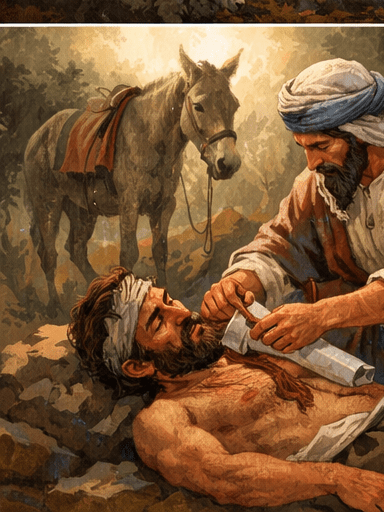
When Jesus encountered a First Century expert in the Law, the issue became: Who is my neighbor? The Parable of the Good Samaritan was the response from Jesus. The backstory to the Parable of the Good Samaritan reveals how First Century Jews misread Leviticus 19:18 to limit who they considered neighbors. It reads as follows:
“Do not seek revenge or bear a grudge against anyone among your people, but love your neighbor as yourself. I am the Lord.“
Just 16 verses later (in Leviticus 19:34), Moses hints at a broader, more expansive meaning to the rule to “love your neighbor as yourself”:
“The foreigner residing among you must be treated as your native-born. Love them as yourself, for you were foreigners in Egypt. I am the LORD your God.”
Distinguishing Among Jews and Gentiles
In the time of Jesus, Jews distinguished between Abraham’s descendants and everyone else (Gentiles). They limited neighbors they were instructed to love to those from among their people because they interpreted Leviticus 19:34 in light of Leviticus 19:18. They interpreted “from among the people” to include descendants of Abraham, and they likely included those foreigners who lived among them and observed their religious practices, but they did not go further.
The Hebrew word translated “foreigner” in verse 34 is ger. It generally means “sojourner, stranger, foreigner, alien,” and it literally means “a guest.” (See Biblehub) Ger is derivative of guwr, which means “to sojourn, dwell, reside, live as a foreigner,” with connotations of being a guest, shrinking & fearing, and being afraid.
According to the topical Lexicon, gurw centers on “the act of taking up residence as a non-native, a ‘sojourning’ that is self-conscious of impermanence and dependence on the goodwill of the host community.” The sense of this word as scholars have come to understand it is of foreign guests who dwell permanently among the people and conform to the requitements of the Mosaic Law. I believe First Century Jews would have had a similar understanding of the concept of neighbor that defined who they were to love.
By the First Century, there were two categories of people: Jews and Gentiles. We know from historical records that some Gentiles lived harmoniously with Jews and more or less subscribed to Jewish religious customs as they were allowed to engage with them.
The Samaritans as Others
There were varying degrees to which Gentiles could be incorporated into Jewish community. Some Gentiles were circumcised, converted to Judaism, and were fully integrated into Jewish community. The largest group of Gentiles who lived among the Jewish community, however, were the “God-fearers”. They were welcome in the temple and synagogue. They participated in prayer and instruction. They ethically aligned with Jewish community, but they were not circumcised, not bound to the full Torah, and were not considered covenant members of the Jewish community.
These Gentiles who believed in God as the Jews did, who worshipped God as the Jews did, and who lived in harmony with biblical, ethical requirements were accepted in Jewish community. They more or less represented the ger in Leviticus 19. They, like the ger, were considered neighbors who must be loved.
The question posed by the expert in the Law in Luke 10 reveals that the scope of who is a neighbor was limited, but with some sense of uncertainty, in the First Century. That uncertainty was settled by Jesus in sharing the Parable of the Good Samaritan.
Samaritans and Jews Opposed Each Other
Samaritans were ethnically Hebrew. They descended from the northern tribes of Israel. They were descendants of Abraham, but they were deviant, ritually impure, and estranged from First Century Jews.
They were people who remained in the land after the exile to Babylon and integrated with the conquering Assyrians. They opposed the return of the exiles who rebuilt the Temple. They rejected Temple worship. They rejected the Levitical priesthood returning from Babylon, and they had their own religious practices.
The hostility between the Jews and the Samaritans was mutual. They were closely related by kinship, but they disagreed sharply over theology, religious practice, and heritage. They were estranged, avoided each other avoidance, and clashed (sometimes violently).
Insiders and Outsiders
Though the Jews would accept the Gentile converts and God-fearing Gentiles into Jewish community, Samaritans and other Gentiles were excluded. They were the people the legal expert’s question was about: Who is my neighbor? They were not from “among the people.”
Many people in the Jewish community, like the expert in the law, had a theology that excluded Samaritans and most Gentiles from the definition of “neighbor”. Their mistaken interpretation and bad theology created insiders and outsiders.
Jesus Cuts Against Our Insider Logic
Jesus reveals how God’s Word cuts against our insider logic. Jesus interprets Scripture and compels us to view our neighbors (whom we should love as ourselves) Expansively. Our neighbors include people who are not like us, people who are heretical and (therefore) threatening to us and people in opposition to us. Outsiders.
Jesus shockingly made a Samaritan the hero in the Parable. Most Jews would not have used “good” in the same sentence as a Samaritan. Samaritans were outsiders, people in opposition to the Jews, heretics, and estranged. Samaritans were not seen as neighbors, but Jesus disavowed them of their bad theology.
We know this, but we are not immune from our own interpretive shortcomings and bad theology. We have less excuse than the Jews to hold such a de minimis view of neighborliness and love (because of the clear words of Jesus), but we can fall into the same interpretive trap.
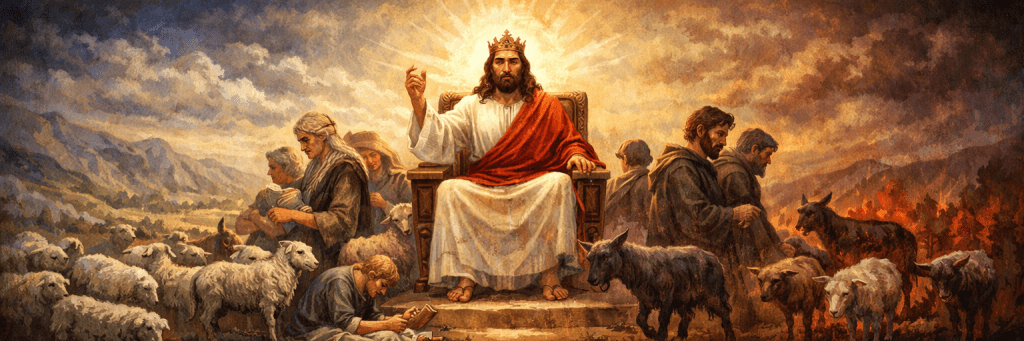
In that context, consider the Parable of the Sheep and the Goats.
The importance of identity is not just a 21st Century trend. The significance of a person’s identity dates back to the Ancient Near Eastern culture preserved in the Bible.
Parents commonly named their children based on prominent identity markers. For instance, Isaac and Rebekah named their second born, Jacob, who was born clinging to his two brother’s ankle. Jacob (Ya’aqov in Hebrew) meant “supplanter,” “heel-catcher,” or “he who follows on the heels of.” The name became part of his identity not just literally; it corresponded with actions to acquire his older brother’s birthright from his father by manipulation and deception. (Gen. 25:26; 27:36; and Hos. 12:2-4)
God often gave people new names to go with their identity in relation to God. After a personal encounter with the Lord, God gave Jacob a new name: Israel, which meant “struggles with God,” “wrestlers with /God,” or “God prevails.” (Gen. 32)
The naming of children and God renaming people according to some key characteristic associated with their personal identity, or a new identity God gave them, is a common theme in the Bible. Groups of people were known by ancestral names, like Israelites, Amalekites, Hittites, etc. Thus, I find significance in the name Moses gave his first born child: Gershom.
Moses was the son of Hebrew parents, but he was placed in a basket in the Nile when Pharaoh ordered the killing of all male Hebrew babies. The Pharaoh’s own daughter found Moses and adopted him, though she allowed him to be nursed by a Hebrew woman who turned out to be Moses’s mother.
Moses grew up in the privilege of the Pharaoh’s house. He was educated in all the ways of Egypt, learned to read and write, and was familiar with Egyptian history, culture, religion, and philosophy. He was Hebrew by birth, but he was Egyptian by upbringing.
Moses must have known that he was Hebrew. It was probably obvious by his facial features, and he might have even been circumcised. He was schooled in Egyptian ways and thinking, but he was probably painfully aware that he was not Egyptian by birth.
One day as he observed an Egyptian beating a Hebrew man, Moses stepped in and killed the Egyptian. I believe Moses identified with the Hebrew man because of his Hebrew ethnicity. He fled into the desert in Midian for fear of punishment from the Egyptians for the murder.
In Midian, he was accepted into the family of a Midianite, married a Midian woman, and settled down there. When his wife, Zipporah, gave birth to a son, “Moses named him Gershom, saying, ‘I have become a foreigner in a foreign land.’” Exodus 2:21-22
Moses named his first son Foreigner because he identified as a foreigner himself. Despite being raised as an Egyptian in Pharaoh’s family with all the privilege associated with the royal household, Moses could not escape the fact of his Hebrew heritage. That knowledge influenced his personal identity. That identify as an outsider – a foreigner – was reinforced in his persona when he settled in Midian to the extent that he extended that identity to his firstborn son.
I find significance in that story and in the realization that Moses identified so poignantly with being a foreigner. That same identity – of being foreign – defined the Hebrew people enslaved in Egypt. It remained with them as they wandered 40 years in the Levant wilderness, and, God sanctified that identity for the Israelites in the Mosaic Law:
“When you reap the harvest of your land, do not reap to the very edges of your field or gather the gleanings of your harvest. Do not go over your vineyard a second time or pick up the grapes that have fallen. Leave them for the poor and the foreigner. I am the Lord your God….
“When a foreigner resides among you in your land, do not mistreat them. The foreigner residing among you must be treated as your native-born. Love them as yourself, for you were foreigners in Egypt. I am the Lord your God.“
Leviticus 19:9-10, 33-34
The Israelites lived 430 years in Egypt by the time Moses led them out of that land. Their memories of the promised land were ancient history. Their memories would be like modern Native Americans recalling the history of the United States in 1596. European settlers at that time comprised a few thousand people at most in precarious settlements in the New World inhabited by millions of indigenous people.
The Roanoke Colony had already failed, and no English settlements remained. Some Spanish missionary and military expeditions existed in the south and west, and French and Portuguese fishing camps existed in Newfoundland. Jamestown (1607), Quebec City (1608), Plymouth (1620), and New Amsterdam (New York, 1624) were not yet established.
Some 430 years later, the Native Americans may identify as outcasts in their own country, like Israelites identified as foreigners in their “home” country of Egypt. The Israelites lived there, but they were not assimilated into Egyptian culture, and they lived there without all the benefits Egyptian privileges.
Though Moses was raised with Egyptian privileges in the royal family, he never lost his Hebrew identity. In that sense, Moses identified similarly to the way Christians are taught to identify themselves in the New Testament: as people of God who are foreigners and exiles (1 Peter 2:10-11), “foreigners and strangers on earth” (Hebrews 11:13), who are now “fellow citizens with God’s people.” (Ephesians 2:19)
For Moses, though, he probably didn’t even feel at home with his own, Hebrew people because of his upbringing. He was raised separately from them. His Hebrew features (and perhaps circumcision) reminded him of his heritage. He could not escape it, but his personal connection to those Hebrew roots was not yet intimate.
Even so, the sense of foreign identify was profound enough that Moses was compelled to come to the aid of a Hebrew stranger. Moses identified with the plight of the Israelites who lived as vulnerable foreigners in a land they could not call their own.
I and my fellow Christians should have the same profound sense of living as strangers in a foreign land in this world – if, indeed, we are citizens of heaven. This realization hits home today as I watch what is happening in the streets of American cities.
Do we identify with the aliens and strangers in our country? Or do we identify with the government that has recently adopted more oppressive and strong handed tactics to deal with immigrants in this country who are not wanted here? If you are not sure these connections belong together, bear with me awhile longer.
I am reeling in sadness today, and it’s complicated. The shooting and death of Alex Pretti on the cold streets of Minneapolis yesterday is tragic, regardless of the narrative anyone believes about it. The narratives are the complicated part.
It’s actually black and white. And, that’s what makes it complicated: some people say it’s black, and some people say it’s white. We couldn’t possibly have more video on this tragedy from more angles than we do, and the whole world has watched the shotting play out in HD and slow motion. It couldn’t be clearer what happened, right?
Wrong. And, we couldn’t be more polarized about it. Not just Republicans and Democrats, but Christians and Christians.
Yesterday, as I read how believers from other countries are responding to the killing of Alex Pretti by ICE agents in Minnesota, I was struck by how united they were in their narrative of what happened – unlike believers in our country at the moment.
The narratives we are telling are wildly divergent, despite many videos from different angles. The narratives people began to tell immediately after live coverage was shared to a watching world diverged as dramatically as black and white, and people have planted Christian flags on both sides.
The President and the Department of Justice issued public judgments while the crime tape was still being stretched out to mark the area for investigation. Alex Pretti is a domestic terrorist, they said. He had a gun and intended to commit mass murder. He was at fault for opposing the efforts of ICE to carry out their duties. It was a tragedy that he is dead but it was his fault for being there, getting in the way, and carrying a gun (which is ironic in itself).
At the same time, people immediately accused ICE agents of cold-blooded murder while the blood still oozed out of Pretti’s lifeless body in the frigid street. Alex Pretti was an ICU nurse, they said. He was a great guy who cared for people. He had a conceal carry license protected by the 2nd Amendment. He stepped in to help a woman, and his hands were not on his gun. ICE agents are at fault for unjustly, mercilessly, and wantonly killing him for expressing his First Amendment rights.
I realize that people, including me, rush to judgment on these things because of their biases. We have all seen the same videos, and we have reached opposite conclusions in keeping with our own beliefs and narratives. If you disagree with me on everything else, I hope you have the integrity and honesty to admit this much.
Christians who focus on Romans 13, law and order, the culture war, and support the President and governing authorities come down on the side of the administration’s narrative about what happened. Christians focused on the Biblical theme of justice for the poor and needy, not oppressing the foreigner, loving your neighbor, and caring for the least, come down on the side of the opposite narrative.
The facts are the same. We all saw the same videos. They differences lie in the the way we view the world and the basic assumptions that inform our worldviews.
But, how can that be? Shouldn’t Christians be unified in Christ? Don’t we all believe that Jesus is God, the second person of the Trinity, the Word of God through whom all things were made who gave up his life on the cross to save sinners from sin and death and rose again to give us hope for our own salvation? Why aren’t we all unified in our “biases” over this incident?
As Christians, we have sung, “They will know us by our love.” We have read the words of Jesus, who said, “The world will know us by the love we have for one another.” We have read that “God so loved the world that he gave his only begotten Son, that whosoever believeth in him should not perish, but have everlasting life..” We follow a crucified savior who gave up his life because he loved us. We have all received by faith the righteousness extended to us by the grace of God, not because we earned it, but despite the fact that we didn’t.
Yet, we are divided by the narratives we have embraced as we watch the same videos and reach exactly opposite conclusions.
This troubles me, and it should trouble you if you are also a believer. Not necessarily because I think I am right or you think I am wrong about the narrative, but because it reveals that Christians, who claim to have a special hold on truth given by divine revelation from God with the guidance of the Holy Spirit, are no different than anyone else in the world. Our unity in Christ doesn’t seem to matter. It doesn’t even seem to exist.
The failure of the German Protestant church to mount a decisive resistance to Nazism has long troubled western Christian conscience. Historians rightly warn against simplistic explanations, but one conclusion has proven difficult to escape: long before Hitler rose to power, the church’s theological confidence had already been weakened. When the state demanded ultimate loyalty, many pastors and congregations lacked the moral clarity and will to refuse.
The nineteenth-century Tübingen School of theology did not cause Nazism. Its scholars were not proto-fascists, nor did they anticipate racial ideology or totalitarian politics. Yet their historical-critical approach to Scripture unintentionally contributed to a Protestant culture in which the Bible increasingly functioned as an object of study rather than a source of commanding authority. When political myth replaced moral truth, the church was unprepared to stand against it because the church had long ago lost its biblical, moral footing.
History does not repeat itself mechanically. The present American situation is not Weimar Germany, and the MAGA movement is not Nazism. Still, history can illuminate how the happenings within the church influence how the church interacts with political culture. That raises a difficult but necessary question for American evangelicals today: what weaknesses in our own theology and habits of thought have made many of us susceptible to the distortions of political power?
The answer is not that evangelicalism has repeated the errors of liberal Protestantism. In many ways, we have made opposite mistakes. But the result—a diminished capacity for prophetic resistance—bears an unsettling resemblance.
Authority Dissolved: The Tübingen Lesson
The Tübingen School, led by Ferdinand Christian Baur in the mid-nineteenth century, treated Scripture primarily as a historical artifact shaped by competing early Christian communities. Biblical texts were analyzed as records of theological conflict rather than as a unified witness to divine revelation. The command and authority of Scripture was diminished, and the sacred became profane. The trajectory of the academy spilled into and watered down the vitality of Christian impact in Protestant Germany.
Clergy trained in historical criticism often hesitated to proclaim Scripture normatively. The Bible remained important, but its authority was qualified, softened, and translated into general ethical ideals compatible with modern culture. Christianity became morally earnest but theologically cautious and politically unimportant.
By the early twentieth century, much of German Protestantism lacked the confidence to say an unambiguous “No” to the state. The problem was not simply fear or cowardice. It was uncertainty—whether God had spoken definitively enough to authorize resistance when power spoke with confidence and force.
Karl Barth saw this clearly. In 1933, as the German church accommodated itself to the Nazi regime, Barth insisted that the church exists only under the authority of God’s self-revelation. Where that authority is weakened, the church becomes vulnerable to captivity by the state.
The lesson is sobering: when Scripture no longer stands above culture, culture will soon stand above the church. Today we can say of Nazi Germany and the church alike, “The grass withers, the flower fades, but the word of our God will stand forever.” (Isaiah 40:8) But, the impact was devastating on Germany, Jews, Europe, and the world at that time, and its effects rumble into the present time.
I do not want to suggest that we can equate Nazi Germany in the 1930’s and 1940’s to the United States of America in the 2010’s and 2020’s. Still, there are parallels between the exercise of State power in the vacuum left by weakened theology that bear some attention.









 Navigating by Faith