The Importance of Our Identity as Citizens of Heaven: Moses, Aliens, and Strangers

Our identity as Christians informs (or should inform) how we see the world


The importance of identity is not just a 21st Century trend. The significance of a person’s identity dates back to the Ancient Near Eastern culture preserved in the Bible.

Parents commonly named their children based on prominent identity markers. For instance, Isaac and Rebekah named their second born, Jacob, who was born clinging to his two brother’s ankle. Jacob (Ya’aqov in Hebrew) meant “supplanter,” “heel-catcher,” or “he who follows on the heels of.” The name became part of his identity not just literally; it corresponded with actions to acquire his older brother’s birthright from his father by manipulation and deception. (Gen. 25:26; 27:36; and Hos. 12:2-4)

God often gave people new names to go with their identity in relation to God. After a personal encounter with the Lord, God gave Jacob a new name: Israel, which meant “struggles with God,” “wrestlers with /God,” or “God prevails.” (Gen. 32)

The naming of children and God renaming people according to some key characteristic associated with their personal identity, or a new identity God gave them, is a common theme in the Bible. Groups of people were known by ancestral names, like Israelites, Amalekites, Hittites, etc. Thus, I find significance in the name Moses gave his first born child: Gershom.

Moses was the son of Hebrew parents, but he was placed in a basket in the Nile when Pharaoh ordered the killing of all male Hebrew babies. The Pharaoh’s own daughter found Moses and adopted him, though she allowed him to be nursed by a Hebrew woman who turned out to be Moses’s mother.


Moses grew up in the privilege of the Pharaoh’s house. He was educated in all the ways of Egypt, learned to read and write, and was familiar with Egyptian history, culture, religion, and philosophy. He was Hebrew by birth, but he was Egyptian by upbringing.


Moses must have known that he was Hebrew. It was probably obvious by his facial features, and he might have even been circumcised. He was schooled in Egyptian ways and thinking, but he was probably painfully aware that he was not Egyptian by birth.

One day as he observed an Egyptian beating a Hebrew man, Moses stepped in and killed the Egyptian. I believe Moses identified with the Hebrew man because of his Hebrew ethnicity. He fled into the desert in Midian for fear of punishment from the Egyptians for the murder.

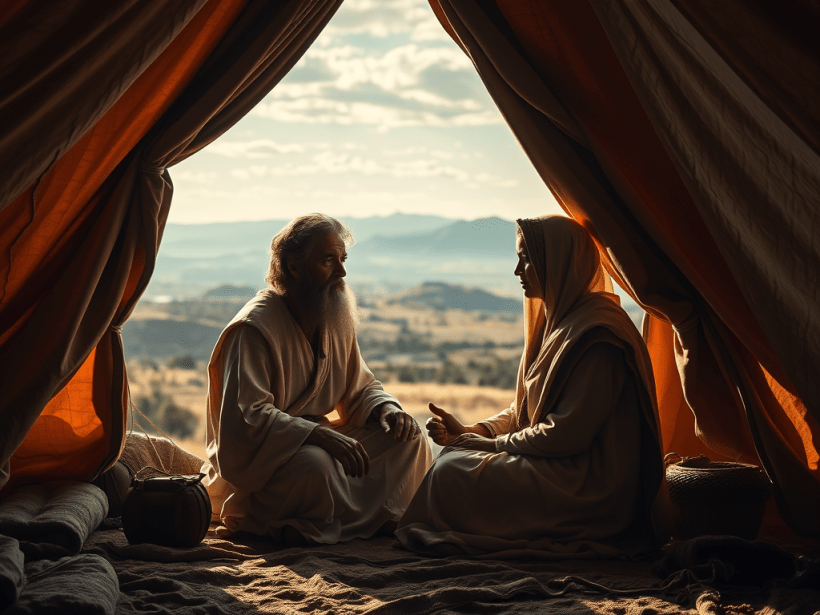
In Midian, he was accepted into the family of a Midianite, married a Midian woman, and settled down there. When his wife, Zipporah, gave birth to a son, “Moses named him Gershom, saying, ‘I have become a foreigner in a foreign land.’” Exodus 2:21-22

Moses named his first son Foreigner because he identified as a foreigner himself. Despite being raised as an Egyptian in Pharaoh’s family with all the privilege associated with the royal household, Moses could not escape the fact of his Hebrew heritage. That knowledge influenced his personal identity.  That identify as an outsider – a foreigner – was reinforced in his persona when he settled in Midian to the extent that he extended that identity to his firstborn son.

I find significance in that story and in the realization that Moses identified so poignantly with being a foreigner. That same identity – of being foreign – defined the Hebrew people enslaved in Egypt. It remained with them as they wandered 40 years in the Levant wilderness, and, God sanctified that identity for the Israelites in the Mosaic Law:


“When you reap the harvest of your land, do not reap to the very edges of your field or gather the gleanings of your harvest. Do not go over your vineyard a second time or pick up the grapes that have fallen. Leave them for the poor and the foreigner. I am the Lord your God….

When a foreigner resides among you in your land, do not mistreat them. The foreigner residing among you must be treated as your native-born. Love them as yourself, for you were foreigners in Egypt. I am the Lord your God.

Leviticus 19:9-10, 33-34


The Israelites lived 430 years in Egypt by the time Moses led them out of that land. Their memories of the promised land were ancient history. Their memories would be like modern Native Americans recalling the history of the United States in 1596. European settlers at that time comprised a few thousand people at most in precarious settlements in the New World inhabited by millions of indigenous people.


The Roanoke Colony had already failed, and no English settlements remained. Some Spanish missionary and military expeditions existed in the south and west, and French and Portuguese fishing camps existed in Newfoundland. Jamestown (1607), Quebec City (1608), Plymouth (1620), and New Amsterdam (New York, 1624) were not yet established.


Some 430 years later, the Native Americans may identify as outcasts in their own country, like Israelites identified as foreigners in their “home” country of Egypt. The Israelites lived there, but they were not assimilated into Egyptian culture, and they lived there without all the benefits Egyptian privileges.

Though Moses was raised with Egyptian privileges in the royal family, he never lost his Hebrew identity. In that sense, Moses identified similarly to the way Christians are taught to identify themselves in the New Testament: as people of God who are foreigners and exiles (1 Peter 2:10-11), “foreigners and strangers on earth” (Hebrews 11:13), who are now “fellow citizens with God’s people.” (Ephesians 2:19)

For Moses, though, he probably didn’t even feel at home with his own, Hebrew people because of his upbringing. He was raised separately from them. His Hebrew features (and perhaps circumcision) reminded him of his heritage. He could not escape it, but his personal connection to those Hebrew roots was not yet intimate.

Even so, the sense of foreign identify was profound enough that Moses was compelled to come to the aid of a Hebrew stranger. Moses identified with the plight of the Israelites who lived as vulnerable foreigners in a land they could not call their own.

I and my fellow Christians should have the same profound sense of living as strangers in a foreign land in this world – if, indeed, we are citizens of heaven. This realization hits home today as I watch what is happening in the streets of American cities.

Do we identify with the aliens and strangers in our country? Or do we identify with the government that has recently adopted more oppressive and strong handed tactics to deal with immigrants in this country who are not wanted here? If you are not sure these connections belong together, bear with me awhile longer.

Continue reading “The Importance of Our Identity as Citizens of Heaven: Moses, Aliens, and Strangers”

The Alex Pretti Shooting: It’s Black and White

The black and white narratives could not be more divergent


I am reeling in sadness today, and it’s complicated. The shooting and death of Alex Pretti on the cold streets of Minneapolis yesterday is tragic, regardless of the narrative anyone believes about it. The narratives are the complicated part.

It’s actually black and white. And, that’s what makes it complicated: some people say it’s black, and some people say it’s white. We couldn’t possibly have more video on this tragedy from more angles than we do, and the whole world has watched the shotting play out in HD and slow motion. It couldn’t be clearer what happened, right?

Wrong. And, we couldn’t be more polarized about it. Not just Republicans and Democrats, but Christians and Christians.

Yesterday, as I read how believers from other countries are responding to the killing of Alex Pretti by ICE agents in Minnesota, I was struck by how united they were in their narrative of what happened – unlike believers in our country at the moment.

The narratives we are telling are wildly divergent, despite many videos from different angles. The narratives people began to tell immediately after live coverage was shared to a watching world diverged as dramatically as black and white, and people have planted Christian flags on both sides.

The President and the Department of Justice issued public judgments while the crime tape was still being stretched out to mark the area for investigation. Alex Pretti is a domestic terrorist, they said. He had a gun and intended to commit mass murder. He was at fault for opposing the efforts of ICE to carry out their duties. It was a tragedy that he is dead but it was his fault for being there, getting in the way, and carrying a gun (which is ironic in itself).

At the same time, people immediately accused ICE agents of cold-blooded murder while the blood still oozed out of Pretti’s lifeless body in the frigid street. Alex Pretti was an ICU nurse, they said. He was a great guy who cared for people. He had a conceal carry license protected by the 2nd Amendment. He stepped in to help a woman, and his hands were not on his gun. ICE agents are at fault for unjustly, mercilessly, and wantonly killing him for expressing his First Amendment rights.

I realize that people, including me, rush to judgment on these things because of their biases. We have all seen the same videos, and we have reached opposite conclusions in keeping with our own beliefs and narratives. If you disagree with me on everything else, I hope you have the integrity and honesty to admit this much.

Christians who focus on Romans 13, law and order, the culture war, and support the President and governing authorities come down on the side of the administration’s narrative about what happened. Christians focused on the Biblical theme of justice for the poor and needy, not oppressing the foreigner, loving your neighbor, and caring for the least, come down on the side of the opposite narrative.

The facts are the same. We all saw the same videos. They differences lie in the the way we view the world and the basic assumptions that inform our worldviews.

But, how can that be? Shouldn’t Christians be unified in Christ? Don’t we all believe that Jesus is God, the second person of the Trinity, the Word of God through whom all things were made who gave up his life on the cross to save sinners from sin and death and rose again to give us hope for our own salvation? Why aren’t we all unified in our “biases” over this incident?

As Christians, we have sung, “They will know us by our love.” We have read the words of Jesus, who said, “The world will know us by the love we have for one another.” We have read that “God so loved the world that he gave his only begotten Son, that whosoever believeth in him should not perish, but have everlasting life..” We follow a crucified savior who gave up his life because he loved us. We have all received by faith the righteousness extended to us by the grace of God, not because we earned it, but despite the fact that we didn’t.

Yet, we are divided by the narratives we have embraced as we watch the same videos and reach exactly opposite conclusions.

This troubles me, and it should trouble you if you are also a believer. Not necessarily because I think I am right or you think I am wrong about the narrative, but because it reveals that Christians, who claim to have a special hold on truth given by divine revelation from God with the guidance of the Holy Spirit, are no different than anyone else in the world. Our unity in Christ doesn’t seem to matter. It doesn’t even seem to exist.

Continue reading “The Alex Pretti Shooting: It’s Black and White”

When the Church Loses Its Prophetic Voice

Biblical Authority, Political Power, and the Temptations of Influence


The failure of the German Protestant church to mount a decisive resistance to Nazism has long troubled western Christian conscience. Historians rightly warn against simplistic explanations, but one conclusion has proven difficult to escape: long before Hitler rose to power, the church’s theological confidence had already been weakened. When the state demanded ultimate loyalty, many pastors and congregations lacked the moral clarity and will to refuse.

The nineteenth-century Tübingen School of theology did not cause Nazism. Its scholars were not proto-fascists, nor did they anticipate racial ideology or totalitarian politics. Yet their historical-critical approach to Scripture unintentionally contributed to a Protestant culture in which the Bible increasingly functioned as an object of study rather than a source of commanding authority. When political myth replaced moral truth, the church was unprepared to stand against it because the church had long ago lost its biblical, moral footing.

History does not repeat itself mechanically. The present American situation is not Weimar Germany, and the MAGA movement is not Nazism. Still, history can illuminate how the happenings within the church influence how the church interacts with political culture. That raises a difficult but necessary question for American evangelicals today: what weaknesses in our own theology and habits of thought have made many of us susceptible to the distortions of political power?

The answer is not that evangelicalism has repeated the errors of liberal Protestantism. In many ways, we have made opposite mistakes. But the result—a diminished capacity for prophetic resistance—bears an unsettling resemblance.

Authority Dissolved: The Tübingen Lesson

The Tübingen School, led by Ferdinand Christian Baur in the mid-nineteenth century, treated Scripture primarily as a historical artifact shaped by competing early Christian communities. Biblical texts were analyzed as records of theological conflict rather than as a unified witness to divine revelation. The command and authority of Scripture was diminished, and the sacred became profane. The trajectory of the academy spilled into and watered down the vitality of Christian impact in Protestant Germany.

Clergy trained in historical criticism often hesitated to proclaim Scripture normatively. The Bible remained important, but its authority was qualified, softened, and translated into general ethical ideals compatible with modern culture. Christianity became morally earnest but theologically cautious and politically unimportant.

By the early twentieth century, much of German Protestantism lacked the confidence to say an unambiguous “No” to the state. The problem was not simply fear or cowardice. It was uncertainty—whether God had spoken definitively enough to authorize resistance when power spoke with confidence and force.

Karl Barth saw this clearly. In 1933, as the German church accommodated itself to the Nazi regime, Barth insisted that the church exists only under the authority of God’s self-revelation. Where that authority is weakened, the church becomes vulnerable to captivity by the state.

The lesson is sobering: when Scripture no longer stands above culture, culture will soon stand above the church. Today we can say of Nazi Germany and the church alike, “The grass withers, the flower fades, but the word of our God will stand forever.” (Isaiah 40:8) But, the impact was devastating on Germany, Jews, Europe, and the world at that time, and its effects rumble into the present time.

I do not want to suggest that we can equate Nazi Germany in the 1930’s and 1940’s to the United States of America in the 2010’s and 2020’s. Still, there are parallels between the exercise of State power in the vacuum left by weakened theology that bear some attention.

Continue reading “When the Church Loses Its Prophetic Voice”

The Sin of Sodom & Gomorrah Summarized: A Warning to the United States of America (and a Reason for Hope)

It may be worse then you think and more relevant than you assume


Since I noticed how Ezekiel summarized the sin of Sodom & Gomorrah earlier this year, I wanted to take a closer look. Ezekiel’s summary was surprising to me, and I wondered, “What did I miss in reading the story?”

I thought it was about sexual sin, and specifically homosexual sin, but Ezekiel doesn’t even mention sexual sin in his summary. This is what Ezekiel says, speaking to Israel:

“You not only followed [the ways of Sodom] and copied their detestable practices, but in all your ways you soon became more depraved than they. As surely as I live, declares the Sovereign Lord, your sister Sodom and her daughters never did what you and your daughters have done.

‘Now this was the sin of your sister Sodom: She and her daughters were arrogant, overfed and unconcerned; they did not help the poor and needy. They were haughty and did detestable things before me.'”

(Ezekiel 16:47-50) Obviously, the story of Sodom & Gomorrah isn’t what I thought it was.

Like most people, I was taught a simple version: God destroyed Sodom and Gomorrah because of homosexuality. End of story.

But when I actually took the time read the text carefully, I realized the Bible tells a far more unsettling story, and a story that is far more relevant to our world today than I imagined. The Bible contrasts hospitality and hostility to strangers (angels) to highlight the root of Sodom & Gomorrah’s sin.

I did a careful exegesis of the Sodom & Gomorrah story previously that demonstrates what the primary the sin of Sodom & Gomorrah was, but today I am just going to summarize it. The summary needs to include the context in which the story of Sodom & Gomorrah is embedded in the Bible.

Before Genesis 19 where we find the story of Sodom & Gomorrah is the story in Genesis 18 of Abraham’s and Sarah’s magnanimous hospitality to three strangers who turn out to be “the Lord” and two angels on their way to Sodom. The one called “the Lord” remained behind talking to Abraham, while the two angels continued on to Sodom where Lot sees them sitting in the gateway of the City. Lot calls to them, invites them in, and shows them the same magnanimous hospitality Abraham showed. (Gen. 19:1-3)

The parallel stories of Abraham’s and Lot’s hospitality that mirror each other in the same pattern set the stage for God’s judgment on Sodom. That’s when things go sideways. The men of the town surround Lot’s house and demand that Lot send them out to be violated sexually.

Abraham welcomes strangers with generosity and honor. Lot does the same, but the men of Sodom do the opposite. They rage against the strangers. They threaten Lot because he is a “foreigner”, and they warn Lot they will treat him worse than what they plan to do to the strangers in Lot’s house if he doesn’t comply.

The town’s men resented Lot being there and resented him inviting other foreigners into his house. They formed an angry mob to humiliate and violate Lot’s guests as a warning: you are not welcome here!

As Ezekiel says, the reason for this conduct is because they were arrogant, overfed and unconcerned about others. They did not help the poor and the needy. Worse, they didn’t just turn the foreigners away; they didn’t just drive them out of town; they tried to punish, violate, humiliate, and shame them.

The Lord told Abraham that He was responding to the great outcry against Sodom & Gomorrah due to the grievousness of their sin. (Gen. 18:20) Such an outcry is the response of people when great injustice is done to them. The scene echoes the story of Cain and Abel when Abel’s blood was said to cry out from the ground in Genesis 4. The same word is used for Israel’s outcry under Egyptian oppression in Exodus 2.

God responds to injustice. God responds specifically to the outcries of people who bear the oppression of that injustice, and God judges those who are unrepentantly responsible for that injustice.

The story of Sodom & Gomorrah is a story of God’s judgment on sin, but it isn’t sexual sin that brings God’s judgment. The sin that prompted God to respond was the sin that caused people to cry out under the weight of injustice.

Jesus later confirms that the sin of Sodom & Gomorrah is inhospitality when he warns towns who do not welcome his followers, saying, “it will be more bearable for Sodom and Gomorrah on the day of judgment than for that town.” Jesus says this in Mathew 10 when he sent his 12 disciples to proclaim the kingdom of God, and Jesus says it again in Luke 10, when he sent out 72 of his followers to heal the sick and proclaim the kingdom.

The context of these statements was the hospitality (or lack of it) shown to his followers. There is no mention of sexual sin—only refusal to welcome, refusal to listen, refusal to be hospitable.

Ezekiel is very specific about the sin of Sodom & Gomorrah:

“This was the sin of your sister Sodom: pride, excess of food, prosperous ease—but she did not help the poor and needy.”

Pride. Comfort. Indifference. Not just lack of empathy, but downright cruelty to the poor and needy – the vulnerable. That is the Bible’s own summary of the sin of Sodom & Gomorrah.

The angels/foreigners in the story of Sodom & Gomorrah are just one category of vulnerable people. Elsewhere, Scripture often mentions widows, orphans, and foreigners together to describe the vulnerable people in the ancient near east who God desired His people to protect and watch over – because God’s heart is to protect and watch over the vulnerable and needy.

Yes, there is sexual sin in the story, but the root of that sin is hostility toward others. In the context of the story as it sits in the greater context of the previous story about Abraham’s radical hospitality, the sexual act is a weapon of the people of Sodom. They use it out of arrogance, out of desire to guard their own wealth and comfort from foreigners, to humiliate, shame, and drive out the foreigners who dared to encroach on on what they had. It is the final expression of a society that idolized comfort, wealth, and lifestyle. Because they didn’t love God, they didn’t love people.

Sodom wasn’t destroyed because it was too permissive. Sodom was destroyed because its people were too proud, too full, too comfortable, and too cruel in their efforts to protect what they had from outsiders.

God heard the cries of those crushed by that system—and He acted.

That’s what makes this story disturbingly relevant today. The sin of Sodom isn’t ancient or obscure. It shows up whenever a society values its own prosperity above allegiance to God and clings to its own comfort, despises the stranger, and silences the cries of the vulnerable to protect what it has.

And that should give Christians (and non-Christians alike) pause in 2025 in the United States of America. God is no respecter of persons. People reap what they sow. God did not spare the people of Israel from His judgment when they repeatedly gave in to idolatry (putting their own interests above God’s interest) and oppressed their neighbors. He will not spare a country or a even a group of believers who do that.

The good news is that God is always, always faithful. He is aways just to forgive those who ask to be forgiven and repent of their ways. I pray that we can be such people.

A Review of Principalities Powers and Allegiances: Submission in Enemy Territory

Untangling submission to authority and allegiance to God


A friend posted an glowing endorsement of the book, Principalities Powers and Allegiances, by Matt Mouzakis & Will Ryan, that intrigues me because the subject is a topic I have spent some time considering and writing about. The book is an exegesis of biblical passages that have posed challenges to modern Christians like myself: Romans 13:1-7 and 1 Peter 2:11-17.

These passages instruct Christians to submit to earthly authorities “for the Lord’s sake” (1 Peter 2:13). Mouzakis and Ryan provide background and Scriptural insight that sheds some fresh light on these passages. It is not new light. In fact, it is ancient light that was likely understood by the original readers of those words, but which has been lost in the centuries since that time.

I do not have the book, but I was curious because of my own interest in the tension between faithful adherence to the Gospel and submission to governing authorities, so I asked Google Gemini for a summary of the book. More specifically, I asked for a summary of the exegesis of Romans 13:1-7 for comparison to my own exegesis. (How Should the Church Act Regarding Authority? and more recently Submitting to Authority For the Lord’s Sake Like Peter, Paul, and Jesus Did)

The exegesis of Romans 13:1-7 offered by Mouzakis and Ryan is a departure from modern reading that views government as God’s benevolent institution for all time. They argue that the passage must be read through the lens of the Deuteronomy 32 worldview and the larger narrative of sin and God’s judgment in the book of Romans.

The Deuteronomy 32 worldview, in a nutshell, is that Yahweh, is the sole supreme Deity, and that the gods of the other nations are lesser, created spiritual beings (“sons of God” or elohim). It pulls from the judgment following the Tower of Babel that included the scattering of the people:

“When the Most High gave to the nations their inheritance,
    when he divided mankind,
he fixed the borders of the peoples
    according to the number of the sons of God.”

(Deut. 32:8)(ESV)

The “sons of God” are sometimes translated “sons of Israel”, but Israel was not yet a nation at that time. Abraham, Isaac, and Jacob (whose name was changed to Israel) from which God formed His people were not yet born. God called Abraham out from among the nations and formed a people of God, the nation of Israel, separate and apart from the nations. Thus, Jews identified only two sets of people: the Jews and the Gentiles.

The Deuteronomy 32 worldview notes that the “sons of God” (the elohim) rebelled. They demanded the worship that belonged only to Yahweh, and they lead the nations into idolatry and violence. They are the principalities and powers that Paul speaks of who rule the “world system.” Jesus defeated those principalities and powers by his life, death, and resurrection (Colossians 2:15), broke down the dividing wall between Jews and Gentiles (Ephesians 2:14), and established his Church for the purpose of reclaiming the nations for the Kingdom of God.

Romans 13 needs to be read in the context of the sweep and arc of the story of God and what He is doing in space and time. Here are the key points of their specific interpretation of Romans 13:

1. The Context:

From Handing Over to Submission

The authors connect Romans 13 directly to Romans 1:21-23, where Paul describes God “handing over” (paradidomi) humanity to the consequences of their idolatry. In the Deuteronomy 32 worldview, this “handing over” included disinheriting the nations and appointing elohim (spiritual beings) to govern them.

The Problematic Authorities:

By the time of the New Testament, these spiritual beings—the principalities and powers—had fallen, becoming demonic forces that oppose God. When humanity rejects God, they are handed over to the “world” and to these spiritual powers, which are associated with the consequences of “sin and death.”

The Assertion:

The Roman government (specifically the Empire under Nero in the 1st Century) is viewed as aligned with these demonic forces. Paul’s message is that because Christians serve KING JESUS, they are no longer slaves to these demonic forces, even while living under their political rule.

2. The Nature of “The Authorities”

The Greek word used for “authorities” in Romans 13:1 is exousiai, which refers both to human governing authorities and spiritual powers (seen in Ephesians 6:12). Mouzakis and Ryan contend that Paul is deliberately using this ambiguous term to encompass the reality that earthly governments are influenced by unseen spiritual powers.

When Paul says the authorities are “instituted by God,” he does not mean God approves or blesses their actions. Rather, God established them as the temporary framework of consequences and judgment that the world is subjected to—a framework that God ultimately controls in his sovereignly.

3. The Ruler as “God’s Servant”

The authors evaluate the terms used for the governing official: leitourgos (minister/servant, v. 6) and diakonos (servant/minister, v. 4).

A Tool of Wrath:

The ruler is called both “God’s servant for good” and an “avenger who carries out God’s wrath” (v.4)(ESV). This wrath is seen not necessarily as God’s positive blessing on good governance, but as the execution of the consequences already outlined in Romans 1—the judgment of being “handed over” to a system that operates by the sword. the “good” is the carrying out of God’s purposes. The government’s function is to maintain basic civic order and punish wrongdoers, which is a necessary restraint in a fallen world, but the government itself is not necessarily acting righteously.

Consistent with this, we can find multiple times in Scripture where unjust nations are identified as servants of God. Isaiah identifies Assyria as the “the rod of my anger, in whose hand is the club of my wrath!” even as Isaiah pronounces, Woe to the Assyrian!” (Is. 10:5-6) Jeremiah called the Babylonian king, Nebuchadnezzar, God’s servant. (Jer.25:9 & 27:6) to bring God’s judgment.

The Non-Endorsement:

The term leitourgos neutral. It refers to public servants, generally. It means a tool or agent of God, like Assyria and Babylon were to accomplish God’s purposes in exiling his people. It is not an endorsement of them as God’s representative.

4. Allegiance vs. Submission

The most crucial distinction is between submission and allegiance:

Allegiance is to Christ:

The Christian’s primary and ultimate loyalty is to Jesus and the Kingdom of God. Our allegiance (our citizenship in the kingdom of God) made the Christian community a rival kingdom to the Roman Empire. That is why Christians were viewed with suspicion and called “atheists” (because they didn’t bow to Caesar and they didn’t worship the Roman pantheon of gods). Jesus was crucified, in part, because he was perceived to claim to be the King of the Jews, though his kingdom is not of this world.

Submission is Tactical:

The command to “be subject” (hypotassō) is a call for voluntary, orderly yielding to maintain peace, prevent anarchy, and avoid creating unnecessary offense that would hinder the spread of the Gospel. Peter says to submit “for the Lord’s sake”, so that the Gospel message is not hindered. It is an act of discipleship lived out in enemy territory.

Taxes and Honor:

Paul’s only specific instruction about submitting to the governing authorities is to “pay to all what is owed them” (v.7), including taxes. He echoed Jesus in this who told us to pay unto Caesar what is Caesar’s and to his disciples to pay the Temple tax. It is a call to fulfill one’s basic civic duty (giving to Caesar what bears Caesar’s image). However, the ultimate message is a remez (a subtle link or hint) to Jesus’s teaching to give yourself wholly to God because you bear His image.

In summary, for Mouzakis and Ryan, Romans 13 is not a command for blind obedience to the state, but a strategic directive for Kingdom citizens to live non-violently and orderly in a world ruled by lesser, fallen powers, while reserving ultimate worship and allegiance for King Jesus.


If you are interested in what the authors have to say about the book, this video features Dr. Matt Mouzakis discussing the process of writing the book and exploring its underlying theological themes in a conversation about writing worship music. Write Biblically Accurate Songs For The Church with Dr. Matt Mouzakis

If you want to read what I have written about the tension between submission to authority and allegiance to God, see How Should the Church Act Regarding Authority? and more recently Submitting to Authority For the Lord’s Sake Like Peter, Paul, and Jesus Did.

Did AI do a good job summarizing the book? I have added to the AI summary I obtained. Did “we” do a good job? If you have read the book, please let me know.

If this helped you, made you curious, or even if you disagree, please feel free to start a conversation in the comments.