
How Do I Help My Brother with a Speck In His Eye When I Have a Log In My Own Eye? Judging Rightly

We cannot grow in maturity and holiness if our focus is on the sin of other people. We have a hard enough time recognizing and dealing with our own sin!


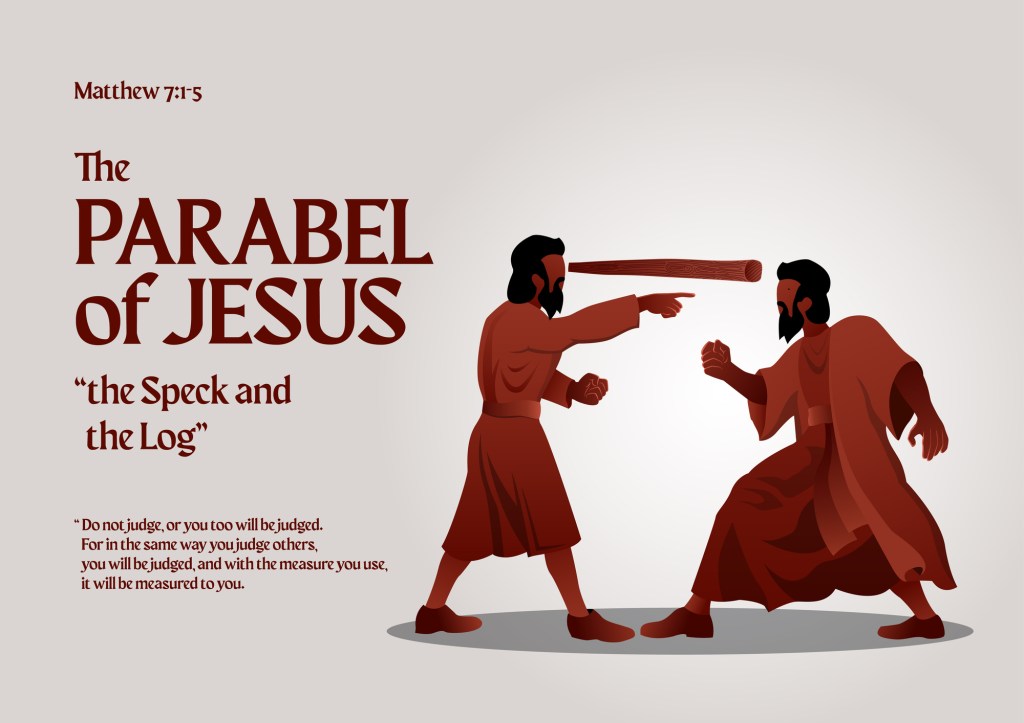
I have written previously about the parable of the log in a person’s eye who sees a speck of saw dust in another person’s eye. (See 8 Important Points about Judging and Judgment) Jesus says that we need to be careful about focusing on the specks in others’ eyes because of the logs in our own eyes. (Matthew 7:1-5)

Jesus is expressly talking about judging others, but the implications are much larger than that. They are about loving others, especially our brothers and sisters in the Lord. It is also about our posture to the world (those who do not know God in Christ, who gave Himself up for us).

We might be tempted to read what Jesus said and walk away thinking that we should not judge other people. That isn’t quite what Jesus says. Jesus says be careful in the way you judge others because the way you judge others is the way you will be judged. (Matt. 7:1-12)

We can’t get away from making judgments, which is nothing more, really, than the conclusions we reach based on what we know. We make judgments about innumerable things every day.

This is also not about Judgment (capital J). Only God has the authority to judge people, and God alone is a true Judge who can weigh all the facts accurately and completely. God alone knows our thoughts and our hearts. We can only judge by appearances, and we judge only from ground level.

When we see a speck in our brother’s eye, the parable should cause us to consider the logs in our own eyes, first. It’s a matter of perspective. What seems like a speck in someone else’s eye appears like a log when that speck is in my eye. Even so, humans have an unusual capacity to get used to those “logs” and forget they even exist.

One point of this parable is that we need to be dealing with our own sin as a matter of first priority. If sin is discovered in our brother, that discovery should cause us to consider first our own sin. I believe this is a fair reading of what Jesus is saying.

Jesus also does not tell us to leave our brother alone with a speck in his eye. Rather, he tells us to be considerate as we determine what to do about. We need to start by considering our own sin sinned (missing the mark) in our own lives. Then we need to approach our brother in the right attitude of heart, with empathy, realizing that we are not any better then our brother who’s speck we have observed.

Today, I have read what Paul says in Galatians 6:1-2 in my daily reading, and the parable about the log and the speck comes rushing back to me. I realize that Paul’s admonition in Galatians 6:1-2 harmonizes with what Jesus was taught his disciples in this parable:

“Brothers and sisters, if a person is discovered in some sin, you who are spiritual restore such a person in a spirit of gentleness. Pay close attention to yourselves, so that you are not tempted too. Carry one another’s burdens, and in this way you will fulfill the law of Christ.”

Galatians 6:1-2 NET (Emphasis added)

I previously observed that we must be in relationship with others to do what Jesus has said (judge rightly). We should not be approaching anyone about a speck in their eye if we do not do it from the perspective of loving relationship (as brothers and sisters). We have to do this in the right relationship, or we will not do it right.

Continue reading “How Do I Help My Brother with a Speck In His Eye When I Have a Log In My Own Eye? Judging Rightly” →

The Surprising Value of the Concept of Sin

The idea of sin makes people feel uncomfortable, and people blame sin for making them feel bad about themselves.


Many people bristle at the Christian idea of sin, and many people fault Christianity for its emphasis on sin. Richard Dawkins criticized Christianity in his book, The God Delusion, that it’s all about sin, sin, sin. His sentiment seems to be a popular one.

As a long-time Christian, I have a “robust” view of sin not just because I have robust respect for the Bible. I see sin in myself, and I see it in mankind, generally. I see it as a fact, like gravity, that makes sense of the foibles, failures, and futility of people and human systems I see in the world.

Not that people are incapable of doing good. Even who do not believe in God can do good. Even in doing good, though, I believe most of us do it good “selfishly” – because it makes us feel good; because of peer pressure; because we want people to honor us; because we want other people to be nice to us; or simply because of the utilitarian ideal that it makes the world a better place for me and my tribe to live in.

Most people, I assume, would be uncomfortable with my assessment. Maybe what I see in myself shouldn’t be “projected” onto other people. Maybe I am right, though. I wouldn’t believe it if I didn’t think it is a fair assessment.

I think one issue people have with the idea of sin is that they don’t know what to do with it. It doesn’t fit into an evolutionary paradigm that celebrates the progress of humanity from primordial ooze to ape to rational being.

Absent a cosmic redeemer, people have no “solution” for sin. Reject the One, and the other makes no sense. Many people don’t want a cosmic redeemer interfering with their self-determination (even people, ironically, who believe we have no self-determination, because we merely dance to our DNA).

People don’t see any “value” in sin. The idea of sin makes people feel uncomfortable. They blame the concept of sin for making them feel bad about themselves. When people measure their goodness against others, they either feel shame or self-righteousness, because they see themselves as better or worse than others.

People blame judgmental attitudes, intolerance, lack of empathy for others, and a host of other evils on the Judeo-Christian concept of sin.

On the other hand, do people who have rejected the Christian concept of sin stop feeling bad about themselves or stop being self-righteous? In my experience, no, they don’t.

Abandoning the idea of sin doesn’t seem to help people not feel bad about themselves, and it doesn’t stop people from being self-righteous. People still compare themselves to others. People still struggle with self-image, and some people still seem to think themselves morally superior to others even after rejecting the concept of sin.

The Christian vocabulary that includes sin has no place in alternative cultural constructs, like cultural Marxism, and the host of critical theories that flow from it. Judgment of others, however, is baked into those constructs, and virtue is signaled for group approval in ways that seem, to me, just as inimical as any bad church environment.

People are shamed and labor under judgmental attitudes perfectly well without the help of Christianity. In fact, I believe the shame and self-righteousness is even worse because other cultural constructs lack the Christian concepts of redemption, grace, and forgiveness.

But, I believe in sin simply because it makes sense of all my experiences and everything that I see in people and the world that is run by people. I have never thought of sin as a value proposition, other than to think that sinfulness is generally bad. I have certainly never thought of the idea of sin as good!

Until now.

Continue reading “The Surprising Value of the Concept of Sin” →

Hope in the Midst of the Warnings in Hebrews

A believing heart turns toward God. As long as it is “today”, we can turn toward God, and we can have confidence that He will forgive.


“Therefore, since we are surrounded by such a great cloud of witnesses, let us throw off every encumbrance and the sin that so easily entangles, and let us run with endurance the race set out for us. Let us fix our eyes on Jesus, the author and perfecter of our faith, who for the joy set before Him endured the cross, scorning its shame, and sat down at the right hand of the throne of God.”

Hebrews 12:1-2[1]


These two verses in Hebrews 12 were shared with me by a gentleman at the church I go to who sends out daily verses by text to a group of men. Sometimes things like this are particularly timely and poignant. These verses inspires my thoughts today.

I have been wrestling with my own sinfulness lately. I have been painfully aware of areas of sinful behavior in my life and sinful attitudes in my heart that I have yet to conquer. The threads of this sinfulness go back to childhood, and they are rooted deeply.

I find myself stumbling over the same things time and again. I sometimes feel like a bird caught in a snare that cannot escape. I am tempted to be completely disgusted with myself, indignant, and condemning. Then, I recall that God is faithful to forgive; and I must ask myself, “Who am I to condemn?” Unless, of course, I am not really “saved”.

I have variously felt convicted, forgiven, hopeful, condemned, hopeless, and depressed in cycles for a long time. I tire of continually going back to God, asking for forgiveness…. again! I fear that my lack of success in overcoming these things means that I do not have the power of the Holy Spirit in me; and maybe I have fooled myself into believing in Christ’s power in my life.

I am reminded today that the letter to the Hebrews carries in it some of the most hopeful and some of the most despairing verses that can be found in the New Testament, like my cycle of feelings. I am digging deeper today to explore them. In doing so, I am reminded that the trajectory of Hebrews is hope!

The following verses provide great hope to the weary Christ follower:


“[S]ince we have a great high priest who has ascended into heaven, Jesus the Son of God, let us hold firmly to the faith we profess. For we do not have a high priest who is unable to empathize with our weaknesses, but we have one who has been tempted in every way, just as we are—yet he did not sin. Let us then approach God’s throne of grace with confidence, so that we may receive mercy and find grace to help us in our time of need.”

Hebrews 4:14-16


If we “hold firmly to the faith we profess” and “approach God’s throne of grace with confidence”, these verses promise mercy and grace to help us in our time of need. These words bring great comfort to a person like me.

Yet, thoughts arise in my mind that are concerning: What does it mean to “find grace to help us in our time of need”? How does this grace help us? Does this grace mean forgiveness in our time of need? If so, then I am thankful for that grace?

What is that grace in our time of need us the power to overcome the sin – to put a stop to it? What if the grace we receive is meant to empower us to stop, and I don’t stop? Does that mean I didn’t receive the grace that is offered? Am I doomed if I continue to fail?

A fear naturally arises that grace is not enough for me, that maybe it isn’t offered to me, or that I have spurned that grace by continuing to fail. If we go on sinning, we fear we will exhaust God’s well of mercy. The consequences of “falling away” loom ominously:


“It is impossible for those who have once been enlightened, who have tasted the heavenly gift, who have shared in the Holy Spirit, who have tasted the goodness of the word of God and the powers of the coming age and who have fallen away, to be brought back to repentance. To their loss they are crucifying the Son of God all over again and subjecting him to public disgrace.”

Hebrews 6:4-6


This passage is particularly ominous in its finality and the impossibility of coming back from “falling away”. I have tasted of the goodness of the word of God, If I go on sinning is there no repentance for me?

Am I the only who thinks like this? Am I the only one who fears being on the wrong side of this grace that is offered, doomed to a life of sin and, eventually, death? Fortunately for us, we have hope!

Continue reading “Hope in the Midst of the Warnings in Hebrews” →

Justice, Mercy, Sin, Forgiveness, Jonah and the Cross

“Correct me, O Lord, but in justice; not in your anger….

“Correct me, O Lord, but in justice; not in your anger, lest you bring me to nothing.” Jeremiah 10:24 ESV

This is my cry today. At some level it is the cry of everyone, or should be the cry of everyone, because we are sinners. We are saved only by God’s grace.

Sometimes, like today for me, we are keenly aware of our sinfulness. Some days we aren’t.

Though I gave myself to God as my Lord and Savior many years ago, I still find myself climbing onto that throne in my heart and taking back control. I may be mindful and submissive in the morning. By evening, I have taken back that position I promised to God in the morning.

Like a bird caught in a snare, I find myself entangled by the old, sinful threads of my life that tangle easily around my feet. I gave them to God once for all time. Only I find myself going back to them, like a moth to a flame. Then, I must turn to God… once again… and again… and cede control again.

I am 61 years old. I have been a believer for 40 years. I know better.

Shouldn’t I be further along in the process of personal holiness and sanctification? Why am I so weak to deal with these things that have plagued me since I was young?

How many times will I fail? How many times will I repent? How many times will I fall? How many times will God forgive me?

I ask myself. I ask God.

Continue reading “Justice, Mercy, Sin, Forgiveness, Jonah and the Cross” →

Ravi Zacharias and the Greatness of Our Hope

We shouldn’t put our leaders on pedestals. Our faith and hope is in God, and God alone.

The buzz in the Christian world over the scandalous details that were reported and corroborated about Ravi Zacharias have subsided a bit, but they will linger in our collective memories. It seems he led a double life for years before his death from cancer in 2020.

The stories that have emerged expose a man who was driven by lust and sexual sin to groom woman for his own personal pleasure. Because he was such a beloved defender of the faith, the news came like shock waves. We have recoiled in horror and tried to process the fact that he turned out to be so different than his public persona.

He was a gifted orator, intelligent, winsome, personable and commanding in his presence and ability to respond to the most difficult challenges skeptics and hostile audiences threw at the Christian worldview. He was a champion defender of the faith. He went boldly into the world’s top academic institutions and unashamedly proclaimed the gospel in the most intellectually rigorous environments in the world with aplomb, tact and grace.

I found connection with him, perhaps, because his approach was filled with a command of literary style and nuance that really spoke to me, a college English Literature major. Thus, the sordid details of a very seamy private life hidden largely to the world until after his death have hit very hard. I, personally, can’t stop thinking about it.

I have watched people wrestle through explanations. People have grappled with “what went wrong”. People have advanced lists of solutions to the perceived problems in the Christian world that allowed this duplicity to go on so long unnoticed and unaddressed (even when allegations came to light).

Disappointment from Christian leaders in my life have rocked, previously, when. I have made the mistake of putting too much trust and personal capital in them (and not enough in God. Himself). So, I am not completely dismayed. Though every man be a liar, still God is true!

Many people have done a good job at dissecting what went wrong and how to avoid similar scandals in the future. I don’t think I would add value to provide my own list of things we should do or not do…. Not that there is a magic pill for the Church to take because it’s messy… People are messy!

I have just been trying to find perspective.

Perspective requires taking a step (or many steps) back. This is hard to do in the immediate wake of such a scandal. It’s hard to do when it hits “close to home”. It’s hard to do when we are personally invested in some way.

Before the facts were known, the natural tendency was to brush off the rumors and give a favorite son the benefit of the doubt. I did that. After the facts of such a scandal are known, we tend to want to wring our hands, wipe our hands from it, and condemn it and the man behind it.

I have taken down most of my references to Ravi Zacharias in this blog, though not all of them. Truth is truth, even if spoken by a duplicitous person. If I can find a reference from someone else, though, for the same proposition, I will use it before referencing Ravi Zacharias. The value of using his voice has been diminished to practically nil.

At the same time, I think we need to dig a little deeper and confront this scandal a bit more squarely in the face. Not that RZIM (the organization Zacharias founded) has not done that with the investigation and disclosure of the news, but I think we can gloss over some sober truth in the process of wringing and washing our hands of the scandal.

Stepping back from the immediate shock and disappointment some thoughts occur to me that (I think) should be discussed. Too soon? I don’t know.

Continue reading “Ravi Zacharias and the Greatness of Our Hope” →