
The contrast between the ministries of Elijah and Elisha provides insight that carries into the coming of the Messiah, the ministry of Jesus, and the New Covenant. The contrast between Elijah and Elisha is a contrast between the Old Covenant and the New Covenant. It is a contrast between an emphasis on the judgment of God and an emphasis on the grace of God and salvation.
In my ignorance, Elijah previously stood out more to me than Elisha, even though Elisha famously asked for and received a double portion of the spirit Elijah had. The spirit of Elijah passes to Elisha as seen in the miracles each of them performs. Scholars often highlight the fourteen miracles performed by Elisha versus the seven miracles performed by Elijah as an example of the double portion, but the differences between Elijah and Elisha go much deeper than that.
The character of the miracles is different. This is something I might not have noticed but for a focus on the details in the story of Elijah over the last few years. Those details led me to see some lessons from the story of Elijah that do not stand out at first blush.
Elijah was an oppositional prophet. He was the antagonist to Ahab and Jezebel. He challenged the prophets of Baal and smoked them in a fiery display of God’s power over the impotent idol (Baal) that Ahab and Jezebel worshipped.
Elijah had all the prophets of Baal slaughtered, but Jezebel was not impressed. She called for Elijah’s head, and he fled in fear. He sulked in self-absorbed pity. He complained to God that he was the only one who was faithful, and he seemed to come close to finding fault even with God for the anti-climactic outcome.
When God tried to show Elijah that God was not in great displays of power like wind, fire, and earthquake, Elijah seemed incapable or unwilling to acknowledge what God was saying. Twice God asked why Elijah ran away to Mount Sinai. Twice Elijah gave God the exact same answer.

Elijah protested to God that he had been zealous, and he insisted that he, alone, was faithful to God in all of Israel…. But clearly, he was not alone. Multiple times the text tells us that Obadiah was faithful; he saved 100 prophets from Jezebel’s decree of capital punishment; and God found 7000 people left who had not bowed to Baal.
Elijah seemed not just disappointed, but upset (with God?) that judgment had not rained down on Ahab and Jezebel and all of Israel. It wasn’t that judgment didn’t loom over their heads; it was that God controls the timing – not Elijah.
God told Elijah to go back and anoint Hazael king of Aram and Jehu king of Israel and to pass his mantle to Elisha. Elijah passed the mantle to Elisha but he never followed through with the other instructions God gave him.
Elijah continued in ministry even after he passed his mantle to Elisha, but he seems to take a back seat to other prophets, and he did not change his attitude. God told him to meet the messengers of the King of Israel to deliver a message. After they delivered the message to the king, the king sent them back to summon Elijah, but he smoked them by calling down fire. The king sent another envoy of messengers, and Elijah smoked them with fire also – killing 50 people at a time.
Though God told Elijah to confront the king’s messengers with his own message, the text is conspicuously silent about Elijah calling down fire on the envoys who came to summon him. The King sent a third group of messengers to summon Elijah, and this time God told him to go with them.
Now that I have spent some time meditating on the stories of the two prophets, Elijah stands out for his brashness, but Elisha stands out as the prophet who is more true to who God is. He is the one whose ministry is more characteristic of God, and his ministry stands out in the way way it bridges the narrative arc of Scripture between Old Covenant and New Covenant, from a focus on Abraham’s descendants to all the nations, from the Law of Moses to the Law of grace, love and Christ.
Elisha signals the change from the old covenant to the new covenant. Elisha points the the direction that the arc and sweep of Scripture will take us. Elisha is the link in this point in the narrative to God’s ultimate plans and purposes in the world.
Elisha’s first miracle matches Elijah’s last miracle – the parting of the Jordan River. (2 Kings 2:13–14) Elijah departs for heaven after parting the river; while Elisha begins his ministry with the parting of the river.

Elisha has the same prophetic spirit as Elijah, but his willingness to trust God, and his perception of his own place in God’s plans and purposes is miles ahead of Elijah. Whereas, Elijah was oppositional, defiant, judgmental, and brash; Elisha was more winsome, understanding, quietly confident, and perceptive.
If Elijah had tunnel vision, Elisha saw the big picture, and that might explain why he was more quietly confident, rather than brash. Whereas, Elijah’s miracles involved dramatic displays of power – especially with fire. Most of Elisha’s miracles are seemingly more understated – they are healing and life-giving:
- He parts the Jordan River with Elijah’s cloak. (2 Kings 2:13–14)
- He heals the waters of Jericho with salt. (2 Kings 2:19–22)
- He provides water to an army when there is no water around. (2 Kings 3:16–20)
- He multiplies a widow’s oil. (2 Kings 4:1–7)
- He promises a son for a barren woman. (2 Kings 4:8–17)
- He raises the woman’s son to life after he dies. (2 Kings 4:18–37)
- He purifies poisoned stew. (2 Kings 4:38–41)
- He feeds 100 men with 20 loaves of barley, leaving leftovers. (2 Kings 4:42–44)
- He heals the Aramean general, Naaman, of leprosy. (2 Kings 5:1–19)
- He makes an iron axe head lost in the water to float. (2 Kings 6:1–7)
- He frustrates the plans of the Aramean King, blinds his army, restores their sight, feeds them, and sends them on their way. (2 Kings 6:8–23)
- A dead man is healed when he is thrown on Elisha’s bones. (2 Kings 13:20–21)
Elijah seems to stand at an intersection between Moses and Jesus, and these miracles seem to be a bridge between the Old Covenant and the New Covenant:
- Parting the Jordan River is reminiscent of Moses parting the sea, Joshua parting the Jordan before entering the Promised Land, and Elijah parting the Jordan before being taken to heaven; and it looks forward to Jesus calming the sea and walking on the water.
- Healing Jericho’s water is reminiscent of Moses making bitter water sweet while looking forward to Jesus, who offers Living Water.
- Feeding 100 men with 20 loaves is reminiscent of manna in the wilderness, and it looks forward to Jesus feeding the 5,000 and the 4,000.
- Multiplying the widow’s oil is a reminder of God providing oil and food in the wilderness and looks forward to Jesus changing water to wine, miraculous catches of fish, and Jesus teaching us to pray for the provision daily bread.
- Healing Naaman of leprosy is reminiscent of the bronze serpent bringing healing in the wilderness and looks forward to Jesus cleansing lepers.
- Promising a son to the barren woman might be reminiscent of Moses being saved in the basket and looks forward to the virgin birth.
- Raising the woman’s son from the dead may have no match in the time of Moses, but it looks forward to the resurrection of Jesus.
- God’s spirit working through the prophets is reminiscent of God’s presence dwelling in the tabernacle, and it looks forward to God’s Holy Spirit dwelling bodily in Christ and in all believers, corporately, who follow him.
Elisha’s miracles involving judgment have a different sense about them. They highlight the importance of having integrity in ministry. Gehazi was stricken with leprosy when he tried to capitalize on Hazael’s desire to reward Elisha. Gehazi tried to appropriate what God was doing for his own, personal benefit, and and he paid the price.
Elijah’s attitude is, perhaps, somewhat akin to Gehazi’s in the sense that both of them wanted something for themselves. Elijah’s desire was more noble: he wanted God and himself to be vindicated. He wanted God’s judgment to be meted out by his own hand. Gehazi was ignoble and base in his desire for personal gain, but both of them were focused on their own desires.
We see this play out in the New Testament examples of the apostles arguing over their places of honor (Mark 10), the Samarian sorcerer who offered to pay Peter for the ability to do miracles (Acts 8), and Ananias and Saphira (Acts 5). Jesus rebuked his apostles for focusing on their own prestige; Peter rebuked the sorcerer for thinking he could buy miraculous power; and Ananias and Saphira were stricken dead for thinking they deceive the apostles to gain personal prestige.
Elisha cursing the 42 youths of Bethel who mocked him is a bit more shocking. This was at the beginning of Elisha’s ministry. Perhaps, he cursed them in haste. He didn’t specifically call out bears to maul them. Perhaps, Elisha did not intend such an immediate and dramatic response by God.

It seems uncharacteristic when looking at the rest of his ministry. God defended him and the integrity of the prophetic ministry, but we don’t see Elisha cursing anyone else for the rest of his life – unlike Elijah, who had a thing for calling down fire, consuming companies of 50 men at a time.
Elisha’s ministry is characterized more by healing and life-giving miracles – cleansing polluted water, multiplying oil and food, giving new life to a barren woman, restoring life to a child, recovering a lost tool, healing disease, and rescuing enemies. Jesus carries that trajectory even further. When James and John want to call down fire like Elijah, Jesus rebukes them (Luke 9:54–56), and the ministry of Jesus is characterized also by the same kinds of healing and life-giving miracles.
Interestingly, both Elijah and Elisha visit widows in times of distress and make miraculous provision for them. Elijah and Elisha both bring those widows’ sons back to life. Their ministries are not opposed to each other. Elisha receives the same spirit Elijah had, but Elisha is more characteristic of the New Covenant to come and of God’s desire for mercy, rather than judgment.
Elisha is not enamored with power and immediate outcomes like Elijah. Elisha seems to understand the lesson Elijah refused to acknowledge – that God is in control, that God is working his purposes in ways we cannot always see, that God does things in God’s timing, and that God controls the outcomes.
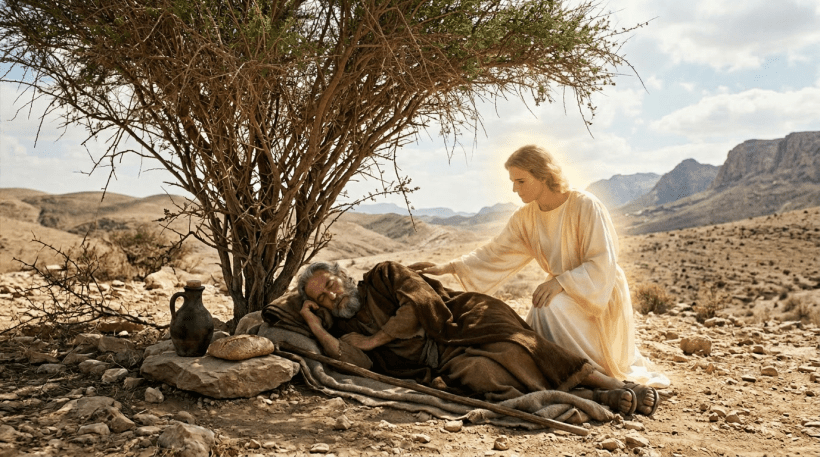
Elijah was bitterly disappointed when Ahab and Jezebel remained in control after his fiery display of God’s power to show up the prophets of Baal. Elijah sulked inconsolably, though God nurtured him back to strength and tried to show him that God is working even when he can’t see it.
Elijah was bitterly disappointed when Ahab and Jezebel remained in control after his fiery display of God’s power to show up the prophets of Baal. Elijah sulked inconsolably, though God nurtured him back to strength and tried to show him that God is working even when he can’t see it.
After showing Elijah that he was not in the wind, fire, or earthquake – that God was in the still small voice – God told Elijah, he was not alone, that 7,000 Israelites remained faithful, and that God’s work will continue through Hazael, Jehu, and Elisha. Yet Elijah’s perspective remained unchanged: he continued to complain to God that he was zealous (as if God isn’t?) and that he alone was faithful (though God told him clearly that wasn’t true).
Elijah was focused on the immediate outcomes of his own ministry. He was focused on his own expectations and desired results. He wanted to see God’s power, judgment, and vindication, and he didn’t seem interested in anything else.
Yes, God is ultimately a Judge, but God does not desire judgment. God desires mercy. Elijah seemed to align with God in his judgment, but Elisha aligned with God in his desire for mercy. In this sense, Elisha represents God more accurately, because God is patient, desiring none to perish and all to be saved. (2 Peter 3:9 & 1 Timothy 2:3-4)
Elijah apparently failed or refused to anoint Hazael as king of Aram, so Elisha did it, but he wept because he foresaw the atrocities Hazael would commit against Israel. (2 kings 8:12) Elisha did as he was told, and he left the outcome to God. Though Elisha knew the outcome, he mourned what happen. In doing this, Elisha foreshadows Jesus when Jesus stood outside of Jerusalem before the “triumphal entry” and wept over the destruction he knew was coming. (John 11:35)
While Moses and Elijah appear with Jesus on the Mount of Transfiguration, they disappear and give way to Jesus, who stands alone as God’s beloved Son in whom He is well pleased. This symbolizes a dramatic shift from the old Covenant to the New Covenant, from the Law of Moses that is incapable of dealing with sin and death to the law of Christ that conquers sin and death.
Elijah’s ministry fades and gives way to the ministry of Jesus. Though Elisha is not represented on the Mount of Transfiguration, his ministry is echoed in the ministry of Jesus.
None of these things diminish Elijah’s role. God used him at the right time and in the right way. Elijah confronted Israel at a moment when the nation needed to know that the Lord—not Baal—was God. But after that confrontation, God raises up Elisha, whose ministry reveals another, and ultimately more complete, dimension of God’s character: patient, restorative, compassionate, and life-giving.
One overarching thought wraps up the lessons from Elisha that I am seeing. Elisha’s tears over Hazael (2 Kings 8:11–13) anticipate Jesus weeping over Jerusalem. (Luke 19:41–44) The prophet who is most like Jesus and, therefore, most like God the Father does not rejoice that judgment is coming. He announces it faithfully because it is God’s word, yet he grieves over the suffering that human rebellion will bring. That combination—obedience without resentment, truth spoken through tears rather than triumph— points forward to the heart of Christ and the heart that his followers should develop.


