“Suicidal Empathy” and Weakness: Trust and the Church

Confusion and red flags are reason to stop and consider who we are and where we are going


A funny thing happened to me one evening recently. I received a text from a number that was not in my contacts. The texter introduced himself and said he was from “VBC”. He said he emailed me, but I didn’t respond, so he was sending me a video of the child I sponsor from Uganda with a link for me to click.

I didn’t know the person. I didn’t get an email, and I don’t sponsor a child from Uganda.

Since scamming people is a billion dollar industry, I was cautious,. I do sponsor a child from Africa, but she lives in Ethiopia. The initials, “VBC”, are the initials for the church I go to, so I didn’t just delete it. I looked up name of the texter, but I couldn’t find his name in the directory.

I wanted to respond positively if he was a brother in my church, but I didn’t know him. What if someone hacked into the church directory? What if they found just enough information to make it sound good and to get me to click on a malicious link?

I texted him back and asked what email he had for me. The email he sent back was one letter off. He also sent an email with a shortened version of my former wife’s name, but it isn’t the shortened version she uses. It was close, but wrong. He had just enough of the right information for me to think it was legitimate but just enough of the wrong information for me to pause.

Finally, I texted the campus pastor, and he confirmed that the man was from VBC (but a different campus). He also did go to Uganda where the church has an ongoing missionary presence.

Then, I remembered: there is a young man in the church with exactly my first and last name. I have only met him once because he is a distant relative, and he goes to a campus of the church that is furthest from the one I go to. With this information, I called the man who texted me, and we had a good a laugh.

My name isn’t common. We both sponsor children in Africa. We both were marred to women with the same first name (different nicknames). The similarities were uncanny, but the differences signaled the need for caution.

I was thinking about this after doing my routine reading the next morning. The reading plan focused on James’s letter “to the twelve tribes scattered among the nations” (James 1:1), and it posed this question:

Have you ever been confused about who sent a text, email, or note?

In light of my experience the previous night, I realized that God might be talking to me! The follow up questions ask whether not knowing who sent the message confuses the meaning and whether knowing who the sender is changes our understanding.

The answer is definitely, yes and yes! I was confused when I wasn’t sure who sent me the original text, and knowing it came from a trusted source changed everything.

The context in which this story and my thoughts arise this morning is the confusion in the church caused by Donald Trump and his sidekick, Elon Musk. I have seen red flags since 2015 and reason for caution. The topic has been much on my mind, because some Christians champion these men and defend everything they do, and other Christians don’t.

It seems to boil down to who you trust and whether we should ignore look the other way at the things that seem a little “off”.

What are we to think? Can we trust them? Do we know who they are? Do we ignore the red flags? Perhaps, more importantly: Do we know who we are?


I am afraid I can’t get very deep into this subject without writing a tome, and I have already written much, so I want to stick with the context out of which this experience and these thoughts flow. Specifically the controversy over Elon Musk’s comment to Joe Rogan: “The fundamental weakness of western civilization is empathy.”


Continue reading ““Suicidal Empathy” and Weakness: Trust and the Church”

God Doesn’t Leave Us Where We Are

God has plans for you.


I wrote some time ago on the subject that God meets us where we are. That blog article has been among the most read articles on this site since I wrote it. It was heartfelt, part of my own journey of discovery, and I think it resonates with the longing and angst that seems always resident in the human heart. Certainly always in mine.

God stands at the door to our hearts knocking. He doesn’t break the door down, and He won’t continue to knock if we ignore Him. He doesn’t overpower us, and He doesn’t seek to compel us against our will.

Yet, He desires us so much that He left His glory behind to become one of us, to enter into our human, historical space, and to offer Himself up for us – to redeem us – and provide a way for us to connect with Him. He took on human form, and He offered Himself up in a human body to demonstrate His love for us. Amazing!

No one can say that God is not invested in our redemption and in our good. No one can show more love or commitment to another person than to lay down his own life for another, and God did that for us.

Yet, He is unwilling to violate our will to coerce us into relationship with Him or to require us to submit to Him – even if it is for our good. He desires a loving relationship with us. He loves us like a parent loves a child because He “gave birth” to us (knitting us together in our mothers’ wombs (Psalm 139)). His love is unwavering even if we ignore Him and go our own way.

Thus, God meets us where we are. We can go nowhere that God is not present and able to meet us – when we are ready to meet Him.

Where can I go from your Spirit?
    Where can I flee from your presence?
If I go up to the heavens, you are there;
    if I make my bed in the depths, you are there.

psalm 139:7-8

God meets us where we are when we are ready and willing to meet Him. He was always there, but we are not always ready or willing. When we get to that “place”, though, God is ever ready to meet us.

Know, however, that “meeting” the God who is always there is not an end; it is just a beginning. It is the beginning of a relationship with your creator. It is just the beginning of God’s good intentions for you.

“‘For I know the plans I have for you,’ declares the Lord, ‘plans to prosper you and not to harm you, plans to give you hope and a future. Then you will call on me and come and pray to me, and I will listen to you. You will seek me and find me when you seek me with all your heart. I will be found by you,’ declares the Lord….”

Jeremiah 29:11-14a

God’s intentions for you are good – to prosper you and not to arm you. We have trouble sometimes trusting God’s goodness, but this is the essence of faith: for “whoever comes to him must believe that he exists and that he rewards those who diligently search for him.” (Hebrews 11:6) His promise for us is so good it is beyond our ability even to imagine! (1 Corinthians 2:9)


Yet, Jesus warns us to count the cost. (Luke 14:28) Why? What cost?

These are important questions that we should ask. There is a catch – a cost – that we need to be aware of: God may meet us where we are, but He doesn’t intend to leave us there.


Continue reading “God Doesn’t Leave Us Where We Are”

The Top 10 Most Read Articles in 2024

This blog has picked up some steam in the last year, and COVID era articles lead the way


I have been blogging since 2012. I began in simple obedience to what I believed God was prompting me to do. I didn’t initially set out to write for anyone in particular. I endeavored only to be obedient to use the gifts God has given me. This blog began as a journey of faith for me, not just as a way to be obedient, but as a way of listening, seeking to understand, and working out what God was working in me.

This blog still is those things, but I soon realized that I wasn’t just writing for me, that I had an audience, albeit a very small one. The audience to whom I found myself writing in those early days was the seeker, the unbeliever, the curious, and the doubter.

Over the years I find have found myself writing often for a different audience. I still have a heart for the seeker, but I find myself writing more to the American church, the people who call themselves Christians, whether their claim is predominantly political, cultural, or spiritual.

I see a large segment of the church identifying uncritically with a political and cultural form of Christianity, as I once did, and missing the ever counter-cultural nature of the kingdom of God. My heart is to urge people to be faithful to Christ alone – not to a nation, a culture, a political party, or even a denomination.

These concerns prompted the article that had the highest views in 2024. With 6241 views, Who Were the Sons of Issachar? And What Might They Mean for Us Today? was the most read article on Navigating By Faith this year. Fitting it is, given the shift in my writing.

This article was a “Covid baby”, written in 2020, as I wrestled with the way some Christians, including some of my friends, embraced a mixture of unabashed support for Donald Trump and an appetite to follow crazy conspiracy trails down rabbit holes as we neared a presidential election in the throes of a worldwide pandemic.

Our nation was greatly polarized, and voices in American church were just as polarized as the world around us. Those tensions over politics, how we should respond to COVID, and how we should faithfully reflect God to the world around us drove me to reflect on the days when nation of Israel was torn between King Saul and David, the man after God’s heart.

These tensions continue today. We all want (or should want) to be people after God’s heart. We still need to know how to understand the times and how God would have us live in them, being faithful to His purpose in harmony with the kingdom of God, which is not a kingdom of this world. These concerns have not abated, which may be why this article has been the most read article each year since I wrote it.

Another, more personal and timeless reflection was the subject of the second most read article in 2024: The Redemption of Korah: the Sons of Korah. Also written during COVID in 2020, this article was viewed 3580 times this year. It has been the second most read article on this blog each year since I wrote it in 2020.

The Redemption of the Sons of Korah speaks to the redemptive work of God despite our worst tendencies. The article followed some research I did about the sons of Korah. Korah led his tribe in rebellion against God’s man, Moses, and they were all swallowed up by the earth.

That seemed to be the end of the story, but something in the text caught me attention, and began to search the rest of Scripture to find out whether any descendants of Korah survived and what became of them. What I found is one of the most poignant, but beautiful, redemption stories in the Bible.

One other article topped 3000 views in 2024, but before I get to it, I pause to reflect on the fact that I previously measured the most read articles of each year in the hundreds. In some years, I could not find ten articles with even 100 views. By 2019, the total viewership had risen to just over 10,000.  It jumped to 20,000 in 2020, the year of COVID. The next three years topped out around 30,000, but this year viewership has jumped above 61,000!

I have no idea what accounts for the change. It isn’t that I have written more articles. I have written double the number and triple the number of articles in previous years. I don’t know what the explanation is for the increase. I don’t monetize this sight, and I only post the articles on my Facebook group, typically. Sometimes, I post to my public Facebook feed, and I post to LinkedIn even more rarely.

I don’t spend much effort to be found, but people seem to find me. In fact, 114,190 people found Navigating By Faith on search engines this year according to WordPress. This compares to 5272 people finding the blog on Facebook where I post all of the articles. Go figure.

Any way, rounding out the top 3 articles is God Meets Us Where We Are, with well over 3000 views. The three most read articles in 2024, including this one, were all written in 2020, during the “COVID era”. During that time, we were all home more, reading more, and reflecting more on the state of the world and our lives.

Continue reading “The Top 10 Most Read Articles in 2024”

Of Shepherds, Angels, the Glory of the Lord, and the Christ Child Born in Humble Estate

At Christmas, we celebrate God coming to us and revealing Himself to us in human form to draw us to Him


“An angel of the Lord appeared to them, and the glory of the Lord shone around them, and they were terrified. But the angel said to them, ‘Do not be afraid. I bring you good news that will cause great joy for all the people. Today in the town of David a Savior has been born to you; he is the Messiah, the Lord.'”

Luke 2:9-11 NIV

This is a classic Christian text remembered at this time of year about the birth of the Christ child. The birth of Jesus in the town of David would have drawn the attention of 1st Century Hebrews who knew their Scripture. The significance of that understanding is preserved for us today by Luke, the traveling companion of Paul the Apostle.

Bethlehem was the birthplace and early home of King David, who is Israel’s most venerated and celebrated king. (1 Samuel 16:1, 1 Samuel 17:12). The prophet, Samuel, who presided over the coronation of David, foretold that God would establish from the lineage of David a kingdom that would last forever. (2 Samuel 7:12-16)

The prophet, Isaiah, lived about three centuries after David. Fourteen kings reigned between David and King Hezekiah, Isaiah’s contemporary. After a span of time longer than the United States of America has been a country, Isaiah repeated and expanded on what Samuel foretold:

“For to us a child is born,
    to us a son is given,
    and the government will be on his shoulders.
And he will be called
    Wonderful Counselor, Mighty God,
    Everlasting Father, Prince of Peace.
Of the greatness of his government and peace
    there will be no end.
He will reign on David’s throne
    and over his kingdom,
establishing and upholding it
    with justice and righteousness
    from that time on and forever.”

Isaiah 9:6-7

The prophet, Micah, a contemporary of Isaiah, He riffed on the same theme:

“But you, Bethlehem Ephrathah,
    though you are small among the clans of Judah,
out of you will come for me
    one who will be ruler over Israel,
whose origins are from of old,
    from ancient times.”

micah 5;2

According to the biblical chronology, these predictions of a coming kingdom and a king “whose origins are from ancient times” were declared 700-1000 years before the birth of Jesus. Those predictions were memorialized in the writings we identify with Samuel, Isaiah, Micah and others, and they were preserved for many centuries before Luke penned his own words tying them to the birth of Jesus of Nazareth, who was born in Bethlehem.

Though it was an ignoble birth by all accounts, we still remember back almost 2000 years now, recalling the prophecies declared from of old. We remember the birth of Jesus, lying in “humble estate” in a manger in the same space where the animals lived.

Hold that thought…. because today, I want to focus on the first half of the verse with which I introduced this article. The passage began with these words:

An angel of the Lord appeared to them, and the glory of the Lord shone around them, and they were terrified….

This may seem like a strange twist to the way I have started this article, but I will bring it back around. I think you will be glad to stick with me as I take seems like a left turn.

Continue reading “Of Shepherds, Angels, the Glory of the Lord, and the Christ Child Born in Humble Estate”

Christmas and the Transcendent, Imminence of God

Jesus is called Emmanuel, which means God, with us.


“If God is real, then He can be known.” This is the assertion made by Dr. Sharon Dirckx, who has a PhD in brain imaging from the University of Cambridge and has held research positions at the University of Oxford and the Medical College of Wisconsin. Dr. Dirckx does not say this lightly.

Dirckx grew up in a secular household, asking questions like “Why can I think? Why do I exist? Why am I a conscious being?” as a child. She was impressed with the “awareness of my own existence, of my own consciousness.” These questions led her on a lifetime quest.

Dirckx knew she wanted to be a scientist as a teenager. Her biology teacher gave her the book, The Selfish Gene, by Richard Dawkins. That book set the course of her thinking as a child “that we are just gene machines, that there’s just the material and that’s all that it means to be a human being.” She absorbed a materialistic worldview from Dawkins and the people around her.

“I arrived at university to study biochemistry assuming that we were material beings and that science and God were not compatible.”

Making Sense of Science and Faith – Sharon’s Story, By Sharon Dirckx, Jana Harmon,on September 13, 2024 Sharon DirckxeX-skepticSide B StoriesCSLI PodcastsJana Harmon

Dr. Dirckx achieved her dream of becoming a scientist, but her path deviated from the materialism she assumed and absorbed as a teenager. She is now the author of several books and a frequent speaker on the subject of faith in God. You can listen to her story on the eX-skeptic podcast embedded below.

I want to pick up and run with her statement: If God is real, then He can be known. I agree with her, but I believe many people make the mistake of thinking that God can be known on their terms. We make the mistake to think that if God exists, He exists within our own purview and within the limitations we experience as human beings that we can control on our terms.

He doesn’t. When we are talking about the creator God who made the universe, and all that is in it, including human beings and all of material reality, we are talking about a God who is transcendent. He is the uncaused causer and the uncreated creator. He is not found in his creation as if He was a component of it.

Such a God is said to be “outside” of the space/time continuum. The concept of such a God includes a spaceless, timeless, immaterial reality that is not contained within or limited by the material world.

Some quantum and theoretical physicists speak variously of consciousness that collapses the wave function of particles, Platonic or Mathematical Realism that imagines immaterial mathematical forms underpinning material reality, and Philosophical Idealism that imagines consciousness or mind-like properties out of which the material world emanates. These are non-theistic attempts to get at the idea that the material world is contingent, and immaterial reality is the fundamental building block of and force behind the universe and reality.

The most robust of these conceptions is the theistic one pulled out of the text of the 60 some writings by 40 some authors compiled in the work we call the Bible. If God is real, and He created the universe as these writings claim, with all of it’s immensity, and if He created life, including humans, He is completely different (Other) than us: God is transcendent.

Yet, people have always had some sense of this transcendent reality. Religious expression is among the oldest of the traces of human history we can find in the archaeological and written records we are able to find from our ancestors.

While we may tend to assume that all primitive humans believed in a panoply of Gods animating the material world, evidence exists to suggest that primitive people from diverse corners of the world believed in one, Creator God. This monotheistic conception of God may, in fact, by the oldest form of religious belief.

Perhaps, the pagan gods that inhabit the material world seem more accessible. They might make demands on our behavior, but they have no province over the thoughts in our minds, our wills, and our hearts.

That we would have a hard time finding a transcendent God and making sense of him is understandable. Imagine a living being the size of an electron viewing a human being from an electron’s vantage point: How does an electron-sized being make sense of a human being – or anything above the quantum level, for that matter?

The difference between a human being and a transcendent, creator God is much greater then the difference between an electron-sized being and a human being. For one thing, they are both part and parcel of the same material reality. The biblical conception of God understands that God transcends the material world.

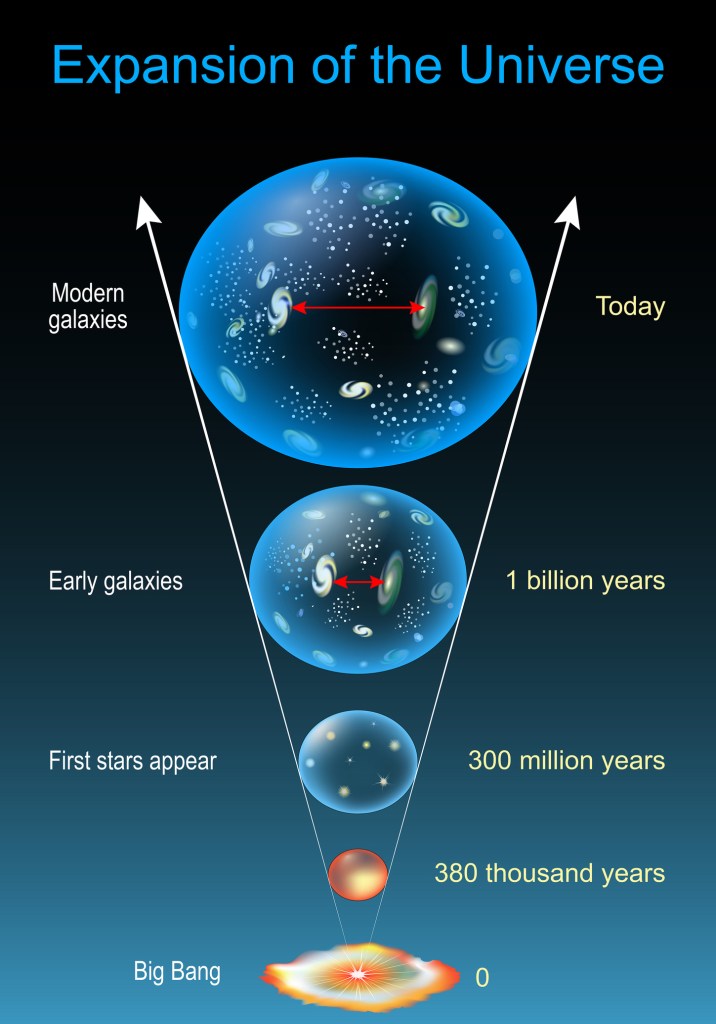
To quantify this difference, we might imagine a human being compared to the infinitely vast space of the universe. Now add in the bit about God being completely “Other”: spaceless, timeless, and immaterial.

I maintain that such a God would need to reveal himself to us. How could we know such a God unless He revealed Himself to us?

I have written about this before. God must “stoop” to us to make himself known. We cannot “ascend” to Him.

Continue reading “Christmas and the Transcendent, Imminence of God”