As often happens with me, the things I have been listening to and reading have converged in a meaningful way. Whether we attribute these “convergences” to God’s presence in our lives or dumb luck, pure happenstance, or “coincidence” is a matter of speculation and faith.
Whatever you want to call it, I take special notice of these things. I pay attention. I take them seriously, and they become signposts on my journey through life.
Perhaps, I am just being a good attorney. I am trained to find harmony and contrast in nuanced fact patterns and to apply legal principals to them. Finding harmonies and contrasts and applying spiritual principals to them operates in the same vein. That’s the way my mind works.
Yesterday, I listened to an interview of Jonathan Pageau by Justin Brierley. Pageau is an interesting character and a critical thinker. His recent conversation with Brierley inspires my writing today.
Raised in Montreal influenced by French Catholicism in a French Baptist Church community, Pageau has moved over to Eastern Orthodoxy by way of 4-year and 3-year stints in the Congo and Kenya. He has an undergraduate degree in postmodern art. He returned from Africa to obtain a degree in Orthodox Theology and Iconology from Sherbrooke University in Quebec. Along the way, Jonathan Pageau has become a cutting edge Christian thinker who is in demand as a speaker.
One line of discussion caught me ear in the interview with Justin Brierley that I want to explore. The subject touches on post-Enlightenment, neo-religious thinking and the proof of God.
Judging by my social media feed, this question is poignantly apropos. It’s not just “people in the world” I see at odds with each other. I see many people posting memes under the banner of Christ, getting their lobbing verbal grenade’s at “the people in the world” and fellow Christians, alike.
I confess I have difficulty not being blunt, and for that I ask for your grace when I say that the spectacle saddens me. Humans have always lived in a world dominated by rising and falling empires, but Jesus came preaching a kingdom not of this world. Almost 2000 years after Jesus died and rose again to emphasize the Good News he proclaimed, we still fly our empire banners alongside Christ.
It wasn’t always like that, though. For almost three centuries after Jesus died on the cross at the hands of the Roman Empire, his followers proclaimed the Gospel without any influence or power in the world. His followers were mocked, derided, and marginalized, and they suffered cycles of persecution culminating in the Great Persecution.
Beginning in 303, Emperor Diocletian, who established a tetrarchy with Maximian, Galerius, and Constantius (the father of Constantine), issued a series of edicts demanding that Christians comply with traditional (pagan) religious practices. (See Wikipedia) Diocletian presaged the Great Persecution when he took power in 284, purging the army of Christians and surrounding himself with public opponents to Christianity. He led an “activist government” and promoted himself as “restorer of past Roman glory”. (Ibid.) (Making Rome great again?)
Diocletian finally ordered “a general persecution” on February 23, 303. The reign of persecution was short-lived (unless you endured it, I suppose). Constantius, the father of Constantine, restored legal equality for Christians in Gaul in 306, and Maxentius usurped Maximian’s control in Italy and North Africa in the same year with a promise of religious toleration. When Licinius ousted Maximinius in 313, the persecution was formally ended.
The political ebbs and tides of the time (with implications for the church) are reminiscent of our political shifts from right to left to right in recent years. Perhaps, little has changed in that way, yet the change that followed in 313 was unprecedented, and this change set the course of the Church on a path it had never before traversed.
Eusebius, the Christian historian, wrote as a contemporary of Constantine with glowing approval of the events that changed the course of Christianity forever. Eusebius is the person who preserved the details of Constantine’s personal story of conversion to Christianity.
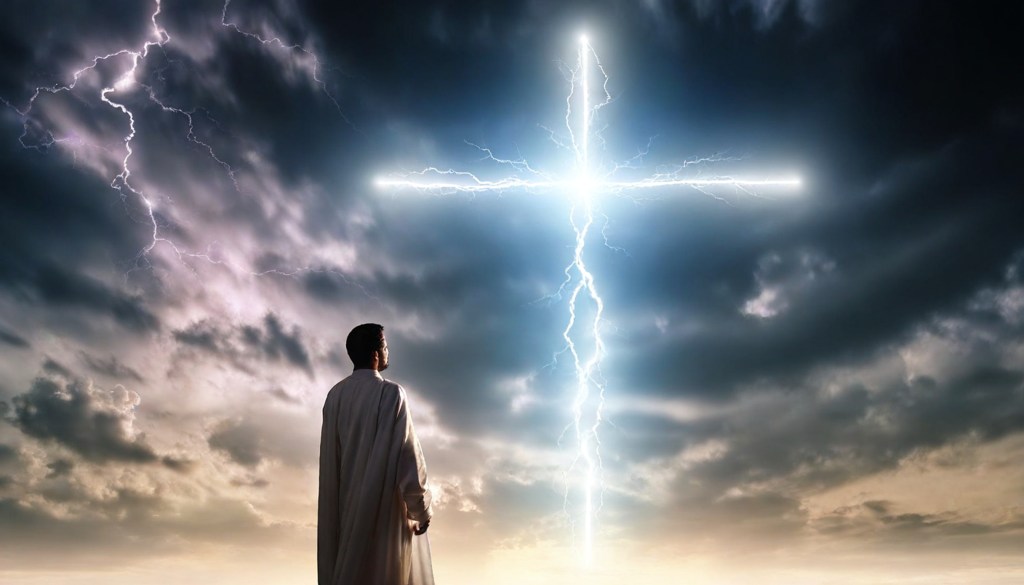
As the story was told by Constantine, he had a vision in 312 shortly before an imminent battle with a challenger to the throne of the Roman Empire, Maxentius, whose army outnumbered Constantine’s. Constantine saw in the sky a giant cross with the inscription, “In this sign conquer!” The vision was followed by a dream that evening in which Jesus purportedly came to him and told him to conquer in his name. Thereafter, Constantine established the cross as the standard for his army and the banner under which the Roman armies marched to battle and conquered in the name of Christ, the lamb of God who died that we might live.
In the podcast (titled Post Christian) featuring the Australian journalist, Greg Sheridan. John Dickson commented on the approval by Eusebius of Constantine’s use of the cross as a symbol of conquering on behalf of the Roman Empire this way:
“A people used to mockery and social exclusion – and worse – were now invited into the very center of power. And perhaps most bizarrely, the Christian sign of humble self-sacrifice – a cross – was now the formal path – the very symbol – of the Roman war machine. It is so hard to get my head around when I consider what Jesus said about the cross – his cross – and its social implications.”
Juxtaposed to the image of Roman armies conquering under the sign of the cross in the name of Jesus, Dickson recalled the story of James and John, the sons of Zebedee, who asked Jesus asking to seat them on the right and the left of Jesus when Jesus rose to power. These brothers, like many First Century Jews, expected a conquering Messiah. They interpreted the prophets to predict a Jewish Messiah “who would lift Israel above Rome and crush the enemies of God.”
Jesus gave them a response they didn’t expect and likely didn’t understand at the time:
“You don’t know what you are asking,” Jesus said. “Can you drink the cup I drink or be baptized with the baptism I am baptized with?”
Mark 10:38
The other disciples became indignant with James and John thinking, perhaps, they they deserved glory and recognition also. They, like many before and after them, may have viewed religion as a path to power and influence, and they may have been annoyed at the audacity of James and John out of jealousy. At this, Jesus brought them together and set them straight.
“You know that those who are regarded as rulers of the Gentiles lord it over them, and their high officials exercise authority over them. Not so with you. Instead, whoever wants to become great among you must be your servant, and whoever wants to be first must be slave of all. For even the Son of Man did not come to be served, but to serve, and to give his life as a ransom for many.”
I became a follower of Jesus in 1979, though I was a wild, untamed stallion when I was first confronted with the Lordship of Christ and verbally submitted to him. I wandered down my own paths in the year that followed, leading me to a breaking point and more complete surrender. (A cycle I have unfortunately repeated more than once.)
Over the following two years, I was about as surrendered to God as I have been my whole life. I was all in – or as all in as I was capable of being at that time, perhaps. During that time, I became a big fan of Keith Green. I even saw him in concert in Des Moines Iowa in 1981 or 1982. He died in a place crash within a year or two after that, and his impact and memory has faded.
When I saw him in concert, though, his radical Christian commitment had been a huge impact on me, and that impact carried with me beyond his death. Thus, my daily reading today recalls to my mind these lyrics by Keith Green:
To obey is better than sacrifice I want more than Sundays and Wednesday nights If you can't come to me every day Then don't bother coming at all
Keith Green was a musical child prodigy who was radically saved by Jesus. He used his great musical talent and platform to become a prophet of sorts to young Christians at the time who wanted an authentic faith.
I was very drawn to a monastic, cloistered life at that age. The truth is that I had long been drawn to that kind of thing going back to the book, My Side of the Mountain, that I read in grade school (about a boy who leaves his parents to hollow out a summer home in the trunk of dead tree in the Catskills). I was already bent that way in my personality.
In a poignant moment in my senior year in college, I faced up to that longing and desire that ran deep in me, and I turned to follow Jesus into the messiness of human society. Jesus escaped to the mountains and the wilderness to be alone with God, but he always returned to the highways, and byways, and the public squares where people live.
Still, the Keith Green spirit of uncompromised obedience to Christ and Christ alone left an imprint on me. His prophetic insistence on radical commitment carried me forward in those early years of my journey with Christ.
Now, I find myself some 40+ years down a road that has taken many twists and turns. That road has taken me through long and winding wilderness areas that were darker than I care to dwell on. It has taken me to the other side of those dark times into the light of a new day, more weary and (hopefully) wiser for the experience. I am still following Jesus as best as I can, but I have a slightly different view of Keith Green’s words today. I hope I can give this the nuance it deserves.
Popular trends arise in culturally contingent ways, and those trends often dominate the public mind for a season. Thus, the idea that Christianity borrowed from prior pagan mythology gained notoriety with the rise of New Atheism. The Zeitgeist: The Movie (2007) is a poster child for this popular trend in thinking.
The Zeitgeist movie forces the narrative, ignoring glaring dissimilarities, and manufacturing similarities that don’t really exist. It ignores (or isn’t familiar with) the relevant academic scholarship, but it has been watched well over one million times. We might say that the Zeitgeist movie has become legendary in a truly mythic sense itself.
I will go out on a limb, nevertheless, to say that Christians have shown far too much angst over this trend of claiming that Christianity is similar to prior pagan mythology. There are critical differences, and they are significant, but there are some similarities also. Do the similarities pose a problem for Christianity?
The short answer is, no. In fact, if truth is truth and reality is reality, ancient, pagan attempts at explaining that reality are likely to hit on some metaphysical truth. If they didn’t, I might begin wonder about the nature of reality and our ability to recognize and understand it.
Mythic literature as a genre is an attempt to provide some explanation and understanding of basic realities and the ebb and flow of life. I am reminded of these things as I sit outside on an unseasonably warm day in November with a view of trees bared of their multicolored leaves that have been collected by my earnest neighbors in piles lining the suburban streets for pickup.
Fall is ebbing into the dark night of winter. The subtle coolness in the breeze portends (what seems to me now) a distant spring. I am braced for what comes next as I enjoy what is likely to be the lest vestige of warmer days for longer than I care to think about.
My hope for the spring, however far off it seems in my present mood, is rooted in my experience of the certainty of the seasons. I know my hope is not fanciful, even as I brace (all too knowingly) for the cold, bleak trudge ahead.
It seems completely natural that ancient mythology captures this duality in stories that have religious significance. These experiences are common to man. We remind ourselves of the hope of spring as we gaze in wonderment at fall trees in the throes of seasonal death and the chill onset of winter. It reminds us of our own life and death sagas, even now in all our modern comforts.
Our modern comforts allow us to be a bit more disconnected and circumspect, perhaps, than our ancient forbearers. Those comforts and great advances in scientific knowledge allow us to be intellectual about these things. Ancient pagans lived literally at the mercy of the seasons, and all the things they didn’t know played like gods on the stage of their fraught imagination.
Modern people chalk seasonal changes up to natural cycles that just happen. We believe humans chased all the gods off long ago. The ownership we have asserted in our knowledge of the way the world works gives us an illusion of control that I surmise is not all that much different than the ancients, who sought some ownership and control of this world through the mediators of gods they thought they could appease.
Pagans found solace in the seasons as we do. Myth is rooted in collective experience, and it is driven by an impulse to understand and import control into our experience. We also have a natural inclination to seek meaning. We might call this impulse a “religious” one.
Though we have the chased the gods off, we still have a religious impulse. Though we no longer believe in many gods, and we no longer venerate ancient myths with more than a curious read, the idea of one, Creator God God persists, and it is not explained away by modern science and knowledge. The Bible, though it has ancient origins, stands up to our modern scrutiny in ways that pagan myth does not.
“If God is real, then He can be known.” This is the assertion made by Dr. Sharon Dirckx, who has a PhD in brain imaging from the University of Cambridge and has held research positions at the University of Oxford and the Medical College of Wisconsin. Dr. Dirckx does not say this lightly.
Dirckx grew up in a secular household, asking questions like “Why can I think? Why do I exist? Why am I a conscious being?” as a child. She was impressed with the “awareness of my own existence, of my own consciousness.” These questions led her on a lifetime quest.
Dirckx knew she wanted to be a scientist as a teenager. Her biology teacher gave her the book, The Selfish Gene, by Richard Dawkins. That book set the course of her thinking as a child “that we are just gene machines, that there’s just the material and that’s all that it means to be a human being.” She absorbed a materialistic worldview from Dawkins and the people around her.
“I arrived at university to study biochemistry assuming that we were material beings and that science and God were not compatible.”
Dr. Dirckx achieved her dream of becoming a scientist, but her path deviated from the materialism she assumed and absorbed as a teenager. She is now the author of several books and a frequent speaker on the subject of faith in God. You can listen to her story on the eX-skeptic podcast embedded below.
I want to pick up and run with her statement: If God is real, then He can be known. I agree with her, but I believe many people make the mistake of thinking that God can be known on their terms. We make the mistake to think that if God exists, He exists within our own purview and within the limitations we experience as human beings that we can control on our terms.
He doesn’t. When we are talking about the creator God who made the universe, and all that is in it, including human beings and all of material reality, we are talking about a God who is transcendent. He is the uncaused causer and the uncreated creator. He is not found in his creation as if He was a component of it.
Such a God is said to be “outside” of the space/time continuum. The concept of such a God includes a spaceless, timeless, immaterial reality that is not contained within or limited by the material world.
Some quantum and theoretical physicists speak variously of consciousness that collapses the wave function of particles, Platonic or Mathematical Realism that imagines immaterial mathematical forms underpinning material reality, and Philosophical Idealism that imagines consciousness or mind-like properties out of which the material world emanates. These are non-theistic attempts to get at the idea that the material world is contingent, and immaterial reality is the fundamental building block of and force behind the universe and reality.
The most robust of these conceptions is the theistic one pulled out of the text of the 60 some writings by 40 some authors compiled in the work we call the Bible. If God is real, and He created the universe as these writings claim, with all of it’s immensity, and if He created life, including humans, He is completely different (Other) than us: God is transcendent.
Yet, people have always had some sense of this transcendent reality. Religious expression is among the oldest of the traces of human history we can find in the archaeological and written records we are able to find from our ancestors.
While we may tend to assume that all primitive humans believed in a panoply of Gods animating the material world, evidence exists to suggest that primitive people from diverse corners of the world believed in one, Creator God. This monotheistic conception of God may, in fact, by the oldest form of religious belief.
Perhaps, the pagan gods that inhabit the material world seem more accessible. They might make demands on our behavior, but they have no province over the thoughts in our minds, our wills, and our hearts.
That we would have a hard time finding a transcendent God and making sense of him is understandable. Imagine a living being the size of an electron viewing a human being from an electron’s vantage point: How does an electron-sized being make sense of a human being – or anything above the quantum level, for that matter?
The difference between a human being and a transcendent, creator God is much greater then the difference between an electron-sized being and a human being. For one thing, they are both part and parcel of the same material reality. The biblical conception of God understands that God transcends the material world.
To quantify this difference, we might imagine a human being compared to the infinitely vast space of the universe. Now add in the bit about God being completely “Other”: spaceless, timeless, and immaterial.
I maintain that such a God would need to reveal himself to us. How could we know such a God unless He revealed Himself to us?
I have written about this before. God must “stoop” to us to make himself known. We cannot “ascend” to Him.