Favoritism in the Bible, The Here & the Hereafter

God’s mercy shows no bounds, and He is equally merciful to all of us.


“Now in those days, when the disciples were growing in number, a complaint arose on the part of the Greek-speaking Jews against the native Hebraic Jews, because their widows were being overlooked in the daily distribution of food.”

Acts 6:1

Even in the early church led by the 12 apostles who lived with Jesus and learned at his feet, the Church was susceptible to favoritism. The early church embraced a radical, communal life in which they pooled their resources, and everyone in need was taken care of. More or less!

The native, Hebrew widows were being taken care of, but the foreign, Greek-speaking widows were being overlooked. Things were not perfect then, and they never are. People are people, and we tend to fall short, even in our best moments.

People naturally tend to look after our own. “Me and mine”, as Pete might have said in the iconic Coen brothers film, O Brother Where Are Thou?

This human characteristic is not all bad. It prompts mothers and fathers to care for and look after their own children. It inspires family members to look after other family members and friends to look after friends.

At the same time, this human characteristic causes us to care more for our own children and families than for others and to care more for our friends than for our neighbors. It causes us to “take care of our own” to the exclusion of “others”, and that can lead to things like racial discrimination, nepotism, and a failure to have empathy for strangers.

James, the half-brother of Jesus, also deals with favoritism in his letter to the early Church. (James 2:1-13) He called the Church to account for showing “special attention” to men “wearing fine clothes” by giving them the best seats while making the poor churchgoers stand or sit on the floor. (James 2:1-4)

James called favoring the wealthy over the poor sin in no uncertain terms! (James 2:9) He described it as breaking the law of God – the law of loving your neighbor as yourself. (James 2:1-2)

James was clear that this kind of favoritism has no place in the family of God. If any favoritism is sanctioned by God, it is the kind of favoritism that focuses on the poor, the less fortunate, and the people that are marginalized by our human tendencies to show favoritism for our own, personal benefit.

When our favoritism is motivated by selfishness, it is sin. James was particularly strong in his condemnation of favoritism motivated by selfish desires. If we “favor” the marginalized, the vulnerable, and the ones who have less influence in this world, we do it without expectation of personal benefit, and we follow in the example of Jesus.

Continue reading “Favoritism in the Bible, The Here & the Hereafter”

God’s Radical, Generous Unfairness

This theme is, perhaps, more prominent in Scripture than we might realize.


If you are like me and most people I know, the parable of the workers in the vineyard is hard to understand and appreciate. This parable that Jesus told is recorded in Matthew 20:1-16. Jesus set the context of the parable with the statement,

For the kingdom of heaven is like a landowner who went out early in the morning to hire workers for his vineyard. He agreed to pay them a denarius for the day and sent them into his vineyard.”

matthew 20:1-2

The context of this is a parable is the kingdom of heaven.

According to the parable, a vineyard owner hired some workers for the day to work in his vineyard. Those first workers began early in the morning, and they agreed to work for a denarius. The comments in the margin of the NIV translation notes that a denarius was the usual wage paid for a day’s work at that time. This makes sense so far.

As the parable goes, the vineyard owner went back out to the marketplace throughout the day, and he continued to solicit people to come work in the vineyard, saying, “I will pay you whatever is right.” And so, additional workers began working at 9:00 AM, at noon, at 3:00 PM, and again at 5:00 PM.

When the work day ended at 6:00 PM, the vineyard owner told his foreman,

“Call the workers and pay them their wages, beginning with the last ones hired and going on to the first.”

Mathew 20:8

Beginning with the workers who started at 5:00 PM, each one was paid a denarius. The workers who began at 3:00 PM were also paid a denarius, and so on.

When the workers who began the day early and worked through the entire day stepped forward, they expected to get more than the other workers. Each one, however, only received a denarius.

They naturally began to complain to the vineyard owner about the unfairness of the vineyard owner. Why should the workers who worked only an hour (or three hours or just half a day) receive the same compensation as the workers who worked all day? Doesn’t that seem unfair?

The early workers agreed to work for a denarius; they got what they agreed to work for; and a denarius was, in fact, the going rate of compensation for a day’s work. From that standpoint, the wage they were paid was fair, but why should a worker who worked for only one hour be paid the same wage?

The relative compensation seems patently unfair to us. Though the first workers got what they bargained for and got what was considered to be a fair wage, the later workers got the same wage for less work.

One thing I had not noticed before is that the point of this parable is to provoke our sense of fairness. How do we know that?

Go back and look at verse 8: Jesus says the vineyard owner specifically informed the foreman to pay the last workers first … in front of all the other workers. If he had paid the first workers first, they would have gotten what they expected, been satisfied with it, and left – not knowing that the later workers were paid the same wage. Instead, he made a point of paying the last workers first.

This parable “works” precisely because it offends our sense of fairness. It seems God expects it to offend us! But what does that say about God?

Continue reading “God’s Radical, Generous Unfairness”

The Dilemma of God Demanding Justice from Beings Incapable of Meeting God’s Standard

There is one critique of the Christian notion of sin and the justice of God that is troubling on its face. That key critique for anyone who claims that God demands justice for sin is that God is seemingly unjust to require justice of beings who can’t measure up.

Many modern people bristle at the Christian idea of sin, and they bristle even more at the idea that God would punish sinners. Frankly, I think many modern people simply don’t understand what sin is and who God is.

But, that aside, there is one critique of the Christian notion of sin and the justice of God that is troubling on its face. That key critique for anyone who claims that God demands justice for sin is that God is seemingly unjust to require justice of beings who can’t measure up.

Alongside the notion that the God of the Bible and demands judgment for not measuring up to God’s just standard is the notion that all people are sinners who don’t measure up. In fact, the New Testament is fairly read to say that people are incapable of living up to God’s standard.

The doctrine of original sin says that we are all corrupted because the sin of Adam and Eve has been passed down generation after generation. Even if we don’t believe in the doctrine of original sin, however, the Bible is clear from the Old Testament to the New Testament that human beings don’t measure up to God’s standard:


They have all turned aside; together they have become corrupt;
    there is none who does good,
    not even one.

Psalm 14:3


They have all fallen away;
    together they have become corrupt;
there is none who does good,
    not even one.

Isaiah 53:5


as it is written:

“None is righteous, no, not one;
   .
 All have turned aside; together they have become worthless;
    no one does good,
    not even one.”

Romans 1:10-12


Jesus said, “No one is good except God alone.” (Mark 10:18 (NIV)) Yet, he says, “Be perfect … as your heavenly Father is perfect?” (Matthew 5:48)

This is the dilemma: How can we be perfect?! “To err is human” the bard once said, and so it seems we are imperfect by our very nature.

Many people reject the idea that God can be just and demand justice from people incapable of measuring up to the standards God’s justice demands. They say it would be unjust for God to demand justice from beings who have no ability to act other than they do, and so fail to meet God’s standards.

God seems to be acting unfairly to demand that we meet His standards when we are 1) created beings, 2) born into sin, and 3) incapable of living up to the perfection God requires.

Other questions tumble after these thoughts: Why didn’t God create us perfect? If we are born sinful, how can God blame us for being sinful? If we are incapable of being perfect, how can God punish us for our imperfection?

Continue reading “The Dilemma of God Demanding Justice from Beings Incapable of Meeting God’s Standard”

Abraham, Isaac, the Blood Path, Christ and Him Crucified

I started on a journey exploring the story of Abraham and Isaac deeper and with more nuance in my previous article, The Story of Abraham and Isaac Revisited: Introduction. The story of God’s seeming demand to Abraham to sacrifice his son, and Abraham being seemingly willing to do it, is quite misunderstood, especially without reference to the Ancient Near East context.

Child sacrifice was ubiquitous among the religions with which Abraham was familiar. Abraham would have thought the demand for the sacrifice of Isaac unsurprising among the arbitrary and capricious gods in the Ancient Near East world he knew.

The story is of the first 11 chapters of Genesis and of Abraham is a revelation that the God of Abraham is different than all the other Ancient Near Eastern gods. In the subsequent article, The Story of Abraham and Isaac Revisited: Here I am!, we explore the interpersonal dynamics of Abraham and Isaac that set the stage for much greater revelation of which God is.

Through Abraham’s dutiful and faithful obedience to the demand he feared would be required of him, God demonstrated His character in a way that was indelibly etched into the experience and psyche of Abraham and Isaac. They would learn that God does not make the same kinds of demands as the other gods: God would provide the sacrifice Abraham feared that God required of him.

In Abraham, Faith and a Hope Deferred, I may seem to take a sideways turn off the path of revelation of God’s character to Abraham, but I will finish the story in this article and get to that point.

The ground we covered in that last article included a blessing by God to Abraham, but the experience of God’s momentary blessing was dampened by the cold reality of God’s yet unfulfilled promise.

In Genesis 15, Abraham sought more assurance from God that the land he lived as a stranger would really become the land of his descendants and, more fundamentally, that he would actually have descendants. Many years had passed, and Abraham was still childless.

In response, God asked Abraham to set up a covenant with five animals of specific types to be slaughtered, cut in half and placed opposite each other on either side of a depression. The blood of those animals drained into the depression creating a blood path. This, Abraham knew, was the stage for entering a covenant with God.

These types of covenants were familiar to ancient Middle Easterners. I understand that similar covenant rituals are practiced today by Bedouins.

Abraham would have known the drill. As the lesser party to the covenant, he would go first, signifying that God should do to him (stomp on a pool of his blood) if Abraham didn’t keep his part of the bargain. With the lesser party committed to the covenant, the greater party would seal the deal, and go last, walking through the blood path.

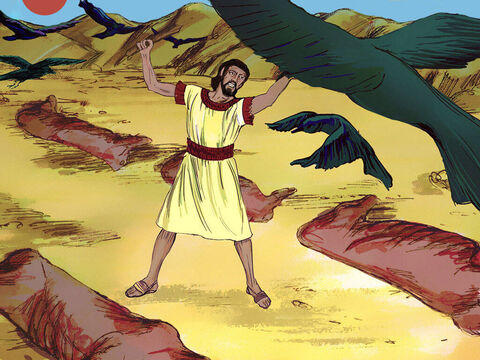
Only Abraham doesn’t initiate the covenant by walking through the blood path. He waits so long that he must drive the birds of prey away from the rotting carcasses. Then Abraham falls into a fitful and dark sleep.

Why did Abraham hesitate? Maybe he realized the significance of what God was setting up – a covenant between a fallible person and the Almighty God! Abraham was not likely worried so much about the commitment God would be making to him, but about the commitment Abraham would be making to God!

So, Abraham, perhaps, feared to enter in to the covenant. He falls into a restless sleep, and God comes to Abraham in his sleep. The “assurance” Abraham receives in his dreams is far from satisfying: God says the promise to Abraham’s descendants would not be finalized for 400 years!

Abraham would be long dead and gone.

This is where we pick up the story. This is where we get the next revelation of the kind of God the God of Abraham is. If we aren’t tracking with the story, we won’t appreciate what happens next:

Continue reading “Abraham, Isaac, the Blood Path, Christ and Him Crucified”

Caste Systems, Nationalism, and True Christian Faith

The thing about a speck in someone’s eye is that it seems like a plank to the one with the speck.

I’m listening to Unbelievable? | Hinduism, Caste & Christianity: Joseph D’Souza and Kancha Ilaiah Shepherd. The following statement by Anglican, Joseph D’Souza, caught me up: “The caste system in India has poisoned the church in India just as racism poisoned the church in the West.”

Joseph D’Souza is an Indian Christian, but he stands as an outsider in India, which is increasingly being driven by a right wing movement to preserve India’s Hindu heritage and power against the threat of Christianity, in particular. Thus, I find it ironic, and convicting, that he finds a parallel between India’s caste system and racial disparity in “the west.”

Kancha Iliah Shepherd, the other participant on the podcast, was born of the Dalit class in India – one step above the untouchable caste/class. Against all odds, and the rules of the caste system, he became educated, and he wrote a book, Why I am not a Hindu, critiquing the caste system.

On the podcast, he questioned what Hinduism has to offer the lower castes who can not receive the education of the Braham caste, cannot learn to read and write the language of the Hindu gods (Sanskrit) and cannot serve in Hindu temples? Why be a Hindu unless one is born a Braham?

D’Souza observed that many Dalit and untouchables in India are becoming Christian because of Christian doctrines, such as the doctrine that all men and women are made in the image of God; God is Creator of all people; and there is no distinction among people (no Jew or Gentile, no slave or free, no man or woman) in Christ.

Though the Hindu nationals have succeeded in passing a law against “forced conversion”, D’Souza says that no one in India is forced to convert to Christianity. People convert because they want to. The church, in fact, stands against the idea of forced conversion.

The present Hindu nationalist movement seems to be partly to blame for Christian conversions because of its adherence to the caste system. The lower castes find in Christianity a God who does not perpetuate a caste system, who made all people equally in His image, and who makes no distinction between people on the basis of caste, birth rights or nationality.

Shepherd adds that God cannot be a nationalist. If there is one true God, He is God of all people in all places, nations and stations in the Earth. Shepherd said this as an Indian of the Dalit caste in India speaking against the Hindu conservative resurgence that forbids lower castes from becoming priests while maintaining a strong Hindu nationalist position.

If we look at the world through the eyes of these Indian men, we can gain some understanding and insight to be applied to our Christian walk in the United States. We can begin to understand why Christian nationalism is heresy and why Christian tolerance, ambivalence, and apathy for racial disparity in the US is poison in the church.

Continue reading “Caste Systems, Nationalism, and True Christian Faith”