The creation of Adam – Vatican Sistine Chapel in Rome, Italy. Created by Michelangelo Buonarroti.
I took some interest in a Facebook post at Bible Archaeology[1] about the image of Tiberius Caesar on a Roman coin like the one Jesus referenced in Matthew 22:15-22.[2] Some scriptural references and back ground facts are the subject of my writing today.
The story is well-known. Some Jewish leaders challenged Jesus with the question, “Is it lawful to pay taxes to Caesar, or not?”
It was a ruse. They were trying put Jesus into the impossible position of aligning either with the Jews (against the Romans) or with the Romans (against the Jews) on the issue of paying taxes.
Jesus famously asked for a coin, and then he asked whose image was imprinted on the coin. It was Caesar’s image, of course. Then Jesus said, “Therefore render to Caesar the things that are Caesar’s, and to God the things that are God’s.”
Perhaps, my interest was piqued because I have written about the story before. I talk about rendering unto Caesar in the context of how Christians should respond to secular authority.[3] I wrote about Jordan Peterson’s comment, crediting the words of Jesus to the creation of the modern principal of the separation of church and state.[4] But I haven’t focused on what it is we are to “render” to God.
I am always excited to learn something new, and the Bible Archaeology post added some details I didn’t know. The first details provide the backstory to the story, which involves Judas the Galilean. The interrelationship of the two stories shows how intertwined, complex, nuanced and harmonious Scripture is within itself and with external facts discovered through historical and archaeological sources, among other things.
I appreciate the historians and archaeologists, like Bible Archaeology, that dig up corroborating details. In the Facebook post, they cite additional scriptural passages on Judas the Galilean that give us insight into why the Pharisees in Galilee challenged Jesus on the issue of paying taxes.
I have been busy of late (what else is new?), so I haven’t written much, though I always have thoughts swirling in my head that I would like to get “down on paper”. Today, I have just a short thread I want to get out of my head.
Paul speaks of the God Abraham believed in as the God “who gives life to the dead and calls into existence the things that do not exist.” (Romans 4:17 ESV)
Many are the gods that people have believed in since time immemorial. From gods made of wood and stone, to trees, mountains, the sun and other natural objects, to the pantheons of Greek and Roman gods, the number of gods people have believed in are legion.
Today, Hindus still have a panoply of gods, and pagans still worship objects of nature (or simply nature, itself). Christians and Muslims have whittled the legion down to one, and atheists believe in, simply, one less God than they. Other than the atheists of the world, most of humanity believes in something transcendent that is labeled divine.
The human drive is to attempt to discern the transcendent. Most agnostic believe that something transcends the natural worlds, though they won’t dare to divine what it is. Even some atheists hold out some form of believe in transcendence, even if they ultimately determine it is illusory. They acknowledge, like Stephen Hawking did, that it is helpful to believe it.
There is mystery in the transcendence we sense breaking into the world. There is intrigue. There is anticipation, and there is hope in the sense of transcendence that lingers often on the blurry edges of our mundane existence, sneaking into it at times leaving us breathless and wondering.
I often allude the curious statement in Ecclesiastes 3:11 that God put eternity in the hearts of men:
“He has made everything beautiful in its time. He has also set eternity in the human heart; yet no one can fathom what God has done from beginning to end.” (NIV)
If God didn’t put a yearning for transcendence into the human heart, where does it come from? I believe that is a rhetorical question.
For many, the idea of a transcendent being or reality is just too much to grasp. It is surrounded by too much uncertainty and requires too much strain and effort to attain even a dark understanding of it that they determine the simpler, easier and preferable course is to remain agnostic or to dismiss the idea of transcendence altogether.
Others have taken the leap to embrace one understanding or another and have committed themselves to that understanding. Thus, the legions of gods that have existed in the constructs of human thought. And that might just be what all or most of them are – constructs of human thought, attempts at putting a “face” on the transcendence we sense in he universe.
One man, Abraham, believed in a God “who gives life to the dead and calls into existence the things that do not exist.” This was a God above all gods. This was a God who spoke the universe into existence.
This was a God who Paul and other first century Judeans believed entered into the world He created in the form of a created being in whom He imprinted His own image. God could enter that being because He created room for Himself in that being. The writer of Hebrews says:
“[Jesus] is the radiance of the glory of God and the exact imprint of his nature…. (Heb. 1:3)
In very recent times, our best scientists have determined that the universe had a beginning. It came into existence a finite time ago. Stephen Hawking demonstrated the necessity of “singularity” (a beginning) mathematically.
The trio of Arvind Borde, Alan Guth and Alexander Vilenkin determined mathematically that any universe that is expanding had a beginning (a singularity) a finite time ago. Thus, a point of singularity, a beginning, would apply to any number of multiverses.
The fact that our universe, and any universe like ours that exists or could possibly exist, had a beginning a finite time ago raises the specter of the transcendent – a Beginner who initiated our universe into existence.
This is the God Abraham believed (a God who “calls into existence the things that do not exist”) in at a time when people were still making gods out of wood and stone. Though the entire world he knew thought they could conjure up and appease gods they made, Abraham believed in the kind of God that is utterly transcendent and which could create a universe out of nothing by speaking it into existence.
Abraham also believed in a God who could raise dead things to life. Paul in the first century, and all the followers of the man, Jesus, claimed that Jesus is the vindication of that belief. That Jesus was God who became man – emptying Himself (Phil. 2:7) to take on the form of a being (man) who God created in His image. (Thus, it was a good fit!)
That man demonstrated the character of God for us in the way he lived out his life. He reflected God’s love for us by his willingness to give his own life for us. He gave us the ultimate, transcendent hope by rising from the dead in that same body and inviting us to follow him.
Now, Paul says, we only have a partial understanding of that God who would stoop to come to us and demonstrate His love for us, but there will come a day when we shall know as we are fully known:
“For now we see only a reflection as in a mirror; then we shall see face to face. Now I know in part; then I shall know fully, even as I am fully known.” (1 Corinthians 13:12)
We yearn for Him because of the eternity that He set in our hearts, and we have some understanding of him because of His image that He placed in us. We can put a “face” to God in the life of Jesus, and we have hope that we will see Him “face to face” because of the resurrection of Jesus in human body he inhabited.
He holds out the promise to all of us that He made through Abraham thousands of years ago – a promise that Abraham could not even articulate other than to say that, through him and his descendants, God would bless all the people of the earth.
And Jesus left for us the Holy Spirit, which is God in the form of Spirit who is available to come into and reside in each one of us (John 14:15-21) who have invited Him in to reside with us to bear witness with our spirits that we are children of God. (Romans 8:16)
These things characterize the God of Abraham who was revealed more completely through the incarnation of Jesus. These things set one conception of God apart from all other conceptions of gods, and even the conceptions of one god that remains aloof. The hope of the God of Abraham is Christ in us!
The Son is the image of the invisible God, the firstborn over all creation.For in him all things were created: things in heaven and on earth, visible and invisible, whether thrones or powers or rulers or authorities; all things have been created through him and for him.He is before all things, and in him all things hold together…. [and he is] Christ in you, the hope of glory.” (Colossians 1:15-17, 26)
I just posted an article imagining a modern parable: The Kingdom of God Is Like an Autostereogram. Today, I am going to write about actual parables that Jesus told. Matthew 13 contains a bunch of them, and they individually and collectively tell a story about the kingdom of God.
Interestingly, Jesus ties the teaching of the law into becoming a disciple of the kingdom of heaven. (Matt. 13:52) We don’t normally associate the precision of a code of laws with the imprecision of parables. It’s almost like a left brain/right brain kind of association.
We tend to categorize and distill things down into neat packages, like a code of laws, but parables don’t seem to fit into our neat packages. Laws and parables seem, at first blush, to be polar opposites, but they aren’t. In fact, the Mosaic Law, which informs the Judeo-Christian tradition, isn’t (perhaps) what we think it is.
We think of the Law of Moses as a code of laws, a list of prescriptions, of do’s and don’ts that must be followed precisely. The Pharisees in Jesus’s day also viewed the Law that way, but Jesus took them to task for it:
Woe to you, scribes and Pharisees, hypocrites! You tithe mint and dill and cumin, but have neglected the weightier matters of the law: justice and mercy and faith. These you ought to have done without leaving the others undone (Matt. 23:23)
Woe to you Pharisees, because you give God a tenth of your mint, rue and all other kinds of garden herbs, but you neglect justice and the love of God. You should have practiced the latter without leaving the former undone. (Luke 11:42)
The Mosaic Law wasn’t (isn’t) simply about following a prescription or recipe to achieve eternal life. The Law was meant to point to something, to point beyond it to God and His purposes.
Jesus said the Law (and the Prophets) “testify” about him! (John 5:39) On the road to Emmaus after he rose from dead, Jesus explained to some of his followers how Moses (the Law) and Prophets were written about him. (Luke 24:27) (Wouldn’t you like to be a fly on that wall?!)
Wait a minute! Does that mean we don’t need to follow the Law? What about the Ten Commandments? Why did God get so angry at the Israelites for not following the Law?
Jesus told the Pharisees they should do both: follow the Law and not neglect the “weightier matters” of the Law (justice and mercy and the love of God). What does that even mean? Why would he say that?
I will give you “my” answer – the way I understand it – informed by the totality of Scripture. In the process, we will see that the Law and the parables Jesus used are really more similar than dissimilar.
If Jesus was walking the earth today, as he did in the 1st Century, he might have said, “the kingdom of God is like an autostereogram.” Until recently, I didn’t know what an autostereogram is, and I am pretty sure they weren’t invented yet in the 1st Century.
The image above is an autostereogram. It appears like a repeating, two-dimensional, abstract design, but it “hides” a three-dimensional image. It isn’t really hidden, but we must “look beyond” the two dimensional image to see it. Can you see the three-dimensional image? (Look to the end for help.)
Our eyes don’t naturally pick up on the three-dimensional object “hidden” in the abstract image. We have to “strain” to see it, though the image is right there in “plain sight”. In truth, straining isn’t the right way to see it. Relaxing is a better description of the “technique” for deciphering the 3D image the lies “behind” the 2D image.
I usually have to stare and stare at an autostereogram to see the three-dimensional object, and sometimes I give up impatiently. When I finally do see it, the image emerges. More aptly, it pops, out at me!
Some people who have eye conditions that inhibit their ability to see the three-dimensional images. If you can’t see them, you might be one of those people. (Or you might just be impatient, like I am sometimes.)
Concentrate at a point in the middle of the 2D picture. Try not to get distracted by looking around the picture.
Let your eyes relax and look through the picture rather than at it. You want to look at a point behind the picture. You will notice that the picture will go slightly out of focus. This is normal, and in fact, this is what you want to happen. For beginners, a useful way to start would be to look at pictures that have been framed. You can then learn to look beyond the picture by using your reflection as a guide.
Once you notice the 3D image, it gets easier. Try to resist the temptation to refocus onto the 2D picture because you will lose the 3D picture if you do that.
People who have never been able to perceive 3D shapes hidden in an autostereogram find it hard to understand remarks such as, “the 3D image will just pop out of the background, after you stare at the picture long enough”, or “3D objects will just emerge from the background”. Until you see it, you can’t imagine what it is like.
A skeptic who can’t see the 3D image might be tempted to write it off as an illusion or the product of an active imagination. The reality of autostereograms with 3D images embedded into a flat, two-dimensional image, however, is fact. You can even generate your own autostereograms on the Internet.
Autostereograms and the inability to see the image within the image remind me of the teaching of Jesus on the kingdom of God. People who have gone from atheist or agnostic to believer often describe the switch in similar terms. Sy Garte, a highly intellectual bio-chemist by education and profession, described his experience of not being able to understand belief in God this way:
I found myself standing on the shores of a sea of mystery, certain that the waters hid treasures of beauty and goodness, but with no way to see them for myself.
(An excerpt from Sy Garte: Why I Believe in the Resurrection, commenting on his book in Peaceful Science, November 19, 2019) He recalled reading the Gospels when he still subscribed to materialism and atheism. At that point in his life, he read them only “to reinforce my atheistic scorn at the stupidity of Christianity, ” he said.
Back then I was focused on the magic, the contradictions, the naiveté of the ignorant who believed in scientifically impossible events like the resurrection.
Years later, no longer convinced that truth was bounded by the parameters established by materialism and atheism, Sy read the Gospels with an open mind. He “relaxed” his view, and this time, he saw the image within the image:
When I read the Gospels the second time, my mind was open, freed of the ideological certainty of atheism. I still saw the apparent contradictions, but now they appeared as evidence for truth, the kind of differences one would expect in true eyewitness accounts [citation omitted]. I still saw what looked like magic, but now it confirmed for me my new-found conviction that science is not the only pathway to truth. And now I saw the figure of Jesus Christ, and reading His words, I realized that God must have seen me standing on the shore, staring helplessly at the waves. Jesus Christ rose from those waters and held out His hand to me.
Sy Garte uses metaphoric language here. He didn’t actually see Jesus emerge or pop out of the pages like the hidden image in an autostereogram. The metaphor fits, though.
At one point in his life, Sy couldn’t even imagine what it would be like to believe in Jesus. Later, when he had relaxed his embrace of atheism and materialism, Jesus virtually leapt off the pages of the Gospels.
Sy Garte’s experience is far from unique. The lightbulb moment, the dramatic paradigm shift, is common to stories of conversion. The description Jesus gave for conversion, being born again, is beautifully descriptive of the experience many people have had who went from no faith to faith.
I recall one friend of mine who described that she suddenly realized she saw the world differently. As she gazed out over the landscape and told me it was alive in ways she never noticed before. In the most recent article I wrote, I described the conversion of an Afghan Muslim. He said recalled how he saw people differently after his conversion, saying that the difference was that he loved them.
These experiences are similar to suddenly being able to see the image inside the image of an autostereogram. Of course, the experience of “seeing” and understanding God, Jesus and the kingdom of God is much more dramatic, meaningful, and life changing. The autostereogram metaphor also makes some sense of the way Jesus described the kingdom of God.
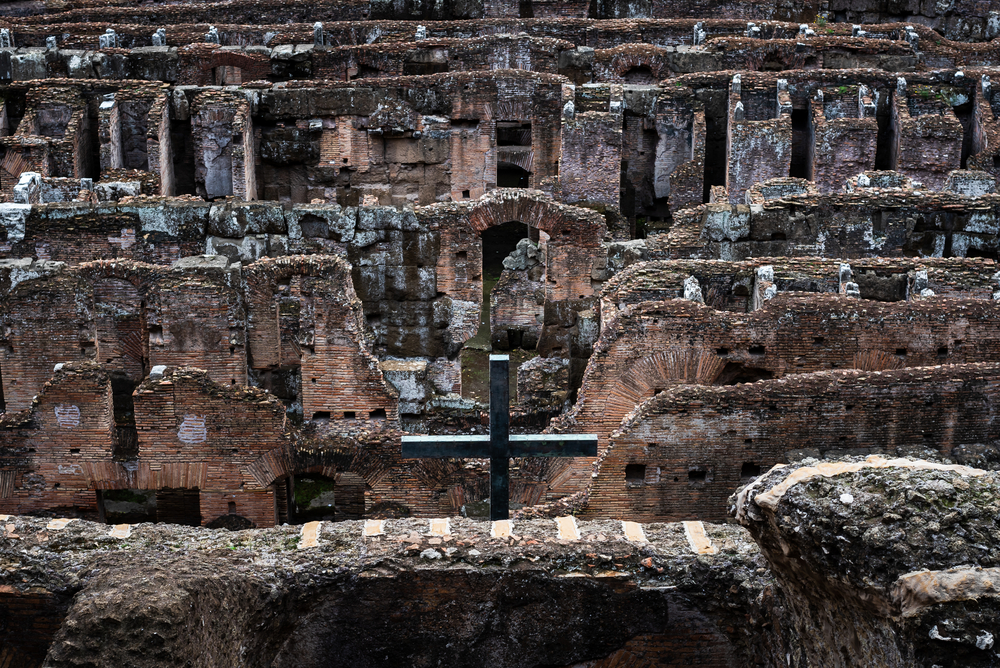
Galleries under the central arena of the Colosseum in Rome, Italy
I read Tom Holland’s new book, Dominion, about a year ago, and I have written about it a few times. Many Christians would not think to read a history about Western Civilization by a self-described secular humanist (once atheist, perhaps now agnostic) historian.
Most non-Christians are likely to be uncomfortable with the chronicle Holland describes of the radically influential role that Christianity played in the development of Western Civilization, providing the foundation, in fact, for secular humanist ideals. When Holland dug down to the bedrock of modern, western values, he was surprised himself to find them anchored on a Christian foundation.
Holland did not set out to write a Christian apologetic, and he seems to remain somewhat uncertain how to process what he “discovered”. What he found, though, changed his mind about Christianity. He gives a brief explanation in the following clip:
Though Holland has had a turnabout on his view of Christianity, he finds himself caught in an odd position wrought by the unexpected discovery that his lifelong, secular humanist values flow from the radical catalyst of Christian influence and remain embedded ubiquitously in its very fabric. The awkwardness of his current position is evident in his interviews and discussions about the book.
Christians and secular thinkers, alike, wrestle with his book. Holland doesn’t hide any warts, and he doesn’t pull any punches. Neither does he obfuscate the thoroughly paradigmatic shift in Western thinking that Christianity worked into a society that once proudly and unashamedly championed strength and privilege over the poor, the weak, and the lowly.
Holland exposes the metanarrative developed during the Enlightenment and thereafter that belies the foundation on which the Enlightenment structure was built. Far from advancing the progression of human values, the Enlightenment threatened to undo the distinctly Christian concern for the poor, weak, and lowly while attempting to wrest western civilization from the hold of the Divine. Humanism saved the Christian ethic, albeit divorced from Christ.
Consider the full title of Darwin’s great tome which staked out the ground of a scientific (and social) revolution free from God’s interference:
“The Origin of Species by means of Natural Selection or the Preservation of Favoured Races in the Struggle for Life”
The title of Darwin’s book championing the evolutionary paradigm, harkens back to the Greco-Roman value system that despised the poor, the weak and the lowly. That value system did not just turn a callous eye at wanton and discriminate cruelty, it cheered on the strong while they snuffed out the weak. It was national sport!
The very reason the full title never “stuck” (I now believe) is due to a fundamental, pervasive, and thoroughly entrenched counter-value of the intrinsic worth of human life that is uniquely Christian in its source.
The intrinsic value of all human life, from the greatest to the least, from the wisest and strongest to the weakest and most imbecilic, from the fittest to the most infirm, is traceable to the Christian belief that all human beings are made in the image of God. That the survival of the fittest did not take hold as a western social or ethical value is attributable to the deeply ingrained Christian ethic that survived yet, despite the efforts to eradicate its God from modern equations.
Modern humanists may attempt to recast Darwin into a humanistic mold, but the idea of “social Darwinism” bears his name through no model of random, unguided selection. According to John G. West, Charles Darwin, himself, set in motion the inertia for eugenics, among other things, that were associated with social Darwinism:
Darwin himself in The Descent of Man provided the rationale for what became the eugenics movement, and how the vast majority of evolutionary biologists early in the twentieth century were right to see negative eugenics as a logical application of Darwin’s theory.
While the defense of Darwin against the charge of social Darwinism has largely succeeded in popular and polite company, the very title of the Origin of Species (by means of Natural Selection or the Preservation of Favoured Races in the Struggle for Life) belies the success of that effort. The fact that the full title is merely a parenthetical today is evidence only of a concerted rescue campaign.
Christian values survived despite the Enlightenment coupe, not because of it. Humanism today assumes the evolutionary paradigm for its science alongside the uniquely Christian paradigm of intrinsic human value. That the two assumptions do not fit well together seems to be lost on modern minds.