When Jesus said we should care for the “least of these, my brothers” and to “love one another”, was he limiting the scope of our love to fellow believers?
In the Parable of the Sheep and the Goats in Matthew 25, Jesus says, “Truly, I say to you, as you did it to one of the least of these my brothers, you did it to me.” (Matthew 25:40) Most people gloss over the qualifier to the least of these… my brothers. Bible scholars, however, have wrestled with the fact that the clear instruction for us to have compassion and care for the hungry, the thirsty, the stranger, and the prisoner – the least of these – is qualified by Jesus by adding “my brothers.”
Some modern scholarship argues for a limited interpretation. These scholars contend that “the least of these, my brothers” refers specifically to the disciples of Jesus and fellow believers, especially those who are suffering persecution or deprivation as a result of their faith. They argue that we can not apply this Parable to the people in the world at large because the category of “the least of these” is qualified by “my brothers.”
In similar fashion, Jesus tells his followers, “By this everyone will know that you are my disciples, if you love one another.” (John 13:35) Jesus does not say that the world will know his disciples by the love they have for people in the world at large; rather, they will be known by the love they have for “one another.”
These two statements of Jesus raise some questions for us. Are Christians only commanded and expected to care for and love each other? Is the Bible silent on whether we should love and care for people who are not followers of Christ? Does it matter whether we love and care for people in the world?
The point of the Parable of the Sheep and the Goats is that the love and care we show for “the least of these my brothers” is tantamount to showing love and care for Jesus. In other words, one’s treatment of “the least of these”, who Jesus calls his brothers, reflects our hearts and our relationship with God, Himself.
This is not inconsistent with the one, primary characteristic that Jesus says should mark his followers – that they love each other. (John 13:35) Love within the Christian community is the hallmark of being a follower of Jesus, and that love and mutual care that Christians have for each other serves as a testimony to the world that we follow Jesus (if, indeed, we are faithful to his commandment).
We might glean from the Parable of Sheep and the Goats that the emphasis on “my brothers” means that Christians only show love for Jesus when they love and care for brothers and sisters in Christ. We might understand from reading John 13:35 that we should focus only on loving each other, as that is the way the world will know us.
Do these passages mean that Christians are only to care for and love each other. Does this special emphasis on loving our brothers and commandment to love each other extend outside the Church? Or does it apply only within the community of believers?
“[I]f anyone says to you, ‘Look, here is the Christ!’ or ‘There He is!’ do not believe it. For false messiahs and false prophets will appear and perform great signs and wonders to deceive, if possible, even the elect.”
Matthew 24:23-24
This is a significant warning from Jesus about future times – our times. It’s easy to call out false messiahs and false prophets, and many have done that, but we should be cautious and careful in our understanding of what a false messiah or false prophet and, more importantly, how to spot one.
The Greek word translated a “false” in this passage is ψευδή (pseudés) meaning “false, untrue”, and “(by extension) erroneous, deceitful, wicked.” The word comes from the root verb ψεύδομα (pseudomai) meaning “to utter a lie or attempt to deceive by falsehood.”
The Greek word Χριστός (Christos), of course, means Christ – the Christ – as in Jesus Christ, but, it could mean more than that. Christos derives from the verb chrio (χρίω), which literally means “to smear or rub with oil.” It also means “to anoint” (especially for a divine purpose” and “(by implication) to consecrate to an office or religious service.”
Jesus used chrio when he said, “The Spirit of the Lord is upon me, because he has anointed me to proclaim good news to the poor.” (Luke 4:18) In more modern terminology, we might say that Jesus was appointed to proclaim good news to the poor. The “anointing” (the pouring of oil on a person) was symbolic of a person’s appointment to a position. In religious circles, we might use the word, “calling,” today.
The idea of anointing a person appointed by God for a particular office was practiced in the Old Testament as well. Samuel “took a flask of olive oil and poured it on Saul’s head”, and he said, “Has not the LORD anointed you ruler over his inheritance?” (1 Samuel 10:1)
Christos has a counterpart in the Hebrew word, מָשַׁח (mashach), meaning “to rub with oil, i.e. to anoint,” and “(by implication) to consecrate.” Hebrew kings, priests, and prophets were anointed in this manner as a way of recognizing their position (appointment). Thus, מָשִׁיחַ (Messiah), literally “Anointed One,” emerged from this practice.
The Greek word, Christos, is the equivalent of the Hebrew word, Messiah, of course. We tend to think only of Jesus Christ, “the” Messiah, when we use those terms, but anointing men for their offices was common practice in the Old Testament and New Testament times by Hebrews and by Greeks. Anyone who was anointed (appointed) for an office was an “anointed one.”
A false Messiah is one who falsely claims or acts as if he is anointed (appointed) for a particular role. The Hebrew word for Prophet (προφήτης (prophétés)) means speaking forth by the inspiration of God, so a false prophet would be one who falsely speaks as if by the inspiration of God.
Jesus uses the terms, false messiahs and false prophets (plural), to signify that many people would come claiming (or claimed) to be messiahs or prophets. He says, they will deceive many people and even the elect, if possible. Elsewhere, Jesus says they “will come to you in sheep’s clothing” and warns us to “Watch out!” (Matt. 7:15)
Is it possible for God’s children to be deceived? I would like to think not, but then why does Jesus warn us to “Watch out!”? Why does Jesus say false messiahs and false prophets might even deceive “the very elect”?
I don’t know if God’s children – the sheep who hear His voice – can ultimately be deceived by false messiahs and false prophets, but that doesn’t mean we could not be deceived at some point or for a time. It’s safe to say, I think, that Jesus would not have warned us at all if it wasn’t at all possible to be deceived to some extent.
At a minimum, Matthew 24:24 highlights the extreme danger and the potential for even believers to be swayed or confused by the powerful deceptions of false messiahs and false prophets. Peter warns us soberly that “there will be false teachers among you” (1 Peter 2:1), so we need to beware. But, how?
So far, we can say from the descriptor of false messiahs and false prophets that they are deceivers; they are not truly anointed for the purposes they or others claim; and they do not truly speak under inspiration from God. They deceive and lie, and that is what makes them dangerous. But, again, how will we know?
When God became man and came to His own people, they didn’t even recognize Him or receive Him. (John 1: 9-11) If God came in the flesh to people with whom God had a covenant for many hundreds of years, and they didn’t recognize Him, we should have the humility to admit that we might not recognize God always when He is active in our world, and for the same reason we might be fooled by false messiahs and false prophets.
What, then, are the clues that a messiah (one who seems to be anointed for a purpose, calling, position) or a prophet (one who purports or who is purported to speak by the inspiration of God) is false? Fortunately, the Bible gives us more information to go on.
About 5 years ago, I wrote God Meets Us Where We Are. I was impressed then (and I still am) that God who created the Universe stoops to come to us. I was also impressed that finding God is not so much about our seeking, but about our opening up to God Who is ever present to us, but never overbearing.
God seems hidden to many people. If we do not really want to see Him as He is and to embrace Him for Who He is, we may never know He is “there” at all.
When we act contrary to God’s character, our sin hides God from us. (Isaiah 59:1-2) The Prophet, Micah, says God “hides his face” from people, even when they cry to Him, because of the evil, the bad, the harm we do. (Micah 3:4)
The “evil” Micah is talking about in this chapter is injustice – the way we treat other people. The “leaders of Jacob” to whom he was talking were taking advantage of their own people for their own benefit. When people do that, they will cry out to God, but God will not respond.
CS Lewis called God the Great Interferer in his autobiographical book, Surprised by Joy. He didn’t want God to exist. He didn’t want to be interfered with. “He wanted to be left alone, and unconsciously knew that if he denied the existence of some Ultimate Authority, then he himself would be that very authority in his own life. Thus, he could live his life according to his own desires.” (Christ the Great Interferer)
When we live to satisfy our own desires, often at the expense of others, we act out of character with God, and we are blinded by the thrust of our own actions from seeing God. He allows our conduct to separate us and hide us from Him because God does not reward our bad behavior.
“The eye is the lamp of the body. If your eyes are healthy, your whole body will be full of light. But if your eyes are unhealthy, your whole body will be full of darkness. If then the light within you is darkness, how great is that darkness!”
Matthew 6:22-23
God desires us to know Him as He is and to desire to be like Him. When we acknowledge our wrong ways (sin) and turn (repent) from them, God is quick to meet us “there”. When we confess our sins, He is just and faithful to forgive us! ( 1 John 1:9)
That is what He is waiting for, but we must come to Him honestly. He isn’t handing out “get out of jail cards” for free. He wants us to desire Him and to desire to be like Him; He isn’t interested in appeasing your conscience for the moment so you can feel better about what you have done and what you will do in the future.
God has given us each other as the testing ground. As Micah indicates, how we treat others determines whether God is hidden to us. Jesus said as much in the Parable of the Sheep and the Goats. “‘Truly I tell you, whatever you did for one of the least of these brothers and sisters of mine, you did for me,'” (Matt. 25:40) and “‘Truly I tell you, whatever you did not do for one of the least of these, you did not do for me.’” (Matt. 25:45)
It seems to me that God designed the world as He did because God desires relationship with people who desire Him, and He provides us a testing ground for that relationship in other people. God will not force Himself on anyone who does not want to know Him – at least for the time being.
There will come a day when our lives end in the natural course or by circumstance that God does not control. Having set His universe in motion, He rarely interferes. Too much interference would frustrate His purposes.
There will also come a day when the time for human seeking is over, when this Project Earth has come to its appointed end, when the time for ultimate redemption and the perfection of God’s purposes is at hand. At that time – when all people see “the Son of Man coming in a cloud with power and great glory” (Luke 21:27) – it will be too late for any seeking
As the Apostle Paul said, “I tell you, now is the time of God’s favor, now is the day of salvation.” (2 Corinthians 6:2) The writer of Hebrews repeats three times for us: “Today, if you hear his voice, do not harden your hearts.” (Hebrews 3:7-8; 3:15; and 4:7)
God is with us now, and the time of His favor – to seek Him and find Him – is now. There are no guarantees for anyone. In fact, the only guaranty is that our time will end: either at our own natural or untimely death or when day of the Lord comes and the time for choosing is over. Do not harden you heart. Now is the day of your salvation.
I wrote the article I am “pressing” here in September 2020. The buzz around the prophecies of a Trump win in the upcoming election was at a fever pitch. People I knew, some dating back 40 years, were caught up in it. I was skeptical. “Do not despise prophecy, but test everything,” was ringing in my ears, my head, and my heart. (1 Thess. 5:20)
I am still skeptical, and the happenings over the last 5 years have done nothing to ameliorate my skepticism. January 6th, the pardons of the people who participated in the January 6th debacle, and everything that is happening now have only sharpened and solidified my skepticism that the movement that is led by Donald Trump is anything close to God’s order or design.
The article published today in The Atlantic, The Minnesota Suspect’s Radical Spiritual World, recalls to my mind this article I wrote what seems like a lifetime ago, in 2020. Vance Boelter, the person accused of killing a Democratic state lawmaker and her husband in their home and who shot up another Minnesota lawmaker and her husband in their home the same evening, was deeply involved in the spiritual movement that is behind Donald Trump.
It is the movement I became involved in when I was 22 in 1982 as a very new Christian.
Boelter graduated from Christ for the Nations Institute in Dallas, founded by Pentecostal evangelist. James Gordon Lindsay, a disciple of the New Order of the Latter Rain. I am not familiar with that strain of the New Apostolic Reformation (NAR, but then much water has passed over the dam since I left the the church I joined in 1982 and went to law school.
I do remember the emphasis on the battle between God and Satan in world and the call to be spiritual warriors in prayer, in worship, and in the way we lived out our lives – including our political involvement. I don’t remember any call to violence, but I can easily see how the fervor might have steered that way. At least for some people.
Boelter texted his family after the shootings, “Dad went to war last night.”
Boelter’s alma mater was swift to denounce his actions: “We are absolutely aghast and horrified that a CFNI alumnus is the suspect. This is not who we are…. CFNI unequivocally rejects, denounces and condemns any and all forms of violence and extremism, be it politically, racially, religiously or otherwise motivated.”
Like I said, I don’t remember any talk whatsoever of violence when I was involved in those circles. We engaged in spiritual warfare through prayer and worship. The article, though, blames “NAR thinking” for Boelter’s actions.
It’s easy to see how the language of warfare might lead them to that conclusion. Many people who were present on January 6th when the Capitol building was overrun by zealous political defenders of Donald Trump were influenced by the thinking of the NAR.
I would like to think that most level-headed people of faith know the difference between spiritual warfare and storming Capitol buildings and shooting politicians. Some obviously don’t, and that is problematic.
After Jesus fed the 5000 on the Galilee mountainside, the people wanted to “make him king by force”, but Jesus withdrew from them to a mountain so they could not do it. (John 6:1-14) When Pontius Pilate asked Jesus, “Are you King of the Jews?” Jesus said, “My kingdom is not of this world. If it were, my servants would fight to prevent my arrest by the Jewish leaders. But now my kingdom is from another place.” (John 18:33, 38)
Jesus is the King of kings who sits at the right hand of the Father in glory, but he is biding his time until he comes again. At that time he will rule heaven and earth. Until then, we are to be salt and light. We are to go and make disciples of all nations. I see no biblical imperative for followers of Christ to take over earthly governments.
That doesn’t mean that some of us are not called to be like Daniel and his friends in the Babylonian government. In that role, though, we are salt and light. We are ambassadors of Christ and His kingdom, which is not of this earth. If we are warriors, we are warriors who carry a cross instead of a sword.
I have wanted to dig into the story of Sodom and Gomorrah for a while now, ever since someone suggested to me that the story isn’t what I think it is. Everyone knows the reference to Sodom and Gomorrah, right? God smote those villages with fire and brimstone because of homosexuality.
That’s what I was taught. At least, that is what I always believed, but I have learned there may be more to the story. The truth is right where we should expect to find it: in the Bible. If you are intrigued as I was, then read on.
First, let’s review the story in Genesis 13. Abram and Lot flourished, and their clans and flocks grew in size in the land God promised Abram. There was tension among their entourages, though, so they decided to separate and spread out. (Gen. 13:5-9)
“Lot looked around and saw that the whole plain of the Jordan toward Zoar was well watered, like the garden of the Lord, like the land of Egypt.” (Gen. 13:10) Lot, therefore, chose move to Sodom and Gomorrah in the plain of Jordon, while Abram remained in Canaan.
Although the land was like a well watered garden, “the people of Sodom were wicked and were sinning greatly against the Lord.” (Gen. 13:13) Thus, we shouldn’t be surprised when that sin catches up to the people of Sodom and Gomorrah.
Before we move on, though, we should acknowledge that Sodom and Gomorrah was a lush, fertile place. It was inhabited with “wicked” people, yet Lot moved there anyway because it was a desirable place to live. Perhaps, the allure of the things of this world and the temptation to associate with people who have accumulated wealth, position, and influence was great, in spite of any misgivings Lot may have had.
This may provide some explanation for why Lot’s wife looked back in defiance of the angel’s warning. She may have regretted leaving.
She may have wanted to return to the abundance and comfort that drew them there, and that desire to hold on to abundance and comfort may have been her undoing.
We should also understand the backstory in Genesis 18 before we get to the story of Sodom and Gomorrah in the next chapter. Before some angles visited Sodom, they visited Abram. Abram saw the three “angels of the Lord” from his tent. He went out to meet them, bowed in respect, and insisted they come to his tent to be refreshed. Abram and Sarai spared no expense to show them hospitality, and the angels returned the favor by affirming God’s promise to the elderly couple: promising that Sarai would bear a child within a year. (Gen. 18:1-15)
Before the angels left, the angels told Abram the reason they came: to investigate Sodom and Gomorrah because “the outcry against Sodom and Gomorrah [was] so great and their sin so grievous.” (Gen. 18:20) This “outcry” that reached the LORD is the first clue to what was going on there. (Gen. 18:21)
The Hebrew word that is translated “outcry” in this verse is za’aq. It mean a shriek, cry for help, cry of distress, lamentation. Thus, something was going on in Sodom and Gomorrah that was causing people to cry out in distress.
The word, outcry, in Genesis 18 should bring Exodus 2:23 to mind where God heard the Israelites cry out. In both cases, in Egypt and in Sodom & Gomorrah, God responds to an outcry of the people living there.
They same word, za’aq, is used in both passages. God responded to the Hebrews cry for deliverance by sending Moses, and God miraculously rescued them from the land of Egypt. In Genesis 18, God similarly responded to a cry for deliverance by sending His angels.
The parallel nature of these stories is important to recognize. The people cried out in distress, and God responded. Parallel stories and themes run throughout the Bible, and we should pay attention to the when they appear, because they usually mean something.
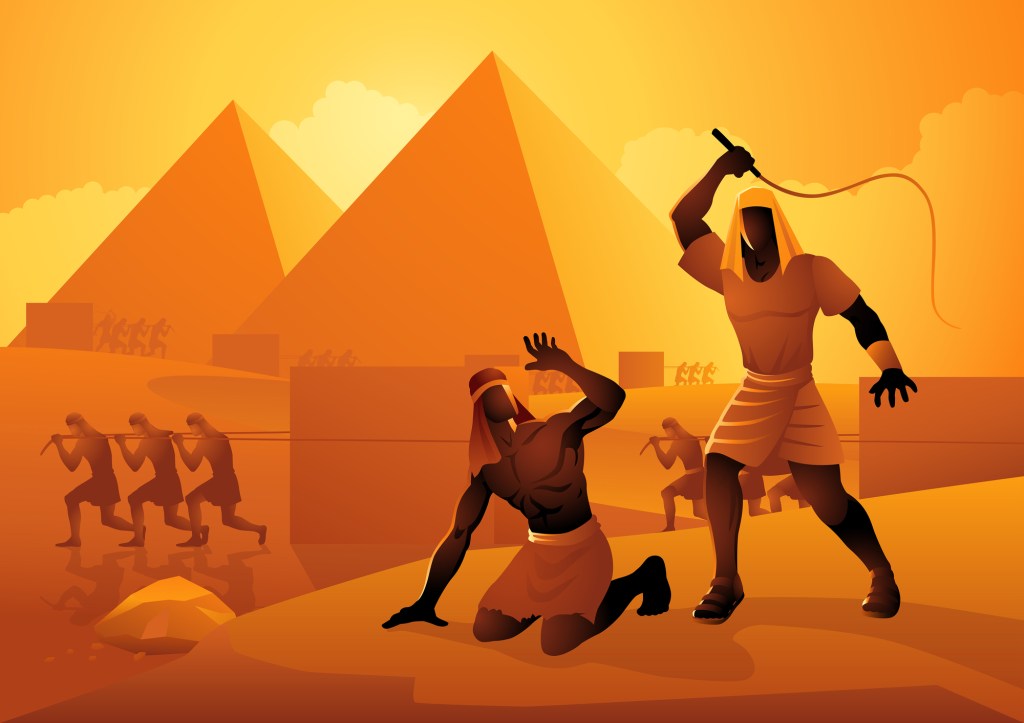
We know why the people cried out in Egypt – because Pharaoh enslaved and mistreated them. The Bible is relatively silent, however, on the circumstances in Sodom and Gomorrah.
If we pay close attention, though, we can find some clues!
In Genesis 19. Lot repeats the pattern of Abram’s hospitality: Lot saw two angels at the city gate, and he went out to meet them, like Abram did. Lot greeted them with respect the same way Abram did, and Lot insisted they come to his home where he prepared a feast for them, just as Abram did. (Gen. 19:1-3) These stories appear one after the other in the biblical narrative, and the parallel symmetry signals that we should pay attention.
Abram and Sarai, by the way, are known for generous hospitality. The generous hospitality of Abram is legendary in Jewish and even Muslim lore. Generous hospitality was a key distinctive of God’s man of faith.
Lot, who was Abram’s kin, demonstrated the same kind of generous hospitality, but the story takes a bad turn. Everything seems great until the men of Sodom surround Lot’s house and demand that Lot bring the angels out to them, “So that we can have sex with them.” (Gen. 19-4-5) When Lot refused, they turned on Lot, This is what they said:
“This fellow [Lot] came here as a foreigner, and now he wants to play the judge! We’ll treat you worse than them.”
genesis 19:9
Most of us, I think, assume the sin of Sodom was primarily sexual in nature. The story certainly seems to suggest that if we miss the clues to what was really going on. The symmetry of the parallel stories leading up to the story of Sodom and Gomorrah suggest that something else is going on. The people crying out in distress, like the Jews in Egypt is another clue, and what the townspeople say to Lot is still another clue.
The clues are in the context and more specifically in the contrast between the way Abram and Lot treated the foreigners/angels and the way the townspeople in Sodom & Gomorrah treat them. Abram and Lot go out of their way to greet the angels, bow to them in respect, make them feel welcome, and show them generous hospitality. The men of Sodom react the opposite way: they respond with hostility. They are angry that the foreigner in their midst (Lot) invited foreign guests into his home, and they they came to punish and humiliate those guests by violating them sexually.
I never noticed these clues in the text before. They cast a different light on the story. It seems that the story is less about men wanting to have sex with the foreigners than it is about brutish inhospitality.
This was a lynch mob. They came to run the foreign guests out of town and to demonstrate their extreme displeasure with Lot for inviting them in to his home. The men wanted to humiliate, violate, and punish Lot’s foreign guests in the worst possible way, and they wanted Lot to understand why: because Lot was a foreigner, and these men were foreigners, who were not welcome in their town.
As side note, I would not likely have noticed all this but for the book I am reading by James K. Hoffmeier, The Immigration Crisis: Immigrants, Aliens, and the Bible. He cites to the Sodom and Gomorrah story as an example of the way people in the Old Testament control their borders and their cities. (See also Judges 19-21 in which a similar scene plays out in Gibeah where the sons of Benjamin treat the Levites passing through in exactly the same way.)
This was the last straw for God. The angels returned the favor Lot showed them by protecting him and his family and by warning them to get out of town quick. As soon as Lot and his family were out of town, “the Lord rained down burning sulfur on Sodom and Gomorrah….” and reduced it to smoke and ash (Gen. 19:10-28)
Aside from some other details that do not seem directly relevant at the moment, that is the story of Sodom & Gomorrah. Most of the references to Sodom & Gomorrah in the rest of the Bible are used as warnings without much commentary, except for three passages. These passages tell the rest of the story.













 Navigating by Faith