Jesus in Our Midst

Whether we see God working in our lives may depend on the assumptions we make from our expectations and our experience.

Reading from Luke 24:13-21.

That very day two [men] were going to a village named Emmaus, about seven miles from Jerusalem, and they were talking with each other about all these things that had happened. While they were talking and discussing together, Jesus himself drew near and went with them. But their eyes were kept from recognizing him. And he said to them, “What is this conversation that you are holding with each other as you walk?” And they stood still, looking sad. Then one of them, named Cleopas, answered him, “Are you the only visitor to Jerusalem who does not know the things that have happened there in these days?” And he said to them, “What things?” And they said to him, “Concerning Jesus of Nazareth, a man who was a prophet mighty in deed and word before God and all the people, and how our chief priests and rulers delivered him up to be condemned to death, and crucified him. But we had hoped that he was the one to redeem Israel.

This encounter took place after Jesus was publicly seized, tried and crucified. These men were discussing the events that everyone was talking about – the death of Jesus.

Jesus had stirred up the hopes and dreams of the people in the region, including these two men, but that hope ended abruptly and shockingly just a couple of days ago.

Jesus was a controversial figure in the first century. He was born into a world that was ripe for his coming. The last of the Hebrew scriptures was written about 300 years prior, and the thrust of the last of those scriptures, the prophets, anticipated the coming of a Messiah.

The first century Palestinian Jews believed this Messiah would be a king that would rescue Israel from Roman rule and reestablish a Jewish Kingdom in the promised land, rekindling the glory of their heritage.

But Jesus defied the expectations.

Continue reading “Jesus in Our Midst”

Becoming Mindful of God

The benefits of mindfulness and prayer are proven in the secular and spiritual worlds.

Depositphotos Image ID: 48782201 Copyright: danr13

The March 2018 issue of the Illinois Bar Journal includes an article by Ed Finkel, an Evanston based freelance writer. The subject is mindfulness for attorneys, inspired by presentations given by Naperville business and estate planning attorney, Mark Metzger. This all may seem too professional and industry-based for this blog, but it got me thinking.

First of all, the legal profession is where I spend a large chunk of my time every week, week after week, month after month, year after year. Finkel correctly notes that the practice of law is a highly stressful occupation. Other occupations also have their share of stress, of course.

We experience stress often in our everyday living as well. The stress of strained personal relationships, financial difficulty and burdens, raising children, and many other kinds of stress weigh upon us. We all feel stress from time to time.

So what does mindfulness for lawyers have anything to do with a blog on navigating by faith? Quite a bit, it turns out.

Continue reading “Becoming Mindful of God”

Search Me Oh God

Depositphotos Image ID: 67632305 Copyright: alazs

Judas Iscariot is a tragic figure in the Gospels. He is known best for betraying Jesus Christ, leading to his crucifixion. John wrote this of Judas many years after the events occurred in the garden of Gethsemane: “he was a thief; as keeper of the money bag, he used to help himself to what was put into it.”

Given John’s characterization of Judas, it’s a bit unnerving, perhaps, to think that Judas spent years in the company of Jesus. Judas knew Jesus intimately and was part of the very inner circle of followers of Jesus. Jesus certainly knew Judas as well. He knew well that Judas would be the one who would betray Him. He “called it” at the Last Supper.

Have you considered the fact that Jesus allowed Judas so close to him all that time, knowing what Judas would do? John’s comment about Judas many years later, describing Judas as a “thief” who helped himself to the funds that Judas oversaw for the group of disciples, suggests that John knew the character of Judas as well.

The betrayal of Jesus, of course, was part of God’s plan. It had it happen. Jesus came to offer himself as a sacrifice for the sins of men, but Jesus added, “But woe to that man who betrays him!”

What sort of man betrays Jesus? Was Judas just an evil person?

Continue reading “Search Me Oh God”

Ritual, Spirit and Truth

Depositphotos Image ID: 23471738 Copyright: ChiccoDodiFC

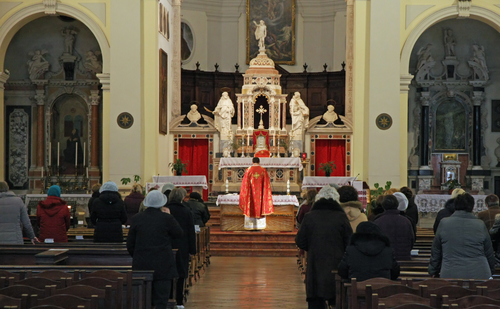
I was raised Catholic. I say that often. Not that it is a bad thing. It’s just my experience. During my time in the Catholic church, through my childhood and early adulthood, I had no connection with God. I can’t lay the blame for that at the feet of the Catholic Church. That was just where I was.

When I became a Believer, when I accepted Christ as my personal Lord and Savior, my life changed. I also began to see the Catholic Church in a different light. I was never into the ritual and observance, which is a major component of the Catholic Church. Not that other denominations and religions don’t have central religious rituals. All religions have ritual observances and traditions.

Those ritual observances and traditions are not, in themselves, bad, but they can create a facade that hides emptiness, darkness and sin. They can create an appearance of piety with no spiritual reality behind them. They can be more superstitious than spiritual, like stroking a rabbits foot for good fortune. In these and other ways, ritual observances can become a substitute for relationship with God.

Continue reading “Ritual, Spirit and Truth”

Selfishness to Salvation

Depositphotos Image ID: 69572625 Copyright: Christin_Lola

Today someone spoke about going “from selfishness to salvation”. I have never heard anyone put it that way before, but it’s as accurate a statement as any I have heard.

Jesus said, “Whoever loves his life loses it, and whoever hates his life in this world will keep it for eternal life.” (John 12:25) Loving and holding tightly to my own life, shutting God out, refusing to concede control to my Creator, desiring to go my own way is the life of a person without God. Marked by a desire to control my own destiny, to be captain of my own soul, so that I can say, at the end of the day, “I did it my way”, is a life lived without God.

The terrifying reality is that God will let us go our own way. He didn’t prevent Adam and Eve from eating the forbidden fruit. They were tempted by the desire to “be like God”[a], to define good and evil for themselves, to make their own choices and, ultimately, to usurp God’s place of prominence in their lives.

The fruit they ate was “good”; it was delightful and even desirable.[b] The fruit, itself, wasn’t necessarily bad (the knowledge of good and evil). The decision to go their own ways, to assert their own wills over the will of God, was their downfall.

Without that fateful choice we might live  idyllic lives. We might forever be “perfect” little angels, but God obviously had something else in mind.  God must have known the choice we would make. Right?

That choice doomed us to the imperfection of our humanness, but it also opened the door to something else completely. It opened up the opportunity for us to enter into a relationship with God we could never have known in that “perfect”, idyllic, innocent (and naive) state.

Continue reading “Selfishness to Salvation”