Submitting to Authority For the Lord’s Sake Like Peter, Paul, and Jesus Did

Both Peter and Paul defied authority by speaking, but spoke about submitting to authority

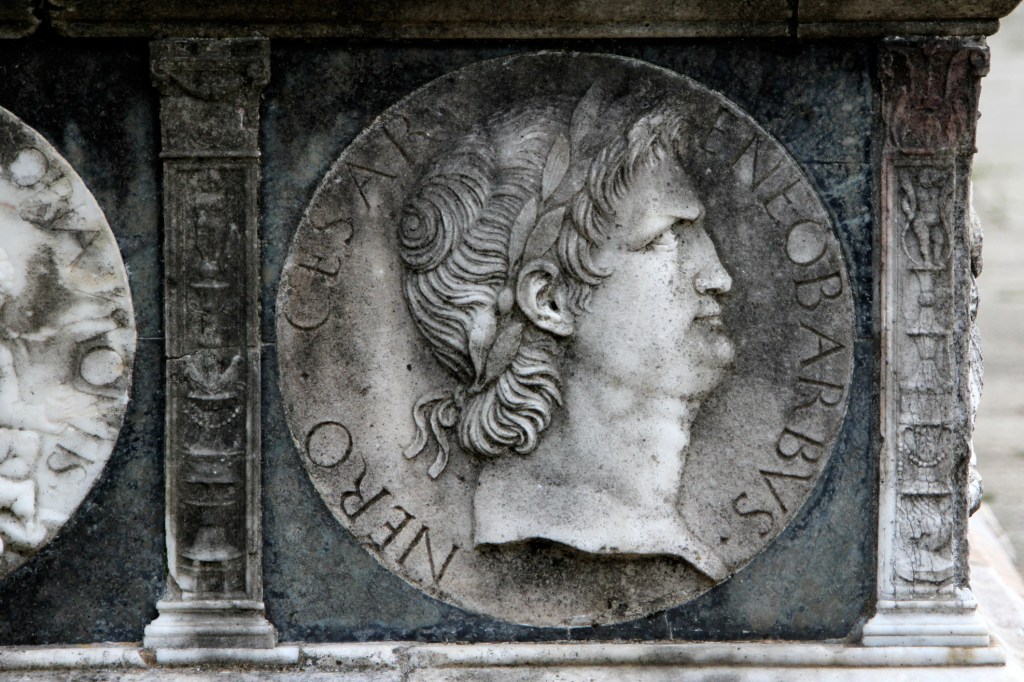
Bas-relief portraying the emperor Nero at the Certosa di Pavia

One of the most discussed texts in early Christian ethics is 1 Peter 2:13–17, because it calls believers to “submit… to every human institution” and to “honor the emperor,” even in times when those institutions were hostile or unjust. Peter, who penned this admonition, ultimately lost his life to an arbitrary, capricious, and unjust Roman Emperor.

13 Submit yourselves for the Lord’s sake to every human authority: whether to the emperor, as the supreme authority, 14 or to governors, who are sent by him to punish those who do wrong and to commend those who do right. 15 For it is God’s will that by doing good you should silence the ignorant talk of foolish people. 16 Live as free people, but do not use your freedom as a cover-up for evil; live as God’s slaves. 17 Show proper respect to everyone, love the family of believers, fear God, honor the emperor.”

1 Peter 2:13–17

Paul, who lost his life to the same Roman Emporer, says similarly,

“Let everyone be subject to the governing authorities, for there is no authority except that which God has established. The authorities that exist have been established by God. Consequently, whoever rebels against the authority is rebelling against what God has instituted, and those who do so will bring judgment on themselves.”

Romans 13:1-2


These two passages speak to the way Christians should honor and submit to earthly authorities. They have posed challenges to Christians from the time there were written. In Peter’s and Paul’s time, Nero was the Roman Emperor. Nero was a brutal, harsh, paranoid ruler who had his own wife and children killed to protect himself and to advance his own ends. Peter and Paul were both martyred by his decree.

The great American story is a far cry from the brutality and caprice of Roman history, but we have lived through our own unjust laws, including laws that protected the institution of slavery and the laws that perpetuated Jim Crow after slavery was finally prohibited. In more recent times, American have laws protected the practice of abortion, and we could find other examples of unjust laws and laws that protect unjust practices if we dig deeper.

I doubt I am exaggerating to say that no nation governed by men has ever been perfectly just, and I doubt no nation of men will ever be perfectly just. How then should Christians in any age govern themselves in light of Peter’s and Paul’s admonitions to honor and submit to governing authorities, including unjust ones?

I previously tried to parse these tensions when I published How Should the Church Act Regarding Authority? the day after January 6th, when supporters of Donald Trump, including many people flying banners of Christian faith, stormed the Capitol building in response to what they thought were unjust election results. At that time, I was critiquing the “insurrection” against the election and inauguration of President Biden. Even if the election results were unjust, shouldn’t Christian have submitted to them?

Now, I find myself critiquing the Trump Administration’s unjust enforcement of immigration laws. Some of the people who defended Trump’s complicity with the January 6th insurrection are now defending the current immigration enforcement practices based on the biblical mandate to honor and submit to authority. It seems to be a tangled mess!

We should obviously be consistent, and not selective, about the law and order we submit to, but how we should live that out in the face of injustice may not seem crystal clear. It’s important, though, that we do the work to rightly divide the Word of God

Continue reading “Submitting to Authority For the Lord’s Sake Like Peter, Paul, and Jesus Did”

What Did Jesus Mean When He Said We Should Give to God the Things that Are God’s?

Having been created in the image of God, we bear the imprint of God, but we must still offer ourselves back to God if we are to be aligned with God.

The creation of Adam – Vatican Sistine Chapel in Rome, Italy. Created by Michelangelo Buonarroti.

I took some interest in a Facebook post at Bible Archaeology[1] about the image of Tiberius Caesar on a Roman coin like the one Jesus referenced in Matthew 22:15-22.[2] Some scriptural references and back ground facts are the subject of my writing today.

The story is well-known. Some Jewish leaders challenged Jesus with the question, “Is it lawful to pay taxes to Caesar, or not?”

It was a ruse. They were trying put Jesus into the impossible position of aligning either with the Jews (against the Romans, losing credibility with them) or with the Romans (against the Jews, risking punishment for opposing Rome) on the issue of paying taxes.

Jesus famously asked for a coin, and then he asked whose image was imprinted on the coin. It was Caesar’s image, of course. Then Jesus said, “Therefore render to Caesar the things that are Caesar’s, and to God the things that are God’s.”

Perhaps, my interest was piqued because I have written about the story before. I talk about rendering unto Caesar in the context of how Christians should respond to secular authority.[3] I wrote about Jordan Peterson’s comment, crediting the words of Jesus to the creation of the modern principal of the separation of church and state.[4] But I haven’t focused on what it is we are to “render” to God.

I am always excited to learn something new, and the Bible Archaeology post added some details I didn’t know. The first details provide the backstory to the story, which involves Judas the Galilean. The interrelationship of the two stories shows how intertwined, complex, nuanced and harmonious Scripture is within itself and with external facts discovered through historical and archaeological sources, among other things.

I appreciate the historians and archaeologists, like Bible Archaeology, that dig up corroborating details. In the Facebook post, they cite additional scriptural passages on Judas the Galilean that give us insight into why the Pharisees in Galilee challenged Jesus on the issue of paying taxes.

Continue reading “What Did Jesus Mean When He Said We Should Give to God the Things that Are God’s?”

The Imago Dei

Each one of us bears the imprint of the Almighty God, and out of that one principal flows all the Law and the Prophets summarized in two commandments.


When Jesus was asked, “What is the greatest commandment,” he said “the greatest commandment is to love God with all your heart, with all your mind and with all your soul”. Jesus didn’t have to go any further. He had been asked what was the greatest commandment, and he answered the question, but he didn’t stop there. He offered a second greatest commandment, which is “to love your neighbor as yourself”. (Matthew 22:36-39)

Why did Jesus go further?

The significance of these two commandments that are the greatest of all is that you and I are made in imago dei – the image of God. Moreover, this revolutionary idea, that we are created in the image of God, is unique to the Judeo-Christian worldview.

The point is further illustrated elsewhere in the same Chapter of Matthew in a confrontation between pupils of the Pharisees, who were sent to challenge Jesus by asking him whether it is lawful to pay taxes to Caesar. They were trying to trap him with a question for which there was no good, politically correct, answer, but Jesus was not deterred by their ill will.

Rather, Jesus requested a coin. Someone produced a denarius (a Roman coin) for him. Ravi Zacharias describes the interchange that ensued this way.

“He held the coin out to [the man who gave it to him], and he said, ‘Whose image is on this?’ The man said, ‘Caesar.’ Jesus said, ‘Give to Caesar that which belongs to Caesar, and give to God that which belongs to God.’ The man should have had a follow up question, and the follow up question should have been, ‘What belongs to God?’ and Jesus would have said, ‘Whose image is on you?’”

Continue reading “The Imago Dei”

Following Jesus on Immigration

Jesus told us to give to Caesar what is Caesar’s, but we are Caesar in a democracy in which we all participate through the right of freedom of speech.


“If you really fulfill the royal law according to the scripture, ‘You shall love your neighbor as yourself,’ you are doing well. But if you show partiality, you are committing sin and are convicted by the law is transgressors. For whoever keeps the whole law but fails in one point he has become guilty of all of it…. So speak and so act as those who are to be judged under the law of liberty. For judgment is without mercy to one who has shown no mercy. Mercy triumphs over judgment.” (James 2:8-10, 12-13)

The immigration issues in the United States are much on everyone’s mind, if for no other reason than Donald Trump and the media are making a big to do about it. Most thinking and empathetic people, however, have watched with some angst as the treatment of families and children crossing the border has brought a moral crisis to our daily awareness.

What should we do with these illegal immigrants and asylum seekers? How should we be treating them and handling the situation? As the videos, photos, stories and reports stream in day after day, we can’t help but notice what is going on and react to it.

How does a Christian respond to the immigration issues that face our country?

Continue reading “Following Jesus on Immigration”

Separating Caesar from the Church

Some thoughts on the church and state and the state of American Christianity.


Everyone has a hierarchy of values. Whatever is at the top of your hierarchy of values is your God, says Jordan Peterson. Although he hesitates to call himself a Christian, he has a good understanding of the Bible and its positive impact on society and people, individually. This particular statement rings with the purity of truth.

Jordan Peterson has been much in the news and was recently interviewed on the Unbelievable? podcast with Justin Brierley. The topic was: Do we need God to make sense of life? The atheist psychologist, Susan Blackmore, was his counterpart. The podcast (linked above) is worth a listen.

Jordan Peterson also claimed in the course of the discussion that the first pronouncement of the ideal of the separation of church and state came from Jesus when he said, “Render to Caesar the things that are Caesar’s; and to God the things that are God’s.” (Matthew 22:21)

Modern Christians (many American Christians anyway) view the modern emphasis on the separation of the church and state as a bad thing. A common assumption seems to be that the “wall of separation” between the church and state is a way for politicians to keep Christians out of politics and to keep politics from the influence of Christians.

What do you think?

Continue reading “Separating Caesar from the Church”