The Importance of Separating from the Culture, Politics, and Spirit of Our Age

We are called to be in the world but not of the world or influenced by the world


I have become hyper vigilant about the influence of our current times, culture, politics, etc. on my theology. We can’t help ourselves but to struggle with the currents of our times as they threaten to push us along in their path.

We might find ourselves swept along without even noticing it. Or we might take the opposite course and fight against those currents in the opposite direction. Both responses are problematic for the Christian who desires to follow Christ and to live according to his kingdom that is not of this world.

Whether we are being carried along by the currents of this present world, or fighting in opposition to them, we can find ourselves being wholly defined by the world – what we are for and what are against – instead of the purpose and commission Christ Jesus gave to us. Both types of responses to the world lead us off the path of following Jesus.

My views on this come from a sermon I heard in my early twenties 40 some years ago. I forget the biblical texts that laid the foundation, but the foundation remains with me: whether we allow the currents of our world to sweep us along or we fight in opposition to those currents, we are constantly in danger of defining ourselves and our theology in relation to the world – rather than in relation to God and His kingdom.

If we are followers of Jesus Christ, we might look at times as if we are going in the direction of the world. At other times, we might look as if we are going in direct opposition to the world. In reality, the Christian who follows Christ is walking a straight path. His path will take us at times in the same direction the world around us seems to be going and at other times in the opposite direction.

Christopher Watkin calls this Christian phenomenon “diagonalization” because it often looks like we are working at cross purposes to the world in both directions. As the world is pushes left, we appear to be pulling right; and as the world pushes right, we appear to be pulling to the left.

The key is that we should not allow ourselves to be defined by the world around us. We should be influenced and defined by God alone and His revelation to us found in the Bible.


I made one statement above that is not exactly true. I do remember one verse on which the sermon that influenced me so many years ago hung: “It is good that you grasp one thing, and also not let go of the other; for the one who fears God comes forth with both of them.” (Ecclesiastes 7:18) I call this holding things in tension.


We do this with the Bible itself. We learn to hold things in tension. Our fear (respect) for God and His word compels us to grasp one thing we know to be true while not letting go of other things we know to be true – even when it is difficult holding onto both things.

We fear (respect, trust) that God has greater perspective than we do. When He tells us to hate sin as He hates sin and to love people (who are all sinners), we need to grasp and hold onto both things as true, even though they may seem (to us) to be in tension with each other.

When we do that, we find that we come forward with both truths and a better understanding of Truth (capital T). We understand, for instance, that God hates sin because of what it does to us and to the rest of His creation, among other things.

As finite beings, we always have an understanding gap. Even when we think we know something, we are ignorant of what we don’t know. The Bible describes that reality by saying that God’s ways are not our ways, and His thoughts are not our thoughts.

We all know “religious” people who are hard, self-righteous, and unloving. They find it easier to hold onto the idea that God hates sin and more difficult to grasp the love God has for people who sin. We also know people who tolerate, accept, and even embrace sin in everyone (including themselves) because they feel that the tension between love for people and hating sin is too difficult to navigate.

People tend to want to gravitate to one end or the other of a spectrum of thoughts that seem to be in tension with each other because it might seem simpler and make more sense to us. For instance, some people reject the idea that human beings can even know truth because of our finitude, while others (in rejecting this post modern skepticism) double down arrogantly on the things we think we know. If we hold these things in tension, we reject the idea that human beings cannot know truth while we remain humble in what we think we know.

The person who fears God, grasps the one thing without letting go of the other. We may not do this perfectly well, but we understand that both of these things are true, and we strive to hold them in tension.

I have taken longer to get to the point than I expected, so I am going to finish this train of thought now by tying it back into the opening paragraph. What does this have to do with influence of the currents of the culture, politics, and spirit of our times on our theology?

Continue reading “The Importance of Separating from the Culture, Politics, and Spirit of Our Age”

The Curious, Mysterious Nature of the Kingdom of God, Its Effects in the World, and Our Place In It

The coming of the kingdom of God is not something that can be observed


“Once, on being asked by the Pharisees when the kingdom of God would come, Jesus replied, ‘The coming of the kingdom of God is not something that can be observed, nor will people say, ‘Here it is,’ or ‘There it is,’ because the kingdom of God is in your midst.” 

Luke‬ ‭17:20‭-‬21‬ ‭NIV‬

I have been continually impressed by the countercultural and otherworldly nature of the kingdom of God. In response to the question by the Pharisees, Jesus plainly said that the coming of the kingdom of God is nothing we can observe, but it is in our midst.

As I think about his response, I am reminded that the Holy Spirit is like that as well. The Spirit is like the wind: we can’t see it, but we can see the effects of the wind.

The wind, of course, is a bit less of a mystery than the Holy Spirit or the kingdom of God. We can measure the wind, and we can (somewhat) predict the direction and velocity of the wind. (However, imprecise our predictions may be!)

The wind is a natural phenomenon driven by natural forces (no matter how difficult it may be to predict those forces). Natural forces are different than the forces of personal agency. The Holy Spirit (and the kingdom of God) are forces driven by agency – God’s agency. The Holy Spirit is a Person, and the kingdom of God is, presumably, advanced by God in the “form” of the Holy Spirit (and by the agency of believers as well).

We don’t confuse the wind with other effects in nature, though we might be apt to confuse the effects of the kingdom of God with other effects, such as political, cultural, and other worldview effects.

I suspect that volumes could be written on this!

What are the effects of the kingdom of God? We can’t see the kingdom coming, but I assume we can the see effects of the kingdom of God coming just like we can see the effects of the wind (or the Holy Spirit). It seems that we have some confusion about these things, just as the Pharisees were confused in the 1st Century. However, we do have some guidance from Jesus to help us.

Continue reading “The Curious, Mysterious Nature of the Kingdom of God, Its Effects in the World, and Our Place In It”

The Group Affiliations the Apostles Had and What It Might Mean for Us

When I look at American expressions of Christianity today, I wonder if we demonstrate the right way to follow Jesus.

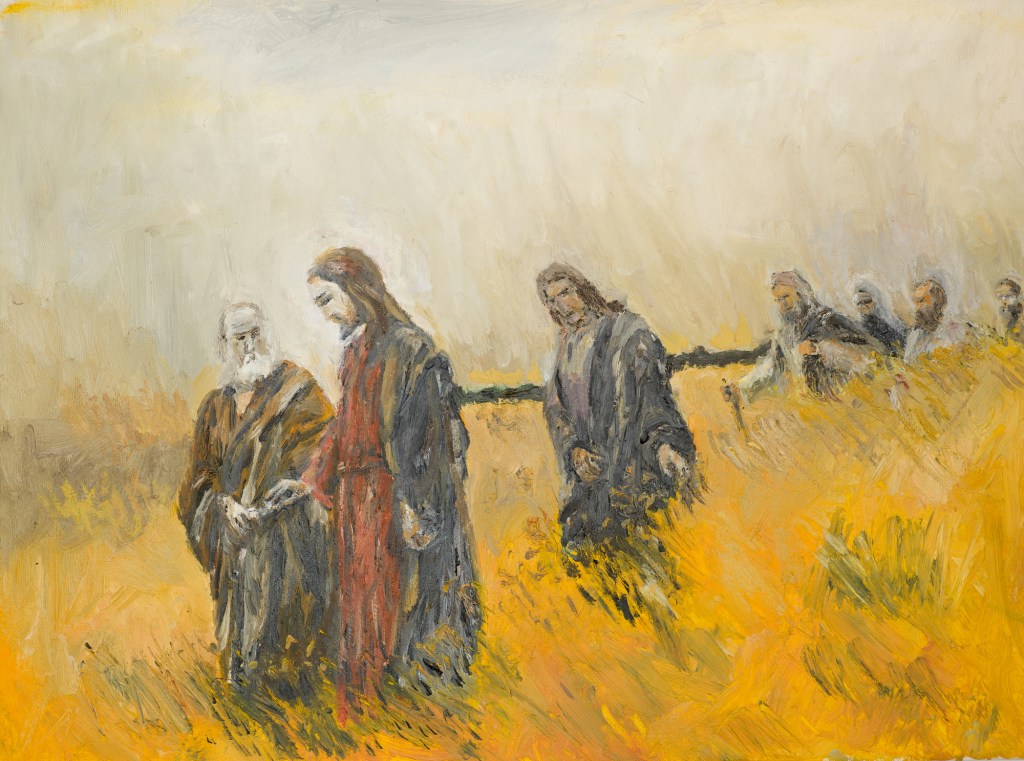
Oil painting illustrating Jesus Christ and his disciples on a meadow

I have spent some time lately considering the various influential groups of people in the time of Jesus and the orientation of those groups toward Jesus. I have wondered why Jesus seemed to pick on the Pharisees more than the other groups, especially since they seemed most aligned with him and had the most in common with him.

As I researched and thought about the various groups of Jewish influencers in the First Century in relation to Jesus, I began to think about the apostles, and their connections to these groups. I am always mining for insight as I read Scripture, and today my mind turns toward the relationship of the twelve apostles to those same groups of First Century, Jewish influencers.

We don’t know much about the background of the twelve disciples, except that most of them were “common” men of generally humble means. One disciple was identified with the Zealots (Simon, the Zealot, also known as Simon the Canaanite). Matthew, the tax collector, might have been Herodian (or may have been viewed as one).

We really don’t know about the group affiliation of the other disciples, at least not from the explicit text. They seem to have been ordinary people with no distinct association with particular groups. They did not seem to be closely associated with any of the five groups Jewish leadership groups in First Century Judea.

Even Simon, who is known as the Zealot, probably left his group behind to follow Jesus. Just as Matthew left behind his livelihood (tax collection) to follow Jesus. Of course, Simon (Peter) and Andrew dropped their fishing nets to follow Jesus, as did the brothers, James and John. It’s no stretch, therefore, to imagine that Simon, the Zealot, would have similarly “dropped” or left behind his affiliation with the Zealots to follow Jesus.

In fact, the theme of leaving behind your group seems to run throughout the teaching and example of Jesus. Jesus said, “[E]veryone who has left houses or brothers or sisters or father or mother or children or lands, for my name’s sake, will receive a hundredfold and will inherit eternal life.” (Matt. 19:29)

He called Peter and Andrew and James and John away from their profession of fishing. He called Matthew, the tax collector, away from his profession of tax collecting. I think it’s fair to assume that Jesus called Simon, the Zealot, away from the Zealots to follow him.

The theme of leaving behind family, livelihood and group identity runs deep in Scripture, all the way back to Abram (as Abraham was originally known) when God called Abram to leave his country, his people, and his father’s household and go to the land God would show him. (Gen. 12:1)

Hebrews 11 commends Abraham for the example of faith demonstrated in responding to God’s call and leaving behind the familiarity of all the things that typically identify people and their place in the world. Abraham and all the people of faith commended in Hebrews 11 demonstrated a kind of faith that made them “aliens and strangers on earth”.

Jesus called the rich young ruler to walk away from his wealth. (Matt. 19:16-30) Jesus told Nicodemus, the Pharisee, that he would have to be born again to see the kingdom of God. (John 3:3) Nicodemus was born into an enviable position in his community and may have winced at the thought of needing to be “born again”.

The kingdom of God is something I have been mulling over for many weeks, and months. It’s a theme I have written about often lately, and it has occupied a prominent place in my meditations lately.

The five main groups of Jewish influencers in the First Century had one thing in common – they were operating on a spectrum of influential relationship to the political structures and religious structures in their world. They were invested and embedded into their positions, and identities, with the people with whom they affiliated – like the partisanship and critical group affiliations we have today.

Along came Jesus, however, and he called people “out of the world”. (John 15:18-19) Jesus called people to leave their lives, and identities, and associations behind to follow him. I believe he is still calling people to the same allegiance today.

We don’t know much about the backgrounds and affiliations of the twelve disciples, perhaps, because they did just that. They left those things behind to follow Jesus. They became known, simply, as disciples of Jesus. They were, simply, Christ followers.

I am interested in these things because of what it means for us. If we would be disciples of Jesus and Christ followers, how do these things translate to our lives in the 21s Century?

Continue reading “The Group Affiliations the Apostles Had and What It Might Mean for Us”