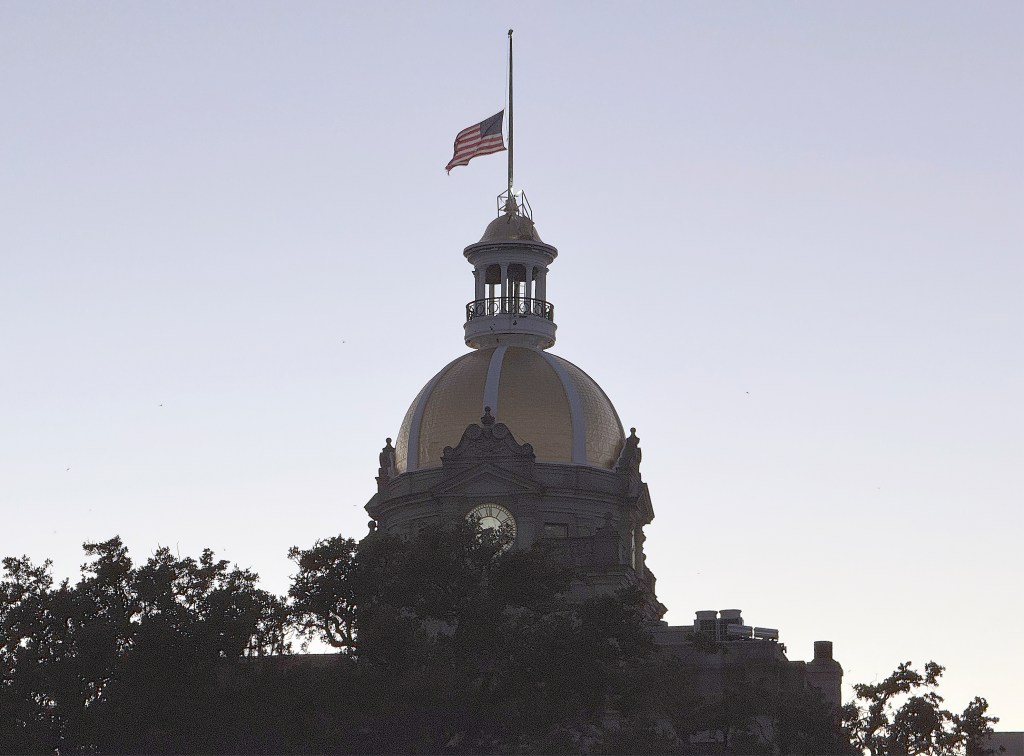
Savannah, GA, USA — 2025: The US flag was at half-mast at the Savannah City Hall dome on September 13, 2025, to honor the memory of conservative activist Charlie Kirk, who was shot and killed on September 10. (iStock Photos)
I hope you will stick with me on this one and give me some grace. I have let my thoughts on the brutal assassination of Charlie Kirk sit on the shelf these last three months to let the dust settle and the emotions wane.
I began writing on the topic when the awful news of his murder was still echoing loudly like shock waves in the air. I began writing the next day, after waking in the middle of the night with a question floating in my mind: Why did Charlie Kirk die?
Different people have different answers to that question, no doubt, but it seemed to be a question prompted by God to me. It challenged me to take that question back to God in prayer.
As I engaged God, the question changed slightly to this: For what did Charlie Kirk die? That question has hung in the air for me the last three months now, though the shock waves have settled into a kind of numbness. Many people have “moved on”, others are entrenched in the narratives they formed long ago, but I think the question still yearns for an answer that months of quiet contemplation might provide.
The failure of the German Protestant church to mount a decisive resistance to Nazism has long troubled western Christian conscience. Historians rightly warn against simplistic explanations, but one conclusion has proven difficult to escape: long before Hitler rose to power, the church’s theological confidence had already been weakened. When the state demanded ultimate loyalty, many pastors and congregations lacked the moral clarity and will to refuse.
The nineteenth-century Tübingen School of theology did not cause Nazism. Its scholars were not proto-fascists, nor did they anticipate racial ideology or totalitarian politics. Yet their historical-critical approach to Scripture unintentionally contributed to a Protestant culture in which the Bible increasingly functioned as an object of study rather than a source of commanding authority. When political myth replaced moral truth, the church was unprepared to stand against it because the church had long ago lost its biblical, moral footing.
History does not repeat itself mechanically. The present American situation is not Weimar Germany, and the MAGA movement is not Nazism. Still, history can illuminate how the happenings within the church influence how the church interacts with political culture. That raises a difficult but necessary question for American evangelicals today: what weaknesses in our own theology and habits of thought have made many of us susceptible to the distortions of political power?
The answer is not that evangelicalism has repeated the errors of liberal Protestantism. In many ways, we have made opposite mistakes. But the result—a diminished capacity for prophetic resistance—bears an unsettling resemblance.
Authority Dissolved: The Tübingen Lesson
The Tübingen School, led by Ferdinand Christian Baur in the mid-nineteenth century, treated Scripture primarily as a historical artifact shaped by competing early Christian communities. Biblical texts were analyzed as records of theological conflict rather than as a unified witness to divine revelation. The command and authority of Scripture was diminished, and the sacred became profane. The trajectory of the academy spilled into and watered down the vitality of Christian impact in Protestant Germany.
Clergy trained in historical criticism often hesitated to proclaim Scripture normatively. The Bible remained important, but its authority was qualified, softened, and translated into general ethical ideals compatible with modern culture. Christianity became morally earnest but theologically cautious and politically unimportant.
By the early twentieth century, much of German Protestantism lacked the confidence to say an unambiguous “No” to the state. The problem was not simply fear or cowardice. It was uncertainty—whether God had spoken definitively enough to authorize resistance when power spoke with confidence and force.
Karl Barth saw this clearly. In 1933, as the German church accommodated itself to the Nazi regime, Barth insisted that the church exists only under the authority of God’s self-revelation. Where that authority is weakened, the church becomes vulnerable to captivity by the state.
The lesson is sobering: when Scripture no longer stands above culture, culture will soon stand above the church. Today we can say of Nazi Germany and the church alike, “The grass withers, the flower fades, but the word of our God will stand forever.” (Isaiah 40:8) But, the impact was devastating on Germany, Jews, Europe, and the world at that time, and its effects rumble into the present time.
I do not want to suggest that we can equate Nazi Germany in the 1930’s and 1940’s to the United States of America in the 2010’s and 2020’s. Still, there are parallels between the exercise of State power in the vacuum left by weakened theology that bear some attention.
As another year closes out, I look back on my journey of faith and thought that is captured in this blog. The blog doesn’t capture all of my journey. Some things remain private, and some things remain undeveloped and unpublished. Of the things I have put out into the sunlight of the blogosphere, though, I hope they have been helpful, encouraging, and challenging, if not interesting.
I usually launch right into the top ten articles (or so) of the year in review, but I want to take a moment to review where I have been and where I am going. The numbers tell a surprising story (to me), but I realize the numbers might be boring to you, so I will try to keep that part brief.
I expect that the substance of the journey may be more intriguing to the reader, but the substance is also more difficult to capture and to summarize. I will do my best.
By the Numbers
I started this blog in September of 2012 with 20 articles that garnered under 500 views. The top article on attributes of success had just over 100 views, 5 likes, and 3 comments. About 180 of the readers came through Facebook. Those early attempts at writing are somewhat embarrassing to me (so no links are provided).
I wrote over 100 articles each year from 2017 through 2021, with the high water mark being 149 articles in 2017. My writing has slowed in the number of articles I have written over the last 4 years as the words per article have increased (peaking at an average of 1908 words per article in 2025)
In 2025, I have published only 57 articles all year, but viewership for the blog is projected to top out around 110,000. That is nearly as many readers as the blog had from 2012 through 2021 combined.
The top article this year was viewed over 23 times more than all the articles published in 2012. In the fact, the top article in 2025 was viewed more times (11,790) than all the articles in any year prior to 2020 (11,016 in 2020).
The climb from 500 views to 110,000 views was not a sudden thing. Readership increased with jumps and plateaus through 2019, with a peak of just over 11,000 in 2018. In 2020, readership jumped over 20,000 views, which I attribute to the pandemic. People were limited in their activities. They stayed inside, and they read more. Perhaps, people were more contemplative because of the psycho-emotional impact of COVID.
I was excited about the increase in readership in 2020 and the increase again to 30,000+ in 2021 as the world began to emerge from the clutches of COVID. With the world getting back to “normal” in the following two years, readership settled around 30,000 views each year for several year.
Just last year, in 2024, the views skyrocketed over 61,000. The upward trajectory has continued in 2025 with projected views on pace to top 110,000.
The sudden increase in readership has taken me totally by surprise. I have not done anything differently than I was doing before, as far as I know. Perhaps, my writing is developing in ways that I do not realize. I do tackle more difficult subject matter and get into greater depth, but I would assume that might turn some people away.
I began writing out of a sense of obedience to God. I felt compelled to make use of the gifting He has given me. My main goal was to be faithful, and that focus continues to be a driving force.
I have tried to stay true to the theme of the blog, which is “navigating by faith.” I try to write out of my own experience, to write in keeping with my own thought and faith journey, and to write as I sense God is leading me.
My Faith Journey
In 2012, I was coming out of a long, slow regression in my faith. Perhaps, others might call what went through a deconstruction. That long, difficult segment of my like journey of my life set the stage.
I wandered for more than two decades in a spiritual malaise. My faith became stagnant. I stopped seeking. I stopped reading the Bible. I stopped praying with purpose. I eventually stopped going to church. I was shrinking back from God.
My priorities had shifted from a spiritual focus to career and providing for my family. The cares and concerns of the world overtook me as I pulled back from spiritual seeking and devotion to God. I moved with my family back to the area where I grew up, and I found myself attracted to and tempted by former ways of thinking and way of life.
As I look back, I can say that I had accumulated baggage that was holding me back and stifling my spiritual growth. I had accumulated theological structures that God needed to strip away. That “deconstruction” was long and painful as I languished in spiritual ruts for over 20 years.
I came to a point at which I had nothing to cling to but God and His mercy. I didn’t even know if He would “take me back” when I came face to face with the realization that the spiritual life within me was in danger of petering out completely, like a pilot light flickering in a cold windy place. I turned to God, and I said, “Where else will I go? Only you have the words of life.”
In that moment of surrender, God had mercy on me. With no illusions of grandeur that characterized my early Christian walk, I sought God and embraced faithfulness. Around that time, I began to sense that God wanted me to write. He didn’t overwhelm me, with it but it was persistent, like the nudging of a gentle wind.
I noticed, and I flirted with the idea for many months before I finally relented in my heart to do it. I set up an account in WordPress, and I began to write in September of 2012. The summary of the last 13 years tells the rest of the story.
I have become hyper vigilant about the influence of our current times, culture, politics, etc. on my theology. We can’t help ourselves but to struggle with the currents of our times as they threaten to push us along in their path.
We might find ourselves swept along without even noticing it. Or we might take the opposite course and fight against those currents in the opposite direction. Both responses are problematic for the Christian who desires to follow Christ and to live according to his kingdom that is not of this world.
Whether we are being carried along by the currents of this present world, or fighting in opposition to them, we can find ourselves being wholly defined by the world – what we are for and what are against – instead of the purpose and commission Christ Jesus gave to us. Both types of responses to the world lead us off the path of following Jesus.
My views on this come from a sermon I heard in my early twenties 40 some years ago. I forget the biblical texts that laid the foundation, but the foundation remains with me: whether we allow the currents of our world to sweep us along or we fight in opposition to those currents, we are constantly in danger of defining ourselves and our theology in relation to the world – rather than in relation to God and His kingdom.
If we are followers of Jesus Christ, we might look at times as if we are going in the direction of the world. At other times, we might look as if we are going in direct opposition to the world. In reality, the Christian who follows Christ is walking a straight path. His path will take us at times in the same direction the world around us seems to be going and at other times in the opposite direction.
Christopher Watkin calls this Christian phenomenon “diagonalization” because it often looks like we are working at cross purposes to the world in both directions. As the world is pushes left, we appear to be pulling right; and as the world pushes right, we appear to be pulling to the left.
The key is that we should not allow ourselves to be defined by the world around us. We should be influenced and defined by God alone and His revelation to us found in the Bible.
I made one statement above that is not exactly true. I do remember one verse on which the sermon that influenced me so many years ago hung: “It is good that you grasp one thing, and also not let go of the other; for the one who fears God comes forth with both of them.” (Ecclesiastes 7:18) I call this holding things in tension.
We do this with the Bible itself. We learn to hold things in tension. Our fear (respect) for God and His word compels us to grasp one thing we know to be true while not letting go of other things we know to be true – even when it is difficult holding onto both things.
We fear (respect, trust) that God has greater perspective than we do. When He tells us to hate sin as He hates sin and to love people (who are all sinners), we need to grasp and hold onto both things as true, even though they may seem (to us) to be in tension with each other.
When we do that, we find that we come forward with both truths and a better understanding of Truth (capital T). We understand, for instance, that God hates sin because of what it does to us and to the rest of His creation, among other things.
As finite beings, we always have an understanding gap. Even when we think we know something, we are ignorant of what we don’t know. The Bible describes that reality by saying that God’s ways are not our ways, and His thoughts are not our thoughts.
We all know “religious” people who are hard, self-righteous, and unloving. They find it easier to hold onto the idea that God hates sin and more difficult to grasp the love God has for people who sin. We also know people who tolerate, accept, and even embrace sin in everyone (including themselves) because they feel that the tension between love for people and hating sin is too difficult to navigate.
People tend to want to gravitate to one end or the other of a spectrum of thoughts that seem to be in tension with each other because it might seem simpler and make more sense to us. For instance, some people reject the idea that human beings can even know truth because of our finitude, while others (in rejecting this post modern skepticism) double down arrogantly on the things we think we know. If we hold these things in tension, we reject the idea that human beings cannot know truth while we remain humble in what we think we know.
The person who fears God, grasps the one thing without letting go of the other. We may not do this perfectly well, but we understand that both of these things are true, and we strive to hold them in tension.
I have taken longer to get to the point than I expected, so I am going to finish this train of thought now by tying it back into the opening paragraph. What does this have to do with influence of the currents of the culture, politics, and spirit of our times on our theology?
Let’s lay politics aside for a moment, and just consider the Word of God. Politics, of course, is the backdrop to this article. A person cannot be completely apolitical, no matter how hard one tries, but political positions shift, evolve and change, while the Word of God is eternal. Therefore, we should put the Word of God first over our political inclinations.
The Word of God existed before God made the universe, and all of creation was made by the Word. (John 1:1-3) God spoke the entire universe into existence (Genesis 1) and made all things by that are seen from what cannot be seen His command. (Hebrews 11:3)
Of course if you are a Christian, you believe that the Word of God became flesh (John 1:14) in Jesus: God with us; God incarnate; God who became man. He proved himself by what he said, by the miracles he did, and by rising from the dead after he was tortured, crucified, and buried.
The Word of God (at least some of it) is preserved in writing for us as it was spoken to and through people who heard God’s voice and responded in faith by preserving it. Jesus, Himself, quoted extensively from the books of what we call the Old Testament as authority for what he said and did. (Interestingly, he never quoted from apocryphal texts.) Jesus, who we believe was God who became man and who rose from the dead, treated those Old Testament writings with great deference – as the word of God.
Jesus quoted Scripture often from Genesis to the Prophets. When Jesus was tempted by Satan in the wilderness, he quoted scripture, including Deuteronomy 8:3: “Man shall not live on bread alone, but on every word that comes from the mouth of God.” When Jesus began his ministry, his first public statement and the description of his ministry came from the prophet, Isaiah:
“The Spirit of the Lord is on me, because he has anointed me to proclaim good news to the poor. He has sent me to proclaim freedom for the prisoners and recovery of sight for the blind, to set the oppressed free, to proclaim the year of the Lord’s favor.”
Luke 4:18-19 (which Jesus told the listeners was fulfilled by him that day in their hearing)
After Jesus rose from the dead, he explained how the Scriptures from Genesis through the Prophets were about him. (Luke 24:27) Jesus was both the Word of God through whom God made the universe, and he honored the word of God preserved in the Bible – calling it his daily bread. It defined his purpose; and it informed who he was.
With that set up, my theme today is the Prophets and what they said about how God’s people should act in the world, especially rulers who wield governmental influence and power. Our political views, how we conduct ourselves in politics, and who we champion as our rulers should be informed and driven by God’s Word.









 Navigating by Faith