The Eternal Significance of the Mundane

We are either moving toward God or moving away from Him. We are never standing still.


Tim Keller, in preaching on the First Temptation of Christ, observed that the first temptation of Jesus by Satan in the desert was a mundane one: “If you are the Son of God, command this stone to become bread.” (Luke 4:3) Everyone needs food. In our modern day, we would say that people not only need food, they deserve it as fundamental right.

Surely, the Son of God deserves bread, and there’s no reason why he shouldn’t just make a little bread out of a stone. Right?

This is how Satan comes at us: “You need it. It’s just a small thing. C’mon, you deserve it!”

In the story, Jesus had just fasted for forty (40) days, and the forty (40) days were over. Jesus was hungry – more like starving! (Luke 4:2) He had done what he set out to do; he fulfilled the commitment he made, and he was free to eat.

This is how Satan works on us. He gets us thinking about ourselves, our needs, and (if he can push us far enough) our rights. “You have a right to that bread! Take it!” It wouldn’t have seemed “wrong” for Jesus to have turned a stone into bread.

And this is the struggle: will we live our lives serving ourselves, doing what we want, going with the flow of our natural inclinations, fulfilling every personal need and desire, the captain of our own souls? Or will we consciously live our lives for God and others, letting God direct us, yielding our selves to the One who made us?

We tend to think of the big temptations, not realizing that Satan is always there trying to get us to feed from his hand.  His hand is always out, offering morsels and tidbits. We often feed from his hand without realizing it. We may go about our days unaware of the momentum of the movement of our hearts, feeding little by little on things that are moving us away, not toward, God.

CS Lewis says we are either moving toward God or moving away from Him. This happens every day, day after day, in all the hundreds and thousands of choices we make, reactions to circumstances and thoughts that we entertain.

The momentum of our lives is something we don’t often stop to consider. It often isn’t obvious to our conscious minds. We may not even be aware of all the little things that add up and feed that momentum in the direction we are going. We are highly aware of the momentous times in our lives, but we are largely unaware of the mundane times where real direction and momentum are sustained.

I think about these things in light of two recent announcements by two prominent (at least highly visible) men who were once Christians and now have renounced their faith. Marty Sampson, the Australian songwriter for the global megachurch, Hillsong, announced this week, “I’m genuinely losing my faith….”[1]

Just days before that, well-known Christian author, Joshua Harris, who championed purity and advocated that Christians shouldn’t date before marriage in a widely popular book, announced (on the heels of his own divorce), “I have undergone a massive shift in regard to my faith in Jesus…. I am not a Christian.”[2]

According to CS Lewis and Tim Keller, we are shifting – all the time. Our momentum is taking us toward God or away from God at any given moment and at every moment in our lives. We are never merely standing still.

Continue reading “The Eternal Significance of the Mundane”

God is the Fulfillment of the Desires He Built into Us

We all have a conscience and a desire and need for the cleansing of our consciences.


“Have mercy on me, O God, according to your steadfast love; according to your abundant mercy blot out my transgressions. Wash me thoroughly from my iniquity, and cleanse me from my sin!” Psalms 51:1-2 ESV

I have written about how we can’t throw out the Old Testament and accept the New Testament in its place, as modern sensibilities might suggest. (See, for instance, Jesus and the “Old Testament God”) The Old Testament is the seed for the New Testament. Everything revealed in the New Testament was first revealed in the Old Testament. The Old Testament finds its fulfillment in the New Testament.

It seems that 21st Century people tend to want to view “the Old Testament God” as something different from the God revealed in the New Testament by Jesus, but Jesus affirmed the Old Testament.  Jesus says that the Old Testament also anticipates and points toward him.

“And beginning with Moses and all the Prophets, he explained to them what was said in all the Scriptures concerning himself.” Luke 24:27

The Bible verse of the day quoted above was prayed by David in Psalm 51. David expressed the desire of all of us when he asked God to have mercy on him, to “blot out” his transgressions, to wash away his iniquity and to cleanse him from his sins. We all have a conscience.

We all have failed our own consciences (let alone God’s standards), and we need cleansing and redemption. This is a deep longing within each one of us.

At the same time, we have the capacity to ignore our consciences and to deny that desire for cleansing and redemption. If we do that too often and too long, our consciences become callous and dull; the desire for redemption diminishes; and we no longer have the sensitivity God built into us that drives us toward Him.

C S Lewis talks about how our desires and our needs have a correlative reality in something that fulfills those desires and needs. He observes that we hunger, and there is food to meet that hunger; we thirst, and there is water to quench that thirst; we have sexual desires, and there is conjugal love we have with another person that fulfills that desire.

The satisfaction is only temporary, however. We have longings for more lasting satisfaction. That those desires are only temporally met and satisfied, says Lewis, suggests that there is something else, something more.

We also have a deeper and more fundamental longing within us to know God and to be known by God, for relationship with God and for eternal life. CS Lewis says that the reality we know, the satisfaction of temporary longings and desires, is some evidence of a more fundamental and satisfying reality that will fulfill our enduring and deepest longings.

The ancient writer of Ecclesiastes was, perhaps, thinking along these same lines when he said that God put eternity into our hearts, yet not so much that we know very much about it:

“He has made everything beautiful in its time. He has also set eternity in the human heart; yet no one can fathom what God has done from beginning to end.” Ecclesiastes 3:11 NIV

Continue reading “God is the Fulfillment of the Desires He Built into Us”

The Place for Experience in the Mix of Science, Faith and the Evidence for God

When asked what would make them believe, some atheists say a personal experience with God would do it.


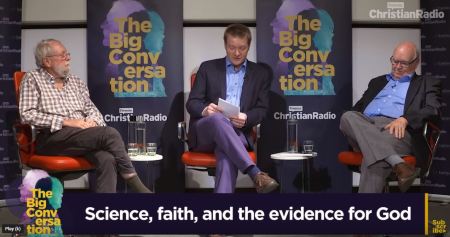
On the show and podcast, Unbelievable! On Christian Premiere Radio in the UK hosted by Justin Brierley, the host often asks people, atheists and Christians, what would make them believe (or not believe, as the case may be). Most people think of arguments or historical or scientific proofs, but not everyone.

In one particular episode Michael Ruse, a professor and philosopher of biology at Florida State Universality, participated in discussion with John Lennox, a professor of mathematics and philosophy at Oxford, on the subject of Science, Faith and the Evidence for God. When asked the question about what would make him believe, Michael Ruse surprisingly (for me at least) said that it would have to be a personal experience with God.

Michael Ruse is a Fellow of the Royal Society of Canada and the American Association for the Advancement of Science. Ruse is an evolutionary biologist who has debated against intelligent design proponents. He has been on the Advisory Council to the National Center for Scientific Education. He is a Bertrand Russell Society award winner for his dedication to science and reason.

Thus, my surprise to hear him provide such an “unscientific” answer to the question of what it would take for him to become a believer. I have since heard other atheists provide similar answers. Intelligent Christians, I think, underestimate the power of personal experience.

To be fair of Michael Ruse, though is a decided atheist, he has a healthy respect for theology. Maybe that is because he is a philosopher, and not just a scientist.

I say “just a scientist” because there is a school of thought among modern scientists that we don’t need philosophy anymore, that science is all we need. (People like Richard Dawkins and Neil deGrasse Tyson have expressed this view.)

But science, by definition, is limited to the study of the natural world, matter and energy (or “molecules in motion” as some like to say). Anyone who makes the claim that science is all we need has made an a priori determination (an initial presupposition) that molecules in motion are the sum of all reality. Neither theology, nor philosophy, fit into a world like that. And, where, then, does that leave mathematics and logic?

Michael Ruse, being an expert in philosophy takes great offense at the notion that philosophy has gone the way of God and is dead (alluding to Nietzsche’s great contention). It’s natural for a philosopher to take that position, I suppose, even an atheist philosopher. After all, he has devoted his life to philosophy!

But then, consider that he knows something of what he talks about. Just as scientists know a great deal more about science than me, a philosopher knows a great deal more about philosophy than, well… a scientist (who studies only molecules in motion). It isn’t hard to understand why such a person might begin to see the world as nothing but molecules in motion when that is the constant and continual focus of life long study, but the theologians and philosophers, even atheistic one, protest there is more.

Continue reading “The Place for Experience in the Mix of Science, Faith and the Evidence for God”

The False Promise of Pleasure

Statue of writer and playright Oscar Wilde in Merrion Square in Dublin, Ireland.

“Meaninglessness does not come from weariness with pain. Meaningless comes from weariness with pleasure….  No one is more fed up with life than one who has exhausted pleasure. Some of the loneliest people in the world are those who have lived indulgent lives and emotionally and physically drive themselves to impotence.”

This is a quotation from Ravi Zacharias in a talk he gave titled, the Problem of Pleasure.* If you listen to Ravi Zacharias much, you will note that he returns to this theme often, and he often mentions Oscar Wilde, the famous Irish poet and playwright. Wilde, of course, was a brilliant writer and thinker who was an outspoken atheist and lived a hedonistic lifestyle.

Wilde is described as “the supreme individualist”. His book, The Picture of Dorian Gray, is described as a “novel of vice hidden beneath art” tinged with “self-conscious decadence”. The Importance of Being Earnest, commonly believed to be his best work written at the height of his career, is more subtle and nuanced, but continues the same theme, as do all of the works of Oscar Wilde. (See Wikipedia)

We know much of Wilde’s private life. Many of his secrets were paraded before the world to see in a much publicized court case, ironically, when Oscar Wilde sued the Marquess of Queensberry for libel.

Queensberry’s son, Lord Alfred Douglas, was the person who introduced Wilde to “the Victorian underground of gay prostitution”. Queensberry’s defense to the libel charges was to prove his statements true by hiring private investigators to uncover the “salacious details of Wilde’s private life”. The trial that Wilde brought against Queensberry left him bankrupt and exposed.

Wilde, the “colourful agent provocateur in Victorian society”, spared himself no pleasure. He also wasn’t shy about his lifestyle. He championed licentiousness in his art and in his life.

Like Solomon, though, he retained a sort of wisdom borne of experience. Having been baptized as a child, he often used biblical imagery in his writing, though it’s use would have likely been considered sacrilegious.

During a two year prison sentence for homosexual actions, he requested copies of the Bible in multiple, languages, Dante’s Divine Comedy and other works with Christian themes. When he was released from prison, the Catholic Church turned down his request to spend six months at a monastery, and Wilde wept at the news.

As I sit here thinking of these things, I am also thinking of the unfolding story of a friend, a very enthusiastic and committed believer in God. He is a lover of the stage, a former Shakespearean performer. In that sense, he shares something in common with the playwright, Wilde.

My friend is in a hospital ICU as I write, having suffered a series of strokes that could leave him uncommunicative and paralyzed. Even in his desperate physical situation, he and his family have experienced the presence of God sustaining them in faith. They exhibit a transcendent joy and peace in the middle of the difficulties they face.

We are naturally attracted to pleasure and pull back from pain. Sometimes, however, the pleasures we seek cause us pain. We tend to think that pleasure is good and pain is bad, if not in a moral sense, then certainly in an experiential sense. God gives us the ability to experience pleasure and pain. In that sense, God gives us both pleasure and pain.

Neither one is intrinsically good or bad. CS Lewis implies this when he says that God whispers to us in our pleasures, but He shouts to us in our pain. Though pain can be the result of our own reckless indiscretions, it isn’t always so. My friend in the hospital is proof of that.

Continue reading “The False Promise of Pleasure”

CS Lewis on the “True Myth”

All myth is an attempt to shine light on truth. True Myth is the ultimate Light shining on the ultimate Truth. 

The Areopagus in Athens

“Now the story of Christ is simply a true myth: a myth working on us in the same way as the others, but with this tremendous difference that it really happened: and one must be content to accept it in the same way, remembering that it is God’s myth where the others are men’s myths: i.e. the Pagan stories are God expressing Himself through the minds of poets, using such images as He found there, while Christianity is God expressing Himself through what we call ‘real things’. Therefore it is true, not in the sense of being a ‘description’ of God (that no finite mind could take in) but in the sense of being the way in which God chooses to (or can) appear to our faculties. The ‘doctrines’ we get out of the true myth are of course less true: they are the translations into our concepts and ideas of that which God has already expressed in a language more adequate, namely the actual incarnation, crucifixion, and resurrection. Does this amount to a belief in Christianity? At any rate I am now certain (a) That this Christian story is to be approached, in a sense, as I approach other myths. (b) That it is the most important and full of meaning. I am also nearly certain that it really happened….”


This quotation is from CS Lewis in a letter to Arthur Greeves: from The Kilns (on his conversion to Christianity), 18 October 1931. It captures the thought process of CS Lewis at the point in time when he was becoming convinced of the truth of Christianity.


If you have read much of what I write, you would easily notice that I quote and reference CS Lewis often. He resonated with me in my faith journey that began in college, and he continues to resonate with me.

He is cited by more diverse groups of people than any Christian thinker, perhaps, in the 20th Century. He had a unique way of approaching things from unique points of view, often pulling fresh ideas from the dusty tomes of ancient literature. His concept of myth and True Myth is one such point (though the source is actually JRR Tolkien).

Some might consider his frequent allusions to ancient, pagan myth heretical. Some might even confuse his love of pagan myth with New Age belief, but he flatly rejected the occult. He was orthodox in unorthodox ways, but his creative approaches to orthodoxy were refreshing and thought-provoking.

We don’t have to look any further than the ultra-orthodox, Apostle Paul, to find some common ground with CS Lewis. When Paul was in Athens, some Epicureans and Stoics he met in the marketplace brought him to the Areopagus to address an erudite Greek crowd. In that address, Paul referenced an altar inscribed “To An Unknown God” and quoted pagan writers when he said:

“in him we move and live and have our being”.

Acts 17:26 (quoting a line from Cretiga, by Epimenides of Knossos)

“For we are indeed his offspring ”

Paul quoted the Cretan philosopher, Epimenides, also in Titus 1:12. Paul knew enough about pagan philosophy and poetry that he could quote from pagan works multiple times in his writings and addresses.

Paul quoted the pagan philosopher to express a spiritual truth about our lives in Christ, and Paul quoted the pantheistic poet, Aratus, to convey a theistic principle about God. (See Acts 17:22-28 – Quoting the Philosophers?) Paul connected with the people “where they were,” using language and references from the culture they understood to convey something about God.

Paul was well-read in the literature of his culture, and he used pagan philosophy and poetry to introduce people to the Gospel. This is exactly what CS Lewis does in in his own writing. Through his deep knowledge of pagan myth, he recognized strands of truth, and he recognized the difference between “man’s myth” and “God’s myth (the the “True Myth”).

In using the term, myth, Lewis is talking about story and narrative. Many stories and narratives convey a modicum of truth. CS Lewis observes that most myth from around the world contains some elements of truth, and Lewis insisted we shouldn’t be surprised by this – because truth is universal.

The difference between myth and True Myth, according to Lewis (and Tolkien), is that all other myth is a shadow of the True Myth. All myth is an attempt to shine light on truth. True Myth is the ultimate Light shining on the ultimate Truth.

All myth conveys truth through storytelling. True Myth isn’t just another story, though; it is “the” Story. It isn’t “just” myth, but reality, because “it really happened,” as CS Lewis said.

The True Myth is the Gospel. God, the Creator of the universe and everything in it, created man in His own image as His crowning creation. Then, God became a man, injecting Himself into His own creation, in order to communicate His very heart to us and to rescue us from going our own way by revealing the ultimate purpose for which God created us – to have loving relationship with God, our Creator.

Continue reading “CS Lewis on the “True Myth””