The Surprising Value of the Concept of Sin

The idea of sin makes people feel uncomfortable, and people blame sin for making them feel bad about themselves.


Many people bristle at the Christian idea of sin, and many people fault Christianity for its emphasis on sin. Richard Dawkins criticized Christianity in his book, The God Delusion, that it’s all about sin, sin, sin. His sentiment seems to be a popular one.

As a long-time Christian, I have a “robust” view of sin not just because I have robust respect for the Bible. I see sin in myself, and I see it in mankind, generally. I see it as a fact, like gravity, that makes sense of the foibles, failures, and futility of people and human systems I see in the world.

Not that people are incapable of doing good. Even who do not believe in God can do good. Even in doing good, though, I believe most of us do it good “selfishly” – because it makes us feel good; because of peer pressure; because we want people to honor us; because we want other people to be nice to us; or simply because of the utilitarian ideal that it makes the world a better place for me and my tribe to live in.

Most people, I assume, would be uncomfortable with my assessment. Maybe what I see in myself shouldn’t be “projected” onto other people. Maybe I am right, though. I wouldn’t believe it if I didn’t think it is a fair assessment.

I think one issue people have with the idea of sin is that they don’t know what to do with it. It doesn’t fit into an evolutionary paradigm that celebrates the progress of humanity from primordial ooze to ape to rational being.

Absent a cosmic redeemer, people have no “solution” for sin. Reject the One, and the other makes no sense. Many people don’t want a cosmic redeemer interfering with their self-determination (even people, ironically, who believe we have no self-determination, because we merely dance to our DNA).

People don’t see any “value” in sin. The idea of sin makes people feel uncomfortable. They blame the concept of sin for making them feel bad about themselves. When people measure their goodness against others, they either feel shame or self-righteousness, because they see themselves as better or worse than others.

People blame judgmental attitudes, intolerance, lack of empathy for others, and a host of other evils on the Judeo-Christian concept of sin.

On the other hand, do people who have rejected the Christian concept of sin stop feeling bad about themselves or stop being self-righteous? In my experience, no, they don’t.

Abandoning the idea of sin doesn’t seem to help people not feel bad about themselves, and it doesn’t stop people from being self-righteous. People still compare themselves to others. People still struggle with self-image, and some people still seem to think themselves morally superior to others even after rejecting the concept of sin.

The Christian vocabulary that includes sin has no place in alternative cultural constructs, like cultural Marxism, and the host of critical theories that flow from it. Judgment of others, however, is baked into those constructs, and virtue is signaled for group approval in ways that seem, to me, just as inimical as any bad church environment.

People are shamed and labor under judgmental attitudes perfectly well without the help of Christianity. In fact, I believe the shame and self-righteousness is even worse because other cultural constructs lack the Christian concepts of redemption, grace, and forgiveness.

But, I believe in sin simply because it makes sense of all my experiences and everything that I see in people and the world that is run by people. I have never thought of sin as a value proposition, other than to think that sinfulness is generally bad. I have certainly never thought of the idea of sin as good!

Until now.

Continue reading “The Surprising Value of the Concept of Sin”

Fruit, Love and False Prophets

It’s a sad state of affairs that Christians today may be more well known for their fighting with each other than for their love for each other. 


Someone commented recently on Facebook that some of the harshest critics of Christians on social media are Christians. (Assuming that anyone who self-identifies as a Christian is a Christian.) This reminded me of what Jesus said to his disciples after Judas left the last supper to betray him.

When he was gone, Jesus said, “Now the Son of Man is glorified and God is glorified in him. If God is glorified in him, God will glorify the Son in himself, and will glorify him at once.
“My children, I will be with you only a little longer. You will look for me, and just as I told the Jews, so I tell you now: Where I am going, you cannot come.
A new command I give you: Love one another. As I have loved you, so you must love one another. By this everyone will know that you are my disciples, if you love one another.”

John 13:31-35

“Now” the Son of Man is glorified, Jesus said. He was lifted up, but it wasn’t the kind of “glory” anyone expected. It was the glory of Jesus being obedient to the Father and accomplishing all that intended.

Jesus knew he was leaving, and (if we read between the lines), he knew the disciples left in front of him would struggle at first. What was the key instruction in this time? What was the one thing he gave them to hold onto?

Love one another. As I have loved you, so you must love one another. By this everyone will know that you are my disciples, if you love one another.”

It’s a sad state of affairs that Christians today may be more well known for their fighting with each other than for their love for each other. 

People will say that the doctrine is important and that Paul and the early church were also concerned about doctrine. This is true, of course.

It also occurs to me that the 1st century Christians lived in a world that was predominantly non-Christian. They were a very small minority. The disagreements among Christians likely went completely unnoticed by the world at large.

Christians are in the majority in the United States today, so negativity from Christians toward Christians in the United states is highly noticeable. With so many people who call themselves Christian, the fighting is going to get noticed.

A person might say further that love is tempered by truth. Love that does not recognize and confirm to truth is not love. Right? I cannot help but thinking, however, that such a statement sounds particularly like something a Pharisee may have said in the 1st century.

Isn’t it a shame that, with so many Christians in this country, we do not shine like that proverbial city on a hill? And, by shine, I mean with the love of God for each other (and for others – and even for our enemies).

Looking back at the first Christian leaders who had disagreements, I see that they spent time in prayer – together with each other. They worked to find common ground, and they agreed to disagree on peripheral things. They did not bicker publicly among themselves.

We see many examples of this in the Book of Acts and the epistles that make up the New Testament. Early Christians did not agree on everything, but they agreed on essentials, and they allowed room for disagreement.

Early Christians did take a strong stand against heresy, but we can’t just everything on which we disagree matters of heresy. Heretical doctrines in the 1st Century, like Gnosticism, have their 21st Century counterparts. We call certain clear departures from orthodox Christianity heretical, like the Jehovah Witnesses and Mormons, but the fighting my friend on Facebook was sad about is fighting among Christians who are somewhere in the range of Christian “orthodoxy”.

That is the rub.

Continue reading “Fruit, Love and False Prophets”

You Might Be A Pharisee If ….

Just when we become proud of our own spiritual advancement we are most in danger of spiritual catastrophe!


[29] “Woe to you, experts in the law and you Pharisees, hypocrites! You build tombs for the prophets and decorate the graves of the righteous. [30] And you say, ‘If we had lived in the days of our ancestors, we would not have participated with them in shedding the blood of the prophets.’

Matthew 23:29-30

Reading this passage in Matthew today reminded of the old bit by the comic, Jeff Foxworthy. If Jeff Foxworthy was a comic in 1st Century Judea, he might have said, “You might be a Pharisee if ____________________ (fill in the blank).”

In a similar vein, we could say, “You might be a Pharisee if you think you would not have opposed Jesus if you lived in Judea in the 1st Century.”

Of course, Jesus wasn’t being funny when he confronted the Pharisees, and this wouldn’t be a comedic schtick.

I don’t think Jesus was saying it was wrong for people to build tombs to the prophets or decorate them with flowers. Jesus was saying it was wrong to say (and think) they would have treated the prophets any differently.

The Pharisees are to us what the prophets were to the Pharisees. We may be tempted to think that we would embraced Jesus if we lived in 1st Century Judea, and would not have opposed him or called for his crucifixion if we we were in the crowd that shouted, “Crucify him!”.

But, that is no different than how the Pharisees thought and what the Pharisees claimed about the prophets that were resisted, derided, and sometimes killed by the “religious” people of their day. Jesus was clearly implying that the religious people of his day (the Pharisees), were no different than the religious people in the days of the prophets.

Can we say, then, that we are different than they?

Only if we adopt the same thinking as the Pharisees! (If I am understanding Jesus accurately.)

The Pharisees thought of themselves more highly than they should have. John came preaching repentance, for the Kingdom of God is near! But, the Pharisees didn’t repent. They didn’t think they needed to repent.

When Jesus – who was God in the flesh – came into the world, the Pharisees didn’t recognize Him or receive Him. (John 1:9-11) They did not prepare themselves for his coming by repenting, as John the Baptist exhorted. They adopted the wrong attitude about what God was doing in their time, and they didn’t hear and respond to what God God’s messenger was saying.

Pharisees say the right things, and they do the right things, but they fool themselves. What the Pharisees said and did was a façade. Their hearts were not aligned with their actions. They claimed to be experts in the Law, but Jesus called them blind guides leading blind followers. (Matt. 15:14)

Pharisees were concerned with appearances and the way people saw them. Pharisees were not as concerned with their heart attitudes. Jesus called them “white-washed tombs” that were empty inside (full of dead people’s bones and uncleanness). (Matt. 23:27-28) We need to be careful that we do become like the Pharisees.

Continue reading “You Might Be A Pharisee If ….”

Christianity’s Ties to the Scientific Method

Christianity was the fertile soil in which scientific method and modern science began to grow


I have heard a number of people assert that Christianity gave birth to the scientific method. Perhaps, the first time I heard that claim was from John Lennox, the famous Oxford University professor of mathematics. I was intrigued, but I didn’t take the time to research his claim at the time.

I have heard the claim repeated multiple times, most recently by Dr. Michael Guillen the astrophysicist, former Harvard professor and TV personality. In fact, he devoted a podcast to the subject (embedded below), so I figured it was time to learn more.

I started with Wikipedia, which has a page on scientific method. Wikipedia begins with Aristotle and focuses on rationalism as the basis for scientific method.

Properly speaking, rationalism is not a method. It is a philosophy, a way to approach the world. Rationalism and Aristotle, though, seem to have led the way to the development of the scientific method.

Aristotle’s inductive-deductive method that depended on axiomatic truths and the “self-evident concepts” developed by Epicurus was an early conception of the way to do science. It was jettisoned, however, for something more like the modern scientific method beginning around the 16th Century. Perhaps, this is why Guillen doesn’t mention Aristotle, except in passing.

After those early pioneers, Wikipedia references some great Muslim thinkers who were influenced by Aristotle (including Avicenna (Ibn Sina) and Averroes (Abū l-Walīd Muḥammad Ibn ʾAḥmad Ibn Rušd)). They placed “greater emphasis on combining theory with practice”, focusing on “the use of experiment as a source of knowledge”. Guillen starts his history of scientific method with these early “flashes” of scientific method in the Muslim world.

These men of the Islamic Golden Age pioneered a form of scientific method, but the inertia did not continue. Moses ben Maimon (Maimonides), the great Jewish theologian, physician, and astronomer, developed a similar emphasis on evidence. He urged “that man should believe only what can be supported either by rational proof, by the evidence of the senses, or by trustworthy authority”. He foreshadowed a future scientific posture, but his prescience also did compel further advancement at the time.

Dr. Guillen credits Robert Grosseteste and Roger Bacon with the formation of the first actual principles of scientific method. Their ideas “caught fire” in Christian Europe from the tinder of academies that began just after the turn of the first millennium, igniting a blaze that would fuel scientific inquiry and endeavor for centuries to come.

“Concluding from particular observations into a universal law, and then back again, from universal laws to prediction of particulars”, Grosseteste emphasized confirmation “through experimentation to verify the principles” in both directions.

Roger Bacon, Grosseteste’s pupil, “described a repeating cycle of observation, hypothesis, experimentation, and a need for independent verification”, including the recording of the way experiments were conducted in precise detail so that outcomes could be replicated independently by others. Bacon’s methodology lead to the modern emphasis on peer-review in science, says Guillen.

Wikipedia mentions Francis Bacon and Descartes. Bacon and Descartes emphasized the importance of skepticism and rigid experimentation, expressly rejecting Aristotle’s dependence on first principles (axioms). Guillen, however, glosses over Descartes to get to Galileo Galilei and Isaac Newton.

Galileo Galilei introduced mathematical proof into the process and continued to distance science from reliance on Aristotelean first principles. Galileo and Newton reformulated the terms of scientific method that would inform modern scientists ever afterward.


That the two latter men were men of faith, along with Grosseteste (a Catholic Bishop) and Roger Bacon, his student, is significant. Maimonides and the Islamic thinkers before him were also men of faith. These men who pioneered the way to modern science were all monotheists who believed in a creator God. 

Science did not really take off until the 17th Century. The trailblazers of the modern scientific method were religious men, and the modern scientific method was born in the religious environment in Christian Europe lead, primarily, by men of faith.

Why did science catch fire in Christian Europe and not in other parts of the world? Why not in China? Or in the world of the eastern religions? This is a question Guillen poses, and he provides a possible answer.

Continue reading “Christianity’s Ties to the Scientific Method”

Pulling at the Threads of the Christian Paradigm that Uniquely Influenced the Western World

Down at the bedrock of modern, western values remains a Christian foundation.

Galleries under the central arena of the Colosseum in Rome, Italy

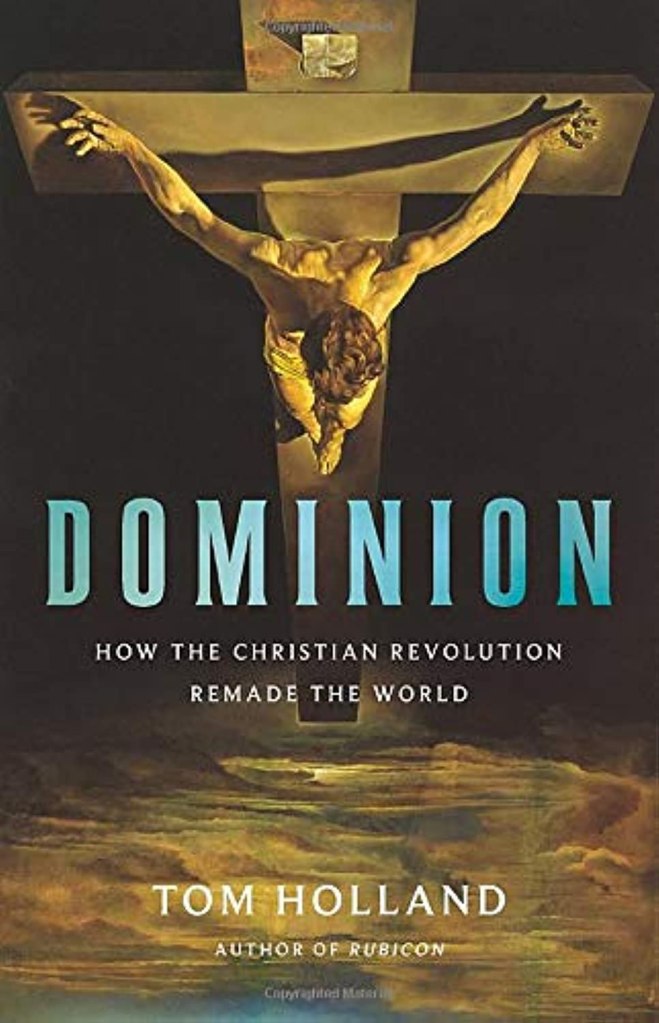
I read Tom Holland’s new book, Dominion, about a year ago, and I have written about it a few times. Many Christians would not think to read a history about Western Civilization by a self-described secular humanist (once atheist, perhaps now agnostic) historian.

Most non-Christians are likely to be uncomfortable with the chronicle Holland describes of the radically influential role that Christianity played in the development of Western Civilization, providing the foundation, in fact, for secular humanist ideals. When Holland dug down to the bedrock of modern, western values, he was surprised himself to find them anchored on a Christian foundation.

Holland did not set out to write a Christian apologetic, and he seems to remain somewhat uncertain how to process what he “discovered”. What he found, though, changed his mind about Christianity. He gives a brief explanation in the following clip:

Though Holland has had a turnabout on his view of Christianity, he finds himself caught in an odd position wrought by the unexpected discovery that his lifelong, secular humanist values flow from the radical catalyst of Christian influence and remain embedded ubiquitously in its very fabric. The awkwardness of his current position is evident in his interviews and discussions about the book.

Christians and secular thinkers, alike, wrestle with his book. Holland doesn’t hide any warts, and he doesn’t pull any punches. Neither does he obfuscate the thoroughly paradigmatic shift in Western thinking that Christianity worked into a society that once proudly and unashamedly championed strength and privilege over the poor, the weak, and the lowly.

Holland exposes the metanarrative developed during the Enlightenment and thereafter that belies the foundation on which the Enlightenment structure was built. Far from advancing the progression of human values, the Enlightenment threatened to undo the distinctly Christian concern for the poor, weak, and lowly while attempting to wrest western civilization from the hold of the Divine. Humanism saved the Christian ethic, albeit divorced from Christ.

Consider the full title of Darwin’s great tome which staked out the ground of a scientific (and social) revolution free from God’s interference:

“The Origin of Species by means of Natural Selection or the Preservation of Favoured Races in the Struggle for Life”

The title of Darwin’s book championing the evolutionary paradigm, harkens back to the Greco-Roman value system that despised the poor, the weak and the lowly. That value system did not just turn a callous eye at wanton and discriminate cruelty, it cheered on the strong while they snuffed out the weak. It was national sport!

The very reason the full title never “stuck” (I now believe) is due to a fundamental, pervasive, and thoroughly entrenched counter-value of the intrinsic worth of human life that is uniquely Christian in its source.

The intrinsic value of all human life, from the greatest to the least, from the wisest and strongest to the weakest and most imbecilic, from the fittest to the most infirm, is traceable to the Christian belief that all human beings are made in the image of God. That the survival of the fittest did not take hold as a western social or ethical value is attributable to the deeply ingrained Christian ethic that survived yet, despite the efforts to eradicate its God from modern equations.

Modern humanists may attempt to recast Darwin into a humanistic mold, but the idea of “social Darwinism” bears his name through no model of random, unguided selection. According to John G. West, Charles Darwin, himself, set in motion the inertia for eugenics, among other things, that were associated with social Darwinism:

Darwin himself in The Descent of Man provided the rationale for what became the eugenics movement, and how the vast majority of evolutionary biologists early in the twentieth century were right to see negative eugenics as a logical application of Darwin’s theory.

While the defense of Darwin against the charge of social Darwinism has largely succeeded in popular and polite company, the very title of the Origin of Species (by means of Natural Selection or the Preservation of Favoured Races in the Struggle for Life) belies the success of that effort. The fact that the full title is merely a parenthetical today is evidence only of a concerted rescue campaign.

Christian values survived despite the Enlightenment coupe, not because of it. Humanism today assumes the evolutionary paradigm for its science alongside the uniquely Christian paradigm of intrinsic human value. That the two assumptions do not fit well together seems to be lost on modern minds.

Continue reading “Pulling at the Threads of the Christian Paradigm that Uniquely Influenced the Western World”