What It Means to Know God

One sure way to know God


The age old questions humans have asked since time immemorial are, “What is God, and how do I know God?” We have conceived of gods as animated trees, mountains, and the sun, the stars, and the moon. We have conceived of gods as a pantheon of god-men and god-women. We have conceived of God as a force that is in everything, and we have conceived of God as an aloof judge and guardian of the ever after.

The Hebrew Scripture provides a robust concept of God, the Creator of the universe, who reveals Himself to human beings, but who remains mysterious and even “hidden” to people who must seek Him. The Tanakh (the Law, the Prophets, and the Writings) that Christians call the Old Testament purports to be God’s revelation to human beings with a promise that those who seek may find Him, “though he is not far from any one of us.” (As the Apostle Paul said to the Greeks in Athens. (Acts 17:27))

Of course, the God of the universe must be greater than we could ever fully comprehend to have created such an intricately designed universe as the one in which we live. If the men who passed on the revelation of this God that has been recorded in the Bible are correct, we can know much about God even if much remains a mystery.

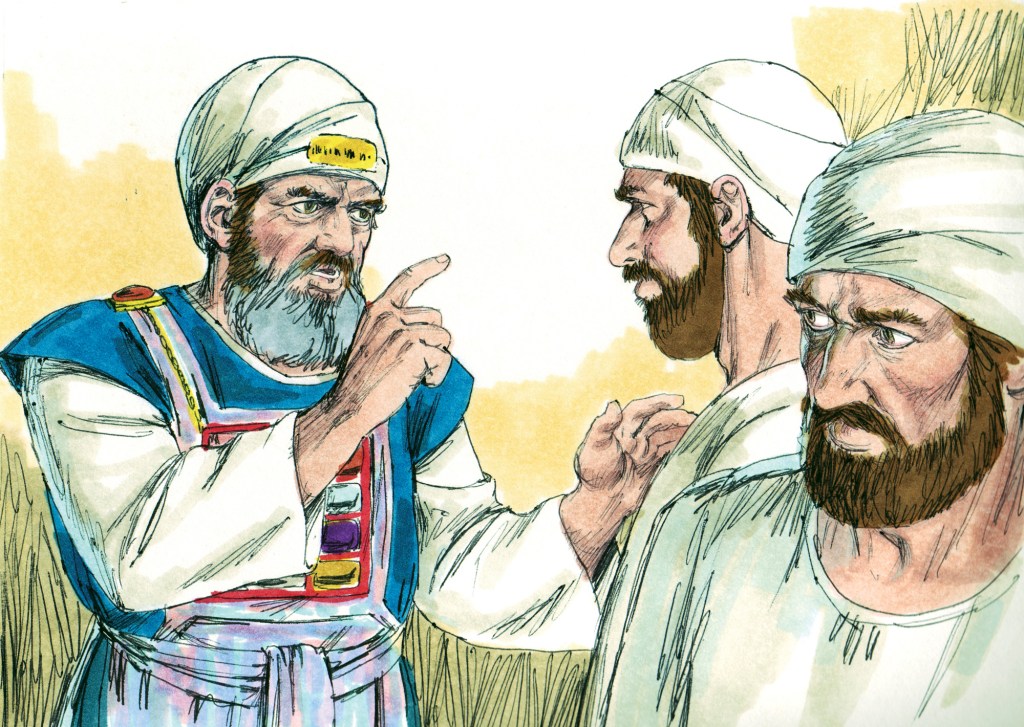
I am impressed today with the words of the Prophet, Jeremiah, who provides a glimpse of who God is in the words of warning he spoke to Jehoahaz, the King of Judah,


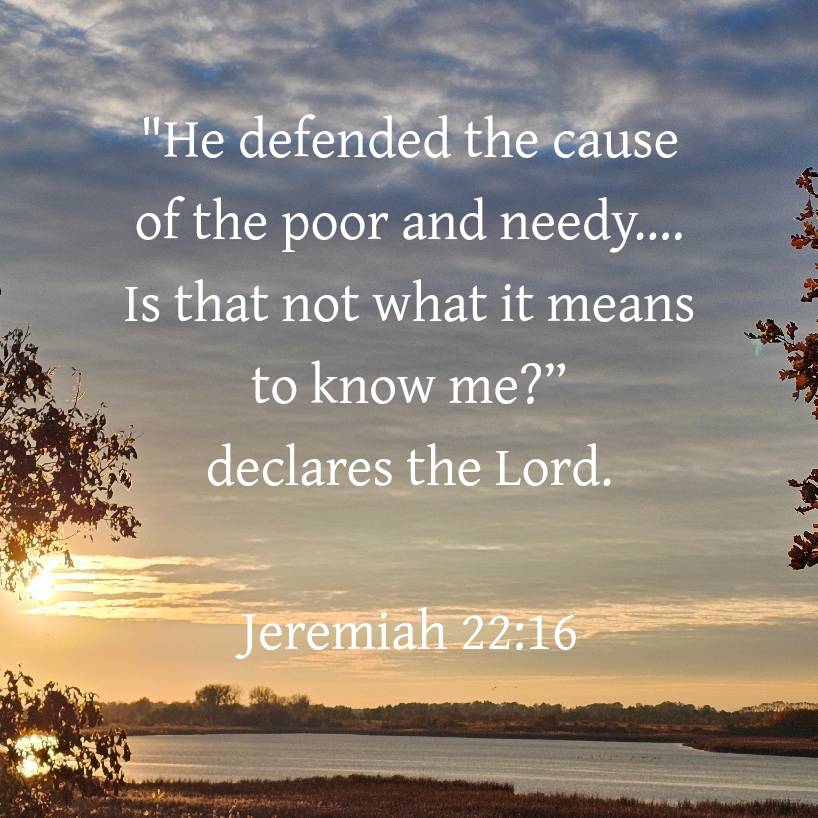
“Woe to him who builds his palace by unrighteousness, his upper rooms by injustice, making his own people work for nothing, not paying them for their labor. He says, ‘I will build myself a great palace with spacious upper rooms.’ So he makes large windows in it, panels it with cedar and decorates it in red. “Does it make you a king to have more and more cedar? Did not your father [King Josiah] have food and drink? He did what was right and just, so all went well with him. He defended the cause of the poor and needy, and so all went well. Is that not what it means to know me?” declares the Lord.

Jeremiah 22:13-16


I have never noticed before that Jeremiah equates defending the cause of the poor and needy with knowing God. In defending the cause of the poor and the needy, we come to know God.


We can search for God here and there and, perhaps, never find Him. In defending the poor and needy, however, we can know the Lord. It’s that simple.

To know someone in a biblical sense is to know more than facts about someone. To know someone biblically is to know someone intimately. The ultimate example of knowing someone biblically is to know someone as a spouse.

Thus, when Jeremiah says that defending the cause of the poor and needy is to know the Lord, he is talking about an intimate, experiential knowledge of the character and nature of God. The cause of the poor and needy is close to God’s heart, and it is essential to who God is.

The Psalmist says, “A father to the fatherless, a defender of widows, is God in his holy dwelling….” (Psalm 68:5) A dwelling place is where a person is most able to be who they are. God’s holy dwelling is where God is “at home”, where God is most like Himself, and the cause of the fatherless and the widow is at the core of who God is in His most intimate place.

Thus, people can intimately know who God is by taking up the cause of the poor and the needy, the widow and the orphan, and similarly vulnerable people.

The opposite is also true. People do not know God to the extent that they do not defend the cause of the poor and needy. This was the point Jeremiah was making when he said of King Johoahaz:


The father of Jehoahaz was Josiah. “He did what was right in the eyes of the Lord.” (2 Kings 22:2) Josiah found the Book of the Law, reestablished Temple worship of God, and destroyed the idols in Judah. (2 Kings 22 & 23) Josiah also defended the cause of the poor and needy, according to the Prophet Jeremiah, and defending the cause of the poor and needy is what it means to know God.

Indeed, Josiah modeled the entire law that Jesus said can be summed up in these two statements: 1) love God with all your heart, mind, body, and soul; and 2) love your neighbor as yourself.

Throughout the Bible, then, we find that a sure way of knowing who God is and what it means to know God is to be concerned with the cause of the poor and needy. This is not liberal wokeness; it is the essence of who God is and what it means to know God.


“Whoever claims to love God yet hates a brother or sister is a liar. For whoever does not love their brother and sister, whom they have seen, cannot love God, whom they have not seen.”

1 John 4:20


Jesus even goes so far as to say that we should love our enemies and so be perfect as our heavenly Father is perfect. (Matthew 5:43-48) Loving others – caring for the poor and needy – is not superfluous or secondary; it is central to who God is and a key in what it means to know God.

Be Like the Sons of Issachar Who Understood the Times

The Kingdom of God is among us and it is yet to come


I recently finished a review of the of history of the blogging on this site: Looking Back at 13 Years of Navigating By Faith. One article stands high above the rest in the sheer number of people who have read/viewed it.

I wrote that article, Who Were the Sons of Issachar? And What Might They Mean for Us Today?, during Donald Trump’s second presidential campaign. Christian support for Donald Trump was characterized by a sense of urgency and high stakes. State COVID restrictions jeopardized religious liberty. BLM aroused woke, liberal, mobs in streets around the country. Christians sounded the alarm that people of faith would be canceled by the most anti-faith Democratic ticket in years if Trump didn’t win.

Prominent Christian leaders like Robert Jeffress and Franklin Graham argued that Trump was a “strongman” needed to protect the nation from “anarchy” and “socialism.” Jeffress excused Trump’s obvious flaws, saying that American Christians didn’t need a “Sunday School teacher” but a “fighter” who would protect Christian interests in a hostile culture. Lance Wallnau framed Trump as a modern King Cyrus—the Persian king used by God to protect His people and restore them to the promised land.

Support for Donald Trump was increasingly framed as a battle against “darkness” and “anti-Christian” forces. While many traditional evangelicals focused on policy, the New Apostolic Reformation (NAR) was mobilized by prophecy, spiritual warfare, and the “Seven Mountain Mandate.” Dozens of self-identified prophets in this network insisted that Trump’s re-election was divinely mandated in a cosmic battle between good and evil controlled by a demonically influenced “deep state.” The current was strong, and a large number of Christians were swept along with it.

A conversation with my best friend from college, who I loved more than a brother, and who I trusted implicitly, left me in full spiritual crisis mode. He expressed his continued support of Trump on the basis of those prophetic claims predicting another presidential victory and the belief that God ordained Donald Trump for this time. My friend urged my to be like the sons of Issachar “who understood the times and knew what Israel should do.” (1 Chronicles 12:32)

I have a healthy respect for God’s ability to speak through people in what we call prophecy. The Apostle Paul commands us not to despise prophecy, but to test everything, hold fast to what is good, and abstain from every evil. (1 Thessalonians 5:20-22) I resolved to give Donald Trump another look and to reconsider him.

I had written in 2020 about wolves in sheep’s clothing with Donald Trump expressly in mind. Jesus said we would know falsehood by its fruit, and the fruit I saw in Donald Trump belied the claims of God’s providential blessing.

That a president is not a pastor made some sense. God can use anyone, even a donkey, right? Maybe Trump is like the Persian King Cyrus who is divinely appointed to restore the Christian heritage of the United States….

A year earlier, in 2019, I reflected on those claims that Trump is like a King Cyrus, and I came to a different conclusion. Trump seemed to me more like a King Saul, the king God’s people wanted – the king they wanted because they did not trust God. They wanted a king like all the other nations, though the Prophet Samuel warned them against it. God gave them the king His people wanted, even though they were rejecting God to ask for a king:


“[W]hen they said, ‘Give us a king to lead us,’ this displeased Samuel; so he prayed to the Lord. And the Lord told him: ‘Listen to all that the people are saying to you; it is not you they have rejected, but they have rejected me as their king. As they have done from the day I brought them up out of Egypt until this day, forsaking me and serving other gods, so they are doing to you. Now listen to them; but warn them solemnly and let them know what the king who will reign over them will claim as his rights.‘”

1 Samuel 8:6-9


God gave them the king they wanted in the same way that God gives people over “to the sinful desires of their heats.” (Romans 1:24) The people were rejecting God as their king, so God gave them over to the king they wanted.


People of that day might have assumed that God was blessing them to give them the king they wanted, but that was not the case. Samuel warned them against it, but they insisted anyway.


King Saul was rebellious, insecure, self-absorbed, and psychotic. He failed to obey God’s commands. He became obsessed with his power and reputation among the people, and he became jealous of David.

Though Saul remained king, God had already rejected him and anointed David to succeed him. Saul tried to take David’s life multiple times in fits of jealous rage, and David escaped into the wilderness.

This is where the Sons of Issachar entered the picture. Though Saul was still king, they “understood the times.” They could see the proverbial writing on the wall. They knew that David was God’s man, and Saul’s reign was ending.

Many people have argued that Donald Trump is like the foreign king, Cyrus, who protected and funded the nation of Israel to return to the Promised Land. I have argued that Donald Trump is not like the foreign king, Cyrus, but like the Israelite King Saul. Donald Trump is the king that God’s people wanted.

Continue reading “Be Like the Sons of Issachar Who Understood the Times”

When the Church Loses Its Prophetic Voice

Biblical Authority, Political Power, and the Temptations of Influence


The failure of the German Protestant church to mount a decisive resistance to Nazism has long troubled western Christian conscience. Historians rightly warn against simplistic explanations, but one conclusion has proven difficult to escape: long before Hitler rose to power, the church’s theological confidence had already been weakened. When the state demanded ultimate loyalty, many pastors and congregations lacked the moral clarity and will to refuse.

The nineteenth-century Tübingen School of theology did not cause Nazism. Its scholars were not proto-fascists, nor did they anticipate racial ideology or totalitarian politics. Yet their historical-critical approach to Scripture unintentionally contributed to a Protestant culture in which the Bible increasingly functioned as an object of study rather than a source of commanding authority. When political myth replaced moral truth, the church was unprepared to stand against it because the church had long ago lost its biblical, moral footing.

History does not repeat itself mechanically. The present American situation is not Weimar Germany, and the MAGA movement is not Nazism. Still, history can illuminate how the happenings within the church influence how the church interacts with political culture. That raises a difficult but necessary question for American evangelicals today: what weaknesses in our own theology and habits of thought have made many of us susceptible to the distortions of political power?

The answer is not that evangelicalism has repeated the errors of liberal Protestantism. In many ways, we have made opposite mistakes. But the result—a diminished capacity for prophetic resistance—bears an unsettling resemblance.

Authority Dissolved: The Tübingen Lesson

The Tübingen School, led by Ferdinand Christian Baur in the mid-nineteenth century, treated Scripture primarily as a historical artifact shaped by competing early Christian communities. Biblical texts were analyzed as records of theological conflict rather than as a unified witness to divine revelation. The command and authority of Scripture was diminished, and the sacred became profane. The trajectory of the academy spilled into and watered down the vitality of Christian impact in Protestant Germany.

Clergy trained in historical criticism often hesitated to proclaim Scripture normatively. The Bible remained important, but its authority was qualified, softened, and translated into general ethical ideals compatible with modern culture. Christianity became morally earnest but theologically cautious and politically unimportant.

By the early twentieth century, much of German Protestantism lacked the confidence to say an unambiguous “No” to the state. The problem was not simply fear or cowardice. It was uncertainty—whether God had spoken definitively enough to authorize resistance when power spoke with confidence and force.

Karl Barth saw this clearly. In 1933, as the German church accommodated itself to the Nazi regime, Barth insisted that the church exists only under the authority of God’s self-revelation. Where that authority is weakened, the church becomes vulnerable to captivity by the state.

The lesson is sobering: when Scripture no longer stands above culture, culture will soon stand above the church. Today we can say of Nazi Germany and the church alike, “The grass withers, the flower fades, but the word of our God will stand forever.” (Isaiah 40:8) But, the impact was devastating on Germany, Jews, Europe, and the world at that time, and its effects rumble into the present time.

I do not want to suggest that we can equate Nazi Germany in the 1930’s and 1940’s to the United States of America in the 2010’s and 2020’s. Still, there are parallels between the exercise of State power in the vacuum left by weakened theology that bear some attention.

Continue reading “When the Church Loses Its Prophetic Voice”

Looking Back at 13 Years of Navigating By Faith

“In their hearts humans plan their course, but the LORD establishes their steps.”


As another year closes out, I look back on my journey of faith and thought that is captured in this blog. The blog doesn’t capture all of my journey. Some things remain private, and some things remain undeveloped and unpublished. Of the things I have put out into the sunlight of the blogosphere, though, I hope they have been helpful, encouraging, and challenging, if not interesting.

I usually launch right into the top ten articles (or so) of the year in review, but I want to take a moment to review where I have been and where I am going. The numbers tell a surprising story (to me), but I realize the numbers might be boring to you, so I will try to keep that part brief.

I expect that the substance of the journey may be more intriguing to the reader, but the substance is also more difficult to capture and to summarize. I will do my best.

By the Numbers

I started this blog in September of 2012 with 20 articles that garnered under 500 views. The top article on attributes of success had just over 100 views, 5 likes, and 3 comments. About 180 of the readers came through Facebook. Those early attempts at writing are somewhat embarrassing to me (so no links are provided).

I wrote over 100 articles each year from 2017 through 2021, with the high water mark being 149 articles in 2017. My writing has slowed in the number of articles I have written over the last 4 years as the words per article have increased (peaking at an average of 1908 words per article in 2025)

In 2025, I have published only 57 articles all year, but viewership for the blog is projected to top out around 110,000. That is nearly as many readers as the blog had from 2012 through 2021 combined.

The top article this year was viewed over 23 times more than all the articles published in 2012. In the fact, the top article in 2025 was viewed more times (11,790) than all the articles in any year prior to 2020 (11,016 in 2020).

The climb from 500 views to 110,000 views was not a sudden thing. Readership increased with jumps and plateaus through 2019, with a peak of just over 11,000 in 2018. In 2020, readership jumped over 20,000 views, which I attribute to the pandemic. People were limited in their activities. They stayed inside, and they read more. Perhaps, people were more contemplative because of the psycho-emotional impact of COVID.

I was excited about the increase in readership in 2020 and the increase again to 30,000+ in 2021 as the world began to emerge from the clutches of COVID. With the world getting back to “normal” in the following two years, readership settled around 30,000 views each year for several year.

Just last year, in 2024, the views skyrocketed over 61,000. The upward trajectory has continued in 2025 with projected views on pace to top 110,000.

The sudden increase in readership has taken me totally by surprise. I have not done anything differently than I was doing before, as far as I know. Perhaps, my writing is developing in ways that I do not realize. I do tackle more difficult subject matter and get into greater depth, but I would assume that might turn some people away.

I began writing out of a sense of obedience to God. I felt compelled to make use of the gifting He has given me. My main goal was to be faithful, and that focus continues to be a driving force.

I have tried to stay true to the theme of the blog, which is “navigating by faith.” I try to write out of my own experience, to write in keeping with my own thought and faith journey, and to write as I sense God is leading me.

My Faith Journey

In 2012, I was coming out of a long, slow regression in my faith. Perhaps, others might call what went through a deconstruction. That long, difficult segment of my like journey of my life set the stage.


I wandered for more than two decades in a spiritual malaise. My faith became stagnant. I stopped seeking. I stopped reading the Bible. I stopped praying with purpose. I eventually stopped going to church. I was shrinking back from God.


My priorities had shifted from a spiritual focus to career and providing for my family. The cares and concerns of the world overtook me as I pulled back from spiritual seeking and devotion to God. I moved with my family back to the area where I grew up, and I found myself attracted to and tempted by former ways of thinking and way of life.

As I look back, I can say that I had accumulated baggage that was holding me back and stifling my spiritual growth. I had accumulated theological structures that God needed to strip away. That “deconstruction” was long and painful as I languished in spiritual ruts for over 20 years.

I came to a point at which I had nothing to cling to but God and His mercy. I didn’t even know if He would “take me back” when I came face to face with the realization that the spiritual life within me was in danger of petering out completely, like a pilot light flickering in a cold windy place. I turned to God, and I said, “Where else will I go? Only you have the words of life.”

In that moment of surrender, God had mercy on me. With no illusions of grandeur that characterized my early Christian walk, I sought God and embraced faithfulness. Around that time, I began to sense that God wanted me to write. He didn’t overwhelm me, with it but it was persistent, like the nudging of a gentle wind.

I noticed, and I flirted with the idea for many months before I finally relented in my heart to do it. I set up an account in WordPress, and I began to write in September of 2012. The summary of the last 13 years tells the rest of the story.

Continue reading “Looking Back at 13 Years of Navigating By Faith”

The Mother Mirror: How Susie Wiles Became Donald Trump’s Surrogate Matriarch

by Daniel Wolfe, J.D., Ph.D.

(The views expressed in this article are solely those of the author and do not necessarily reflect the views of any employer, organization, or institution with which the author is affiliated. )

Trust in God and be true to yourself.” — Donald Trump (attributed to his mother)


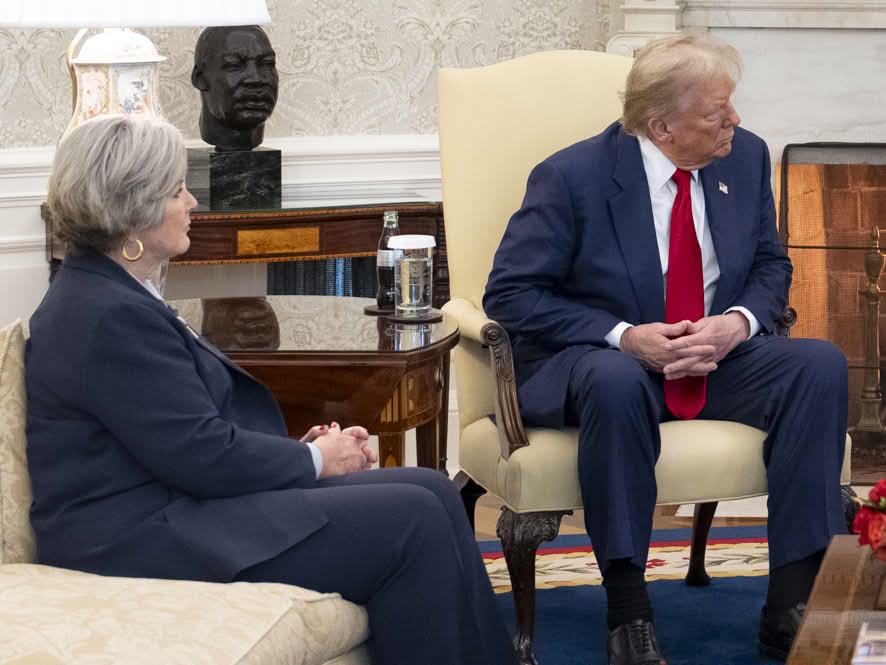
In a career defined by glitz, volatility, and domination, Donald Trump has rarely ceded power or emotional intimacy to anyone—especially not to women. And yet, two women stand apart from the parade of advisers, media figures, and family members who have passed through his orbit: Mary Anne MacLeod Trump, his late mother; and Susie Wiles, his current White House Chief of Staff and perhaps the most enduring political influence in his life.

From a psychodynamic standpoint, their connection is more than incidental. Wiles’s quiet dominance, maternal distance, and unflappable loyalty appear to mirror key psychological traits that Trump associated with his mother—a woman he revered, idealized, and never fully reached. As Trump now enters what may be the final chapter of his public life, Wiles is not merely a staffer. She is, in many respects, a surrogate matriarch—a stabilizing figure who satisfies his need for emotional containment, maternal loyalty, and internal order.

The Queen from Tong: Mary Anne MacLeod Trump’s Silent Influence

Born in 1912 in the Village of Tong on Scotland’s windswept Isle of Lewis, Mary Anne MacLeod was the tenth of ten children in a Gaelic-speaking, deeply Presbyterian household. The family home had no indoor plumbing, and her childhood was shaped by poverty, discipline, and religious rigor. At 18, she boarded the SS Transylvania and sailed to New York City, alone, with $50 to her name and a stated intention to become a domestic servant.

What followed was a dramatic social ascent. Mary Anne met Fred Trump, a rising real estate developer, at a party. They married in 1936 and had five children. Though she never shed her Scottish accent, she fully embraced American prosperity and Protestant respectability. She became active in the Daughters of the American Revolution, volunteered in hospitals, and dressed with regal precision.

As reported by journalist Mary Pilon in The New Yorker, friends and family members remembered Mary Anne MacLeod Trump as “tight-lipped,” “polished,” “proper,” “unassuming,” “friendly,” and “pleasant”—a reserved woman of dignity and discipline, but not demonstratively affectionate. Trump himself noted her deep reverence for public ceremony, stating, “Her loyalty to Scotland was incredible. She respected and loved the Queen.” He also credited her with influencing his “sense of showmanship.” (Pilon, 2016).

In her memoir Too Much and Never Enough, Mary Trump—herself a clinical psychologist—describes how her grandmother’s illness and retreat from family caregiving duties created emotional voids. Mary and her siblings took on caretaking roles in her absence, leading to feelings of abandonment and shaping Donald Trump’s later emotional defenses. She further details how Fred Trump Sr.’s emotional detachment and controlling behavior created insecurity in the family and contributed to Donald Trump’s narcissistic tendencies.

And yet Donald idolized his mother. “Part of her disinterest was, I believe, interpreted by Donald as exclusivity,” Mary Trump writes. “She was mysterious. The less she said, the more he needed to earn her attention.” From a psychodynamic perspective, this creates a powerful early template: a mother who is emotionally withheld but idealized—instilling in the child a lifelong yearning to gain her approval, or to replicate her presence through proxies.

In object relations theory, such a mother becomes an internalized object—a kind of psychic icon. She represents containment, elegance, structure—but also loss and emotional distance. The boy grows into a man who seeks out women who resemble her not in warmth, but in silence, dignity, and control.

The Strategist in the Shadows: Who Is Susie Wiles?

Susie Wiles is no stranger to male power. The daughter of legendary NFL broadcaster Pat Summerall, she grew up surrounded by high-stakes masculinity. But unlike many women in Trump’s orbit—Hope Hicks, Kellyanne Conway, Kayleigh McEnany, Karoline Leavitt—Wiles is not a media figure. She is a tactician. Her professional life has been spent in the background, managing Republican campaigns with ruthless efficiency, from Jack Kemp to Rick Scott to Ron DeSantis—and finally to Donald Trump.

She first joined the Trump campaign in 2016 to oversee Florida, and her work was credited as critical to his win. She returned in 2020 and again in 2024. In the chaos of Trump’s third presidential campaign, Wiles outlasted and outmaneuvered more combative or flamboyant aides. By 2025, she was named Chief of Staff—the first woman to ever hold the role under Trump. And perhaps the only one who truly commands his respect.

What makes Susie Wiles unique is not charisma or ideological purity but emotional restraint. She doesn’t grovel. She doesn’t scold. She doesn’t leak to the press. According to Politico Magazine and West Wing Playbook, Wiles is a discreet, disciplined strategist. She rarely seeks publicity and is consistently portrayed as a “steady hand” who effectively manages Trump’s impulses and internal chaos.

From a psychological standpoint, this demeanor taps directly into the mother archetype that Trump internalized: a woman who offers structure without intrusion, loyalty without dependence. She doesn’t try to be his friend or surrogate daughter. She is, psychologically, his mother in political form: elegant, efficient, and emotionally self-contained.

Recent reporting in Vanity Fair highlights the candid nature of Wiles’s own reflections on President Trump and members of his Cabinet, revealing an unusually frank assessment of internal dynamics, including comments on Trump’s personality and other senior officials—remarks that drew swift criticism from within the administration as being misrepresented or taken out of context. Vanity Fair journalist Chris Whipple, who conducted months of on-the-record interviews with Wiles, subsequently defended the accuracy of his piece, noting that all conversations were recorded and verified.

The Vanity Fair profile also underscores Wiles’s complex role: though she offered unusually candid characterizations of Trump and others in his orbit—comments that were later disputed as being selectively framed—she remained publicly loyal, reiterating her defense of Trump’s leadership and the administration’s accomplishments. This juxtaposition further illustrates the delicate psychological balance Wiles maintains: revealing enough about internal pressures to demonstrate credibility, yet steadfast in her alignment with Trump’s public persona.

The Vanity Fair interviews portray Wiles as central to both decision-making and narrative control inside the West Wing, a portrayal that has attracted debate not only about the content of her remarks but also about the media framing of her role—revealing once again how Wiles both shapes and buffers Trump’s inner circle.

A Psychodynamic Reading: Maternal Transference in Power Relationships

In classical Freudian terms, Wiles may represent a maternal transference object—a figure onto whom Trump projects unresolved feelings and unmet needs from childhood. Where Mary Anne withheld affection, Wiles withholds emotion. Where Mary Anne offered structured approval, Wiles offers structured control. And unlike Trump’s past advisers, Wiles never threatens his fragile ego. She doesn’t seek glory. She simply stays—a feat few others have achieved.


Psychological profiles consistently depict Donald Trump as a grandiose, high-energy, low-agreeableness figure—a volatile combination described by Dr. Dan McAdams as “sky-high extraversion … rock-bottom agreeableness … and grandiose narcissism” (McAdams, 2016). Indirect diagnostic work (Immelman & Griebie, 2020) places him squarely in narcissistic, dominant, and impulsive personality patterns. Mental health experts in The Dangerous Case of Donald Trump warn of malignant narcissism—a severe form characterized by interpersonal cruelty and paranoia (Lee, 2019). Clinicians like Craig Malkin and theorists such as Kohut and Bosson also point to the deeper emotional void underlying Trump’s persona—one that maternal transference figures may uniquely address. Therapists such as Wendy Behary similarly argue for a behavioral-based understanding of his narcissistic structure.

Nancy McWilliams (2011) describes narcissistic personality organization as marked by internal fragility, frequent use of idealization and devaluation, and a reliance on external validation. She explains that analysts working with this type often become unconscious “containers” for projected emotions, experiencing emotional obliteration, boredom, or invisibility.

As interpreted from McWilliams, transference figures often exert their power not through what they do, but through how they resonate. They become stand-ins for an early internal object—particularly in individuals who, like Trump, display signs of narcissistic personality structure: grandiosity, need for adulation, fear of shame, and an unconscious desire for omnipotent control.

What narcissistic individuals crave, McWilliams notes, is not just admiration—but a “containing other”: someone who does not collapse in the face of their outbursts, and who does not betray them by seeking autonomy. Wiles plays that role impeccably. She withstands Trump’s rage, channels it, and survives it. She offers maternal containment, not romantic or filial rivalry. That is what keeps her in his orbit.

Other advisers have challenged Trump (John Kelly), manipulated him (Steve Bannon), or infantilized him (Rudy Giuliani). Wiles does none of that. Instead, she mirrors back the qualities Trump yearned to see in his mother: discretion, loyalty, restraint, and elegance.

The Politics of Maternal Containment

This is not just a psychological curiosity. It is a political reality. Wiles has arguably had more sustained influence over Trump than any adviser since the beginning of his political career. She shaped the tone of his 2024 campaign—more disciplined, less erratic. She consolidated staffing, minimized legal exposure, and even managed access to the President.

Unlike previous chiefs of staff, Wiles does not appear to negotiate with Trump’s narcissism. She regulates it. That regulation—the ability to soothe without submitting—represents a maternal function in psychodynamic theory. And in Wiles, Trump may have finally found the mother he idealized but never emotionally possessed.

It also explains why he hasn’t turned on her. Trump, infamous for discarding aides with theatrical vengeance, has remained steadfastly loyal to Wiles. Even when others within his inner circle reportedly questioned her influence, he resisted. Just as a child resists separating from a “good enough” mother (in Winnicottian terms), Trump clings to Wiles not just as a strategist, but as a psychic anchor. In effect, Wiles might stabilize Trump not by commanding him, but by quietly containing him, as a good-enough mother does for an emotionally vulnerable child.

A Closing Reflection: The Boy and the Queen

As Donald Trump enters the final act of his storied and polarizing career, it is Susie Wiles—not his children, not his ideological acolytes—who quietly holds the reins. She does so not by reflecting Trump’s aggression, but by embodying his mother’s mystery: a woman whose silence commands, whose order contains, whose loyalty never fully soothes the ache it addresses.

In Wiles, Trump may see a second chance to earn the approval he never quite captured from Mary Anne. And in his loyalty to her, one glimpses the enduring truth of psychodynamic theory: that the past is never past. It is alive, enacted, and dressed in new clothes—this time, in a red blazer, seated quietly in the West Wing, holding the world’s most unmanageable man in the palm of her maternal hand.


References: