Jesus is the Alpha and the Omega, the beginning and the end. (Revelation 1:8; 21:6; and 22:13) Jesus was in the beginning with God, the Father, and the universe and all that is in it was made through Jesus. (John 1:1-3)
At this time of year, we celebrate God descending to become man in Jesus of Nazareth, born in Bethlehem into a common family in a far flung place. Jesus was God in his very nature, but he deigned to shed himself of that glory and power to become man, to become a servant to his own creation, and to humble himself to the point of death at the hands of his own creation. (Philippians 2:5-8)
In the end, Jesus will be exalted to the “highest place” with a “name that is above every name.” (Phil. 2:9) Every knee in heaven and on earth will bow to him, and every tongue will acknowledge that “Jesus Christ is Lord,” to the glory of God the Father.” (Phil. 2:10-11)
From the garden of Eden to the new heavens and earth and the New Jerusalem in which God will dwell with His people, God has had a plan from the beginning to the end. God set eternity in the hearts of people, but not so that we would know the beginning from the end. (Ecclesiastes 3:11) We don’t know, but God knows. Do we trust Him?
That is the question in my mind on this 1st day of the New Year in 2026. That is the question with which I challenge myself. Will I trust Him with my life? With the world? With the insanity that seems to characterize the year that just ended in United States of America where I live?
Since God created the universe and populated it with people and animals, God ordained and allowed people to populate the Earth. God didn’t dictate how the history of His creation would unfold. He created Adam and Eve with the capacity to live in sync with God and the universe, but He also gave them the capacity to go their own ways. God had a plan from the beginning, but He allowed the universe and mankind, His crowning creation, to unfold as it would.
I am beginning a new year of reading through the Bible as I have done many years in the past. I have read through the first handful of chapters in Genesis, and my thoughts gather around the question: will I trust God better in the New Year?
The age old questions humans have asked since time immemorial are, “What is God, and how do I know God?” We have conceived of gods as animated trees, mountains, and the sun, the stars, and the moon. We have conceived of gods as a pantheon of god-men and god-women. We have conceived of God as a force that is in everything, and we have conceived of God as an aloof judge and guardian of the ever after.
The Hebrew Scripture provides a robust concept of God, the Creator of the universe, who reveals Himself to human beings, but who remains mysterious and even “hidden” to people who must seek Him. The Tanakh (the Law, the Prophets, and the Writings) that Christians call the Old Testament purports to be God’s revelation to human beings with a promise that those who seek may find Him, “though he is not far from any one of us.” (As the Apostle Paul said to the Greeks in Athens. (Acts 17:27))
Of course, the God of the universe must be greater than we could ever fully comprehend to have created such an intricately designed universe as the one in which we live. If the men who passed on the revelation of this God that has been recorded in the Bible are correct, we can know much about God even if much remains a mystery.
I am impressed today with the words of the Prophet, Jeremiah, who provides a glimpse of who God is in the words of warning he spoke to Jehoahaz, the King of Judah,
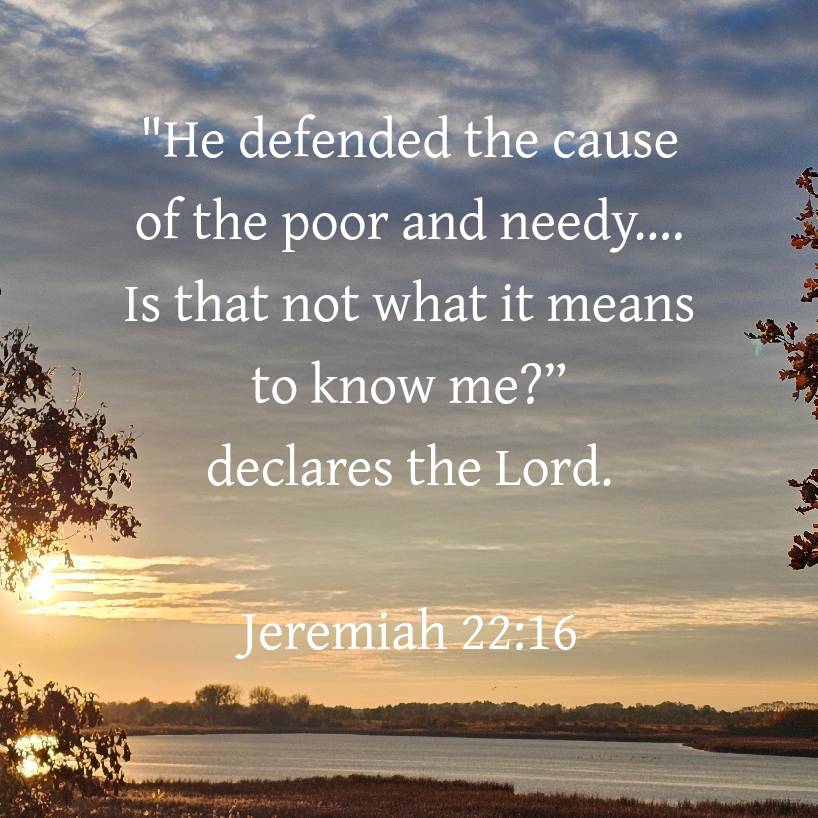
“Woe to him who builds his palace by unrighteousness, his upper rooms by injustice, making his own people work for nothing, not paying them for their labor. He says, ‘I will build myself a great palace with spacious upper rooms.’ So he makes large windows in it, panels it with cedar and decorates it in red. “Does it make you a king to have more and more cedar? Did not your father [King Josiah] have food and drink? He did what was right and just, so all went well with him. He defended the cause of the poor and needy, and so all went well. Is that not what it means to know me?” declares the Lord.”
Jeremiah 22:13-16
I have never noticed before that Jeremiah equates defending the cause of the poor and needy with knowing God. In defending the cause of the poor and the needy, we come to know God.
We can search for God here and there and, perhaps, never find Him. In defending the poor and needy, however, we can know the Lord. It’s that simple.
To know someone in a biblical sense is to know more than facts about someone. To know someone biblically is to know someone intimately. The ultimate example of knowing someone biblically is to know someone as a spouse.
Thus, when Jeremiah says that defending the cause of the poor and needy is to know the Lord, he is talking about an intimate, experiential knowledge of the character and nature of God. The cause of the poor and needy is close to God’s heart, and it is essential to who God is.
The Psalmist says, “A father to the fatherless, a defender of widows, is God in his holy dwelling….” (Psalm 68:5) A dwelling place is where a person is most able to be who they are. God’s holy dwelling is where God is “at home”, where God is most like Himself, and the cause of the fatherless and the widow is at the core of who God is in His most intimate place.
Thus, people can intimately know who God is by taking up the cause of the poor and the needy, the widow and the orphan, and similarly vulnerable people.
The opposite is also true. People do not know God to the extent that they do not defend the cause of the poor and needy. This was the point Jeremiah was making when he said of King Johoahaz:
The father of Jehoahaz was Josiah. “He did what was right in the eyes of the Lord.” (2 Kings 22:2) Josiah found the Book of the Law, reestablished Temple worship of God, and destroyed the idols in Judah. (2 Kings 22 & 23) Josiah also defended the cause of the poor and needy,according to the Prophet Jeremiah, and defending the cause of the poor and needy is what it means to know God.
Indeed, Josiah modeled the entire law that Jesus said can be summed up in these two statements: 1) love God with all your heart, mind, body, and soul; and 2) love your neighbor as yourself.
Throughout the Bible, then, we find that a sure way of knowing who God is and what it means to know God is to be concerned with the cause of the poor and needy. This is not liberal wokeness; it is the essence of who God is and what it means to know God.
“Whoever claims to love God yet hates a brother or sister is a liar. For whoever does not love their brother and sister, whom they have seen, cannot love God, whom they have not seen.”
1 John 4:20
Jesus even goes so far as to say that we should love our enemies and so be perfect as our heavenly Father is perfect. (Matthew 5:43-48) Loving others – caring for the poor and needy – is not superfluous or secondary; it is central to who God is and a key in what it means to know God.
I became a follower of Jesus in 1979, though I was a wild, untamed stallion when I was first confronted with the Lordship of Christ and verbally submitted to him. I wandered down my own paths in the year that followed, leading me to a breaking point and more complete surrender. (A cycle I have unfortunately repeated more than once.)
Over the following two years, I was about as surrendered to God as I have been my whole life. I was all in – or as all in as I was capable of being at that time, perhaps. During that time, I became a big fan of Keith Green. I even saw him in concert in Des Moines Iowa in 1981 or 1982. He died in a place crash within a year or two after that, and his impact and memory has faded.
When I saw him in concert, though, his radical Christian commitment had been a huge impact on me, and that impact carried with me beyond his death. Thus, my daily reading today recalls to my mind these lyrics by Keith Green:
To obey is better than sacrifice I want more than Sundays and Wednesday nights If you can't come to me every day Then don't bother coming at all
Keith Green was a musical child prodigy who was radically saved by Jesus. He used his great musical talent and platform to become a prophet of sorts to young Christians at the time who wanted an authentic faith.
I was very drawn to a monastic, cloistered life at that age. The truth is that I had long been drawn to that kind of thing going back to the book, My Side of the Mountain, that I read in grade school (about a boy who leaves his parents to hollow out a summer home in the trunk of dead tree in the Catskills). I was already bent that way in my personality.
In a poignant moment in my senior year in college, I faced up to that longing and desire that ran deep in me, and I turned to follow Jesus into the messiness of human society. Jesus escaped to the mountains and the wilderness to be alone with God, but he always returned to the highways, and byways, and the public squares where people live.
Still, the Keith Green spirit of uncompromised obedience to Christ and Christ alone left an imprint on me. His prophetic insistence on radical commitment carried me forward in those early years of my journey with Christ.
Now, I find myself some 40+ years down a road that has taken many twists and turns. That road has taken me through long and winding wilderness areas that were darker than I care to dwell on. It has taken me to the other side of those dark times into the light of a new day, more weary and (hopefully) wiser for the experience. I am still following Jesus as best as I can, but I have a slightly different view of Keith Green’s words today. I hope I can give this the nuance it deserves.
“[Y]ou are still influenced by the flesh. For since there is still jealousy and dissension among you, are you not influenced by the flesh and behaving like unregenerate people?”
1 Corinthians 3:3 NET
I am inspired by Paul’s first letter to the Corinthians (of which we have record). The topic I want to write about is what Paul calls “the flesh”. We might just call it sin. The doctrine of sin is not popular today, but the Bible doesn’t pull any punches about it, and neither should we.
We do need to view it in the right context, though. The Bible is clear that all people have sinned, and all people do sin. John says that anyone who denies they have sinned is a liar, (1 John 1:8) but John adds that God is faithful and just to forgive us when we confess our sin to Him. (1 John 1:9)
Paul wrote this letter to “the church of God in Corinth, to those sanctified by Christ Jesus and called to be His holy people, together with all those everywhere who call on the name of our Lord Jesus Christ….” (1 Cor. 1:2) Thus, he is writing to Christians – Christians who are “still influenced by the flesh”.
Yes, Christians are influenced by the flesh, and Christians are susceptible to sin.
The notion of sin is disfavored and much maligned, but most people would agree that “to err is human”. The biblical notion of sin is not much different than this popular understanding of what it means to be human. It means in its various forms in the Greek to fail, to miss the mark, to do wrong, to misstep, etc. (See Biblehub)
The Greek word translated “flesh” in the New English Translation is σαρκικός, ή, όν (sarkikos). It means “pertaining to the flesh, carnal” (“behavior which is typical of human nature … with special focus upon more base physical desires” according to the HELPS word studies found at the Biblehub website).
Fleshiness is human tendency. Therefore, we might change the popular idea of what it means to be human by saying, “To sin is human.”
The Bible claims that only one human being in history was without sin, and that person was Jesus of Nazareth, who the Bible claims was actually God incarnate (God who became human). The Bible also claims that Jesus came to deliver humans from the limitations of sin (and from death). This was his purpose – to invite us into relationship with God as children to become who God always meant us to be – to be free of sin and death, to live in eternal relationship with God, having the same characteristics God has.
This is a process that starts with a commitment to God in Christ, and it culminates in our own victory over sin and death. The ultimate realization of this victory, however, only occurs after our resurrection:
“So will it be with the resurrection of the dead. The body that is sown is perishable, it is raised imperishable; it is sown in dishonor, it is raised in glory; it is sown in weakness, it is raised in power; it is sown a natural body, it is raised a spiritual body.”
1 Corinthians 15:42-43
“I declare to you, brothers and sisters, that flesh and blood cannot inherit the kingdom of God, nor does the perishable inherit the imperishable. Listen, I tell you a mystery: We will not all sleep, but we will all be changed—in a flash, in the twinkling of an eye, at the last trumpet. For the trumpet will sound, the dead will be raised imperishable, and we will be changed. For the perishable must clothe itself with the imperishable, and the mortal with immortality.”
1 Corinthians 15:50-53
Paul calls this transformation the perishable being clothed with the imperishable, and the mortal with immortality. (1 Cor. 15:54) Thus, we do not attain this perfection until we die and are resurrected, but we are called into relationship with God in this life where the process of change this begins the to happen
Paul’s purpose in writing this letter to the Christian Corinthians (and Christians everywhere and at all times) was to address their fleshiness – their sin. Though they had the “mind of Christ” (1 Cor. 2:16), they were still influenced by the flesh. (1 Cor. 3:3) Just as we are. So we should take note.
Daniel Mann does a good job of explaining Why Christ, as God Incarnate, Had to Die for Our Sins. In reading his explanation, my mind goes to statements like God’s “transcendent love” and “total abhorrence for sin”, God’s “righteousness” and “divine forbearance” for sin, and the price that had to be paid “to satisfy God’s righteous character”.
Daniel describes his own reaction to these concepts formerly, as a non-Christian. He felt God was a “deceiving sadist” until one day he realized that Jesus was God incarnate, that God did not merely sacrifice a created being – God sacrificed Himself in human form!
Indeed, that is the central point of Christian belief, which is described beautifully and poignantly in Paul’s letter to the Philippians (2:5-8):
In your relationships with one another, have the same mindset as Christ Jesus:
Who, being in very nature [form of] God, did not consider equality with God something to be used to his own advantage; rather, he made himself nothing by taking the very nature [form] of a servant, being made in human likeness. And being found in appearance as a man, he humbled himself by becoming obedient to death— even death on a cross!
These things would be small consolation, also, if not for the victory on the other side of the cross (Phil. 2:9-11)
Therefore God exalted him to the highest place and gave him the name that is above every name, that at the name of Jesus every knee should bow, in heaven and on earth and under the earth, and every tongue acknowledge that Jesus Christ is Lord, to the glory of God the Father.
That Jesus was fully man and fully God incarnated into a man is key to the understanding of Christianity. That God is three “persons” in one is also key, as it provides some explanation how God can incarnate Himself into the form of a man and die (in human flesh), though God remains self-existent and eternal, the Creator (and not a created being).
Not that there is no mystery in this. I concede this is hard for creatures who are limited dimensionally to wrap our heads around these ideas.
Finally, it explains how (and why) death to Jesus in the flesh had no power over him. As God incarnate, death “could not hold him”. (Acts 2:24)
But, I am not writing to clarify these aspects of Christian doctrine. I want to focus on Daniel Mann’s personal revelation that Jesus was God incarnate, and his death was voluntary – God sacrificing Himself, and not God sacrificing some created being.
This realization made all the difference for him. When he really understood this distinction, he began to see the love of God that was demonstrated in that act of self-sacrifice – something God did not have to to, but He did it for us because He loves us.
Other people, I know, are not convinced. Indeed, if a person understands Jesus to be human only, and not God incarnate, the story makes no sense.
Another stumbling block is God’s “abhorrence for sin” and the need to satiate a “righteous” God. These Christian concepts are foreign territory for many people. Why, if God is so loving, does He demand sacrifices for sin?