Prayer That Is Not Over Matched by Every Buzzing Fly

The only remedy for the condition of our hearts is God. We have to go continually to God.

Depositphotos Image ID: 130894040 Copyright: SIphotography

John Newton, who wrote Amazing Grace, said this about prayer in a letter to a friend:

Our ability to pray is so weak that, if we are sitting in a room trying to pray, we are over matched by the buzzing of a fly.

Tim Keller says that prayer is hard for us for a number of reasons, not the least of which is that we have “distance” from God is the due to the fact that we live in a physical world, while God does not. We are absorbed by the physicality of the world in such a way that is hard for us to contact to a non-physical God. What, then, is prayer that we can engage in it, engage God and overcome the obstacles that get in the way?

Continue reading “Prayer That Is Not Over Matched by Every Buzzing Fly”

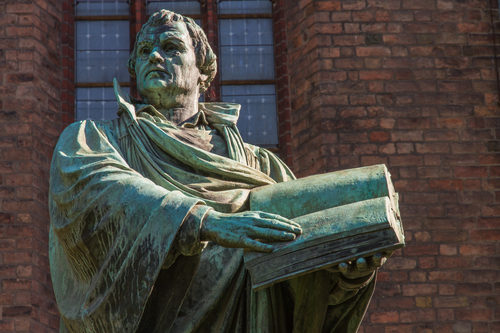
Reformation and Renewal

If we aren’t willing to renew our wineskins periodically, the old ones wear out and don’t hold the new wine like they did when they were fresh.

depositphotos Image ID: 10694365 Copyright: rumifaz

Today us Reformation day. I don’t really care about Halloween, so I figure I should say something about the Reformation.

You might call me a reformed Catholic. I grew up in the Catholic Church. When I encountered Jesus Christ, the living Son of God, who shed His glory to become a man, walked in obedience to His own purposes, died on the cross for our sins, and rose again from the dead, my life changed.

When I accepted Jesus Christ as my Lord and Savior, I left the Catholic Church for greener pastures. I have been involved with and visited many churches since then, and I am still looking for greener pastures. Along the way, I have learned that Catholics haven’t cornered the market on rigid structures and white-washed tombs.

Continue reading “Reformation and Renewal”

Balance Between Scripture and Spirit

Reaching for one without letting go of the other

ChristianPics.co

I feel compelled by the Holy Spirit (I hope) to explain myself a bit. Please forgive me if this gets into a little self-conscious rambling.

I have touched recently on some important doctrinal issues without really addressing them in a doctrinal way. That is intentional, but that leaves me a little self-conscious about it.

I have brushed past many doctrinal issues in this blog, and some of them are themes that I come back to quite often. Recently, I have veered dangerously close to issues like the inerrancy of the Bible and Bible hermeneutics, though I have not used words like that, other than to acknowledge at some points those rocks that exist in the turbulent waters.

I often reflect on the sovereignty of God and the free will of man. I often reflect on atonement, redemption, salvation and similar themes, though I don’t often use those words. Anytime we speak of the cross, the specter of those doctrinal ideas arises.

I am usually not all that conscious about doctrine in the sense of academic formality or denominational purity. This also is intentional, though it isn’t intended in any rebellious, skeptical or heretic away.

What I always aim for is “mere Christianity”.

Continue reading “Balance Between Scripture and Spirit”

The Law Foreshadows the Spirit

The Law given to the nation of Israel was is a necessary precursor to the law of the Spirit.

  Photo by Steve Murray – Where Moses looked into the promised land

“But the fruit of the spirit is love, joy, peace, patience, kindness, goodness, faithfulness, gentleness, self-control; against such things there is no law.” (Galatians 5:22-23)

The Spirit does what the Law could never do.

The law is exterior to us. It imposes a standard for us to follow, but it does not give us the desire or the power to follow it. The Spirit gives us both.

Continue reading “The Law Foreshadows the Spirit”

Interplay of the Word and the Spirit

God works through “the word” He gave us through the writers of the New Testament, along with His Spirit working in us to guide into truth.

Depositphotos Image ID: 36662225 Copyright: alexraths

I recently heard a Sermon on Matthew 3:15. The verse was posited for the proposition that believers in Christ should be baptized as a public expression of faith in obedience to God. This is a pretty fundamental proposition that most Christian denominations would advocate in some form or another.

In Matthew 3, John the Baptist has been preaching repentance, turning to God and baptism to make the way for one who “is coming soon who is greater than I am – so much greater that I’m not worthy even to be his slave and carry his sandals”.[1] This was Jesus, of course. Then we are told that Jesus went to Galilee to the Jordan River to be baptized by John, and John tried to talk him out of it, saying, “I am the one who needs to be baptized by you….”[2] This is the context in which Jesus makes the statement that was the focus of the sermon.

The New Living Translation of the Bible was used for the textual reference. I tend to use the ESV and NASB translations because they are more literal. They are word for word translations, rather than phrase for phrase (or idea for idea) translations, like the NLT. The word for word translations tend to be considered more accurate and more authentic to the original text. These are things I was thinking as I listened to the message, and I wondered what difference a more literal translation would make.

Continue reading “Interplay of the Word and the Spirit”