In Luke four, Jesus announced his public ministry in his hometown synagogue with these words:
“The spirit is on me because he has anointed me to proclaim good news to the poor. He has sent me to proclaim freedom for the prisoners and recovery of sight for the blind, to set the oppressed free, to proclaim the year of the Lord’s favor.”
Luke 4:18-19
Good news to the poor, freedom for prisoners, and freedom for the oppressed echoes Isaiah 61. “[T]he year of the Lord’s favor” echoes Leviticus 25, where Moses passed on the jubilee instructions given by the LORD to the LORD’s people.
Jesus was saying that these things foretold by Isaiah and the Jubilee instructions from Moses were fulfilled in him. Most of us are familiar with the way that many of the prophecies in Isaiah were fulfilled in Jesus, but we may not appreciate how Leviticus 25 takes on special significance – and controversy – in the life and ministry of Jesus.
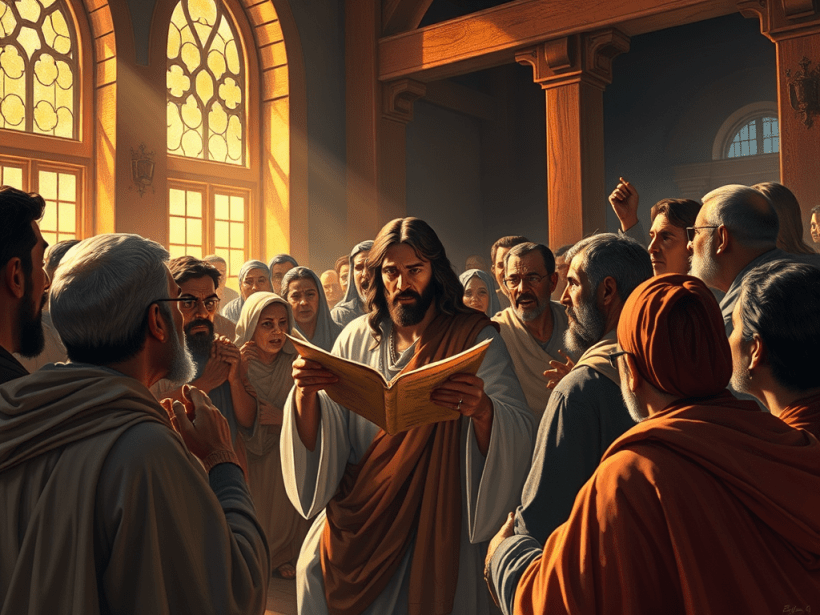
Jesus announced his public ministry in a dramatic way in his hometown synagogue when he asked for the Isaiah scroll, opened it, read the words quoted above, and sat down. The people in the synagogue were initially “amazed at the gracious words” Jesus spoke. (Luke 4:22) By the end of the short exchange that occurred after that, the people wanted to throw Jesus off a cliff. (Luke 4:28-29) What happened?
The words of Jesus that provoked his hometown people to anger were these:
“‘Truly I tell you,’ he continued, ‘No prophet is accepted in his hometown. I assure you that there were many widows in Israel in Elijah’s time, when the sky was shut for three and a half years and there was a severe famine throughout the land. Yet Elijah was not sent to any of them, but to a widow in Zarephath in the region of Sidon. And there were many in Israel with leprosy in the time of Elisha the prophet, yet not one of them was cleansed—only Naaman the Syrian.'”
Luke 4:24-27
Why did these two stories provoke the people to anger? Maybe the better question (the one we might not want to ask) is whether we are much different than they were?
The tension that played out in that Galilean synagogue when Jesus announced his ministry presages our modern reality 2000 years later. We still have a difficult time with the instructions, intentions and long-term plans that God announced when He told Abram that all the nations of the earth would be blessed through his descendants.
Today, I want to review some relevant provisions in Isaiah 61 and Leviticus 25 to explore why that reference did not sit well with God’s people. It wasn’t the references so much as the stories of Elijah and Elisha that he connected to them. Those stories – and what they suggest – may still not resonate well.
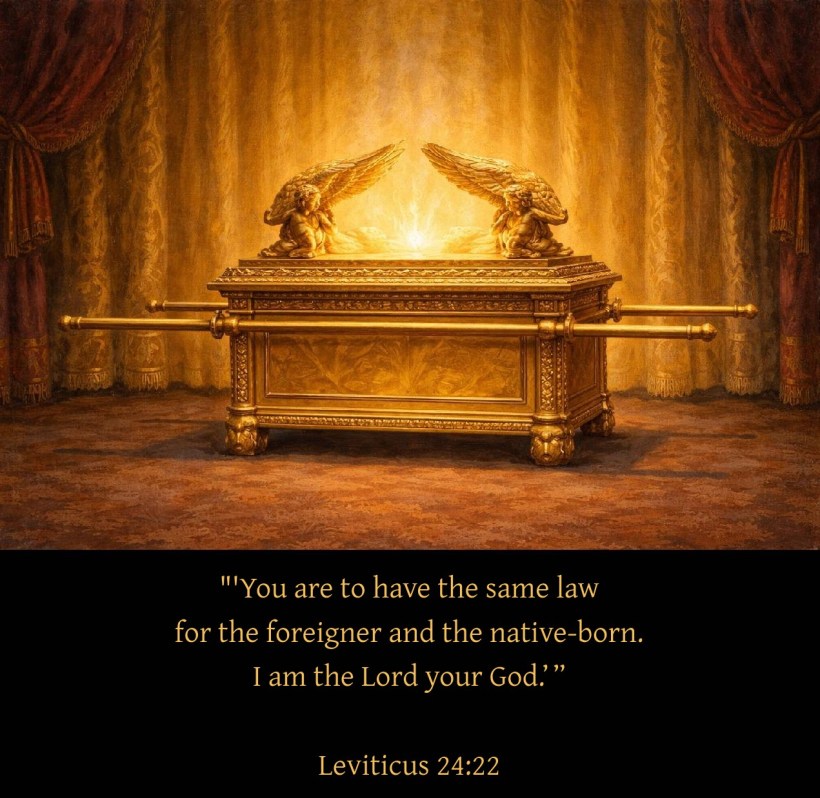
“You are to have the same law for the foreigner and the native-born.”
Leviticus 24:22
That single line, given by the Lord to Moses, is often read narrowly: foreigners are subject to the same penalties as citizens. True—but incomplete. Law is not merely punitive; it is protective. If the same law binds the foreigner, the same law also shields the foreigner. Justice, in the biblical sense, is reciprocal.
The rules that apply to foreigners are embedded in the sacred Law God gave to Moses for His people. The Law even applied specific protections to foreigners:
Leviticus 19:9–10 — Leave gleanings for the poor and the foreigner.
Leviticus 23:22 — Harvest leftovers belong to the foreigner and poor.
Deuteronomy 24:19–21 — Leave grain, olives, and grapes for foreigners.
Deuteronomy 26:12 — Tithes every third year support foreigners.
The Reciprocity Built into God’s Law
Leviticus develops this principle further. In Leviticus 25, the Lord instructs Israel that if a native-born Israelite loses his land and falls into poverty, he is to be treated as a foreigner among them. Why? Because the law already required Israel to provide for foreigners in their midst. By placing impoverished Israelites into the same category as foreigners, God establishes a profound reciprocity:
The protections of the law given to the Israelites apply to the foreigners living among them. The protections given to outsiders become the safety net for insiders when they fall.
This is not accidental. It reveals something essential about God’s character: His justice is inseparable from His mercy.
Other passages reinforce the pattern of concern for foreigners:
Leviticus 19:34 — “The foreigner residing among you must be treated as your native-born. Love them as yourself.”
Deuteronomy 1:16–17 — Judges must hear cases fairly, whether involving Israelites or foreigners.
Deuteronomy 10:18–19 — God “loves the foreigner residing among you, giving them food and clothing.”
Deuteronomy 24:17 — Do not deprive foreigners of justice.
God’s intentions are reinforced over and over:
Exodus 22:21 — “Do not mistreat or oppress a foreigner, for you were foreigners in Egypt.”
Exodus 23:9 — Do not oppress a foreigner; you know their experience
Leviticus 19:33–34 — Do not mistreat; love them as yourself
Deuteronomy 10:19 — Love the foreigner, for you were foreigners
Israel’s memory of its own foreignness was meant to inform Israel’s identity and to shape its ethics. Their past vulnerability became the foundation of their present compassion. They were never to forget who they were and to treat people as they would want to be treated.
Set Apart—But Not Set Against
God was forming a people set apart—a light to the nations (Isaiah 49:6). Yet their distinctiveness was never meant to become isolation or superiority. From the beginning, God’s promise to Abraham was expansive:
“All peoples on earth will be blessed through you.”
Genesis 12:3
Election was never exclusion. The chosen people existed for the sake of the unchosen. We are the benefactors of God’s expansive purpose today.
Jubilee and Land Ownership
Leviticus 25 also introduces the Year of Jubilee – a system of Law that reinforces the design and purpose of God. Under this system, land could not be owned permanently:
“The land must not be sold permanently, because the land is mine and you reside in my land as foreigners and strangers.”
Leviticus 25:23
Even in the Promised Land, Israel was reminded: you are tenants, not owners.
This theme echoes throughout Scripture. Humanity has lived in exile since Eden. Abraham lived in tents (Hebrews 11:9–10), because he was waiting for a city “whose architect and builder is God.” The saints of old lived as “foreigners and strangers on earth.” (Hebrews 11:13) This is the hallmark of God’s people – their ingrained identity.
The New Testament continues the theme:
Philippians 3:20 — “Our citizenship is in heaven.”
1 Peter 2:11 — “I urge you, as foreigners and exiles…”
The Apostle John saw in vivid detail what Abraham and the saints of old only saw from afar:
“Then I saw ‘a new heaven and a new earth,’ for the first heaven and the first earth had passed away, and there was no longer any sea. I saw the Holy City, the new Jerusalem, coming down out of heaven from God.”
Revelation 21:1-2
Our true home is the New Jerusalem – where Jesus has prepared rooms for all of his people. The Kingdom of God is not of this world. The biblical story reframes our identity: no matter where we are born, God’s people live as resident aliens awaiting a better country and a City the architect and builder of which is God.
The American Tension
The United States is not ancient Israel, and the Mosaic Law is not our civil code. Yet the heart of God revealed in Scripture has not changed. The law written on stone has given way to the law written on hearts (Jeremiah 31:33), but its moral trajectory remains.
The failure of the German Protestant church to mount a decisive resistance to Nazism has long troubled western Christian conscience. Historians rightly warn against simplistic explanations, but one conclusion has proven difficult to escape: long before Hitler rose to power, the church’s theological confidence had already been weakened. When the state demanded ultimate loyalty, many pastors and congregations lacked the moral clarity and will to refuse.
The nineteenth-century Tübingen School of theology did not cause Nazism. Its scholars were not proto-fascists, nor did they anticipate racial ideology or totalitarian politics. Yet their historical-critical approach to Scripture unintentionally contributed to a Protestant culture in which the Bible increasingly functioned as an object of study rather than a source of commanding authority. When political myth replaced moral truth, the church was unprepared to stand against it because the church had long ago lost its biblical, moral footing.
History does not repeat itself mechanically. The present American situation is not Weimar Germany, and the MAGA movement is not Nazism. Still, history can illuminate how the happenings within the church influence how the church interacts with political culture. That raises a difficult but necessary question for American evangelicals today: what weaknesses in our own theology and habits of thought have made many of us susceptible to the distortions of political power?
The answer is not that evangelicalism has repeated the errors of liberal Protestantism. In many ways, we have made opposite mistakes. But the result—a diminished capacity for prophetic resistance—bears an unsettling resemblance.
Authority Dissolved: The Tübingen Lesson
The Tübingen School, led by Ferdinand Christian Baur in the mid-nineteenth century, treated Scripture primarily as a historical artifact shaped by competing early Christian communities. Biblical texts were analyzed as records of theological conflict rather than as a unified witness to divine revelation. The command and authority of Scripture was diminished, and the sacred became profane. The trajectory of the academy spilled into and watered down the vitality of Christian impact in Protestant Germany.
Clergy trained in historical criticism often hesitated to proclaim Scripture normatively. The Bible remained important, but its authority was qualified, softened, and translated into general ethical ideals compatible with modern culture. Christianity became morally earnest but theologically cautious and politically unimportant.
By the early twentieth century, much of German Protestantism lacked the confidence to say an unambiguous “No” to the state. The problem was not simply fear or cowardice. It was uncertainty—whether God had spoken definitively enough to authorize resistance when power spoke with confidence and force.
Karl Barth saw this clearly. In 1933, as the German church accommodated itself to the Nazi regime, Barth insisted that the church exists only under the authority of God’s self-revelation. Where that authority is weakened, the church becomes vulnerable to captivity by the state.
The lesson is sobering: when Scripture no longer stands above culture, culture will soon stand above the church. Today we can say of Nazi Germany and the church alike, “The grass withers, the flower fades, but the word of our God will stand forever.” (Isaiah 40:8) But, the impact was devastating on Germany, Jews, Europe, and the world at that time, and its effects rumble into the present time.
I do not want to suggest that we can equate Nazi Germany in the 1930’s and 1940’s to the United States of America in the 2010’s and 2020’s. Still, there are parallels between the exercise of State power in the vacuum left by weakened theology that bear some attention.
I have yet to find my equilibrium after the Charlie Kirk killing. I didn’t know Charlie Kirk. I didn’t follow him. I heard him speak one time at an event in which Ravi Zacharias was the keynote speaker, but I never watched, or listened, or read anything from Charlie Kirk online. I didn’t agree with his Republican apologetic, though I couldn’t have identified anything Charlie Kirk specifically said before his death.
Since his death, I have heard and read testimony of his love for Jesus. His wife, Erika, publicly forgave his killer in an ultimate act of sacrificial obedience to Jesus.
Charlie Kirk’s legacy will always be that of a follower of Jesus and a staunch Republican, friend and defender of Donald Trump, who maintained political views opposed to mine.
I am a born again Christian. I believe in the death of Jesus Christ for the forgiveness of my sins and his resurrection from the dead. I believe the Bible is the word of God and His revelation to mankind. I read the Bible daily. I believe there is only one path to God, and that is through Jesus Christ. I go to church every Sunday, and I am involved in Wednesday evening and Saturday morning Bible studies.
I have been a Christian for 45 years. The fundamentals of my faith have not changed in that time, but I have gone down some side roads from which I had to retreat back to a more orthodox faith. I was tempted by the prosperity gospel, and I once embraced an Americanized Christianity verging on idolatry.
Jesus is the same yesterday, today, and forever. God has not changed during my life (or at any time since the foundation of the earth), but I have changed often, as I have had to adjust my thinking, confess my sin, and allow my mind to be transformed by God’s Word and the influence of the Holy Spirit in my life.
I am a work in progress, of course. I have yet to arrive at any final destination, but I look forward with yearning for the day when I see Him face to face, and I will know as I am fully known!
I used to believe that all true Christians should (and therefore must) believe all of the same things about everything. That makes sense in a rationalistic way because we all have the same Holy Spirit, and we all read the same Bible, so we all should believe exactly the same things about everything. Right?
I recall today the Flying Fickle Finger of Fate award from Rowan and Martin’s Laugh In back in 1968. When I was 8 years old, Laugh In was a hip variety show of biting political humor that was mostly lost on my young mind. The award was a dubious honor ceremoniously presented each week to public figures, corporations, and government agencies for ridiculous “achievements”.
The Fickle Finger of Fate suggests the unpredictable and arbitrary nature of luck or destiny. As finite human beings, we don’t control our fates, and we cannot know the twists and turns that await us in the future.
The award has an ironic backstory. Star Trek was moved from the coveted 7:00 PM spot to the dreaded 10:00 PM “death slot” by NBC to make room for Laugh In. The hip, comedic variety show, however, was popular only for a relatively a short stint from 1968 to 1973 and has largely been forgotten by all but impressionable young minds.
Star Trek, on the other hand, went on to become an iconic science fiction series. It was ahead of its time, and it became a hit in off-network syndication, inspiring sequels and movies for almost 50 years.
Fate is certainly a fickle thing. Driven by polls and ratings to attract the largest audience, NBC obviously did not foresee the lasting success of the Star Trek brand. They also did not expect the short-lived lifespan of their cutting edge variety show that replaced Star Trek.
As Christians, we don’t believe in fate, of course. We don’t believe in random chance. We believe in God who designed and ordered the universe and established our place in it.
The future, however, is equally unknowable to us. As the writer of Ecclesiastes said thousands of years ago, “God set eternity in the heart of man, but not so that he can know the end from the beginning.” (Ecc. 3:11). The Prophet Isaiah said it this way,
“’For my thoughts are not your thoughts, neither are your ways my ways,’ declares the Lord. ‘As the heavens are higher than the earth, so are my ways higher than your ways and my thoughts than your thoughts.'”
Isaiah 58:8-6
God famously, but lovingly, rebuked Job for insisting on understanding things he could not fathom. As with Job, we are invited to have faith and to trust God, but we have more reason for hope and trust than Job, because we know our redeemer lives. He rose from the dead!
We understand that God can be trusted because of His willing demonstration of love for us in emptying Himself to become a man and laying down His life for us. We have no option but to trust Him, but we know we can trust him because of His love for us that He demonstrated on the cross.
Still, we easily are easily swayed and influenced by external pressures. We may think that we understand the times when we are only blowing in the shifting winds of “fate” (powers and principalities that want to blow us off course).
Paul says these powers and principalities are operative in the world. They are “spirits of the age” that play us like instruments if we are not grounded in the Word of God and led by His Holy Spirit.
Jesus used the phrase, reed blowing in the wind, when he addressed a crowd that went into the wilderness to see John the Baptist: “Did you you go to see a “reed swayed in the wind?” (Matt. 11:7-18)
John the Baptist was not just a curiosity. He was not a fleeting personality (like Rowan & Martin) with no lasting importance or purpose. He was the messenger of the Messiah, foretold by the prophets preparing the way for Jesus, the suffering servant who would take away the sins of the world. John was an agent in God’s eternal plan, and Jesus was (and is) the key figure in that plan.
Though he was foretold by the Prophets, no one knew exactly how things would unfold – not even God’s own people. In fact, they didn’t recognize God’s Messiah or receive him when he came. (John 1:11). Crowd of common people were drawn to Jesus, but smarter and more prestigious religious leaders were not.
Many have come, and many have gone. Many have claimed to be the harbingers of promise and special knowledge in their times, but many have proven wrong in their predictions.
The reality is that we do not know what we do not know. We must ever remain open to letting God’s Word shape us and direct us, and we must ever remain attentive to allow the Holy Spirit to guide us in applying His Word in our times.
Even now, smart people – including learned, religious people – believe and act as if they know the times. It is the same in every age and every generation, but we are easily swayed and blown by the winds of fate and human influence that seek to drive the course of history not always in ways that are aligned with God’s plan and purposes. To that generation, and to ours, Jesus said:
“They are like children sitting in the marketplaces and calling out to others: ‘We played the pipe for you, and you did not dance; we sang a dirge, and you did not mourn.’”
Matt. 11:16-17
Human tendency is to trust ourselves. The smarter we are, the more we trust in our own ability to figure it out. Perhaps, this explains why so many scientists and PhD’s are atheists. Perhaps, this is why so many of the religious leaders in the time of Jesus were blind leaders of the blind. Perhaps, we are susceptible to the same error.
We don’t know the end from the beginning. We don’t know God’s thoughts unless He reveals them. God doesn’t dance to the tunes we play. Our tunes are often just riffs on the spirits of our age changing as those spirits change their tunes that we follow.
I reflect on these things as I think through changes in the winds influencing the evangelical church in my lifetime.. We need to be grounded in the Word of God and in tune with the Spirit of God. (See Hearing the Voice of God for Today) if we are not, we become reeds blowing in the wind.
A few weeks ago, I created a short list of issues on which Evangelicals (my tribe) have swayed in the political winds during my lifetime. I have done some research to confirm and correct my intuitions, and that exercise has confirmed my suspicions that we have, indeed, been reeds blowing in the political winds over the last 60 years. Following are just a few examples.










 Navigating by Faith