Why Does Jesus Repeatedly Prioritize Christians Loving One Another?

Loving each other, our neighbors, and even our enemies


Jesus shocked his followers one day with the Parable of the Sheep and the Goats in which Jesus likened the love and care we show to people in need – the hungry, the thirsty, the stranger, the people lacking clothes, the sick, and the prisoner – to showing love and care for him. Jesus said, “[W]hatever you did for one of the least of these brothers and sisters of mine, you did for me.” (Matthew 25:40)(NIV)

Until recently, I had glossed over the qualifier to this statement: Whatever you did for one of the least of these brothers and sisters of mine, you did for me. When someone pointed out to me that the statement is qualified, it nagged at me.

What did Jesus mean when he said “these brothers and sisters of mine”? Did he mean only his biological family? Did he mean his followers? Or did he mean something else?

In another passage while Jesus was talking to a crowd, someone told him his mother and brothers were outside wanting to speak with him. He responded by pointing to his disciples, saying, “Here are my mother and my brothers. For whoever does the will of my Father in heaven is my brother and sister and mother.” (Matthew 12:49-50)

Does this mean that we only apply the Parable of the Sheep and the Goats to followers of Christ who are hungry, thirsty, in need of clothing, strangers, sick, and imprisoned? Does it mean that we have no divine obligation to love and care for other people (even in our own family)?

Along the same line, I previously noticed that Jesus qualified his prediction that the world would know his followers by their love. He said, “By this everyone will know that you are my disciples, if you love one another.” (John 13:35) That qualifier has nagged me for sometime, and for the same reasons as the qualifier in Matthew 25 was now nagging me. I knew I needed to dig into this and develop a better understanding of what Jesus is saying in these passages.

After meditating on these things and considering other Bible passages, I worked out my analysis in Who Are Christians to Love? Matthew 25 and John 13. I determined that we need to understand the bigger picture, and we need to understand context.

Many passages exist throughout Scripture from the Old Testament through the New Testament that convey God’s intention that we love all people. The Bible is rich with passages clearly and emphatically stating that we should love all people, just as God loves all people.

The second greatest commandment – to love your neighbor as you love yourself – is not qualified. The Parable of the Good Samaritan makes clear that our neighbors include people regardless of their ethnic, national, and religious identity – even people we are strongly tempted to despise.

Jesus eliminated all guesswork when he told us that loving our neighbors extends even to our enemies. The example Jesus gives is that God causes sun to shine on the good and the evil and rain to fall for the benefit of the righteous and the unrighteous. (Matthew 5:44-45) God doesn’t withhold good things like sun and rain from the evil and the unrighteous, and neither should we. We are to be like Him in showing basic love and care for all people.

Jesus added that even pagans love those who love them. We would be no different than a pagan if all we did was to love those who love us back. (Matthew 5:43-48) Rather, we are to “be perfect as God is perfect” and love all people like God loves people, the good and the evil, the righteous and the unrighteous.

When Jesus healed the sick, drove out demons, gave sight to the blind, and showed compassion to people, he did not distinguish between Jews and Gentiles or believers and unbelievers. Of the ten lepers that Jesus healed, only one of them came back to thank him and give glory to God (Luke 17:11-19), yet He healed all of them.

When Jesus announced his ministry in his hometown synagogue he recalled two stories that triggered the people to want to kill him. These stories demonstrate how God loves not just the Jews (and how the Jews had a hard time accepting that reality). These are the words that provoked his hometown people to want to kill him:

“I assure you that there were many widows in Israel in Elijah’s time, when the sky was shut for three and a half years and there was a severe famine throughout the land. Yet Elijah was not sent to any of them, but to a widow in Zarephath in the region of Sidon. And there were many in Israel with leprosy in the time of Elisha the prophet, yet not one of them was cleansed—only Naaman the Syrian.”

Luke 4:25-27

The Sidonians were Phoenicians, descendants of the Canaanites who constantly battled the Jews, and Sidon was the hometown of Jezebel, the foreign queen who led King Ahab and the nation of Israel astray. Naaman was a Syrian General who had attacked the Israelites. He was a foreigner, an outsider, from Samaria, and enemy of Israel. Jesus was conveying to his people that he came not just for them; he came even for their enemies.

Like the people in that synagogue, we struggle to love people we despise. We struggle to love people who have wronged us. We struggle to love people who do not believe as we do. Frankly, we have difficulty loving people in the family of God, too, and sometimes we do not even love the people who love us very well.

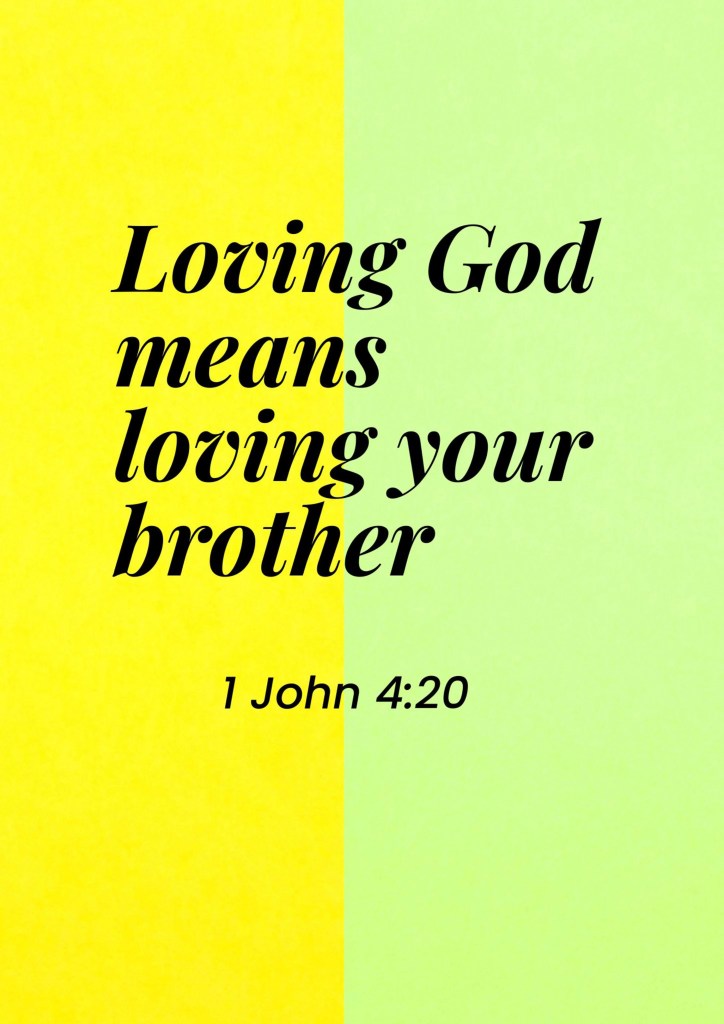
The difficulty we have in loving people, even fellow believers, does not excuse us from taking the commandments Jesus gave us to heart. The greatest commandment – to love God – is ultimately inextricably intertwined with the second greatest commandment – to love our neighbors as ourselves. John makes this clear:

“For whoever does not love their brother and sister, whom they have seen, cannot love God, whom they have not seen. And he has given us this command: Anyone who loves God must also love their brother and sister.”

1 John 4:20-21

There is that qualifier again – brother and sister. But, we know from other passages of Scripture that the divine obligation to love extends beyond our spiritual family to our neighbors and to our enemies also. Why, then, do those pesky qualifiers keep showing up? I have some thoughts that I will share.


Continue reading “Why Does Jesus Repeatedly Prioritize Christians Loving One Another?”

Who Are Christians to Love? Matthew 25 and John 13

When Jesus said we should care for the “least of these, my brothers” and to “love one another”, was he limiting the scope of our love to fellow believers?


In the Parable of the Sheep and the Goats in Matthew 25, Jesus says, “Truly, I say to you, as you did it to one of the least of these my brothers, you did it to me.” (Matthew 25:40) Most people gloss over the qualifier to the least of these… my brothers. Bible scholars, however, have wrestled with the fact that the clear instruction for us to have compassion and care for the hungry, the thirsty, the stranger, and the prisoner – the least of these – is qualified by Jesus by adding “my brothers.”

Some modern scholarship argues for a limited interpretation. These scholars contend that “the least of these, my brothers” refers specifically to the disciples of Jesus and fellow believers, especially those who are suffering persecution or deprivation as a result of their faith. They argue that we can not apply this Parable to the people in the world at large because the category of “the least of these” is qualified by “my brothers.”

In similar fashion, Jesus tells his followers, “By this everyone will know that you are my disciples, if you love one another.” (John 13:35) Jesus does not say that the world will know his disciples by the love they have for people in the world at large; rather, they will be known by the love they have for “one another.”

These two statements of Jesus raise some questions for us. Are Christians only commanded and expected to care for and love each other? Is the Bible silent on whether we should love and care for people who are not followers of Christ? Does it matter whether we love and care for people in the world?

The point of the Parable of the Sheep and the Goats is that the love and care we show for “the least of these my brothers” is tantamount to showing love and care for Jesus. In other words, one’s treatment of “the least of these”, who Jesus calls his brothers, reflects our hearts and our relationship with God, Himself.

This is not inconsistent with the one, primary characteristic that Jesus says should mark his followers – that they love each other. (John 13:35) Love within the Christian community is the hallmark of being a follower of Jesus, and that love and mutual care that Christians have for each other serves as a testimony to the world that we follow Jesus (if, indeed, we are faithful to his commandment).

We might glean from the Parable of Sheep and the Goats that the emphasis on “my brothers” means that Christians only show love for Jesus when they love and care for brothers and sisters in Christ. We might understand from reading John 13:35 that we should focus only on loving each other, as that is the way the world will know us.


Do these passages mean that Christians are only to care for and love each other. Does this special emphasis on loving our brothers and commandment to love each other extend outside the Church? Or does it apply only within the community of believers?


Continue reading “Who Are Christians to Love? Matthew 25 and John 13”

What Was the Sin of Sodom and Gomorrah?

A clue is that people cried out in distress

It is probably not exactly what you think


I have wanted to dig into the story of Sodom and Gomorrah for a while now, ever since someone suggested to me that the story isn’t what I think it is. Everyone knows the reference to Sodom and Gomorrah, right? God smote those villages with fire and brimstone because of homosexuality.

That’s what I was taught. At least, that is what I always believed, but I have learned there may be more to the story. The truth is right where we should expect to find it: in the Bible. If you are intrigued as I was, then read on.

First, let’s review the story in Genesis 13. Abram and Lot flourished, and their clans and flocks grew in size in the land God promised Abram. As their estates grew, tensions arose among their entourages, and they decided to separate and spread out. (Gen. 13:5-9)

“Lot looked around and saw that the whole plain of the Jordan toward Zoar was well watered, like the garden of the Lord, like the land of Egypt.” (Gen. 13:10) The desirability of the land prompted Lot to choose Sodom and Gomorrah in the plain of Jordon, while Abram remained in Canaan.

Although the land was desirable, the story ends with this ominous statement: “The people of Sodom were wicked and were sinning greatly against the Lord.” (Gen. 13:13) Did Lot know what he was getting into?

That statement is there for a reason. We should take note. The land was inhabited with “wicked” people, yet Lot moved there anyway. Perhaps, the allure of a well watered garden – like the garden of Eden and like Egypt – was so great that Lot ignored the fact that wicked people lived there.

The mention of similarity to Egypt should also recall the desire of the people in the wilderness to go back to Egypt. Though they were enslaved there, the land was lush, and they had food and comfort. It seems that these allurements caused Lot to overlook the obvious problem with choosing to live there.


The comment also may provide an explanation for why Lot’s wife looked back in defiance of the angel’s warning. She may have regretted leaving such a desirable place to live, despite the wickedness of the people there.


She may have wanted to return to the abundance and comfort that drew them there, and that desire to hold on to abundance and comfort in the face of the abject wickedness of the people may have been her undoing.

We should also understand the backstory in Genesis 18 before we get to the story of Sodom and Gomorrah Genesis 19. Before the angels visited Sodom, they visited Abram.

Abram saw the three “angels of the Lord” from his tent. He went out to meet them, bowed in respect, and insisted they come to his tent to be refreshed. Abram and Sarai spared no expense to show them hospitality, and the angels returned the favor by affirming God’s promise to the elderly couple: promising that Sarai would bear a child within a year. (Gen. 18:1-15)

Before the angels left, the angels told Abram the reason they came: to investigate Sodom and Gomorrah because “the outcry against Sodom and Gomorrah [was] so great and their sin [was] so grievous.” (Gen. 18:20) This “outcry” that reached the LORD is the first clue to what was going on there. (Gen. 18:21)

The Hebrew word that is translated “outcry” in this verse is za’aq. It mean a shriek, cry for help, cry of distress, lamentation. The outcry means something was going on in Sodom and Gomorrah that was causing people to cry out for help in distress.

The word, outcry, in Genesis 18 should bring to mind Exodus 2:23 where God heard the Israelites cry out in distress over their oppressive treatment by the Egyptians. In both cases, in Egypt and in Sodom & Gomorrah, God responds to an outcry of the people living there.

They same word, za’aq, is used in both passages. God responded to the Hebrews cry for deliverance by sending Moses, and God miraculously rescued them from the land of Egypt. In Genesis 18, God similarly responded to a cry for deliverance from Sodom by sending His angels to investigate.

The parallel nature of these stories is important to recognize. The people cried out in distress, and God responded. Parallel stories and themes run throughout the Bible, and we should pay attention to them when they appear. They usually mean something.


We know why the people cried out in Egypt – because Pharaoh enslaved and mistreated them. The Bible is relatively silent, however, on the circumstances in Sodom and Gomorrah. If we pay close attention, though, we can find some clues!


Back to the story: In Genesis 19, Lot repeats the pattern of Abram’s hospitality. Lot saw two angels at the city gate, and he went out to meet them, like Abram did. Lot greeted them with respect the same way Abram did, and Lot insisted they come to his home where he prepared a feast for them, just as Abram did. (Gen. 19:1-3) These stories appear one after the other in the biblical narrative, and the parallel symmetry signals that we should pay attention.

Abram and Sarai, by the way, are known for generous hospitality. The generous hospitality of Abram is legendary in Jewish and even Muslim lore. Generous hospitality was a key distinctive of Abraham, God’s man of faith.

Lot, who was Abram’s kin, demonstrated the same kind of generous hospitality, but the story takes a bad turn. Everything seems great until the men of Sodom surround Lot’s house and demand that Lot bring the angels out to them, “So that we can have sex with them.” (Gen. 19-4-5) When Lot refused, they turned on Lot, This is what they said:

“This fellow [Lot] came here as a foreigner, and now he wants to play the judge! We’ll treat you worse than them.”

genesis 19:9

Most of us, I think, assume the sin of Sodom was primarily sexual in nature. The story certainly seems to suggest that if we miss the clues to what was really going on. The symmetry of the parallel stories leading up to the story of Sodom and Gomorrah suggest that something else is going on. The people crying out in distress, like the Jews in Egypt is another clue, and what the townspeople say to Lot is still another clue.

The clues are in the context and the contrast between the way Abram and Lot treated the foreigners/angels and the way the townspeople in Sodom & Gomorrah treated them. Abram and Lot go out of their way to greet the angels, bow to them in respect, make them feel welcome, and show them generous hospitality. The men of Sodom react the opposite way: they respond with hostility. They are angry that the foreigner in their midst (Lot) invited foreign guests into his home, and they came to punish and humiliate those guests by violating them sexually.

I never noticed these clues in the text before. They cast a different light on the story. It seems that the story is less about men wanting to have sex with men than it is about brutish inhospitality the strangers/foreigners.


This was a lynch mob. They came to run the foreign guests out of town and to demonstrate their extreme displeasure with Lot for inviting them in to his home. The men wanted to humiliate, violate, and punish Lot’s foreign guests in the worst possible way, and they wanted Lot to understand why: because Lot was a foreigner, and these men were foreigners, and they were not welcome in their town.


As side note, I would not likely have noticed this but for the book I am reading by James K. Hoffmeier, The Immigration Crisis: Immigrants, Aliens, and the Bible. He cites to the Sodom and Gomorrah story as an example of the way people in the Old Testament controlled their borders and their cities. (See also Judges 19-21 in which a similar scene plays out in Gibeah where the sons of Benjamin treat the Levites passing through in exactly the same way.)

I am reminded of the Parable of the Sheep and the Goats in which people did not realize the way they treated foreigners (and other vulnerable people) was like treating Jesus that way – good and bad. I am also reminded of Hebrews 13:2: “Do not forget to show hospitality to strangers, for by so doing some people have shown hospitality to angels without knowing it.” Mistreating strangers – similarly – might be nistreating angels!

This was the last straw for God. The angels returned the favor Lot showed them by protecting him and his family. The angels warned them to get out of town quick. As soon as Lot and his family were out of town, “the Lord rained down burning sulfur on Sodom and Gomorrah….” and reduced it to smoke and ash (Gen. 19:10-28)

Aside from some other details that do not seem directly relevant at the moment, that is the story of Sodom & Gomorrah. Most of the references to Sodom & Gomorrah in the rest of the Bible are used as warnings without much commentary, except for three passages. These passages tell fill in the rest of the story.

Continue reading “What Was the Sin of Sodom and Gomorrah?”

How Should We Judge Our Neighbors?

Who we judge and how we judge are keys to how we will be judged.


Many things are said about judging, and confusion persists about whether Christians are to judge or not to judge. I wrestled through the seeming conundrum – to judge or not to judge – a number of years ago and came up with 8 Important Points About Judging and Judgment. I didn’t realize, then, how these principles tie into the way we should look at immigration.

In very brief summary, Jesus said, “Judge not, that you be not judged” (Matt. 7:1), and followed immediately with the statement, “For in the way you judge, you will be judged; and by your standard of measure, it will be measured to you.” (Mt. 7:2) He was not telling us not to judge; he was telling us to be careful how we judge. This is critical.

The statements in Matthew 7 cited above are the set up for the short parable of the person with a log in his eye trying to take the speck of his brother’s eye. The parable ends with Jesus telling us first to take the log out of our own eye; then we can see accurately to take the speck out of our brother’s eye.

Paul riffs on this theme Jesus preached when he said, “If we would judge ourselves, we would not be judged.” (1 Cor. 11:31 NKJV) Paul also picks up on something I missed for years in the log and speck parable. In that parable, Jesus is talking about “judging” our brother. Who we judge is just as critical as how we judge.

When I first discovered this, I realized that I and most Christians I know had it all wrong. That lightbulb went on when I read these words by the Apostle, Paul:

 “What business is it of mine to judge those outside the church? Are you not to judge those inside?”

1 corinthians 5:12

Jesus only talked about judging our brothers, and Paul makes it clear this means people in the church. We have no business judging people outside the church. “God will judge those outside.” (1 Cor. 5:13) (This is why we need to preach the gospel to them!)

Of course, when we feel compelled to judge someone else, we should always examine ourselves first. We should always be careful how we judge, because we how we judge others is how we will each be judged. We should never judge people outside the church – because Jesus came not to condemn – and neither should we; he came to save.

Notice these themes that Jesus preached:

  • We will be shown mercy as we show mercy to others (Matt. 5:7)
  • We will be forgiven as we forgive others (Matt. 6:15); and
  • We will be judged as we judge others (Matt. 7:2);

Consistent with what Jesus preached, the themes of judgment and mercy are tied together by James:

When James adds that “mercy triumphs over judgment,” he is highlighting a standard that is based on God’s character. God desires mercy and not sacrifice (Hosea 6:6); God desires mercy, which is why Jesus came to call sinners to himself (Matt. 9:13); and God desires us to be merciful as He is merciful. (Luke 6:36)


So many people view God as an angry God who is full of wrath and judgment. Nothing could be further from the truth. “The Lord is merciful and gracious, slow to anger, and abounding in steadfast love.” (Psalm 103:8) “The steadfast love of the Lord never ceases; his mercies never come to an end.” (Lamentations 3:22)


God is just because he is merciful! Biblical justice is characterized by mercy. Thus, justice without mercy is not biblical justice:

“Therefore the Lord waits to be gracious to you; therefore he will rise up to show mercy to you. For the Lord is a God of justice; blessed are all those who wait for him.” 

Isaiah 30:18

But what does this have to do with judging neighbors? Why did James ask the rhetorical question: “Who are you to judge your neighbors?” This question ripples back to the question, “Who is my neighbor?” The context in which God told us to love our neighbors is a good place to start with answers to these questions.

Continue reading “How Should We Judge Our Neighbors?”

Wolves, Weeds, and the Way of Jesus

We may be sometimes fooled into listening to the voices of wolves, rather than the voice of the Good Shepherd.


I went to bed last night concerned I was getting things wrong. Specifically, I have been critical of Donald Trump and what he has done since he took office again, and I have been getting push back from many people. It isn’t the many people that concerns me, but my brothers and sisters in Christ who are calling me out on this.

It seems so obvious to me that the things being done are wrong, and the way they are being done is wrong, but other Christians are not seeing it. I prayed to God last night, “If I am wrong, please correct me.”

This morning my daily reading included this verse:

“I am sending you out like sheep among wolves. Therefore be as shrewd as snakes and as innocent as doves.” Matthew 10:16

I was doubting myself last night, so my first thought was to check the context, even though I know it. Sure enough, it was what I remembered:

“These twelve Jesus sent out with the following instructions: ‘Do not go among the Gentiles or enter any town of the Samaritans. Go rather to the lost sheep of Israel. ‘” Matthew 10:5-6 

I have read this passage dozens of times, probably, since I became a Christian over 40 years, but I didn’t realize the context of the sheep among wolves statement made by Jesus until the last year. When I read that passage recently, I said to myself, “Wait a minute! Jesus said that to his disciples when he sent them out to his own people – the Jews.” What!?

He said, don’t go to the Gentiles, and don’t even go to the Samaritans; go “the lost sheep of Israel.” He would later send them to the Samaritans; and he ultimately sent his followers to Judea, to Samaria, and to the ends of the earth.

Of course, he sent them to the lost of sheep of Israel. Maybe not all the people of Israel were lost sheep. Maybe the wolves were only among the lost sheep of Israel.

Surely, the people in the church today are not the lost sheep. The church is filled with the elect. The church is filled with sheep who hear the shepherd’s voice. I believe that is true!

At the same time, I think it is safe to say that not everyone who goes to church is a child of God. The old adage that parking yourself in a garage does make you an automobile is true. Jesus said it this way: “The kingdom of heaven is like a man who sowed good seed in his field. But while everyone was sleeping, his enemy came and sowed weeds among the wheat….” (Matthew 13:24-25)

I am sobered by this. I don’t think that Jesus was saying that all God’s people at that time were wolves. Maybe the wolves weren’t even people. Sometimes, we can take a metaphor too far. He was telling them to be careful, to be circumspect, to remember what he taught them, and not to be lead astray – even among God’s people. We may be sometimes fooled into listening to the voices of wolves, rather than the voice of the Good Shepherd.


This is the story of God and His people. God sent His prophets to His people again and again, and they did not listen. (Jeremiah 26:5) When God commissioned Isaiah, He told Isaiah that the people would hear, but not understand, and they would see, but they would not perceive, and this would continue until the land was in ruins and only a remnant remained. (Isaiah 6:1-13)


Of course, I am not the Prophet, Isaiah. I am a sinful man saved by the grace of a loving God. I have my own faults and biases and sinful tendencies, and I could be wrong. I am acutely aware of this.

Last night before I went to bed, I listened to a pastor talk about the triumphal entry in Luke, and I remember it this morning. I wrote about the triumphal entry last year with some new insights I had gained from a podcast. He hit on the same insights.

Jesus was entered Jerusalem on the colt of a donkey around the time Pontius Pilate entered Jerusalem from the opposite direction, from Caesarea. Picture the incongruity of a full grown man sitting on a colt of a donkey with his legs dragging the ground under the poor little beast. Then picture the Roman ruler of the land came from the opposite direction in a mighty procession with banners and fanfare and a show of force with all the military show of Communist China.

Jesus was coming to die on a cross, but the people greeted him like he was a king who would ascend the throne of David and overthrow the Roman government. They shouted, “Hosanna!” (Save us!) They waived palm branches to herald the Messiah they believed would save them from the Romans like a hammer, and they laid their garments down in submission.

The people didn’t understand that Jesus came to die on a cross. The poignancy of this incongruence is understood best by how the story in Luke ends:

“As he approached Jerusalem and saw the city, he wept over it and said, ‘If you, even you, had only known on this day what would bring you peace—but now it is hidden from your eyes. The days will come upon you when your enemies will build an embankment against you and encircle you and hem you in on every side. They will dash you to the ground, you and the children within your walls. They will not leave one stone on another, because you did not recognize the time of God’s coming to you.'”

Luke 19:41-44

Those people would have said they did recognize the time of God’s coming, right?! They got it right: he was the Messiah! They recognized that Jesus was God’s Messiah promised of old.

In that general sense, they did get it right. Jesus was/is the Messiah, but their expectations of what that meant and what he would do was wrong. They thought he came to conquer, but he came to die.

By the end of that week, the people who waived palm branches and laid their garments down had changed their tune. They wanted Barabbas released, not Jesus.


As discussed in the conversation linked below in the video, they wanted the way of Barabbas – the sword – not the way of Jesus, the cross. They didn’t want a suffering Messiah; they wanted a conquering Messiah. They didn’t want the Lamb of God; they wanted the Lion of Judah.


We aren’t much different than they. For all of our Bibles and bible apps, we don’t even know Scripture as well as they did! Lifeway Research reports that only 36% of Evangelicals read the Bible every day, and only 32% of Protestant, read the Bible every day.

We have our own expectations of the way God should do things, and we tend to lean back into what someone recently called the default stance of the flesh – the appeal of power and influence. But, that isn’t God’s way. Jesus showed us God’s way, and he invites us to follow his way as he followed the Father’s way in this present world.

Paul reminds us,

“But God chose the foolish things of the world to shame the wise; God chose the weak things of the world to shame the strong. God chose the lowly things of this world and the despised things—and the things that are not—to nullify the things that are….”

1 Corinthians 1:27-28

We need to be careful not to be hearers who don’t understand and seers who don’t perceive. We need to be careful to choose God’s way, which is not our way. We need to carry our crosses and not swords.

Does any of this make me “right”? No. But, I am seeking God. I am trying to be true, to know Him, and to be like Him. That is my heart’s desire. I am trying to recognize and honor God in these times and to reflect His heart and character as best as I can understand it.

The lesson of the words of Jesus to be careful of the wolves among the sheep, the lesson of the prophets, and Paul’s reminder that God shames the wise and the strong by choosing what seems to be foolishness and weakness means that I need to resist the default position of the flesh (to rely on power and influence). I need to be grounded in God’s Word and not everything that anyone who is a Christian says. I need to be aware that weeds grow among the wheat and wolfish things appear among the sheep.

Though every man be a liar, yet God is true! (Romans 3:4) The heart of a man is deceitful above all things. (Jeremiah 17:9) This is true of me and my heart if I am not careful and do no guard it. We need each other, and we need to hold each other accountable, not to political ideologies and cultural ways, but to the Word of God and the way of Jesus.