Critical Race Theory from a Christian Perspective


I have been writing to encourage the evangelical church, in particular, to speak up and get involved in doing justice as God would have us do it. (Here and here.) We have been champions of proclaiming the Gospel, but we haven’t exactly been champions of doing justice.

My goal isn’t to shame anyone into jumping onto a cultural bandwagon, but to focus on God’s heart that is characterized by justice and our role in participating in God’s purposes. If we want to be involved in following Jesus as he followed the Father, I think we need to do justice.

He has told you, O man, what is good; and what does the Lord require of you but to do justice, and to love kindness, and to walk humbly with your God.

Micah 6:8

There is no condemnation for those who are in Christ, but God calls us to do justice.

At the same time, we need to be mindful, always, of truth. Biblical justice has a vertical element and a horizontal element: man to God and man to man. We need to be aligned in both directions with God and His character.

Critical race theory has become a viable contender in the modern cultural arena for defining injustice and prescribing how to fight it. Critical race theory, by its very nature, attempts to control the discussion. As Christians, though, we need to keep our focus on the Gospel as we wade into the fray.

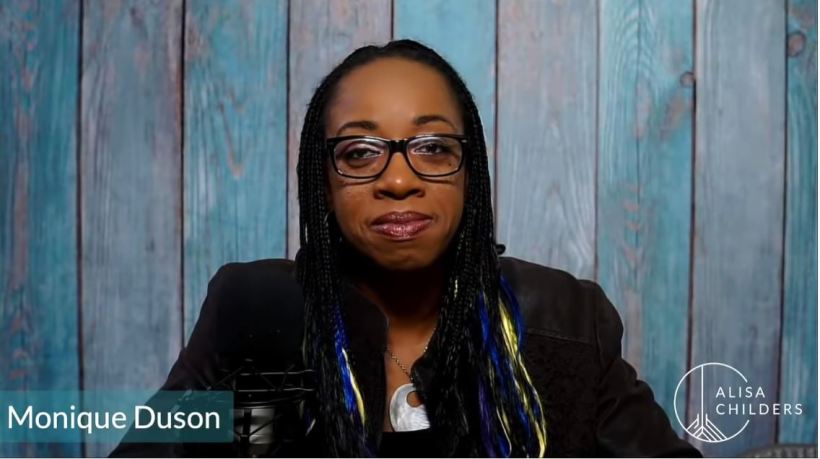
In this article, I summarize a conversation between Alisa Childers and Monique Duson on Race, Injustice, and the Gospel of Critical Race Theory. (The full interview is embedded at the end of this article.) I have been meaning to write on the subject of the difference between Gospel justice and social justice (which often devolves into justice without the Gospel), for well over a year. This, I think, is a helpful introduction to the subject.

I will address critical race theory (CRT) here, and I will follow with some thoughts on need for the evangelical church to be actively involved in doing true (biblical) justice.

Background.

Monique Duson grew up with critical race theory in south LA. The ideas that drive critical race theory (CRT) were her frame of reference before she even had a label for them. She was nurtured and educated by it. Her world was defined by an us-against-them orientation: whites against blacks.

She didn’t really know the philosophy or the foundations that under-girded that framework until she attended college at Biola University, a Christian institution. Even there, she recalls, she really didn’t question it or put it into a Gospel perspective.

In fact, she had always assumed “the Gospel” in the United States of America was a white concept that was part of the oppression of white power structures. She didn’t realize this construct comes from CRT, and she didn’t realize the historical Gospel isn’t “white” until after college when she was challenged to research it.

As she learned that Jesus wasn’t white and the culture in which the Gospel first introduced wasn’t white, Monique came to realize, “The Gospel we have perceived isn’t white Protestantism.” The Gospel predated the European influences that eventually spread the Gospel to the New World.

Because of Monique’s background and personal experience with critical race theory, she is uniquely able to identify where CRT and biblical notions of justice and the cure for injustice diverge. The rest of this article focuses on CRT as another gospel that is different than the true Gospel that Jesus preached.

Continue reading “Critical Race Theory from a Christian Perspective”

Evangelicalism and Injustice Part II

We must recognize injustice and speak to it if we are going to represent God, the Father, accurately to the world. 


In Evangelicalism and Injustice Part I, I discussed how the evangelical world has been a champion of preaching the Gospel, but we have not been champions of doing justice. In fact, we have shied away from it.

Less Gospel-orientated people, religious and otherwise, have rushed in to fill the void we have left, including people with philosophies and worldviews that are hostile and antithetical to the Gospel. I will address those things in a follow up post.

Meanwhile, the burden that weighs on my heart in these days is that our God is a God of righteousness and justice at the very foundation of His throne. (Psalm 89:14) This should be our foundation too as children of God our Father.

Jesus carried that great pillar of God’s character forward in the parable of the sheep and the goats, instructing his followers that those who will be blessed by God and receive their inheritance at the throne of God (calling Psalm 89 to mind) are the people who feed the hungry, give drink to the thirsty, invite the stranger in, clothe those in need, heal the sick and visit prisoners.

Jesus announced his ministry by reading from the Isaiah scroll. He said that God anointed him to preach the gospel to the poor, to proclaim release to the captives, and recovery of sight to the blind, and to set free those who are oppressed. (Luke 4:18-19, quoting from Isaiah 61:1)

The good news (the Gospel), in this way, is holistic. Jesus demonstrated that holistic approach of preaching good news and doing justice in his ministry. If we are to be his followers, we should do what Jesus did as he did what he saw the Father doing. (John 5:19)

When Jesus quoted from Isaiah, the prophet, he was calling to mind the great theme of all the prophets, which is the call of God to His people to do justice. Zechariah, for instance, says,

“This is what the Lord Almighty said: ‘Administer true justice; show mercy and compassion to one another.'” (Zech 7:9)

And he adds what true justice looks like:

“‘Do not oppress the widow or the fatherless, the foreigner or the poor. Do not plot evil against each other.'” (Zech 7:10)

James picks up the same theme in the New Testament.

“Religion that God our Father accepts as pure and faultless is this: to look after orphans and widows in their distress and to keep oneself from being polluted by the world.” (James 1:27)

James emphasizes the need for doing, not simply giving mental ascent to what Jesus says. The example he provides falls into the Old Testament definition of “doing justice”:

“Suppose a brother or a sister is without clothes and daily food. If one of you says to them, ‘Go in peace; keep warm and well fed,’ but does nothing about their physical needs, what good is it? In the same way, faith by itself, if it is not accompanied by action, is dead.” (James 2:15-17)

Evangelicalism has been very good at preaching and proclaiming.  Many evangelical organizations exist, like Administer Justice (which I mentioned in the first blog article), that both proclaim the good news and do justice (meet the needs of the poor, the oppressed, the prisoners, widows, orphans and strangers), but evangelicalism, as a whole, falls a bit short on the justice side of the equation. Let’s be honest.

Continue reading “Evangelicalism and Injustice Part II”

Comments on Freedom and the Clash of Ideas

If any speech or expression is deemed unworthy of protection on the basis of its content, no speech or expression is safe.


“The clash of ideas is the sound of freedom.”  (Lady Bird Johnson)

I grew up in the 1960’s and 1970’s, bring born at the very end of 1959. My young, impressionable mind recalls the assassination of JFK, Robert Kennedy and Dr. Martin Luther King, Jr. I remember watching the riots during the Democratic National Convention in Chicago, the Kent State protest and shooting, the footage of the Vietnam War and the Nixon impeachment on the nightly news.

The world seemed a chaotic place, no less than it does today, on this 4th day of July, 2020.

In the 1960’s, the dissident voice championed First Amendment rights that included the freedom of assembly and freedom of speech. I remember that freedom cry as a child superimposed over news footage of a burning US flag. The patriot in my young heart was equally shocked by the flag burning and impressed by the necessity of the freedom that allowed that flag to burn.

In law school, I learned the nuances of the jurisprudence that grows out of our US Constitution in which the First Amendment is enshrined. The clash of ideas is so sacred in our constitutional framework that it allows even the idea of abolishing that very framework to be heard.

In the 21st Century, many things have changed, while somethings have remained the same. Many of the dissident ideas from the 1960’s have become mainstream, and more “conservative” voices have become dissident. I am no longer shocked by the burning of the flag (and, perhaps, the point of burning a flag is no longer poignant for the same reason).

The angst of the 1960’s of my youth has been replaced by the angst of the 21st Century of my middle age. The reasons for my angst are much different, yet very much the same at their core. I have grown and changed in my views, but the emotional strain of the human condition remains.

I fear, at times, that the framework that protected the freedom to burn US flags in the 1960’s might, itself, be destroyed in my lifetime, or the lifetime of my children, by the fire of ideas that are antithetical to that freedom.


The ideas in colleges and universities around the country that seem to dominate those institutions promote the silencing of dissident voices. Speaker engagements are canceled as the loudest voices want not even a whisper to be heard in opposition.


One theme of the dominant social, philosophical and political ideologies that thrive on college campuses today is that certain voices should be silenced, while other voices should be magnified – a kind of totalitarianism of ideas. This worldview would destroy the foundation of the First Amendment if the First Amendment is not held firm.

I am shocked by this new predominant view as I was once shocked by the burning of a US flag. The shock stems not from the evils in society this ideological view aims to address, as I find some common ground in those concerns. I am shocked that the proposed remedy involves weakening the most fundamental freedom that protects freedom itself – the freedom of ideas and the right to express them.

The idea of “hate speech”, as well-intentioned as it sounds, is inimical to a framework of freedom that protects the clash of ideas. Nowhere is freedom more necessary to be protected, than at the intersection of ideas and the right to express them. One person’s hate speech is another person’s freedom of expression.

If we allow the idea of hate speech into the fabric of First Amendment jurisprudence, we threaten its very foundation. What we characterize as “hate” today is subject to change with changing societal norms tomorrow. No speech is safe from the label of “hate” if labels are allowed to silence speech.

While such a worldview has some appeal and laudable goals, it cannot be advanced by the abolition of freedom of speech. Yet, I realize at the same time, that freedom, real freedom, protects even those ideas that are antithetical to freedom and demands that they be heard.


As shocked as I was in my naïve youth to watch the US flag burn in the streets of America, I understood the importance of allowing that expression to be heard. That I am no longer shocked by that expression is of no consequence.


In fact, freedom of speech is nowhere more vital than the protection of speech that is offensive. Favored speech doesn’t need protection.  If any speech or expression is deemed unworthy of protection on the basis of its content, no speech or expression is safe.

Continue reading “Comments on Freedom and the Clash of Ideas”

Justice Means Working in the Fields Among the Wheat and the Weeds

Jesus warned us that weeds would grow up with the wheat, but the fields are ripe for the harvest.


The recent turmoil that was triggered by the killing of George Floyd has put a focus on justice in our country. In a sense, justice is on trial. Racial justice is the primary focus, but justice generally is implicated.

Most people are focusing on racial justice right now, but I have seen people with signs at rallies with messages aimed at “police brutality” generally. The spark of emotional reaction has ignited the flames of passion in all people who believe that injustice exists in our systems of justice.

One good example of that more general focus on justice is the “autonomous zone” created by protestors in the City of Seattle, WA.  (Seattle protesters set up ‘autonomous zone’ after police evacuate precinct by Danielle Silva and Matteo Moschella for CBS News June 11, 2020) The police have abandoned the East Precinct in response, and the protestors have replaced the sign on the police station to read “Seattle People Department”.

Many Christians, especially evangelicals, who tend to be conservative, having traditional values and respect for authority, react negatively to such extreme radicalism, and for good reason. In doing so, though, we fail to see, ignore, or gloss over real justice issues that should be addressed.

Our God is just. Righteousness and justice are the foundation of God’s character. (Ps. 89:14) Righteousness and justice should be priorities to us as they are to God.

We might think of justice in terms of punishment, but that is a very warped and inaccurate view of biblical justice. “Biblical references to the word ‘justice’ mean ‘to make right.’ Justice is, first and foremost, a relational term — people living in right relationship with God, one another, and the natural creation. From a scriptural point of view, justice means loving our neighbor as we love ourselves and is rooted in the character and nature of God. As God is just and loving, so we are called to do justice and live in love.” (What does social justice really mean? by Adam Taylor, World Vision February 20, 2012)

Many Christians get tripped up by the term, social justice, because of secular baggage associated with the term. Indeed, social justice has taken on connotations that might by antithetical to some biblical principles. Because justice is a primary characteristic of God, however, we can’t let competing visions of what justice looks like to get in our way of doing justice.

God desires for us to be salt and light in the world. That means getting involved. Jesus warned us that weeds would grow up with the wheat (Matt. 13:24-30), but the fields are ripe for the harvest. To be involved in the harvest, we need to venture out into the fields, weeds and all.

Continue reading “Justice Means Working in the Fields Among the Wheat and the Weeds”

Focusing on Following Jesus in a Chaotic World

God continues to work out His purpose in history.


There is so much angst in the world today. First the corona virus and now the explosion of racial tensions. The political and worldview polarization we we have experienced in recent years have been magnified as political machines ramp up for another presidential election. It even threatens to pull the church apart.

I have recently written about black lives matter and white privilege from a biblical perspective, in an attempt to redeem those phrases from a biblical point of view.  I realize that those terms are loaded. The Black Lives Matter organization has a specific message and worldview that runs contrary to biblical principles at various points, but I tried to find the kernels of truth in those phrases through a biblical lens.

We run a risk in the church of getting off the narrow path of following Jesus by aligning ourselves too closely with a particular political platform, secular philosophy or other way of viewing the world that is not gospel focused. We also run a risk of falling off the narrow path the other way, by  reacting in opposition to everything a particular political platform, philosophy or worldview stands, just because some of it (or even most of it) is contrary to “off”.

Truth is truth, and truth is objective. No one person or particular view is apt to be absolutely true, because we are flawed beings with limited perspective. The likelihood of one person, one church, one theology being absolutely true in every detail is not likely.

At the same time, truth is truth. It is objective, and people can see it. That means that even people who may not acknowledge the truth of the gospel may, nevertheless, accurately see some aspect of the truth.

It’s like science, the facts and evidence must be interpreted. We are all looking at the same facts and evidence, but we do not all interpret it the same way. Still, the facts and evidence are the same. We continually discover new facts and evidence that alters our interpretations of the facts and evidence we previously knew, and we sometimes discover that what we thought we knew is not accurate.

God, of course, never changes. He is the same yesterday, today and forever. Our perspective, knowledge and understanding, however, is finite and limited, and that requires we adopt a posture of humility in our understanding.

God’s Word doesn’t change, but our perspective of it changes. Think of the radical change of perspective Jesus introduced to the descendants of Abraham! God became man, came to His own people, and they didn’t even recognize Him!

Continue reading “Focusing on Following Jesus in a Chaotic World”