Separating Caesar from the Church

Some thoughts on the church and state and the state of American Christianity.


Everyone has a hierarchy of values. Whatever is at the top of your hierarchy of values is your God, says Jordan Peterson. Although he hesitates to call himself a Christian, he has a good understanding of the Bible and its positive impact on society and people, individually. This particular statement rings with the purity of truth.

Jordan Peterson has been much in the news and was recently interviewed on the Unbelievable? podcast with Justin Brierley. The topic was: Do we need God to make sense of life? The atheist psychologist, Susan Blackmore, was his counterpart. The podcast (linked above) is worth a listen.

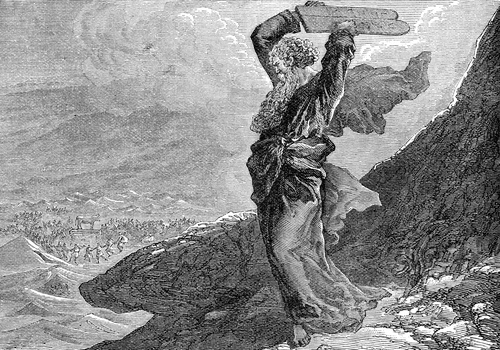
Jordan Peterson also claimed in the course of the discussion that the first pronouncement of the ideal of the separation of church and state came from Jesus when he said, “Render to Caesar the things that are Caesar’s; and to God the things that are God’s.” (Matthew 22:21)

Modern Christians (many American Christians anyway) view the modern emphasis on the separation of the church and state as a bad thing. A common assumption seems to be that the “wall of separation” between the church and state is a way for politicians to keep Christians out of politics and to keep politics from the influence of Christians.

What do you think?

Continue reading “Separating Caesar from the Church”

Judging the Old Testament God with New Testament Morality

We beat the God of the Old Testament over the head with the morality of the New Testament.


I am a fan of Perry Marshall, the author of Evolution 2.0, and a champion of the integration of science and faith. I don’t necessarily agree with him on his conclusions about evolution, but (frankly) that is only because I am not a science guy. I don’t disagree with him either. Perry Marshall, Hugh Ross of Reasons to Believe, Stephen Meyer of the Discovery Institute, and Francis Collins and BioLogos all present reasoned and evidence-based views on science and faith, as do others, and they don’t all agree.

Such is the character of being finitely human. We see in part. We know in part. We just don’t have the kind of perspective to be able to get our arms around the big picture to any degree of mathematical certainty. I enjoy reading them all, and I even listen to and read the atheists and agnostics from time to time.

One of the main objections to “the God of the Bible” is on the basis of morality, not of science. Charles Darwin and Albert Einstein both shared difficulty understanding a God who could/would allow so much pain and suffering in the world. If God is all-loving and all-powerful, what gives? So the thinking goes.

The recent post by Perry Marshall, Isn’t a Deist God a Little Less Troublesome?, deals with this issue. In the article, Perry responds to a someone who rejected Christianity on these moral grounds, but who could not get past the evidence that life could not have just happened the way it exists in the universe with such order without some Help.

Continue reading “Judging the Old Testament God with New Testament Morality”

Sam Harris Podcast with Bart Erhman – Part 6 – Postscript


I have taken some time in previous blog articles to summarize my comments about an interview of Bart Ehrman by Sam Harris. Ehrman talks about his early induction into a fundamentalist Christian world and losing his faith. He talks about the issues with biblical interpretation that led him away from belief.  I provide some comment on issues that possibly factor into his loss of faith, and the most recent articles address a modern view of miracles that avoids wrestling with evidence of the resurrection, and an observation that I share with others: that atheists and fundamentalists interpret the Bible similarly (two sides to the same coin).

One way to summarize Bart Ehrman’s story is the rejection of a rigid, wooden Christianity that imposes (or tries to impose) a “literal” meaning to everything in the Bible.  For Erhman, this is an all or nothing proposition.  Either the Bible is all literally true, or it is all literally false.

This is a false dichotomy.  It fails to appreciate nuance, different genres in the Bible, the significance of symbolical, metaphorical and allegorical meanings, context, and many other things.  It is the position of someone insisting that the Bible be read in a certain way and read through a particular lens, rather than allowing the Bible to speak for itself.

When we approach the Bible, or any literature, with our own assumptions and presuppositions, we have already begun to dictate where we will end up. Ehrman originally approached the Bible with the assumption that it was all literally true (whatever “literally” meant to him and the people who influenced him). Ehrman now approaches the Bible with the assumption that it is all literally false, and that colors the way he reads it.

Harris’s reliance on Hume’s standard for determining the proof of a miracle comes back to mind.  If we set the bar “exceedingly” high, as Hume says we should, we rig the analysis, from the start, to discount every miraculous claim.  That the standard we have set is impossible to meet is the ultimate point. They don’t believe in miracles so they don’t take evidence of miracles seriously, whatever the evidence is.

This way of approaching a subject doesn’t seem very scientific or scholarly to me.  Yet, Harris is a scientist.  Erhman is a scholar.  While skepticism is a useful tool, it needs to be employed with a dose of humility, and the same skepticism should be applied to the “hermeneutics of skepticism” employed by the skeptic.

When the interview starts, Harris talks about people failing to use skeptical scientific tools.  Harris is, generally, referring to the scientific method. The scientific method is primarily a skeptical approach, demanding proof.  There is nothing inherently wrong with that approach.  The danger, however, is that we sneak all kinds of presuppositions into our scientific approach which, by their very nature, will dictate outcomes.  This really is not what the scientific method, in its purest form, is meant to be.

Continue reading “Sam Harris Podcast with Bart Erhman – Part 6 – Postscript”

Sam Harris Podcast Interview with Bart Ehrman – Part 3 – Withering Sun

Some seed falls on hard rocky ground. It grows up fast, but its roots are shallow. When the heat of the sun comes, the plant shrivels and dies.


In previous installments, I have written two blog articles on my observations regarding an interview of Bart Ehrman by Sam Harris on What is Christianity. Bart Ehrman is an agnostic, New Testament scholar at Princeton, and Sam Harris is one of the so-called “new atheists”. In the first article, I relate portions of Ehrman’s story about his “loss of faith”, and I question whether he really had anything but a very shallow idea of faith to begin with. In the second installment, I talk about a certain wooden fundamentalism that continues to be apparent in how Ehrman sees the Bible. It’s a kind of all or nothing approach. Previously, he accepted all of it; now he accepts none of it.

Before moving on to other observations, I want to stop and raise a couple of points related to the portion of the interview already covered. First of all, I want to go back to the comment made by Ehrman about the charismatic youth leader who influenced him in a local Campus Crusade for Christ chapter. Erhman describes the “sinner’s prayer” he recited as an induction. The same youth leader urged him to go to Moody Bible Institute if he wanted to be a “serious Christian”.

Erhman was obviously influenced by this charismatic youth leader. Many of us are similarly influenced by charismatic people that we meet along the way. Some of us are influenced to do things that we might not otherwise do and which have no lasting import to us when we leave the circle of that influence.

Continue reading “Sam Harris Podcast Interview with Bart Ehrman – Part 3 – Withering Sun”

Lost Boys with Guns

Depositphotos Image ID: 184293546 Copyright: belchonock

The gun debate rages on anew, with the flames refueled by the Florida school shooting. Other potential causes of our unique problem with gun violence, mass shootings and school shootings in particular are being identified, usually by the gun advocates. Mental health, removing God from schools and religion from public life, and other things. Do we have a gun problem? Do we have a mental health problem? Do we have a lack of purpose and meaning problem? I think the answer is probably, yes, to all of the above, but there is another problem that no one seems to be talking about. At least, I haven’t seen anyone talk about it until I read an Op-ed article in the NY Times today by Michael Ian Black, The Boys Are Not All Right.

In reading his piece, it dawns on my that, together with whatever other problems we have that contribute to make the United States the only country in the world in which school shootings occur on a regular basis, we have a boy problem. We have a problem with our boys. Our boys are not all right!

It shouldn’t be rocket science for us to realize that girls don’t do mass shootings. They just don’t. Most mass shootings are committed by adolescent boys or young, college-age men. The exceptions are older men. Girls don’t shoot people up like that.

This statistic should jump out at us!

Why are mass shootings, and school shootings in particular, committed by boys and by men? What is the difference between boys and girls, men and women, that explains this phenomenon?

Another fairly obvious statistic is that the incidents of mass shootings and school shootings, in particular, have risen exponentially in the last 30 years. In fact, just 40 years ago, mass shootings were quite rare. Now they have become routine, regular, common-place – whatever you want to call it. We aren’t even surprised any more. What has happened in the last 30 years to cause this spike in mass shootings and school shootings?

I think Michael Black has turned over the stone to a possible answer. My thoughts on the subject, inspired by his article, are linked here

via The Lost Boys with Guns.