What Does It mean that the Kingdom of Heaven Is Subjected to Violence, and Violent People Take It By Force?

Does Jesus authorize violent or forceful behavior in defending Christianity?


I engage in many conversations with people of faith on just about any topic. I remember one conversation (on the topic of guns, I believe) in which a fellow believer cited Mathew 11:12 in support of a Christian defense of gun ownership.


From the days of John the Baptist until now, the kingdom of heaven has been subjected to violence, and violent people have been raiding it.” Matthew 11:12 NIV


My friend also mentioned Jesus turning over tables and instructing his followers to buy swords (Luke 22:36, though he tells them in the same chapter to but them down (Luke 22:49-51); “for all who draw the sword will die by the sword.” (Matthew 26:52)). My friend believes that Jesus was saying that force, and even violence, is ok as long as it is used for a good purpose.

I am reminded of his comments as I read through Matthew 12 in my yearly reading plan. I didn’t follow up on his comment then, but reading this passage in context brings it to mind, and it brings clarity to me at the same time.

Does this passage justify violent or forceful behavior in defending Christianity? That is the question

Let’s start with the context. Jesus is preaching in Galilee where John the Baptist has recently been imprisoned for calling out Herod for adultery. John was no shrinking violet. He was bold and forthright, and it landed him behind bars when Herod didn’t take kindly to the criticism.

While in prison, John heard reports of the miraculous things that Jesus was doing. These reports prompted John to send his own followers to ask Jesus, “Are you the one who is to come, or should we expect someone else?” (Matt. 11:3).

I imagine John the Baptist was wrestling with doubt as he languished in prison. In his mind, and in the minds of most Jews at that time, the Messiah was expected to come and take over the world, but it didn’t seem to be happening. The Roman Empire was still very much in charge.

John’s imprisonment must have given him second thoughts about the Messiah stuff. The miraculous signs seemed to mark Jesus as the Messiah, but why was he not wielding the power and the glory of God against the Roman occupation and Roman Empire? John the Baptist may have been hoping that Jesus was just biding his time when he sent for a report.

Jesus sent this message back:


Go back and report to John what you hear and see: The blind receive sight, the lame walk, those who have leprosy are cleansed, the deaf hear, the dead are raised, and the good news is proclaimed to the poor. Blessed is anyone who does not stumble on account of me.” (Matt. 11:4-6) (quoting Isaiah 35:5-6)


Was that the report John was expecting? Jesus didn’t say anything about driving out Rome and restoring King David’s throne. He didn’t pull from the prophetic messages about a conquering messiah. He pulled a different thread from the Prophets.

When John’s followers left, Jesus praised John the Baptist to the disciples. He affirmed that John the Baptist is the one spoken of in Malachi 3:1 – the messenger sent ahead of the Messiah to prepare the way. He affirmed that he is the Messiah, but the response he sent back to John was about healing, cleansing, and proclaiming good news to the poor.

In this context, Jesus said, “the kingdom of heaven has been subjected to violence, and violent people have been raiding it.”

Jesus seems to be confirming only what John was already hearing about the miraculous signs, but John already knew about those things. Therefore, I think Jesus was doing more than confirming what John already knew. Jesus was tying what he was doing to prophetic passages like the language he quoted from Isaiah when he announced his public ministry (Luke 4:18-19):


The Spirit of the Lord is on me,
    because he has anointed me
    to proclaim good news to the poor.
He has sent me to proclaim freedom for the prisoners
    and recovery of sight for the blind,
to set the oppressed free,
     to proclaim the year of the Lord’s favor.”


These words from Isaiah 61:1-2 with overtones from Isaiah 58:6 were read aloud by Jesus in his hometown synagogue in Nazareth before he sat down with all eyes on him and said, “Today this scripture is fulfilled in your hearing.” (Luke 4:21) These are the words Jesus used to to characterize the purpose for which he came.

We know, of course, that Jesus came to die on a cross, but John and his followers didn’t know that and probably could not have imagined it. Jesus’s followers also didn’t get it even when he tried to tell them.

Jesus pulled passages from Isaiah that alluded to the suffering servant motif to affirm his identity. John the Baptist would have immediately recognized the thread Jesus was pulling, but it wasn’t likely what he was expecting or what he was hoping.

First Century Jews were expecting the Messiah to reestablish the Davidic kingdom “here and now”. The Romans were well aware of that Jewish sentiment and had been putting down factions of zealots who took up the sword to attempt to bring it about.

Imagine Pontius Pilate’s confusion that prompted him to ask Jesus, “Are you the king of the Jews? …. Your own nation and the chief priests have delivered you over to me. What have you done?” This is how Jesus responded to Pontius Pilate:


My kingdom is not of this world. If my kingdom were of this world, my servants would have been fighting, that I might not be delivered over to the Jews. But my kingdom is not from the world.” (John 18:36)


With this as the backdrop, let’s turn back to Matthew 12. If we understand the context, and the bigger picture, we see that Jesus is not advocating violence or force: he is doing just the opposite.

Continue reading “What Does It mean that the Kingdom of Heaven Is Subjected to Violence, and Violent People Take It By Force?”

Should Christians Be Like Elijah and Call Down Fire on People Who Reject Them?

God has been working out His plans and unfolding His purposes – the redemption of mankind and of His creation – throughout history


I am reading through Kings and Chronicles right now in my annual trek through the Bible, and the Prophet, Elijah, has been the “star” these last few days. Elijah means “Yahweh is my God” in Hebrew. He is known for his great faith and is one of the most prominent and revered prophets in the Old Testament.

Elijah is known for his fierce faith in the face of difficult circumstances when Ahab, the King of Israel, and his domineering, foreign wife, Jezebel killed off most of the faithful Hebrew prophets and instituted the worship of Baal and Asherah for the nation of Israel.

Elijah stood defiantly against Ahab and Jezebel who sought to kill him for his defiance Elijah is, perhaps, most known for his public challenge to the prophets of Baal and Asherah that culminated in a powerful demonstration of Yahweh’s superiority to those foreign gods.

This story and another story in a similar vein to it are the backdrop for this article. If Elijah is an exemplary man of faith, to what extent should we follow his example today in the expression of our faith in the face of governmental and cultural opposition?

Continue reading “Should Christians Be Like Elijah and Call Down Fire on People Who Reject Them?”

The Importance of Humility, Openness, and Generosity toward the Holy Spirit in Reading Scripture

We need to be ever humble before God and ever humble in our reliance on our own understanding


In my last blog post, I wrote about the crippled woman Jesus healed in the synagogue, to the synagogue leader’s chagrin (The Danger of Being Too Set in Our Interpretation of What God Requires and What He Is Doing). The synagogue leader thought Jesus shouldn’t be working/healing on the Sabbath, so he instructed the crowd that they could come any other day of the week to be healed, but not on the Sabbath. (Luke 13:10-17)

It seems ridiculous to us, but who knows what doctrines, dogmas, understandings, and ways of thinking we have that get in our way of recognizing God and what He is doing in our present time. If we shrug our shoulders at the seeming insignificance of the Sabbath concern, we will miss the weight of this encounter.

The keeping of the Sabbath was a sacred tradition that goes all the way back to Genesis, when God rested after the six (6) days of creation. (Gen. 2:2-3) Moses passed on the commandment directly from God when the Hebrews were delivered out of Egypt: “Six days you shall labor and do all your work. But the seventh day is a sabbath to the Lord your God; you shall not do any work….” (Ex. 20:9-10)

The Sabbath was reinforced by Moses as part of the covenant relationship established by God with the Israelites. Many centuries before Jesus, God told Moses:

“Say to the Israelites, ‘You must observe my Sabbaths. This will be a sign between me and you for the generations to come, so you may know that I am the Lord, who makes you holy. Observe the Sabbath, because it is holy to you. Anyone who desecrates it is to be put to death; those who do any work on that day must be cut off from their people.” (Ex. 31:13-14)

Can you see why the first century Hebrews held so tightly to their Sabbath doctrine? It was a commandment; it was sacred; it was an intimate sign of their covenant with God going back many centuries; and the penalty of violating the Sabbath in the Mosaic law was death (or being cut off from the people).

For that reason, the Jewish leaders added strict protocols to the observance of the Sabbath to be sure that no one violated it, even inadvertently. Thus, when Jesus did something highly irregular, like calling a crippled woman forward in the synagogue in the first place, and then healing her, the synagogue leader was legitimately concerned, in his mind, about a violation of that sacred commandment.

Yet, in his concern for not offending God and for observing law, he failed to recognize God in the flesh standing right before him! Ironically, the Law that was intended to point the Hebrews to God got in the way of the him recognizing God.

God commanded them to keep the Sabbath at the risk of death and exile! Thus, they believed they couldn’t be too careful! What are we to make of this?

One clue is in the details of the response by Jesus. He called the religious leaders hypocrites because they untied their livestock and took them out to get water on the Sabbath. (Luke 13:13) If they believed that caring for their animals on the Sabbath was ok on the Sabbath, they should have recognized that healing a person was ok also.

“Yes, but God commanded!”, the synagogue leader might have said. I suppose Jesus might have asked in return, “Commanded what?” The synagogue leader might have protested further, “But we cannot be too careful! These things are not to be taken lightly. We need to err on the side of caution, lest we step over the line!”

These things should not be taken lightly, no doubt, but the synagogue leader obviously missed something of essential importance. What he missed, I think is better understood in the context of some global criticisms Jesus expressed toward the religious leaders of his day (which likely are as applicable today as they were then):

“Woe to you, teachers of the law and Pharisees, you hypocrites! You give a tenth of your spices—mint, dill and cumin. But you have neglected the more important matters of the law—justice, mercy and faithfulness. You should have practiced the latter, without neglecting the former. You blind guides! You strain out a gnat but swallow a camel.” (Matt. 23:23-24)

The Law and all of its rules were not meant to be the end all be all. Paul says the law was a guardian or tutor to lead us to Christ. (Gal. 2:24) Perhaps partially, to help us recognize our need for Christ in our inability to keep the Law. Perhaps, partially, to provide rituals by and through which a relationship could be established with God. Perhaps, in other ways as well.

The point is that the Law was never meant to define the totality of God’s relationship with people. What God wanted, which is what the Law was intended to teach, was for the Hebrews to love Him and for them to love each other.

Jesus said as much when he said the Law can be summed up succinctly in two phrases: Love God, and love your neighbor.

This was not a new concept when Jesus spoke those words, though. Jesus was once asked, “What is greatest commandment?”, by a teacher of the Law. When Jesus said the greatest commandment is to love God, and the second greatest commandment is to love our neighbor, the teacher commended Jesus for the answer, demonstrating that the teacher of the Law knew the answer, himself. (Mark 12:28-34)

When the teacher of the law commended Jesus for the answer, Jesus told the teacher that he answered “wisely” and, therefore, is “not far from the kingdom of God.” (Mk. 12:34) In other words, the key to unlocking the “mystery” of the Law is to understand that it is meant to teach us to love God and love our neighbors. If we fail to see that, we are missing the boat

When we hold too tightly to our doctrinal constructs to the point that we miss the ultimate point, like the synagogue leader did, we fail to understand God; we fail to recognize God when He is acting in our midst; and we risk being on the “outside” with God, though we may be good, religious people in every other way.


Jesus said,

“The eye is the lamp of the body. If your eyes are healthy, your whole body will be full of light. But if your eyes are unhealthy, your whole body will be full of darkness. If then the light within you is darkness, how great is that darkness!”

Matthew 6:22-23

How do we apply this? How do we make sense of the things God has commanded us without missing the forest for the trees? How do we take a lesson from the synagogue ruler? I am no theologian, but I have some thoughts.

Continue reading “The Importance of Humility, Openness, and Generosity toward the Holy Spirit in Reading Scripture”

Take a Risk to Prepare Room for God in Your Life

If you won’t leave what you’re guarding to see what God is doing, then what you are guarding is your god.

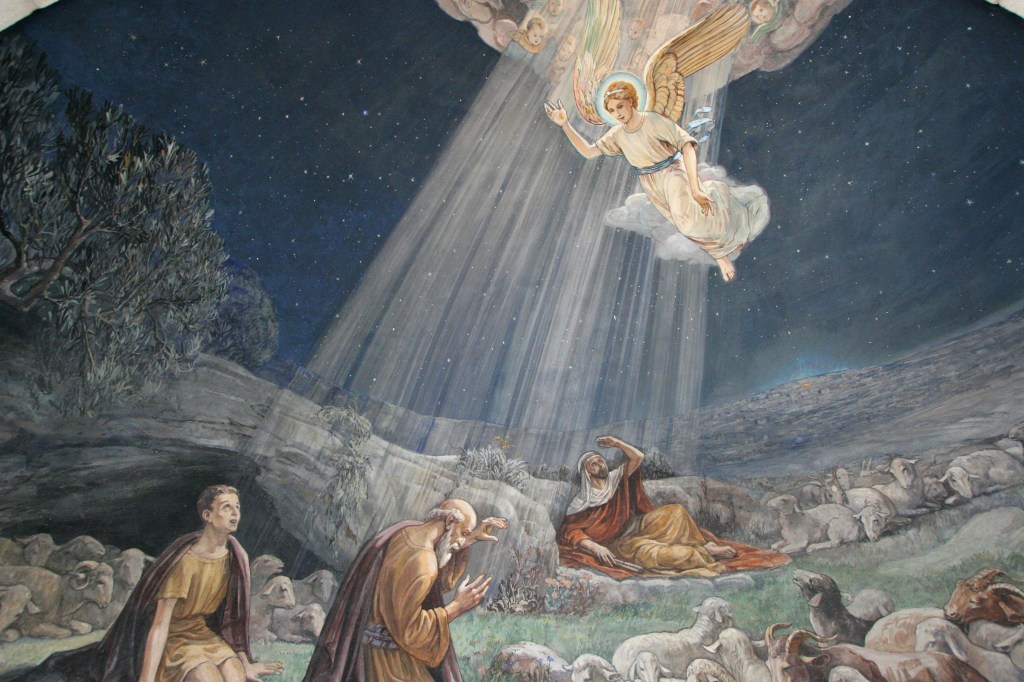
An angel of the Lord visited the shepherds and informed them of Jesus’ birth, Bethlehem, Church at the Shepherds’ Fields

My inspiration today comes from the sermon at church.[1] Very little of my material in this blog is original. If I am being perfectly candid, none of it is. After all, there is nothing new under the sun!

The sermon today was on the shepherds who left their fields in response to the message they received from an angel to seek out and visit the Christ child who was born near them in a manger used to feed animals.[2] If we are tempted to think that the purpose of this story in Luke’s Gospel is the miraculous appearance of an angel to these shepherds, I believe we would be wrong.

The story of the shepherds follows right on the heels of the story of Joseph and Mary traveling to Joseph’s ancestral home, Bethlehem, for a census that was being taken. While they were there, Mary gave birth to Jesus. Luke concludes that story with this seemingly insignificant statement:


“Then she gave birth to her firstborn son, and she wrapped him tightly in cloth and laid him in a manger, because there was no guest room available for them”.

Luke 2:2:7


We have the wrong picture in our heads if we are imagining a guest room in an inn. Mary and Joseph went to Joseph’s ancestral community where his family was gathering from wherever they were scattered. They may not have known their extended family members well, but they likely stayed in one of their homes.

The guest room in the home would have been upstairs, and it was already taken by the time they arrived, so they were forced to stay on the ground floor of the home with the animals. The manger was a food trough. Their accommodations were not the least bit inviting.

The smell of animal dung, urine, and straw hung in the darkness of the cold, dank air. The animals slept or chewed their cud. There was no fanfare for God who was had just entered His own creation in the humblest of circumstances.  

Meanwhile, an angel suddenly stood before a watchful group of shepherds in the outlying hills of Bethlehem. The abrupt apparition broke the silence like lightning from the sky. They were alarmed, but the angel calmed them. “Do not be afraid”, the angel said.


“Look, I proclaim to you good news that will be for all the people: Today in the city of David a Savior was born for you, who is the Messiah, the Lord.”

Luke 2:10-11


The angel added the instruction that they would find a sign: a baby wrapped tightly in cloth, laying in a manger. (Luke 2:13) Nothing seems special about this sign. A little unusual, maybe, that the child would have no other place to lay. Perhaps, though, the shepherds heard echoes of these words in the angel’s statement:


“Therefore the Lord himself will give you a sign: The virgin will conceive and give birth to a son, and will call him Immanuel.”

Isaiah 7: 14


An inkling from the Prophet Isaiah may have just dawned on them when “a multitude of heavenly host” appeared with the angel praising God and saying:


“Glory to God in the highest heave, and peace on earth to people he favors.”

Luke 2:14


They were moved. The angel encouraged them to “look” for themselves, and they didn’t hesitate. They decided among themselves “to go see”. (Luke 2:15)

We might be tempted gloss over the scene and fail to consider their circumstances. They were shepherds, and their job was to watch over the sheep. Sheep are prone to wander off. Even if they don’t stray, they are sitting ducks for large predators like lions, wolves and bears. Guarding the sheep was their livelihood.

The shepherds risked losing the sheep to leave them. They risked the sheep wandering off or being attacked if they left them. They risked losing their jobs.

The shepherds were menial laborers, dispensable and easily replaceable, but when the angel encouraged them to go see, they didn’t hesitate. They responded and went.

The word, “see”, is emphasized in this passage. They responded and saw for themselves. They experienced God for themselves. They didn’t just listen and ponder; they went and saw for themselves.

As I reflect on this, I note that they might have missed the Messiah if they didn’t respond right away. It occurs to that, when God prompts us, perhaps not as dramatically, how we respond is critical. Whether we respond at all, and how promptly we respond, may be a matter of whether we encounter God… or not.

Continue reading “Take a Risk to Prepare Room for God in Your Life”

How Did Jesus, the Exact Representation of God, Describe Himself and Demonstrate Who He Is?

I find myself contemplating often the words Jesus used to describe his purpose. Jesus gave us description immediately before he launched into his public ministry. This is the way it went down, and this is what he said:

“And he came to Nazareth, where he had been brought up. And as was his custom, he went to the synagogue on the Sabbath day, and he stood up to read. And the scroll of the prophet Isaiah was given to him. He unrolled the scroll and found the place where it was written,

“’The Spirit of the Lord is upon me,
    because he has anointed me
    to proclaim good news to the poor.
He has sent me to proclaim liberty to the captives
    and recovering of sight to the blind,
    to set at liberty those who are oppressed,
to proclaim the year of the Lord’s favor.’

‘And he rolled up the scroll and gave it back to the attendant and sat down. And the eyes of all in the synagogue were fixed on him. And he began to say to them, ‘Today this Scripture has been fulfilled in your hearing.’”

Luke 4:16-21

The famous announcement of his purpose came after John the Baptist piqued the interest of the local people, proclaiming, “Prepare the way for the Lord”. It came after John the Baptist challenged people to repent and be baptized.

The announcement took place after Jesus spent 40 days out in the wilderness being tempted by the devil. Jesus had not yet begun his “public ministry”, when he stood up to read in his home town synagogue from the words of Isaiah, the Prophet – words spoken about Jesus over 500 years before that day.

This was the announcement of what Jesus came to do. The Spirit was on him to proclaim good news to the poor, to proclaim liberty to the captives and recovery of sight to the blind, to set at liberty those who are oppressed, and to proclaim the year of our Lord’s favor.

It wasn’t just a prophecy to be fulfilled. It was the very purpose for which God emptied Himself and became a man incarnate. God came to reveal Himself in the material world, to reveal His very heart and His love for mankind.

This was the message that He was trying to convey over the many centuries through the one people who inclined an ear toward Him. But, they didn’t completely get it. They wandered and strayed in their devotion to God, and they mistook His law for nothing but a code of conduct that might earn them the favor of God.

They didn’t understand the relationship He desired to form with them. They didn’t understand His love for them or the singularity of His own devotion to them and the purposes He established for them before the foundation of the heavens and the earth.

They didn’t even recognize Him when He came to them, albeit emptied of all that would not fit into human form (Phil. 2:5-7) They didn’t recognize Him stripped of all His power, holiness and glory.

He did not come with pomp and circumstance. He came humbly in the form of a man just like them. His coming was barely a whisper. is arrival went all but unnoticed. Born in a humble setting to poor, common parents, he grew up in an area of Judea that was off the beaten path and not a little “backwards”.

His first 30 years of life were so unremarkable we know next to nothing about them. The first public stir that is recorded is the day he stood up and read from the Isaiah scroll, sat down, and announced, “Today this Scripture has been fulfilled in your hearing.”

People were so unready for anything extraordinary from Jesus that they marveled and asked each other, “Isn’t this Joseph’s son?” (Luke 4:22) Then, he seemed to provoke them (Luke 4:23-28), and they burned with anger at his audacity. (Luke 4:28)

It was an inauspicious start to his “public ministry”. He bombed in his hometown synagogue.

What he said of himself, however, is preserved for eternity. It is the key to understanding the heart and character of God revealed through Jesus, “the exact representation of His nature”. (Heb. 1:3) What Jesus said that day and what Jesus did is the best demonstration of God’s heart and character that we, as finite beings, might understand.

Continue reading “How Did Jesus, the Exact Representation of God, Describe Himself and Demonstrate Who He Is?”