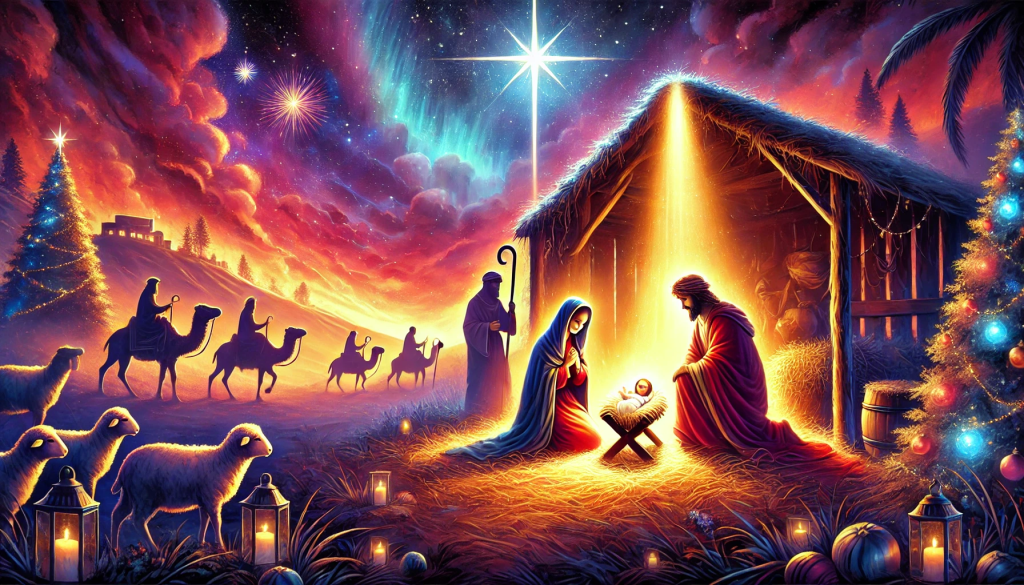
Christmas: The Triumph of the Almighty God Is Not Exactly As We Might Have Imagined It

The hope we reflect on in wonderment at this time of year

The words of the ancient prophet, Isaiah, are spoken often this time of year:

“For to us a child is born, to us a son is given, and the government will be on his shoulders. And he will be called Wonderful Counselor, Mighty God, Everlasting Father, Prince of Peace. Of the greatness of his government and peace there will be no end. He will reign on David’s throne and over his kingdom, establishing and upholding it with justice and righteousness from that time on and forever. The zeal of the Lord Almighty will accomplish this.”

Isaiah 9:6-7 NIV

These words were spoken many centuries before one, Jesus of Nazareth, was born in Bethlehem while his parents were in town for a census. This passage is full of triumph: “Mighty God”, an “Everlasting Father”, and “Prince of Peace”. “The government will be on his shoulders,” and he will “reign on David’s throne” – the “Lord Almighty!”

These words foretell of a mighty, conquering, benevolent God. (Benevolent after the conquering bit, of course). Human beings have always venerated and celebrated strength, and what could be more compelling to us than a conquering king (provided he is benevolent also!)
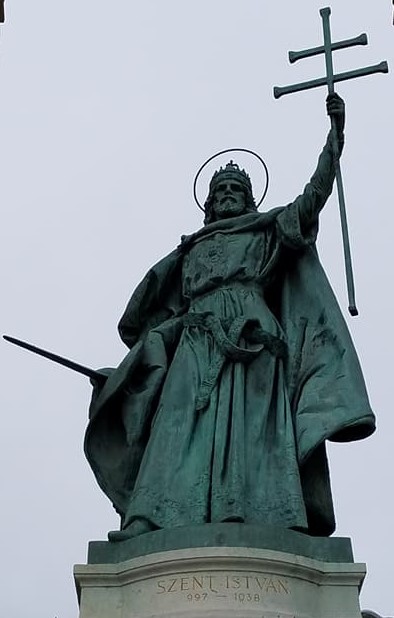
This is the way people view God and the world. This view of God inspired the crusades. It inspired many kings and nobleman through the ages like Stephen I, Szent István király. Born in 975, Stephen took the throne on December 25, 1000, and he became the last “grand prince of the Hungarians”, and he is the first King of Hungary.


I took the photos I have reproduced here when I was visiting my daughter in Hungary this time of year 6 years ago. The prominence of Steven and other kings in Hungarian lore is evident in the statuary around Budapest and in the stately basilica named after him that lies near the Danube in the center of the City.
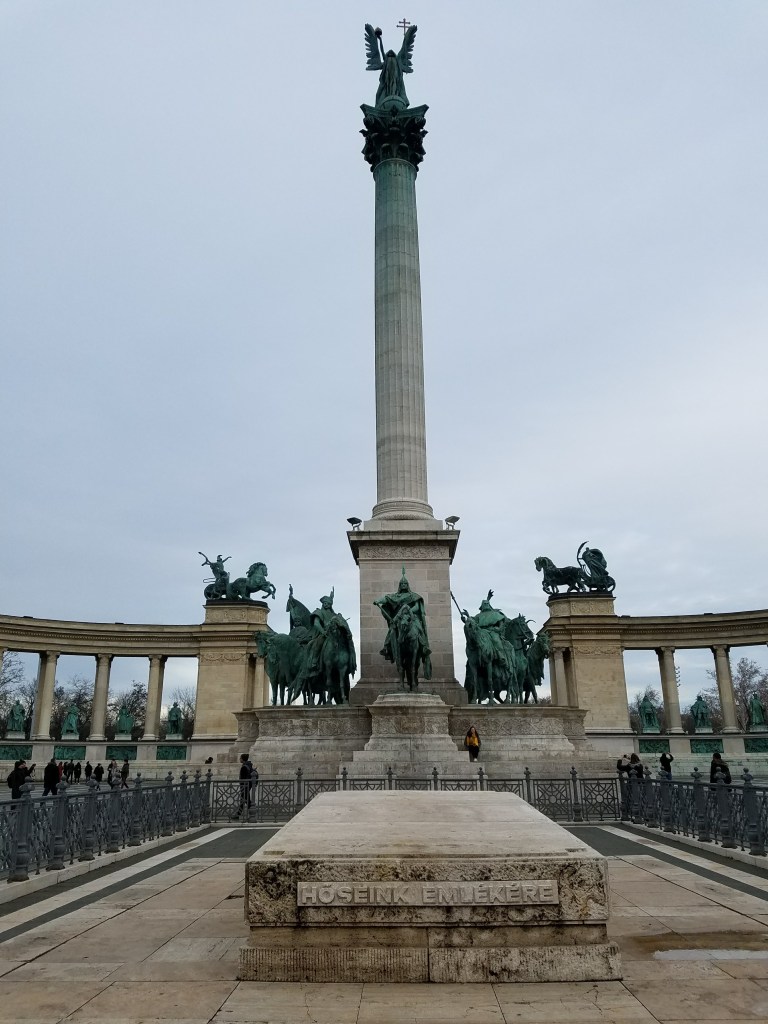

Stephen succeeded his father as a grand prince of the Hungarians, but he had to fight for the throne against his own extended family. He fought many wars against surrounding tribes and chieftains, including his own uncle. He “converted his uncle’s ‘country to the Christian faith by force’ after its conquest,” and he “encouraged” the spread of Christianity “by meting out severe punishments for ignoring Christian customs.” (See Wikipedia)

Many modern minded people with sensibilities trained over the last generation likely squirm (or fume) over stories like Stephen’s, as children are taught in grammar school to recoil at the “imperialism” of our Western/Christian forebears. The so-called “Christian nationalists” among us likely count Stephen a hero of the faith.

Indeed, Hungarians today proudly celebrate Saint Stephen as a national hero, but this celebration seems more focused on nationalistic pride than the spread of Christian faith – if faith can be commandeered by force. Stephen is hailed for unifying the tribal regions around him under his kingship, giving birth to the nation of Hungary.

That the nation was unified under a Christian flag seems to be more of a national identity than a statement of faith. While I was visiting, I observed that Hungarians did not appear, as a whole, to be a people of devout faith.

A 2017 poll reveals that Hungarians, indeed, are not very religious. While about 76% of Hungarians self-identified as “Christian”, only about 8% of Hungarians attended church services on a weekly basis, “placing Hungary among the countries with the lowest church attendance in Europe” (according to my very cursory research using Chat GPT).

While the notion of a king conquering in the name of Christ may be a source of national pride for some, it makes other people feel uneasy. It makes me uneasy.

We celebrate at Christmastime the triumphal prophecies foretold by Isaiah of the Lord Almighty taking the government on his shoulders with zeal and reigning on David’s throne. Yet, this imagery contrasts with the images of the story of the birth of Jesus, born of a humble virgin in a lowly manger because they had no influence to make room for themselves anywhere else.

As this story goes, God incarnate was born in poverty, on the edge of the Roman empire, in the humblest of circumstances, to parents who were not even married. God came into the world as an infant, weak and vulnerable.

God is human form became a refugee when his parents fled to Egypt to avoid King Herod’s decree to kill the male babies in the region of Galilee. They returned after Herod’s death but moved to the more remote and neglected area of Nazareth where Jesus grew up in almost total anonymity apart from the small community of people who knew him.

These realities stand in stark contrast to the conquering and reigning king imagery of Isaiah and the images of kingly might we celebrate in people like Saint Stephen. We consider these paradoxical images this Christmas day, December 25, 2024, as we recall the birth of our Savior and Lord, Jesus, and what it all means for us.

Continue reading “Christmas: The Triumph of the Almighty God Is Not Exactly As We Might Have Imagined It”

Comments on Why God Became Incarnate and Died for Our Sins

Daniel Mann does a good job of explaining Why Christ, as God Incarnate, Had to Die for Our Sins. In reading his explanation, my mind goes to statements like God’s “transcendent love” and “total abhorrence for sin”, God’s “righteousness” and “divine forbearance” for sin, and the price that had to be paid “to satisfy God’s righteous character”.

Daniel describes his own reaction to these concepts formerly, as a non-Christian. He felt God was a “deceiving sadist” until one day he realized that Jesus was God incarnate, that God did not merely sacrifice a created being – God sacrificed Himself in human form!


Indeed, that is the central point of Christian belief, which is described beautifully and poignantly in Paul’s letter to the Philippians (2:5-8):

In your relationships with one another, have the same mindset as Christ Jesus:

Who, being in very nature [form of] God,
    did not consider equality with God something to be used to his own advantage;
rather, he made himself nothing
    by taking the very nature [form] of a servant,
    being made in human likeness.
And being found in appearance as a man,
    he humbled himself
    by becoming obedient to death—
        even death on a cross!

These things would be small consolation, also, if not for the victory on the other side of the cross (Phil. 2:9-11)

Therefore God exalted him to the highest place
    and gave him the name that is above every name,
that at the name of Jesus every knee should bow,
    in heaven and on earth and under the earth,
and every tongue acknowledge that Jesus Christ is Lord,
    to the glory of God the Father.

That Jesus was fully man and fully God incarnated into a man is key to the understanding of Christianity. That God is three “persons” in one is also key, as it provides some explanation how God can incarnate Himself into the form of a man and die (in human flesh), though God remains self-existent and eternal, the Creator (and not a created being).

Not that there is no mystery in this. I concede this is hard for creatures who are limited dimensionally to wrap our heads around these ideas.

Finally, it explains how (and why) death to Jesus in the flesh had no power over him. As God incarnate, death “could not hold him”. (Acts 2:24)

But, I am not writing to clarify these aspects of Christian doctrine. I want to focus on Daniel Mann’s personal revelation that Jesus was God incarnate, and his death was voluntary – God sacrificing Himself, and not God sacrificing some created being.

This realization made all the difference for him. When he really understood this distinction, he began to see the love of God that was demonstrated in that act of self-sacrifice – something God did not have to to, but He did it for us because He loves us.

Other people, I know, are not convinced. Indeed, if a person understands Jesus to be human only, and not God incarnate, the story makes no sense.

Another stumbling block is God’s “abhorrence for sin” and the need to satiate a “righteous” God. These Christian concepts are foreign territory for many people. Why, if God is so loving, does He demand sacrifices for sin?

Continue reading “Comments on Why God Became Incarnate and Died for Our Sins”

The Dilemma of God Demanding Justice from Beings Incapable of Meeting God’s Standard

There is one critique of the Christian notion of sin and the justice of God that is troubling on its face. That key critique for anyone who claims that God demands justice for sin is that God is seemingly unjust to require justice of beings who can’t measure up.

Many modern people bristle at the Christian idea of sin, and they bristle even more at the idea that God would punish sinners. Frankly, I think many modern people simply don’t understand what sin is and who God is.

But, that aside, there is one critique of the Christian notion of sin and the justice of God that is troubling on its face. That key critique for anyone who claims that God demands justice for sin is that God is seemingly unjust to require justice of beings who can’t measure up.

Alongside the notion that the God of the Bible and demands judgment for not measuring up to God’s just standard is the notion that all people are sinners who don’t measure up. In fact, the New Testament is fairly read to say that people are incapable of living up to God’s standard.

The doctrine of original sin says that we are all corrupted because the sin of Adam and Eve has been passed down generation after generation. Even if we don’t believe in the doctrine of original sin, however, the Bible is clear from the Old Testament to the New Testament that human beings don’t measure up to God’s standard:


They have all turned aside; together they have become corrupt;
    there is none who does good,
    not even one.

Psalm 14:3


They have all fallen away;
    together they have become corrupt;
there is none who does good,
    not even one.

Isaiah 53:5


as it is written:

“None is righteous, no, not one;
   .
 All have turned aside; together they have become worthless;
    no one does good,
    not even one.”

Romans 1:10-12


Jesus said, “No one is good except God alone.” (Mark 10:18 (NIV)) Yet, he says, “Be perfect … as your heavenly Father is perfect?” (Matthew 5:48)

This is the dilemma: How can we be perfect?! “To err is human” the bard once said, and so it seems we are imperfect by our very nature.

Many people reject the idea that God can be just and demand justice from people incapable of measuring up to the standards God’s justice demands. They say it would be unjust for God to demand justice from beings who have no ability to act other than they do, and so fail to meet God’s standards.

God seems to be acting unfairly to demand that we meet His standards when we are 1) created beings, 2) born into sin, and 3) incapable of living up to the perfection God requires.

Other questions tumble after these thoughts: Why didn’t God create us perfect? If we are born sinful, how can God blame us for being sinful? If we are incapable of being perfect, how can God punish us for our imperfection?

Continue reading “The Dilemma of God Demanding Justice from Beings Incapable of Meeting God’s Standard”

How Did Jesus, the Exact Representation of God, Describe Himself and Demonstrate Who He Is?

I find myself contemplating often the words Jesus used to describe his purpose. Jesus gave us description immediately before he launched into his public ministry. This is the way it went down, and this is what he said:

“And he came to Nazareth, where he had been brought up. And as was his custom, he went to the synagogue on the Sabbath day, and he stood up to read. And the scroll of the prophet Isaiah was given to him. He unrolled the scroll and found the place where it was written,

“’The Spirit of the Lord is upon me,
    because he has anointed me
    to proclaim good news to the poor.
He has sent me to proclaim liberty to the captives
    and recovering of sight to the blind,
    to set at liberty those who are oppressed,
to proclaim the year of the Lord’s favor.’

‘And he rolled up the scroll and gave it back to the attendant and sat down. And the eyes of all in the synagogue were fixed on him. And he began to say to them, ‘Today this Scripture has been fulfilled in your hearing.’”

Luke 4:16-21

The famous announcement of his purpose came after John the Baptist piqued the interest of the local people, proclaiming, “Prepare the way for the Lord”. It came after John the Baptist challenged people to repent and be baptized.

The announcement took place after Jesus spent 40 days out in the wilderness being tempted by the devil. Jesus had not yet begun his “public ministry”, when he stood up to read in his home town synagogue from the words of Isaiah, the Prophet – words spoken about Jesus over 500 years before that day.

This was the announcement of what Jesus came to do. The Spirit was on him to proclaim good news to the poor, to proclaim liberty to the captives and recovery of sight to the blind, to set at liberty those who are oppressed, and to proclaim the year of our Lord’s favor.

It wasn’t just a prophecy to be fulfilled. It was the very purpose for which God emptied Himself and became a man incarnate. God came to reveal Himself in the material world, to reveal His very heart and His love for mankind.

This was the message that He was trying to convey over the many centuries through the one people who inclined an ear toward Him. But, they didn’t completely get it. They wandered and strayed in their devotion to God, and they mistook His law for nothing but a code of conduct that might earn them the favor of God.

They didn’t understand the relationship He desired to form with them. They didn’t understand His love for them or the singularity of His own devotion to them and the purposes He established for them before the foundation of the heavens and the earth.

They didn’t even recognize Him when He came to them, albeit emptied of all that would not fit into human form (Phil. 2:5-7) They didn’t recognize Him stripped of all His power, holiness and glory.

He did not come with pomp and circumstance. He came humbly in the form of a man just like them. His coming was barely a whisper. is arrival went all but unnoticed. Born in a humble setting to poor, common parents, he grew up in an area of Judea that was off the beaten path and not a little “backwards”.

His first 30 years of life were so unremarkable we know next to nothing about them. The first public stir that is recorded is the day he stood up and read from the Isaiah scroll, sat down, and announced, “Today this Scripture has been fulfilled in your hearing.”

People were so unready for anything extraordinary from Jesus that they marveled and asked each other, “Isn’t this Joseph’s son?” (Luke 4:22) Then, he seemed to provoke them (Luke 4:23-28), and they burned with anger at his audacity. (Luke 4:28)

It was an inauspicious start to his “public ministry”. He bombed in his hometown synagogue.

What he said of himself, however, is preserved for eternity. It is the key to understanding the heart and character of God revealed through Jesus, “the exact representation of His nature”. (Heb. 1:3) What Jesus said that day and what Jesus did is the best demonstration of God’s heart and character that we, as finite beings, might understand.

Continue reading “How Did Jesus, the Exact Representation of God, Describe Himself and Demonstrate Who He Is?”

On the Willows There

One of the most hauntingly beautiful songs ever written and recorded is On the Willows from Godpsell, the musical. Take a moment to listen to the song and the words.

The song lyrics are found in Psalm 137 from the Hebrew Bible and the Christian Old Testament:

“By the waters of Babylon, there we sat down and wept, when we remembered Zion. On the willows there we hung up our lyres. For there our captors required of us songs, and our tormentors, mirth, saying, ‘Sing us one of the songs of Zion!’ How shall we sing the Lord’s song in a foreign land?”

Psalm 137:1‭-‬4 ESV

The Psalm is a communal lament of the exiled people of Abraham’s ancestry in Babylon yearning for Jerusalem in their homeland. The rivers of Babylon are the Tigris and the Euphrates and their tributaries.

As I meditate on these things, I find it ironic that the region of the Tigris and Euphrates are thought to have been the location of the Garden of Eden. When the Psalm was written, the area was governed by Nebuchadnezzar II, the most powerful ruler in the known world at the time, who had sieged Jerusalem, captured its inhabitants, and driven them to Babylon.

The song captures beautifully the sorrow and longing of a people who had recently lost their homes and all that was familiar to them. Not just their homes, but their way of life, their safety and security, their community, their culture, their ancestral roots, and their spiritual sanctuary – the Temple. Everything they valued most highly was lost in the exile, even their purpose and reason for living.

Jerusalem was the gem of the land God had promised to their ancient father, Abraham. Abraham had wandered from Ur, not far from Babylon, at the direction of God over one thousand miles to a “land God would show him”, a land God promised for his descendants.

Several generations after Abraham, his descendants were forced by famine to find refuge in Egypt where they were initially welcomed with open arms. They were eventually enslaved there for the ambitions of the Egyptian Pharaohs. They labored there, captives in slavery, for approximately 400 years.

Through a miraculous series of events, Moses led them out of Egypt and out of the grasp of their captors. They wandered 40 years through desert regions between the land of their former captivity and the land God promised many, many generations earlier to Abraham. God lead them by cloud during the day and by fire at night.

When they finally arrived in the land God promised so many years earlier, a land flowing with milk and honey, it was a homecoming of epic proportions. They lived and flourished there for many generations and centuries.

They were able to fend off the surrounding threats and to establish an Eden of sorts for themselves. Their safety and security that allowed them to construct a grand Temple where they could commune intimately with their God who rescued them out of slavery and delivered them to the promised land.

But all was not well in this Eden. Much like the first Eden, choices were made that ran counter to the designs and intentions for their wellbeing.

Through the Prophets, we learn that they became complacent in their comfort and abundance. They forgot the God who rescued them and delivered them into the land and gave themselves to idols. They stopped doing justice among one another, and they became as corrupt, wicked and evil as the nations that were driven out of the land before them.

This cycle of Edenic living, exile, longing, deliverance, redemption, Edenic living, exile and longing is the story of humankind. The exile is long and the yearning for Eden is great.

Continue reading “On the Willows There”