A very good friend and sister in Christ recently gave a devotional presentation to a faith-based non-profit Board of which I am a member. She reflected on her experience of being a minority as a Christian growing up in India, where less than two percent (2%) of the population is “Christian” (including Catholics, Jehovah Witnesses, and Mormons).
Her poignant story of personal struggle with minority status and finding blessing in it, hits home with me. I have never felt like a minority in the visceral way that she experienced it. The blessing she found through Scripture in embracing her minority status is a lesson for all believers.
Being a Christian in a Non-Christian World
My friend struggled with her minority status as a Christian in India. She was ridiculed, teased, and looked down upon. By God’s grace, she felt her divine calling as a child of God, but her identity as a Christian came with consequences.
The consequences proved even more difficult for her sister, who applied to medical school. The admissions officer said she must recant her faith to be approved for assignment to any med school. She refused, and she gave up her dream of becoming a physician. Minority status in a majority world as consequences.
Being a Foreigner in the United States
When she emigrated to the United States she felt the joy of being a part of the Christian majority. Over time, however, the struggle with minority status began to resurface again. She stood out because of her ethnicity, accent, and cultural differences. She realized, “I am a minority within my Christian majority realm.”
This was a very personal struggle for her because of her childhood experience in India. She thought that moving to American where Christians are in the majority would be different. Instead, she felt the sting of minority status. Though she was a Christian in an ostensibly Christian country, she was still an outsider and a foreigner because of her nationality, ethnicity, and cultural differences.
Being a Foreigner in the World
She shared that God met her in the struggle and confronted her with His Word. What she learned through this process was sobering for her, and it is a lesson for those of us who have always lived in majority status in a majority Christian nation.
She began to realize what a privilege it is to be a minority because we are called as believers out of the world where wide is the path that leads to destruction. We are set apart by God from the world, which means we are called to minority status in the world.
Narrow is the path that leads to life. Minority status is the Christian experience.
The Privilege of Minority Status
As she focused on these things God was showing her in His Word, she became grateful for her experience as a Christian in a majority non-Christian country. This experience gave her perspective that American Christians lack.
The first episode of the Uncommon Ground podcast with Justin Brierley is titled “What is Behind the Poetry of Reality?” The podcast features a conversation with Richard Dawkins and the former Archbishop of Canterbury, Rowan Williams. Dawkins of New Atheist fame has a purely materialist view of reality – maintaining that reality is comprised only of materials things that operate on their own without the aid of God or any immaterial thing.
The discussion is amicable and informative, if not predictable. Rowan Williams accepts the evolutionary paradigm, but believes in God – an immaterial, personal creator of the universe. They seemed to agree on the science. The only difference is that Williams believes there is a God behind the science and the universe.
When Brierley asked Williams to summarize Richard Dawkins’ view of reality, Dawkins graciously conceded, “Rowan… understands so well that he can summarize what I think better than I can.”
Dawkins should be given credit for reading Williams’ recent book that was the backdrop for the discussion, but Dawkins admitted to being “baffled” by it.
Dawkins was unable to provide a cogent summary of Williams’ view of reality. He succeeded only in criticizing Rowan’s view, and Dawkins conceded, “I think Rowan understands where I’m coming from much better than I understand where he’s coming from.”
This reminds me of C.S. Lewis, who says that the Christian worldview can take in science into account, but a view of the world limited to the constructs of science cannot take into account Christianity. One is robust enough to hold the other, but the other is not sufficiently robust to do the same. (I have provided the whole quotation in its context below.)
I will admit that the robustness of Christianity to be able to make sense of science does not necessarily make it true. Conversely, the limited scope of science that is unable to account for Christianity does not necessarily make it untrue. If reality truly consists of nothing but matter and natural processes, then the limitations of science are the limitations of reality itself.
I think that reality is not sufficiently explained by science, which is limited to natural explanations. I am also fascinated with Dawkins’ attempt to explain his own worldview as follows:
“I see the world as a very complex thing, like a clock or like a car or like a computer, and, and in the case of a clock or a computer or a car, I know how it’s made. It’s made by engineers with drawing boards and they… put together the parts and, and those parts all work together. [T]he equivalent of the engineer in the world of nature is evolution by natural selection.”
I am an English literature major and an attorney. In both disciplines, the ability to draw connections, and distinctions, and juxtapositions between and among word meanings and concepts is essential. Attorneys are professionals in comparing and contrasting facts and circumstances to be to argue (consistent with clients’ interests) that laws either apply in the same way or do not apply in the same way to similar but different sets of facts and circumstances. Perhaps, this why I noticed that Richard Dawkins made a category error. Or did he?
I am writing today about the Parable of the Good Samaritan and the Parable of the Sheep and the Goats in light of the Old Testament passage that introduces what Jesus called the second greatest commandment: love your neighbor as yourself. (Leviticus 19:18) If you have read anything I have written lately, you know that I have have been meditating on this theme.
How People Misinterpreted “Neighbor”
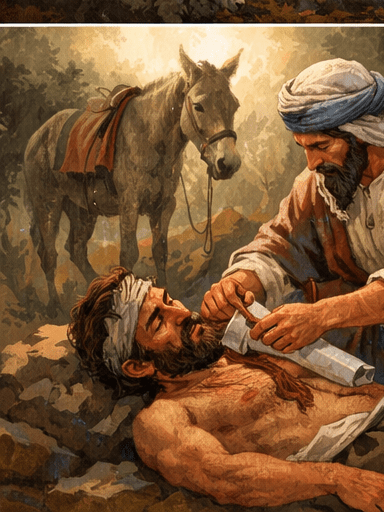
When Jesus encountered a First Century expert in the Law, the issue became: Who is my neighbor? The Parable of the Good Samaritan was the response from Jesus. The backstory to the Parable of the Good Samaritan reveals how First Century Jews misread Leviticus 19:18 to limit who they considered neighbors. It reads as follows:
“Do not seek revenge or bear a grudge against anyone among your people, but love your neighbor as yourself. I am the Lord.“
Just 16 verses later (in Leviticus 19:34), Moses hints at a broader, more expansive meaning to the rule to “love your neighbor as yourself”:
“The foreigner residing among you must be treated as your native-born. Love them as yourself, for you were foreigners in Egypt. I am the LORD your God.”
Distinguishing Among Jews and Gentiles
In the time of Jesus, Jews distinguished between Abraham’s descendants and everyone else (Gentiles). They limited neighbors they were instructed to love to those from among their people because they interpreted Leviticus 19:34 in light of Leviticus 19:18. They interpreted “from among the people” to include descendants of Abraham, and they likely included those foreigners who lived among them and observed their religious practices, but they did not go further.
The Hebrew word translated “foreigner” in verse 34 is ger. It generally means “sojourner, stranger, foreigner, alien,” and it literally means “a guest.” (See Biblehub) Ger is derivative of guwr, which means “to sojourn, dwell, reside, live as a foreigner,” with connotations of being a guest, shrinking & fearing, and being afraid.
According to the topical Lexicon, gurw centers on “the act of taking up residence as a non-native, a ‘sojourning’ that is self-conscious of impermanence and dependence on the goodwill of the host community.” The sense of this word as scholars have come to understand it is of foreign guests who dwell permanently among the people and conform to the requitements of the Mosaic Law. I believe First Century Jews would have had a similar understanding of the concept of neighbor that defined who they were to love.
By the First Century, there were two categories of people: Jews and Gentiles. We know from historical records that some Gentiles lived harmoniously with Jews and more or less subscribed to Jewish religious customs as they were allowed to engage with them.
The Samaritans as Others
There were varying degrees to which Gentiles could be incorporated into Jewish community. Some Gentiles were circumcised, converted to Judaism, and were fully integrated into Jewish community. The largest group of Gentiles who lived among the Jewish community, however, were the “God-fearers”. They were welcome in the temple and synagogue. They participated in prayer and instruction. They ethically aligned with Jewish community, but they were not circumcised, not bound to the full Torah, and were not considered covenant members of the Jewish community.
These Gentiles who believed in God as the Jews did, who worshipped God as the Jews did, and who lived in harmony with biblical, ethical requirements were accepted in Jewish community. They more or less represented the ger in Leviticus 19. They, like the ger, were considered neighbors who must be loved.
The question posed by the expert in the Law in Luke 10 reveals that the scope of who is a neighbor was limited, but with some sense of uncertainty, in the First Century. That uncertainty was settled by Jesus in sharing the Parable of the Good Samaritan.
Samaritans and Jews Opposed Each Other
Samaritans were ethnically Hebrew. They descended from the northern tribes of Israel. They were descendants of Abraham, but they were deviant, ritually impure, and estranged from First Century Jews.
They were people who remained in the land after the exile to Babylon and integrated with the conquering Assyrians. They opposed the return of the exiles who rebuilt the Temple. They rejected Temple worship. They rejected the Levitical priesthood returning from Babylon, and they had their own religious practices.
The hostility between the Jews and the Samaritans was mutual. They were closely related by kinship, but they disagreed sharply over theology, religious practice, and heritage. They were estranged, avoided each other avoidance, and clashed (sometimes violently).
Insiders and Outsiders
Though the Jews would accept the Gentile converts and God-fearing Gentiles into Jewish community, Samaritans and other Gentiles were excluded. They were the people the legal expert’s question was about: Who is my neighbor? They were not from “among the people.”
Many people in the Jewish community, like the expert in the law, had a theology that excluded Samaritans and most Gentiles from the definition of “neighbor”. Their mistaken interpretation and bad theology created insiders and outsiders.
Jesus Cuts Against Our Insider Logic
Jesus reveals how God’s Word cuts against our insider logic. Jesus interprets Scripture and compels us to view our neighbors (whom we should love as ourselves) Expansively. Our neighbors include people who are not like us, people who are heretical and (therefore) threatening to us and people in opposition to us. Outsiders.
Jesus shockingly made a Samaritan the hero in the Parable. Most Jews would not have used “good” in the same sentence as a Samaritan. Samaritans were outsiders, people in opposition to the Jews, heretics, and estranged. Samaritans were not seen as neighbors, but Jesus disavowed them of their bad theology.
We know this, but we are not immune from our own interpretive shortcomings and bad theology. We have less excuse than the Jews to hold such a de minimis view of neighborliness and love (because of the clear words of Jesus), but we can fall into the same interpretive trap.
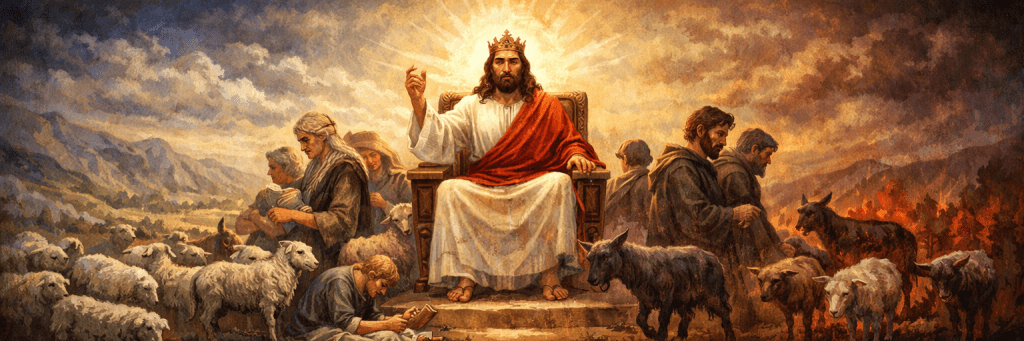
In that context, consider the Parable of the Sheep and the Goats.
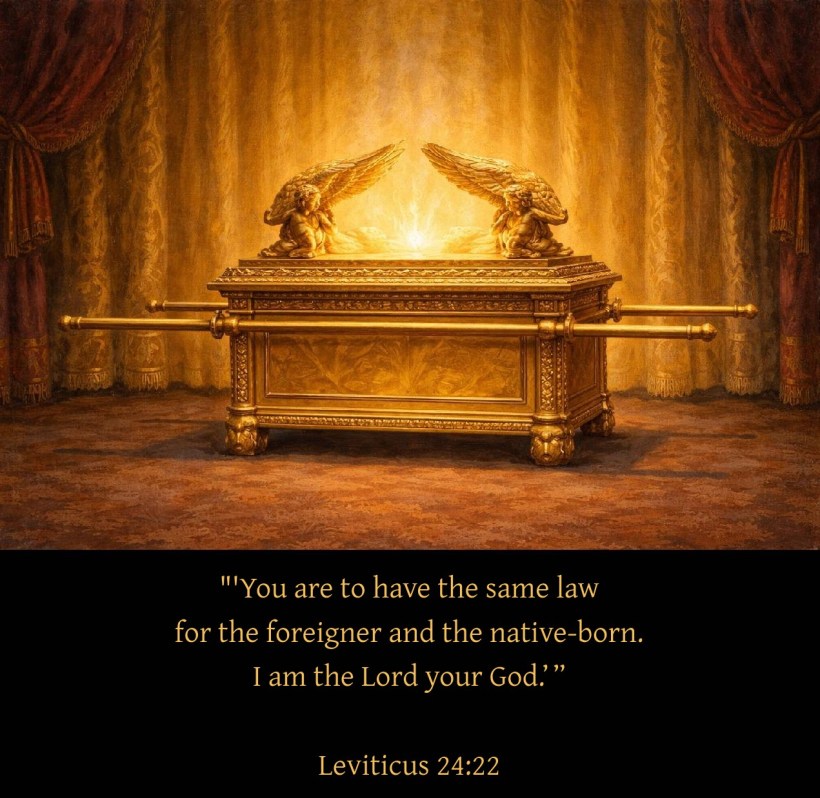
“You are to have the same law for the foreigner and the native-born.”
Leviticus 24:22
That single line, given by the Lord to Moses, is often read narrowly: foreigners are subject to the same penalties as citizens. True—but incomplete. Law is not merely punitive; it is protective. If the same law binds the foreigner, the same law also shields the foreigner. Justice, in the biblical sense, is reciprocal.
The rules that apply to foreigners are embedded in the sacred Law God gave to Moses for His people. The Law even applied specific protections to foreigners:
Leviticus 19:9–10 — Leave gleanings for the poor and the foreigner.
Leviticus 23:22 — Harvest leftovers belong to the foreigner and poor.
Deuteronomy 24:19–21 — Leave grain, olives, and grapes for foreigners.
Deuteronomy 26:12 — Tithes every third year support foreigners.
The Reciprocity Built into God’s Law
Leviticus develops this principle further. In Leviticus 25, the Lord instructs Israel that if a native-born Israelite loses his land and falls into poverty, he is to be treated as a foreigner among them. Why? Because the law already required Israel to provide for foreigners in their midst. By placing impoverished Israelites into the same category as foreigners, God establishes a profound reciprocity:
The protections of the law given to the Israelites apply to the foreigners living among them. The protections given to outsiders become the safety net for insiders when they fall.
This is not accidental. It reveals something essential about God’s character: His justice is inseparable from His mercy.
Other passages reinforce the pattern of concern for foreigners:
Leviticus 19:34 — “The foreigner residing among you must be treated as your native-born. Love them as yourself.”
Deuteronomy 1:16–17 — Judges must hear cases fairly, whether involving Israelites or foreigners.
Deuteronomy 10:18–19 — God “loves the foreigner residing among you, giving them food and clothing.”
Deuteronomy 24:17 — Do not deprive foreigners of justice.
God’s intentions are reinforced over and over:
Exodus 22:21 — “Do not mistreat or oppress a foreigner, for you were foreigners in Egypt.”
Exodus 23:9 — Do not oppress a foreigner; you know their experience
Leviticus 19:33–34 — Do not mistreat; love them as yourself
Deuteronomy 10:19 — Love the foreigner, for you were foreigners
Israel’s memory of its own foreignness was meant to inform Israel’s identity and to shape its ethics. Their past vulnerability became the foundation of their present compassion. They were never to forget who they were and to treat people as they would want to be treated.
Set Apart—But Not Set Against
God was forming a people set apart—a light to the nations (Isaiah 49:6). Yet their distinctiveness was never meant to become isolation or superiority. From the beginning, God’s promise to Abraham was expansive:
“All peoples on earth will be blessed through you.”
Genesis 12:3
Election was never exclusion. The chosen people existed for the sake of the unchosen. We are the benefactors of God’s expansive purpose today.
Jubilee and Land Ownership
Leviticus 25 also introduces the Year of Jubilee – a system of Law that reinforces the design and purpose of God. Under this system, land could not be owned permanently:
“The land must not be sold permanently, because the land is mine and you reside in my land as foreigners and strangers.”
Leviticus 25:23
Even in the Promised Land, Israel was reminded: you are tenants, not owners.
This theme echoes throughout Scripture. Humanity has lived in exile since Eden. Abraham lived in tents (Hebrews 11:9–10), because he was waiting for a city “whose architect and builder is God.” The saints of old lived as “foreigners and strangers on earth.” (Hebrews 11:13) This is the hallmark of God’s people – their ingrained identity.
The New Testament continues the theme:
Philippians 3:20 — “Our citizenship is in heaven.”
1 Peter 2:11 — “I urge you, as foreigners and exiles…”
The Apostle John saw in vivid detail what Abraham and the saints of old only saw from afar:
“Then I saw ‘a new heaven and a new earth,’ for the first heaven and the first earth had passed away, and there was no longer any sea. I saw the Holy City, the new Jerusalem, coming down out of heaven from God.”
Revelation 21:1-2
Our true home is the New Jerusalem – where Jesus has prepared rooms for all of his people. The Kingdom of God is not of this world. The biblical story reframes our identity: no matter where we are born, God’s people live as resident aliens awaiting a better country and a City the architect and builder of which is God.
The American Tension
The United States is not ancient Israel, and the Mosaic Law is not our civil code. Yet the heart of God revealed in Scripture has not changed. The law written on stone has given way to the law written on hearts (Jeremiah 31:33), but its moral trajectory remains.
I am reminded today of the backstory to the Parable of the Good Samaritan. Second Temple Jews interpreted the Law about loving your neighbor as yourself to mean they should love their Hebrew neighbors as themselves. They didn’t extend the law of loving their neighbors to the Gentiles because of Leviticus 19:18:
“Do not seek revenge or bear a grudge against anyone among your people, but love your neighbor as yourself.”
They read the qualifying language in that verse – among your people – as a limit to the requirement to love your neighbor as yourself. Just 16 verse slater (in Leviticus 19:33-34), the principle of loving your neighbor is expanded:
“The foreigner residing among you must be treated as your native-born. Love them as yourself, for you were foreigners in Egypt. I am the Lord your God.”
Foreigners are not expressly called neighbors in verse 34, but Israelites were commanded to “love them as yourself” all the same.
It’s easy to see how Jews arrived at their conclusions. Leviticus 19:18 is the first expression of the rule, so they might have assumed it should be given precedence. Foreigners were not called neighbors in verse 34, so there is a distinction to be made. This is how we use Bible verses as proof texts and sneak in our outside assumptions and biases to guide us to an interpretation that makes sense to us – but is wholly inconsistent with the meaning God intended.
How do we know how God intended it? Jesus
When the expert in the law asked Jesus what he must do to inherit eternal life, Jesus turned the table on him and asked, what does the law say. Love God and love your neighbor was the answer, but the expert pressed Jesus to ask, “Who is my neighbor?” Jesus responded with the Parable of the Good Samaritan that provides us an expanded interpretation of who is my neighbor. (Luke 10:25-37) In case we might still question that interpretation, Jesus removes all doubt in Matthew 5:43-44:
“You have heard that it was said, ‘Love your neighbor and hate your enemy.’ But I tell you, love your enemies….”
We need to do careful biblical exegesis with integrity to avoid proof texting and sneaking in assumptions that are motivated by our natural biases. We need to let Scripture, itself, provide interpretive guidance; we need to let the words of Jesus (the Word made flesh) be an interpretative filter; and we need to let the Spirit guide us. “The letter of the Law kills, but the Spirit gives life.”
People are naturally provincial and tribal. We are naturally inclined and biased in that way. Paul calls our natural inclinations “the flesh,” and he warns us to guard against them. We might call the flesh our “insider logic,” and the Bible cuts against that insider logic at every turn.
Our natural inclinations are to take care of ourselves and our kind first. Our natural inclinations are to view others with suspicion and distrust. Our natural inclinations are to seize and hold onto what I can get for myself and leave others to fend for themselves. Our natural inclinations encourage us to adopt a zero sum gained attitude.
When Jesus tells us to take up our crosses and follow him, he is telling us to let go of our insider logic driven by our naturally biased assumptions. When he says the last shall be first, and the first shall be last, and the greatest among you shall be servants of all, he is cutting against our natural inclinations that inform our insider logic.
When Paul said, “[C]onsider your calling, brothers and sisters, that there were not many wise according to the flesh, not many mighty, not many noble,” he was cutting against our how we naturally see ourselves that feeds our insider logic. (1 Cor. 1:26) When Paul said, “There is neither Jew nor Gentile, neither slave nor free, nor is there male and female, for you are all one in Christ Jesus,” he is saying there are no insiders in the kingdom of God. (Gal. 3:8)
Our insider logic makes sense if we begin with our natural inclinations, but the Bible which is God’s revealed word and Jesus, the Word in the flesh, cut against the grain of our insider logic. When we seek first the kingdom of God, we check our privileges and other allegiances at the door.









 Navigating by Faith