“An angel of the Lord appeared to them, and the glory of the Lord shone around them, and they were terrified. But the angel said to them, ‘Do not be afraid. I bring you good news that will cause great joy for all the people. Today in the town of David a Savior has been born to you; he is the Messiah, the Lord.'”
Luke 2:9-11 NIV
This is a classic Christian text remembered at this time of year about the birth of the Christ child. The birth of Jesus in the town of David would have drawn the attention of 1st Century Hebrews who knew their Scripture. The significance of that understanding is preserved for us today by Luke, the traveling companion of Paul the Apostle.
Bethlehem was the birthplace and early home of King David, who is Israel’s most venerated and celebrated king. (1 Samuel 16:1, 1 Samuel 17:12). The prophet, Samuel, who presided over the coronation of David, foretold that God would establish from the lineage of David a kingdom that would last forever. (2 Samuel 7:12-16)
The prophet, Isaiah, lived about three centuries after David. Fourteen kings reigned between David and King Hezekiah, Isaiah’s contemporary. After a span of time longer than the United States of America has been a country, Isaiah repeated and expanded on what Samuel foretold:
“For to us a child is born, to us a son is given, and the government will be on his shoulders. And he will be called Wonderful Counselor, Mighty God, Everlasting Father, Prince of Peace. Of the greatness of his government and peace there will be no end. He will reign on David’s throne and over his kingdom, establishing and upholding it with justice and righteousness from that time on and forever.”
Isaiah 9:6-7
The prophet, Micah, a contemporary of Isaiah, He riffed on the same theme:
“But you, Bethlehem Ephrathah, though you are small among the clans of Judah, out of you will come for me one who will be ruler over Israel, whose origins are from of old, from ancient times.”
micah 5;2
According to the biblical chronology, these predictions of a coming kingdom and a king “whose origins are from ancient times” were declared 700-1000 years before the birth of Jesus. Those predictions were memorialized in the writings we identify with Samuel, Isaiah, Micah and others, and they were preserved for many centuries before Luke penned his own words tying them to the birth of Jesus of Nazareth, who was born in Bethlehem.
Though it was an ignoble birth by all accounts, we still remember back almost 2000 years now, recalling the prophecies declared from of old. We remember the birth of Jesus, lying in “humble estate” in a manger in the same space where the animals lived.
Hold that thought…. because today, I want to focus on the first half of the verse with which I introduced this article. The passage began with these words:
An angel of the Lord appeared to them, and the glory of the Lord shone around them, and they were terrified….
This may seem like a strange twist to the way I have started this article, but I will bring it back around. I think you will be glad to stick with me as I take seems like a left turn.
Most people know well the checkered history of Christianity on racism, especially in the United States. Much less is said (and therefore known) on the checkered history of science on racism in the west. One reason for that difference in our collective memories is the Enlightenment narrative: that science rescued the world from Christianity. More on that below.
I am not writing today to criticize Christianity less or science more for the moral failing of the history of racism in America. I am writing to bring some clarity where a popular narrative muddies the waters.
I think most people can agree that American (and British) Christianity has a racist past, but we have short (and biased) memories on this score. History is replete with dominant people groups subjecting other people groups to slavery, genocide, and other atrocities. It wasn’t just Americans, or western civilization, or Christians that perpetuated the evil of slavery.
That we even call those things atrocities today is a credit to Christianity. The story of Jesus voluntarily dying at the hands of the dominant power of his day, urging his followers to live lives of self-sacrifice, and looking after the benefit of others as he did changed everything.
It took three centuries, but the cross eventually became the symbol of this religious movement characterized by self-sacrificial love.
Prior to the death of Jesus, the cross was the ultimate symbol of the exultant might of the dominant state over its subjects. Those in power determined the values of the society they ruled, and those values were imposed with Draconian force on those who lived under that power. “Might makes right” was just the way the world was for most of history.
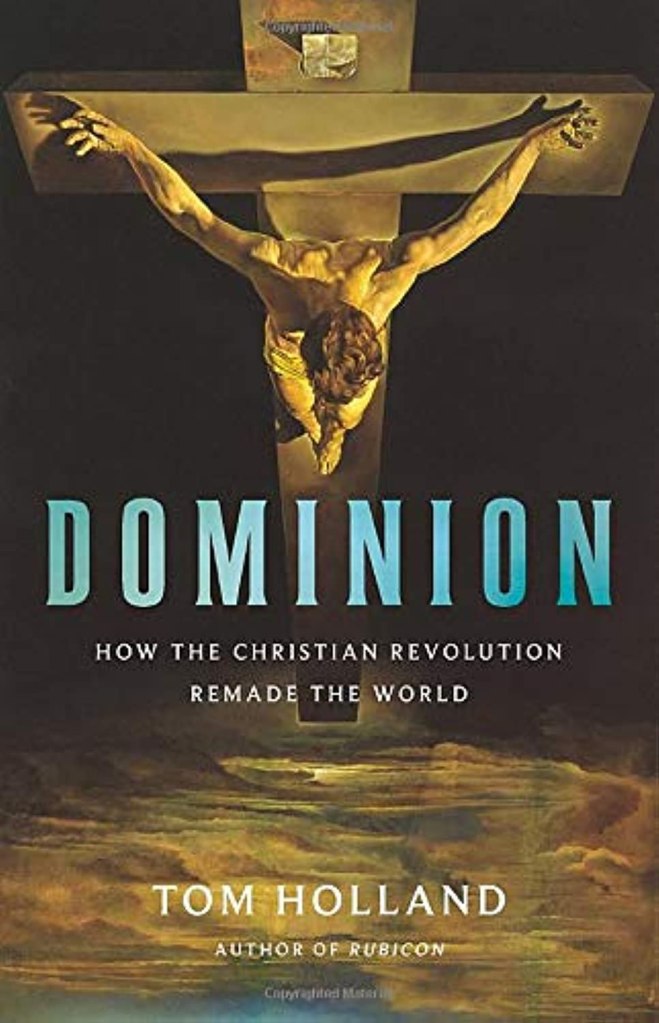
Tom Holland, in his seminal book, Dominion: How the Christian Revolution Remade the World, found the nexus for a radical change in the west in the crucifixion of Jesus. That event and the movement it inspired changed forever how the west (and now the rest of the world) views power and morality.
Tom Holland was an atheist When he did the research for this book. His area of expertise is Greco-Roman history. He was steeped in the brutish nature of the Roman world that championed power and elite, male dominance over all that was weak.
When he set out to trace his secular humanist values in western civilization, he knew there was some discontinuity between the Greco-Roman values he knew so well and his own, modern notions of basic human rights, so he was curious to locate the origin of that seismic shift.
His book, Dominion, traces our modern values from the roots where he found them in the history of western civilization. He found they go back to Jesus of Nazareth and the people who gave their lives to follow him.
The death of Jesus on the cross radically subverted the assumptions that ruled the world to that point. The Greco-Roman world that valued and honored power above all things gave way over time to the man who is claimed to be the Savior of the world who let himself be led like a lamb to his own slaughter. His life and message of self-sacrificial love became the bedrock for modern civil rights, human dignity, and the assumption that the powerful should shelter and care for the weak.
The criticism of Christians for racism and its worst manifestation – slavery – is deserved. Mostly because Christians “should’ve known better”. Of all people, Christians should have known better!
The water gets murky, though, in our modern memory because it has been influenced by a narrative that obscures the truth. The narrative that exposes the failing of Christianity often does so by directing attention away from the nonreligious world of reason and science, as if there is “nothing to see here.”
This view that rose to prominence during the Enlightenment is prevalent still today. It puts the full weight of condemnation for our failings on religion (and Christianity in particular). This is a false narrative, and, it obscures the truth and warps our perceptions that still persist.
There is nothing inherently wrong with science and reason. It is people who are flawed, and the flaws of people are not confined to science, or religion, or to any particular ideology or worldview. No ideology or worldview is immune.
People cite the great church father, Augustine, in defense of the view that the earth is only thousands (rather than billions) of years old. Indeed, I believe this was (more or less) Augustine’s view, based on the science and knowledge that was available to him in the 5th Century when he lived. Augustine believed the earth was young.
That isn’t the end of our understanding of Augustine, though. To understand Augustine, we might be aided by a basic review of the mythological, philosophical and scientific views that were prevalent in his world at the time.
According to my inquiry on Bing Co-Pilot, the mythology of the time didn’t attempt to date the age of the earth. Science (such as it was) also had not established a position. Philosophy, however, provided two opposing views.
The philosophical camps were led by Aristotle and Lucretius. Aristotle argued that the earth was eternal, and Lucretius argued that the earth formed relatively recently (based on a lack of records prior to the Trojan War). (The Trojan War dates to the 11th or 12th Century BCE.) Thus, the two competing views in Augustine’s day were 1) eternal earth or 2) young earth. There was no inkling in Augustine’s time that the earth might be very old, but not eternal.
Interestingly, Aristotle’s view of an eternal earth shifted to an eternal universe, and that view became the accepted scientific view that lasted well into the 20th Century. This was Einstein’s view when he developed the Theory of Relativity.
The past eternal view of the universe was only debunked and rejected by the scientific consensus in the second half of the 20th Century, and then only very reluctantly. (Even now, some scientists demonstrate a desire to find support for a past eternal universe, but support for that view seems to get thinner and thinner as time goes on.)
In the uncertain stew of mythology, philosophy, and science in the 5th Century, Augustine acknowledged that a literal, 6-day reading of the creation story in Genesis is not an irrational interpretation. That is basically how he put it.
He didn’t endorse that view, however. He thought the better view was that the “days” in Genesis 1 do not correspond to earthly (24 hour) days. Even in his exploration of a “literal” reading of Genesis, Augustine incorporated allegorical nuance.
Augustine did not believe that “literal” and “allegorical” meanings were mutually exclusive, and neither did most of the early church fathers. What Augustine and the early church fathers meant by the “literal” meaning of Scripture was what the people who wrote the original words literally meant and how the audience to whom they communicated understood them.
In this effort to understand what the writers meant, the early church fathers assumed that the original meanings included metaphor, symbolism, and literary devices. None of the early church fathers (that I am aware of) argued for the modern sense of strict literalism in the interpretation of Scripture.
Though most early Christians believed literally in the historicity of the biblical accounts (to use a modern term), they also accepted the richness of allegorical meaning in Scripture at the same time. In fact, the metaphorical meaning of Scripture was assumed to be the deeper, more spiritually significant meaning.
Augustine (along with Clement of Alexandria and Origen) ultimately rejected the calendar-day view of the Genesis creation story in favor of instantaneous creation with a kind of day/age view of the creation passage in Genesis. The great Jewish theologians, Philo and Hilary of Poitiers also took this view that God created the earth instantaneously.
We should recognize that the day-age view that Augustine and others preferred was probably not the consensus, but it also wasn’t considered heresy. The theology and the philosophy were unsettled, and science had not yet developed as we know it. The Church allowed for robust disagreement on the age of the earth, because it was not considered essential doctrine.
I should stop here, at the risk of pointing out something you already know, and look at the meaning of the Hebrew word, יוֹם (yom). This word is translated into the English word, day, in Genesis 1. As with most Hebrew words, yom has many nuanced meanings and applications, both literal and figurative. The various meanings include:
Day, as opposed to night
Day as a division of time
Day as defined by evening and morning
Day as in a time (like harvest)
Day as in an age or epoch of time
In addition to the definitions, most Hebrew words have both literal and figurative meanings and applications. Thus, Augustine’s position that the days in Genesis can be read to mean an “earthly” or “ordinary” day did not exclude the idea of applying them more figuratively. That duality is consistent with the way Hebrew words and Hebrew language works. This built-in literal/figurative duality of Hebrew words informed the thinking of the early church fathers.
Augustine is famous for preferring allegorical readings and applications of Scripture. In his early two-volume work on Genesis in which he took issue with the Manicheans, Augustine explored the position that the days in Genesis are seven epochs of redemptive history corresponding with seven stages of the Christian life. (See Did Augustine Read Genesis 1 Literally? by Gavin Ortlund citing De Genesis contra Manichaeos 1.23.35-1.25.43, in Augustine, On Genesis, 62-68.)
When Augustine set out to write a “literal” interpretation of Genesis, he didn’t mean what people today might think he meant. Even his “literal” reading of Scripture was not strictly literalist. It was an attempt to understand what the original writers (literally) meant and what their audience understood it to mean.
Science in St. Augustine’s day was not advanced enough to weigh in on the age of the earth, but Augustine was a strong proponent of understanding facts and objective truth. The science of his day, for instance, had settled the spherical shape and circumference of the earth. That the earth was round and even the size of the perimeter of the earth was well established and understood among academics since before the time of Christ. (It is purely a myth, for instance, that Columbus had to convince people the earth was not flat.) Augustine’s view of scientific knowledge and its relationship to Scripture is what I want to highlight here.
As an English Literature major in college, I have always been interested in literary devices. Symbolism, hyperbole, allegory, imagery, metaphor, analogy, and simile are some common literary devices, and we can add parable to the list.
Jesus often spoke in parables, but he also used other literary devices. The statement that it’s easier for a camel to go through the eye of a needle than for a rich man to enter the kingdom of God is both figurative and hyperbole.
According to the Oxford Dictionary online, “figurative” means “departing from a literal use of words; metaphorical.” Many literary devices are figurative, including all the ones I listed in the opening paragraph. Literary devices make our communication more interesting, and they communicate truth in a way that is more nuanced, robust, and multi-dimensional than literal statements.
Jesus often used literary devices to convey nuanced, spiritual meaning. For instance, in the Sermon on the Mount, Jesus encouraged a more nuanced (spiritual) understanding of sin when he said:
“You have heard that it was said, ‘You shall not commit adultery.’[Literal] But I tell you that anyone who looks at a woman lustfully has already committed adultery with her in his heart.” [Figurative]
Matthew 5:27-28
In fact, Jesus used figurative language often. To some people, he spoke only figuratively! (Matthew 13:34) (in parables) He even spoke figuratively to his disciples, and he seems to express frustration when they didn’t get it:
“When the disciples went to the other side, they forgot to take bread. ‘Watch out,’ Jesus said to them, ‘beware of the yeast of the Pharisees and Sadducees.’ So they began to discuss this among themselves, saying, ‘It is because we brought no bread. When Jesus learned of this, he said, ”You who have such little faith! Why are you arguing among yourselves about having no bread? Do you still not understand? Don’t you remember the five loaves for the five thousand, and how many baskets you took up? Or the seven loaves for the four thousand and how many baskets you took up? How could you not understand that I was not speaking to you about bread? But beware of the yeast of the Pharisees and Sadducees!’ Then they understood that he had not told them to be on guard against the yeast in bread, but against the teaching of the Pharisees and Sadducees.” [emphasis added]
Matthew 16:5-12 NET
The “yeast of the Pharisees and Sadducees” is a figurative statement. Jesus wasn’t talking about bread (literally). When the disciples didn’t get what he was talking about, Jesus told them literally not to take him literally! He also seems to suggest that seeing the figurative meaning is a matter of faith. (Not the other way around.)
Jesus used the metaphor of yeast to convey the idea of the corrupting influence of the Pharisees and Sadducees in the community. We have to discern, though, what he meant. Was he talking about their thinking, their teaching, their attitudes, their assumptions, their hypocrisy, all of the above, or something else? …. Truth be told, I am not exactly sure exactly what all he meant by their “yeast”.
That’s the thing with figurative speech. It isn’t as precise. It doesn’t carry with it a detailed explanation, but figurative speech can be more profound than literal speech, and it can carry fuller and deeper meaning.
Often though, figurative meaning requires deeper thinking and discernment to determine all the meaning. The meaning has a surface level meaning and a deeper level meaning. The meaning may even be multi-layered, which explains why we often “see” new things in Scripture the more we read it and become familiar with it.
The Jesus had to provide some explanation to the disciples in the example above, because they didn’t fully understand it (telling them that he wasn’t making a point about bread at all), but Jesus doesn’t fully explain exactly when he meant by the “yeast” of the Pharisees. What is it about the Pharisees and Sadducees that Jesus was talking about? He doesn’t really say!
People we we label “fundamentalists” have developed the idea that we do not take the Bible seriously if we do not take it literally. The ministry of Jesus is replete with examples that run completely counter to that idea, but it’s easy to understand why people might want to read the Bible literally. It’s easier! We don’t have to wonder what is meant if we simply take it literally. At that same time, we run the risk of missing the whole point if we insist on reading everything literally.
Many people bristle at the Christian idea of sin, and many people fault Christianity for its emphasis on sin. Richard Dawkins criticized Christianity in his book, The God Delusion, that it’s all about sin, sin, sin. His sentiment seems to be a popular one.
As a long-time Christian, I have a “robust” view of sin not just because I have robust respect for the Bible. I see sin in myself, and I see it in mankind, generally. I see it as a fact, like gravity, that makes sense of the foibles, failures, and futility of people and human systems I see in the world.
Not that people are incapable of doing good. Even who do not believe in God can do good. Even in doing good, though, I believe most of us do it good “selfishly” – because it makes us feel good; because of peer pressure; because we want people to honor us; because we want other people to be nice to us; or simply because of the utilitarian ideal that it makes the world a better place for me and my tribe to live in.
Most people, I assume, would be uncomfortable with my assessment. Maybe what I see in myself shouldn’t be “projected” onto other people. Maybe I am right, though. I wouldn’t believe it if I didn’t think it is a fair assessment.
I think one issue people have with the idea of sin is that they don’t know what to do with it. It doesn’t fit into an evolutionary paradigm that celebrates the progress of humanity from primordial ooze to ape to rational being.
Absent a cosmic redeemer, people have no “solution” for sin. Reject the One, and the other makes no sense. Many people don’t want a cosmic redeemer interfering with their self-determination (even people, ironically, who believe we have no self-determination, because we merely dance to our DNA).
People don’t see any “value” in sin. The idea of sin makes people feel uncomfortable. They blame the concept of sin for making them feel bad about themselves. When people measure their goodness against others, they either feel shame or self-righteousness, because they see themselves as better or worse than others.
People blame judgmental attitudes, intolerance, lack of empathy for others, and a host of other evils on the Judeo-Christian concept of sin.
On the other hand, do people who have rejected the Christian concept of sin stop feeling bad about themselves or stop being self-righteous? In my experience, no, they don’t.
Abandoning the idea of sin doesn’t seem to help people not feel bad about themselves, and it doesn’t stop people from being self-righteous. People still compare themselves to others. People still struggle with self-image, and some people still seem to think themselves morally superior to others even after rejecting the concept of sin.
The Christian vocabulary that includes sin has no place in alternative cultural constructs, like cultural Marxism, and the host of critical theories that flow from it. Judgment of others, however, is baked into those constructs, and virtue is signaled for group approval in ways that seem, to me, just as inimical as any bad church environment.
People are shamed and labor under judgmental attitudes perfectly well without the help of Christianity. In fact, I believe the shame and self-righteousness is even worse because other cultural constructs lack the Christian concepts of redemption, grace, and forgiveness.
But, I believe in sin simply because it makes sense of all my experiences and everything that I see in people and the world that is run by people. I have never thought of sin as a value proposition, other than to think that sinfulness is generally bad. I have certainly never thought of the idea of sin as good!








 Navigating by Faith