The Importance of How We View God and Ourselves

He who is forgiven little, loves little.

depositphotos Image ID:31614317 Copyright: DesignPicsInc
depositphotos Image ID: 31614317 Copyright: DesignPicsInc

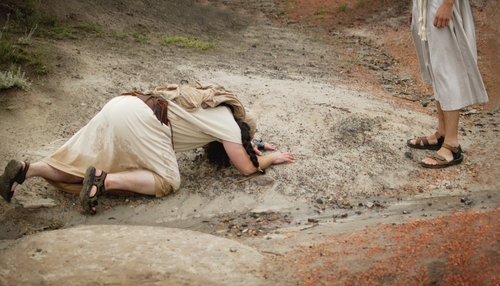
The story of the sinful woman who wipes Jesus’ fee with her tears and anoints them with oil is a tender but rather uncomfortable story. [i] A Pharisee had invited Jesus to eat with him at his house. While reclining at the Pharisee’s table, a woman, a known sinner, came up behind him.

Where did she come from? How did she get into the Pharisee’s house? Was she, perhaps, a daughter of the Pharisee, one of whom he was not very proud? was there something else going on? We don’t know.

When she came up behind Jesus, she was weeping, and she began to wet his feet with her tears. She wiped his feet with her hair, kissed his feet and anointed them with oil. A greater display of open, unabashed affection is hard to imagine. Thinking of the vulnerability and openness of her affection is even uncomfortable.

The Pharisee was taken aback, as we would be, mumbling to himself that surely Jesus must know who this woman is. Her reputation was well known, at least to the Pharisee.

Continue reading “The Importance of How We View God and Ourselves”

Viewing God in the Mirror of Our Lives

 (c) Can Stock Photo


“Now we see as if in a mirror dimly… but then we will see face to face.”

Corinthians 13:12 (ESV)

The filter through which we see God is the physical, spiritual, emotional and conscious person we see staring back at us in the mirror. Our perspective of God comes filtered through our own selves.

Think about that for a moment….

If our sense of who we are is distorted, our view of God is distorted. If we don’t see ourselves accurately, we can’t see God accurately.  Having an accurate view of God requires us to have an accurate view of who we are.

Continue reading “Viewing God in the Mirror of Our Lives”

The Temptation to Complain

Photo by Beth Drendel

Why should any living man complain?[i] You are alive! Therefore, you have hope.

Your life, no doubt, has not gone the way you hoped it would. Looking back, there may be many regrets. You may deeply wish that you had known then what you know now, and if only you had some foresight, some sheer luck perhaps, things would be much different.

But things are what they are, and no amount of wishful thinking will change the course of events that have happened to this point.

Have you made mistakes? Be honest! We all make mistakes, and not just mistakes of choice – we all do things we should not have done. We have all done things that we knew we should not have done because they were not right.

We try to “redeem” those mistakes. Sometimes, we try to redeem them by re-characterizing our actions, thoughts and decisions, owning them as if they were right because they are who we are.

That is the temptation of modern life. “Be who you are” – whatever that may be. “Never apologize for who you are”.

But who are you?

Are you your own person?

Continue reading “The Temptation to Complain”

The Greatest Being is God

God is by definition the greatest, the maximal being.

Yosemite by Kallie Carlson

St. Anselm postulated that the greatest being is God. Dr. William Lane Craig often references God as the “maximal being”. If we can envision something greater than God, then the something greater has to be God, because God is the greatest being. God is by definition the greatest, the maximal being.

That is why every single sin committed must be punished. Why? Because God is perfectly just. A perfectly just being punished every crime. If we imagine a god who published some crimes and not others, that would not be the most just being. He might be merciful and nice, but he would not be the most just. We could imagine someone more just – a being who punishes every crime.

We could also conceive of someone who is merciful, who can forgive everything that could possibly be done, from the smallest offenses to the greatest. If we conceive of a judge who forgives some things, but not all things, that would not be God. God would have to be absolutely merciful and forgiving.

God would have to be absolutely just and absolutely merciful at the same time. Any being who is not the most just and/or the most merciful is not God.

God must also absolutely love. Continue reading “The Greatest Being is God”

Taking the Emotion out of Sin: A Study in the Substance of Death and Life

Let’s put aside the issue of morality, take the emotion out sin and see what we have left.

 (c) Can Stock Photo


“[T]he wages[1] of sin[2] is death, but the free gift of God is eternal life in Christ Jesus our Lord.” Romans 6:23.

We tend to view sin in moralistic terms, but I wonder sometimes if we might look at sin in non-moralistic terms. The adage, “we are what we eat”, is an apt description for sin. How we eat is a moral issue for some people, but most people (or many at least) don’t view eating that way.

We tend to view sin in moralistic terms, as in reaping what we sow. [3] What if we try to take the morality out of the discussion? What would we have left?

Although sin is a moral issue at heart, the emotion of morality in this modern, post-Christian age in the US may obscure how we view sin and the relationship between sin and death.

Men have tried to hijack morality and claim it as a product of their own making. If God exists, however, He is the author of morality. God, Himself, is the moral standard. I would say that, without God, there is no such thing as objective morality.

If God doesn’t exist, we create our own morality, and your morality might be different than my morality. The morality that is predominant in my community, may not be the morality to which your community subscribes. No one is ultimately right, and no one is ultimately wrong, except that those with the power and influence get to set the standard.

But that’s not what this piece is about. Let’s put aside the issue of morality and take the emotion out of the equation. Let’s take the emotion out of sin and see what is left.

Continue reading “Taking the Emotion out of Sin: A Study in the Substance of Death and Life”