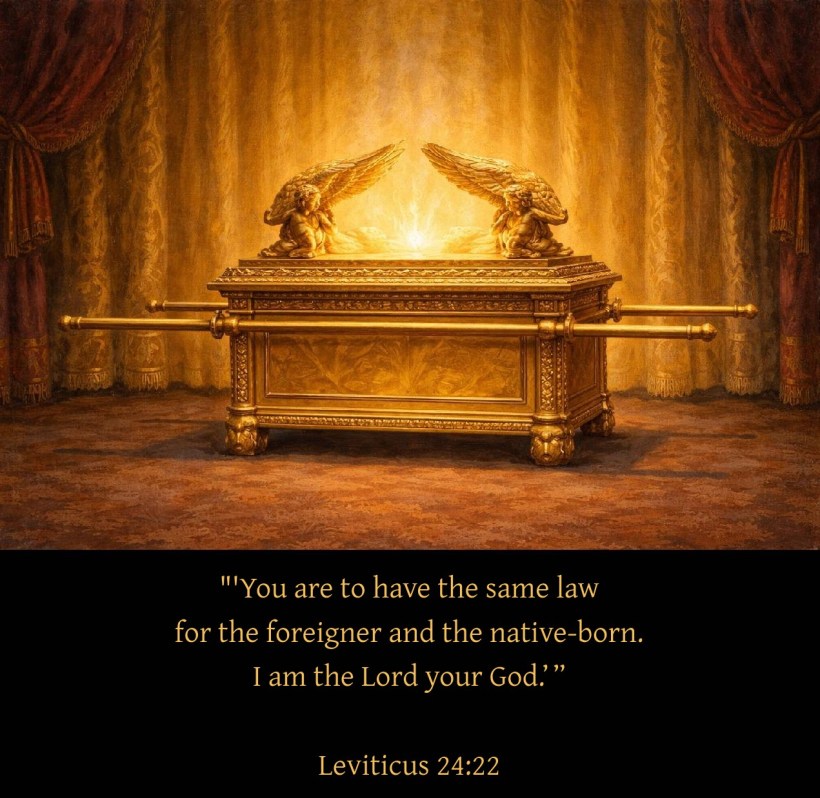
“You are to have the same law for the foreigner and the native-born.”
Leviticus 24:22
That single line, given by the Lord to Moses, is often read narrowly: foreigners are subject to the same penalties as citizens. True—but incomplete. Law is not merely punitive; it is protective. If the same law binds the foreigner, the same law also shields the foreigner. Justice, in the biblical sense, is reciprocal.
The rules that apply to foreigners are embedded in the sacred Law God gave to Moses for His people. The Law even applied specific protections to foreigners:
- Leviticus 19:9–10 — Leave gleanings for the poor and the foreigner.
- Leviticus 23:22 — Harvest leftovers belong to the foreigner and poor.
- Deuteronomy 24:19–21 — Leave grain, olives, and grapes for foreigners.
- Deuteronomy 26:12 — Tithes every third year support foreigners.
The Reciprocity Built into God’s Law
Leviticus develops this principle further. In Leviticus 25, the Lord instructs Israel that if a native-born Israelite loses his land and falls into poverty, he is to be treated as a foreigner among them. Why? Because the law already required Israel to provide for foreigners in their midst. By placing impoverished Israelites into the same category as foreigners, God establishes a profound reciprocity:
The protections of the law given to the Israelites apply to the foreigners living among them. The protections given to outsiders become the safety net for insiders when they fall.
This is not accidental. It reveals something essential about God’s character: His justice is inseparable from His mercy.
Other passages reinforce the pattern of concern for foreigners:
- Leviticus 19:34 — “The foreigner residing among you must be treated as your native-born. Love them as yourself.”
- Deuteronomy 1:16–17 — Judges must hear cases fairly, whether involving Israelites or foreigners.
- Deuteronomy 10:18–19 — God “loves the foreigner residing among you, giving them food and clothing.”
- Deuteronomy 24:17 — Do not deprive foreigners of justice.
God’s intentions are reinforced over and over:
- Exodus 22:21 — “Do not mistreat or oppress a foreigner, for you were foreigners in Egypt.”
- Exodus 23:9 — Do not oppress a foreigner; you know their experience
- Leviticus 19:33–34 — Do not mistreat; love them as yourself
- Deuteronomy 10:19 — Love the foreigner, for you were foreigners
Israel’s memory of its own foreignness was meant to inform Israel’s identity and to shape its ethics. Their past vulnerability became the foundation of their present compassion. They were never to forget who they were and to treat people as they would want to be treated.
Set Apart—But Not Set Against
God was forming a people set apart—a light to the nations (Isaiah 49:6). Yet their distinctiveness was never meant to become isolation or superiority. From the beginning, God’s promise to Abraham was expansive:
“All peoples on earth will be blessed through you.”
Genesis 12:3
Election was never exclusion. The chosen people existed for the sake of the unchosen. We are the benefactors of God’s expansive purpose today.
Jubilee and Land Ownership
Leviticus 25 also introduces the Year of Jubilee – a system of Law that reinforces the design and purpose of God. Under this system, land could not be owned permanently:
“The land must not be sold permanently, because the land is mine and you reside in my land as foreigners and strangers.”
Leviticus 25:23
Even in the Promised Land, Israel was reminded: you are tenants, not owners.
This theme echoes throughout Scripture. Humanity has lived in exile since Eden. Abraham lived in tents (Hebrews 11:9–10), because he was waiting for a city “whose architect and builder is God.” The saints of old lived as “foreigners and strangers on earth.” (Hebrews 11:13) This is the hallmark of God’s people – their ingrained identity.
The New Testament continues the theme:
- Philippians 3:20 — “Our citizenship is in heaven.”
- 1 Peter 2:11 — “I urge you, as foreigners and exiles…”
The Apostle John saw in vivid detail what Abraham and the saints of old only saw from afar:
“Then I saw ‘a new heaven and a new earth,’ for the first heaven and the first earth had passed away, and there was no longer any sea. I saw the Holy City, the new Jerusalem, coming down out of heaven from God.”
Revelation 21:1-2
Our true home is the New Jerusalem – where Jesus has prepared rooms for all of his people. The Kingdom of God is not of this world. The biblical story reframes our identity: no matter where we are born, God’s people live as resident aliens awaiting a better country and a City the architect and builder of which is God.
The American Tension
The United States is not ancient Israel, and the Mosaic Law is not our civil code. Yet the heart of God revealed in Scripture has not changed. The law written on stone has given way to the law written on hearts (Jeremiah 31:33), but its moral trajectory remains.
Continue reading “Foreigners, Neighbors, and Citizens of God’s Kingdom in the United States of America Today”









 Navigating by Faith