
How Do I Help My Brother with a Speck In His Eye When I Have a Log In My Own Eye? Judging Rightly

We cannot grow in maturity and holiness if our focus is on the sin of other people. We have a hard enough time recognizing and dealing with our own sin!


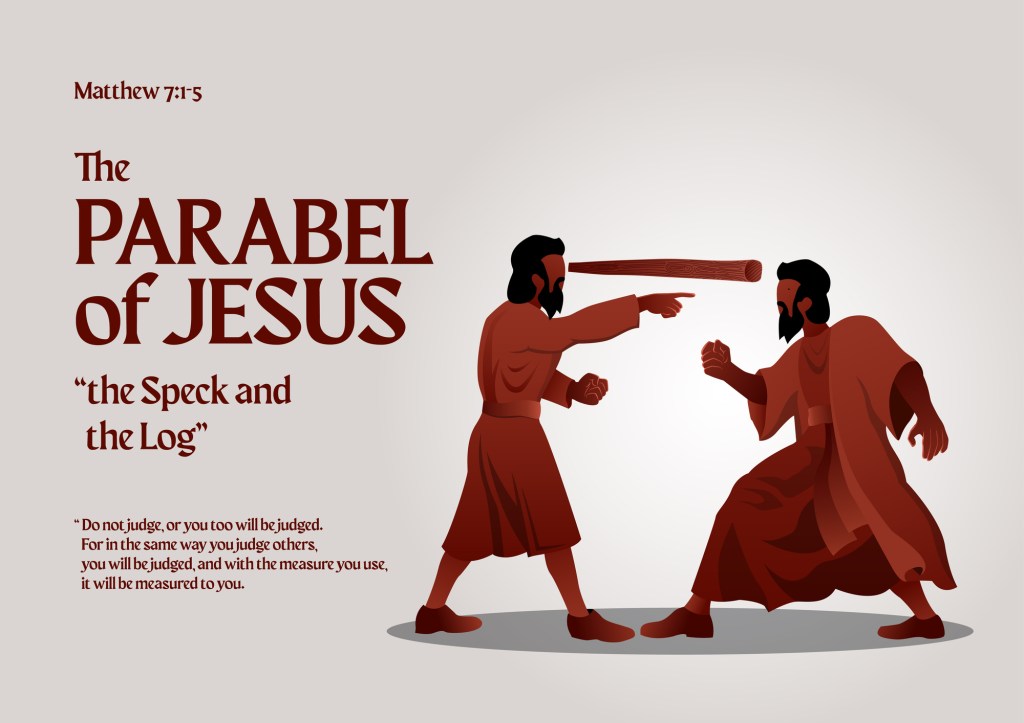
I have written previously about the parable of the log in a person’s eye who sees a speck of saw dust in another person’s eye. (See 8 Important Points about Judging and Judgment) Jesus says that we need to be careful about focusing on the specks in others’ eyes because of the logs in our own eyes. (Matthew 7:1-5)

Jesus is expressly talking about judging others, but the implications are much larger than that. They are about loving others, especially our brothers and sisters in the Lord. It is also about our posture to the world (those who do not know God in Christ, who gave Himself up for us).

We might be tempted to read what Jesus said and walk away thinking that we should not judge other people. That isn’t quite what Jesus says. Jesus says be careful in the way you judge others because the way you judge others is the way you will be judged. (Matt. 7:1-12)

We can’t get away from making judgments, which is nothing more, really, than the conclusions we reach based on what we know. We make judgments about innumerable things every day.

This is also not about Judgment (capital J). Only God has the authority to judge people, and God alone is a true Judge who can weigh all the facts accurately and completely. God alone knows our thoughts and our hearts. We can only judge by appearances, and we judge only from ground level.

When we see a speck in our brother’s eye, the parable should cause us to consider the logs in our own eyes, first. It’s a matter of perspective. What seems like a speck in someone else’s eye appears like a log when that speck is in my eye. Even so, humans have an unusual capacity to get used to those “logs” and forget they even exist.

One point of this parable is that we need to be dealing with our own sin as a matter of first priority. If sin is discovered in our brother, that discovery should cause us to consider first our own sin. I believe this is a fair reading of what Jesus is saying.

Jesus also does not tell us to leave our brother alone with a speck in his eye. Rather, he tells us to be considerate as we determine what to do about. We need to start by considering our own sin sinned (missing the mark) in our own lives. Then we need to approach our brother in the right attitude of heart, with empathy, realizing that we are not any better then our brother who’s speck we have observed.

Today, I have read what Paul says in Galatians 6:1-2 in my daily reading, and the parable about the log and the speck comes rushing back to me. I realize that Paul’s admonition in Galatians 6:1-2 harmonizes with what Jesus was taught his disciples in this parable:

Brothers and sisters, if a person is discovered in some sin, you who are spiritual restore such a person in a spirit of gentleness. Pay close attention to yourselves, so that you are not tempted too. Carry one another’s burdens, and in this way you will fulfill the law of Christ.”

Galatians 6:1-2 NET (Emphasis added)

I previously observed that we must be in relationship with others to do what Jesus has said (judge rightly). We should not be approaching anyone about a speck in their eye if we do not do it from the perspective of loving relationship (as brothers and sisters). We have to do this in the right relationship, or we will not do it right.

Continue reading “How Do I Help My Brother with a Speck In His Eye When I Have a Log In My Own Eye? Judging Rightly”

Current Lessons in the Parable of the Good Samaritan: Focusing on the Weightier Matters of the Law

We often fail to help people in need because we are focused on the good things we are doing

I have been involved in the faith-based legal aid organization, Administer Justice, in different capacities for about 12 years. I am an attorney. AJ is an organization founded by an attorney, Bruce Strom, who left his lucrative law practice to provide pro bono (free) legal services for people who can’t afford a lawyer. AJ helps churches run Gospel Justice Centers.

Bruce’s book, Gospel Justice, describes his calling and the journey he began over 20 years ago. Gospel Justice follows the familiar parable of the Good Samaritan and what it means to love your neighbor as God commands. Implicit in the parable is the question: who is my neighbor?

I have learned recently, that parables were common in the rabbinical tradition of the time, and the set up of a priest, a Levite and a third person was a common parable structure. It is the equivalent to the modern set up for a joke: a priest, an Irishman, and a Scotsman walk into a bar…..

According to Marty Solomon of the BEMA Podcast, the third person (the one through whom the lesson is learned) was often a Pharisee in the rabbinical Jewish tradition of the First Century. Jesus turned the tables by making the third person a Samaritan.

Samaritans had Hebrew DNA. They were ancestors of the Israelites who were left behind during the exile. They had intermarried and changed their religious practices to accommodate their mixed marriages and life without the Temple. The Jewish remnant that returned to rebuild the Temple saw them as mongrels who abandoned the faith. For Centuries, Samaritans were despised by the Jews who rebuilt the Temple and carried on the traditions of the Mosaic Law.

The priests and Levites represent good, religious people and the devotion to traditional values. They represent respectable, hard-working people who have faithfully kept those traditional values through hundreds of years of faithful adherence in difficult times.

When the priest and Levite in the parable pass by the anonymous, injured man on the road, we react with modern sensibilities that are honed by two millennia of Christian thought, tradition, and conditioning to judge them. First Century Pharisees, however, would have viewed the situation differently.

The injured man had no identify. They might have wondered who he was. (Raising the question: who is my neighbor?) Pharisees and Sadducees may have disagreed on whether aid should be offered to Gentiles, but they would have agreed that the mongrel Samaritans did not merit their aid.

They also would have recognized that the priest and the Levite had good reasons to pass over to the other side of the road and keep going. Among other things, priests were forbidden to touch a corpse. (Lev. 21:1–3) Touching a corpse, or even being in the same space as a corpse meant impurity, and they needed to maintain purity to perform their duties.

The rules that governed these things were complex and nuanced. (See Introduction to the Jewish Rules of Purity and Impurity) Becoming impure meant that a priest could not attend to his ritual duties without going through a time of ritual cleansing. The risk that the injured man might be dead was no small consideration to them.

Perhaps, this seems like being generous to them, but their lives revolved around the rituals handed down centuries ago in the Torah. They were sacred, and their identity and their purpose in life revolved around maintaining those rituals, which they had done since the time of Moses, the great, great grandson of Levi.

If we think times and people are different now, they are, but less so than we might be tempted to think. Most modern Americans (even religious ones) do not practice ritual like First Century Jewish leaders did. We are less religiously ritualistic, perhaps, than ever before. Yet, we are no different, really, in our devotion to our own values and doctrines.

Continue reading “Current Lessons in the Parable of the Good Samaritan: Focusing on the Weightier Matters of the Law”

Favoritism in the Bible, The Here & the Hereafter

God’s mercy shows no bounds, and He is equally merciful to all of us.


“Now in those days, when the disciples were growing in number, a complaint arose on the part of the Greek-speaking Jews against the native Hebraic Jews, because their widows were being overlooked in the daily distribution of food.”

Acts 6:1

Even in the early church led by the 12 apostles who lived with Jesus and learned at his feet, the Church was susceptible to favoritism. The early church embraced a radical, communal life in which they pooled their resources, and everyone in need was taken care of. More or less!

The native, Hebrew widows were being taken care of, but the foreign, Greek-speaking widows were being overlooked. Things were not perfect then, and they never are. People are people, and we tend to fall short, even in our best moments.

People naturally tend to look after our own. “Me and mine”, as Pete might have said in the iconic Coen brothers film, O Brother Where Are Thou?

This human characteristic is not all bad. It prompts mothers and fathers to care for and look after their own children. It inspires family members to look after other family members and friends to look after friends.

At the same time, this human characteristic causes us to care more for our own children and families than for others and to care more for our friends than for our neighbors. It causes us to “take care of our own” to the exclusion of “others”, and that can lead to things like racial discrimination, nepotism, and a failure to have empathy for strangers.

James, the half-brother of Jesus, also deals with favoritism in his letter to the early Church. (James 2:1-13) He called the Church to account for showing “special attention” to men “wearing fine clothes” by giving them the best seats while making the poor churchgoers stand or sit on the floor. (James 2:1-4)

James called favoring the wealthy over the poor sin in no uncertain terms! (James 2:9) He described it as breaking the law of God – the law of loving your neighbor as yourself. (James 2:1-2)

James was clear that this kind of favoritism has no place in the family of God. If any favoritism is sanctioned by God, it is the kind of favoritism that focuses on the poor, the less fortunate, and the people that are marginalized by our human tendencies to show favoritism for our own, personal benefit.

When our favoritism is motivated by selfishness, it is sin. James was particularly strong in his condemnation of favoritism motivated by selfish desires. If we “favor” the marginalized, the vulnerable, and the ones who have less influence in this world, we do it without expectation of personal benefit, and we follow in the example of Jesus.

Continue reading “Favoritism in the Bible, The Here & the Hereafter”

The Way of Righteousness and the Holy Command: the Holy Command

We escape the corruption of the world by the way of righteousness and the sacred command. But, what if we lose the way and don’t know the sacred commandment?


I started this short series with a passage from 2 Peter 2:20-21:

If they have escaped the corruption of the world by knowing our Lord and Savior Jesus Christ and are again entangled in it and are overcome, they are worse off at the end than they were at the beginning. It would have been better for them not to have known the way of righteousness, than to have known it and then to turn their backs on the sacred command that was passed on to them.

They “they” who escaped the corruption of the world only to be entangled in it again are the false prophets Peter accuses at the beginning of the chapter of introducing “destructive heresies” and “denying the sovereign Lord who bought them.” (2 Pet. 2:1) Peter says these false prophets are like dogs returning to their vomit. (v. 22) Seducing the unstable (v. 14) and appealing to the lustful desires of the flesh, they entice “people who are just escaping from those who live in error.” (v. 18)

In the introductory article, I note that the words of judgment Peter unleashes on these false prophets might lead to a concern that we could one of those unstable ones who are enticed and entrapped. Those who struggle with sins that so easily entangle us might easily feel condemned in this tirade.

The solemn warning that such ones are better off not knowing Jesus. than knowing the way of righteousness and turning their back on the sacred command is enough to send a shiver down the spine. The actions Peter describes, however, are the fruits of turning away from the sacred command. These fruits are not the problems in themselves, but the symptoms of disconnecting from the way of righteousness and the sacred command.

In the second article, I explored the way of righteousness. The way of righteousness is the way of Jesus, who is the Way! Knowing Jesus and knowing the way of righteousness is the same thing.

The way of righteousness means embracing and walking in light of his sacrifice on the cross by which we are justified and we are considered righteous before God the Father. It means trusting in Jesus and the grace of God the Father. It means ceasing from our striving to earn the way and the pride that goes with our achievement.

The way of righteousness means following Jesus and maintaining relationship with Jesus, who is our Living Water, our Bread of Life, and the Vine in which we have become the branches (extensions of him). Knowing the way of righteousness and turning from the sacred command is to disconnect and to go our own way.

But what is the sacred command? This was my big question as I read through this passage recently, and this question is ultimately what motives me to write this short series.

I admit, that I wasn’t sure as I read through this passage. I should have known, because Jesus was pretty clear about it. But, I didn’t. I had lost sight of it. It’s so easy to lose sight of what’s important in the turmoil in the world that often spills over into my own heart.

Continue reading “The Way of Righteousness and the Holy Command: the Holy Command”

Fruit, Love and False Prophets

It’s a sad state of affairs that Christians today may be more well known for their fighting with each other than for their love for each other. 


Someone commented recently on Facebook that some of the harshest critics of Christians on social media are Christians. (Assuming that anyone who self-identifies as a Christian is a Christian.) This reminded me of what Jesus said to his disciples after Judas left the last supper to betray him.

When he was gone, Jesus said, “Now the Son of Man is glorified and God is glorified in him. If God is glorified in him, God will glorify the Son in himself, and will glorify him at once.
“My children, I will be with you only a little longer. You will look for me, and just as I told the Jews, so I tell you now: Where I am going, you cannot come.
A new command I give you: Love one another. As I have loved you, so you must love one another. By this everyone will know that you are my disciples, if you love one another.”

John 13:31-35

“Now” the Son of Man is glorified, Jesus said. He was lifted up, but it wasn’t the kind of “glory” anyone expected. It was the glory of Jesus being obedient to the Father and accomplishing all that intended.

Jesus knew he was leaving, and (if we read between the lines), he knew the disciples left in front of him would struggle at first. What was the key instruction in this time? What was the one thing he gave them to hold onto?

Love one another. As I have loved you, so you must love one another. By this everyone will know that you are my disciples, if you love one another.”

It’s a sad state of affairs that Christians today may be more well known for their fighting with each other than for their love for each other. 

People will say that the doctrine is important and that Paul and the early church were also concerned about doctrine. This is true, of course.

It also occurs to me that the 1st century Christians lived in a world that was predominantly non-Christian. They were a very small minority. The disagreements among Christians likely went completely unnoticed by the world at large.

Christians are in the majority in the United States today, so negativity from Christians toward Christians in the United states is highly noticeable. With so many people who call themselves Christian, the fighting is going to get noticed.

A person might say further that love is tempered by truth. Love that does not recognize and confirm to truth is not love. Right? I cannot help but thinking, however, that such a statement sounds particularly like something a Pharisee may have said in the 1st century.

Isn’t it a shame that, with so many Christians in this country, we do not shine like that proverbial city on a hill? And, by shine, I mean with the love of God for each other (and for others – and even for our enemies).

Looking back at the first Christian leaders who had disagreements, I see that they spent time in prayer – together with each other. They worked to find common ground, and they agreed to disagree on peripheral things. They did not bicker publicly among themselves.

We see many examples of this in the Book of Acts and the epistles that make up the New Testament. Early Christians did not agree on everything, but they agreed on essentials, and they allowed room for disagreement.

Early Christians did take a strong stand against heresy, but we can’t just everything on which we disagree matters of heresy. Heretical doctrines in the 1st Century, like Gnosticism, have their 21st Century counterparts. We call certain clear departures from orthodox Christianity heretical, like the Jehovah Witnesses and Mormons, but the fighting my friend on Facebook was sad about is fighting among Christians who are somewhere in the range of Christian “orthodoxy”.

That is the rub.

Continue reading “Fruit, Love and False Prophets”