How Did Jesus, the Exact Representation of God, Describe Himself and Demonstrate Who He Is?

I find myself contemplating often the words Jesus used to describe his purpose. Jesus gave us description immediately before he launched into his public ministry. This is the way it went down, and this is what he said:

“And he came to Nazareth, where he had been brought up. And as was his custom, he went to the synagogue on the Sabbath day, and he stood up to read. And the scroll of the prophet Isaiah was given to him. He unrolled the scroll and found the place where it was written,

“’The Spirit of the Lord is upon me,
    because he has anointed me
    to proclaim good news to the poor.
He has sent me to proclaim liberty to the captives
    and recovering of sight to the blind,
    to set at liberty those who are oppressed,
to proclaim the year of the Lord’s favor.’

‘And he rolled up the scroll and gave it back to the attendant and sat down. And the eyes of all in the synagogue were fixed on him. And he began to say to them, ‘Today this Scripture has been fulfilled in your hearing.’”

Luke 4:16-21

The famous announcement of his purpose came after John the Baptist piqued the interest of the local people, proclaiming, “Prepare the way for the Lord”. It came after John the Baptist challenged people to repent and be baptized.

The announcement took place after Jesus spent 40 days out in the wilderness being tempted by the devil. Jesus had not yet begun his “public ministry”, when he stood up to read in his home town synagogue from the words of Isaiah, the Prophet – words spoken about Jesus over 500 years before that day.

This was the announcement of what Jesus came to do. The Spirit was on him to proclaim good news to the poor, to proclaim liberty to the captives and recovery of sight to the blind, to set at liberty those who are oppressed, and to proclaim the year of our Lord’s favor.

It wasn’t just a prophecy to be fulfilled. It was the very purpose for which God emptied Himself and became a man incarnate. God came to reveal Himself in the material world, to reveal His very heart and His love for mankind.

This was the message that He was trying to convey over the many centuries through the one people who inclined an ear toward Him. But, they didn’t completely get it. They wandered and strayed in their devotion to God, and they mistook His law for nothing but a code of conduct that might earn them the favor of God.

They didn’t understand the relationship He desired to form with them. They didn’t understand His love for them or the singularity of His own devotion to them and the purposes He established for them before the foundation of the heavens and the earth.

They didn’t even recognize Him when He came to them, albeit emptied of all that would not fit into human form (Phil. 2:5-7) They didn’t recognize Him stripped of all His power, holiness and glory.

He did not come with pomp and circumstance. He came humbly in the form of a man just like them. His coming was barely a whisper. is arrival went all but unnoticed. Born in a humble setting to poor, common parents, he grew up in an area of Judea that was off the beaten path and not a little “backwards”.

His first 30 years of life were so unremarkable we know next to nothing about them. The first public stir that is recorded is the day he stood up and read from the Isaiah scroll, sat down, and announced, “Today this Scripture has been fulfilled in your hearing.”

People were so unready for anything extraordinary from Jesus that they marveled and asked each other, “Isn’t this Joseph’s son?” (Luke 4:22) Then, he seemed to provoke them (Luke 4:23-28), and they burned with anger at his audacity. (Luke 4:28)

It was an inauspicious start to his “public ministry”. He bombed in his hometown synagogue.

What he said of himself, however, is preserved for eternity. It is the key to understanding the heart and character of God revealed through Jesus, “the exact representation of His nature”. (Heb. 1:3) What Jesus said that day and what Jesus did is the best demonstration of God’s heart and character that we, as finite beings, might understand.

Continue reading “How Did Jesus, the Exact Representation of God, Describe Himself and Demonstrate Who He Is?”

If God’s Love Casts Out Fear, Being Filled with the Spirit means Being Filled with Love Free from Fear


The apostle, John, wrote, “Perfect love casts out fear.” (1 John 4:18) This was written by a man who, when the chips were down for Jesus, kept his distance from Jesus in fear with the rest of the apostles.

When Jesus tried to tell his disciples of the need for him to die and be raised from the dead, they did not understand. Jesus predicted John and all the other disciples would forsake him, and they did.

“You will all fall away because of Me this night…. (Matthew 26:31)

Peter pumped his chest with bravado as he protested that he would never leave, (Matthew 26:32-33), but Jesus knew Peter better than Peter knew himself. He knew that Peter would deny him not once, but three separate times. (Matthew 26:34)

So great was the fear that overtook the disciples that they scattered after Jesus was taken by the Roman soldiers. Though Peter stayed back to witness the interrogation, beatings, mocking and humiliation to which Jesus was subjected, Peter denied that he knew him three times.

Fear is a powerful emotion. It can overwhelm us and cause us to stumble from the path that we know is right. How do we overcome fear? How did John come to say that perfect love casts out all fear?

When Jesus was present, the apostles were different men. One of them even drew a sword on the Roman soldiers when they came to take Jesus in the garden. (Matthew 26:51) But, with Jesus absent, suffering at the hands of those same Roman soldiers, the apostles’ bravado turned to fear.

Even after Peter and John went to the tomb, found it empty and “believed” (John 20:8), they were still fearful. When Jesus came to them after he had risen from the dead, he found the disciples behind locked doors “for fear of the Jews”. (John 20:19)

In that encounter, Jesus appeared to them, showed them his hands and his side, and spoke to them. He breathed on them and said to them, “receive the Holy Spirit”. Certainly that would have changed the demeanor of the disciples! Right?

It didn’t. Eight days later Jesus came to them again, and he found them, once again, inside and behind locked doors. (John 20:26) Nothing had changed.

After Jesus ascended to heaven, after spending forty more days with the apostles, speaking to them and confirming his words with signs (Acts 1:1-3), the apostles returned to the upper room where they had been staying. (Acts 1:12) They remained shut up and cloistered.

The apostles were not empowered by Jesus appearing to them. They were not empowered by Jesus breathing the Holy Spirit upon them or by explaining to them everything that they didn’t understand. After all of that, the apostles remaining holed up in the upper room.

The apostles didn’t venture out with boldness until after the Holy Spirit came upon them and filled them. (Acts 2:2-4) Filled with the Holy Spirit, they drew a crowd. (Acts 2:6) Filled with the Holy Spirit they stood up and addressed the crowd, and the crowd was “amazed and astonished”. (Acts 2:7) Filled with the Holy Spirit, Peter boldly addressed the “men of Judea and all who live in Jerusalem” (Acts 2:14) demanding that they repent and be baptized. (Acts 2:38)

The same apostles who cowered and scattered when Jesus was taken and remained in hiding in fear of the Jews even after Jesus appeared to them risen from the dead did not become courageous proclaimers of the Gospel until they were filled with the Holy Spirit.

Love is from God (1 John 4:7), and God is love. (1 John 4:8) Those who are filled with the Holy Spirit are filled with love, and perfect love casts out all fear.

If we are fearful, we have are not been filled with the Holy Spirit. If we are fearful, we are not filled with love. If God is love, the Spirit of God is love, and perfect love casts out all fear. .

God, please fill me with your Holy Spirit and drive out the fear lurking in my heart!

Who is My Neighbor? And Who is a Neighbor to Me? The Discomfort of Grace.

Grace is exercised among people who are not like you, who challenge you, who are uncomfortable to be around.

I have often touted the Unbelievable Podcast on Christian Premiere Radio in the UK, and I do it again here. I recommended the episode on Philip Yancey live Q&A on faith, doubt and the future of the US church: Saturday 19 March 2022. Much was discussed in the episode that I could write about, but one thing stands out above the rest to me this morning. Philip Yancey said,

“It’s easy to find a church, to gravitate toward a church, where people look like you, and smell like you, and vote like you.”

Most of us go to churches like that. It’s a human tendency to gravitate toward people with whom we have the most connections, to settle in with people with whom we have the most in common, to spend time with people most like us, but Yancey says,

“That’s not the way to exercise grace. Grace is exercised among people who are not like you, who challenge you, who are uncomfortable to be around, people who are immoral. That’s where to exercise grace.”

Such a radical statement challenges most of us, I think. I am guilty of settling into churches where I feel most comfortable, but what if God wants me to engage in a church, or in groups, or with people with whom I feel uncomfortable? Would I be open to that possibility?

Jesus often urged people to love their neighbors. When I think of my neighbors, I think of the people in my neighborhood who I know and spend time with. If you are like me, you probably think immediately of your neighbors you know, but what about your neighbors you don’t know?

Jesus knew that people tend to favor those who are like them when he told the parable of the Good Samaritan. (Luke 25:30-35) In the parable, an unidentified man is attacked by robbers, stripped of his clothes, beaten and left for dead. (Luke 25:30) Three people come along and see him lying there: a priest, a Levite, and a Samaritan.

The priest and the Levite were the people most like the man who asked the question that prompted the parable. He was an expert in the Law of Moses, a Jewish leader.

He actually began with a more esoteric question: “What must I do to inherit eternal life?” Jesus turned the question on him, asking “What is written in the Law?” (Luke 25:25-26)

When the man responded, “‘Love the Lord your God with all your heart and with all your soul and with all your strength and with all your mind’; and, ‘Love your neighbor as yourself,'”, Jesus answered anti-climatically, “You have answered correctly…. Do this and you will live.”

That might have been the end of the conversation, but the expert in the law “wanted to justify himself”. Perhaps, he wanted affirmation that he was reading the law correctly. Perhaps, he wanted Jesus to acknowledge his deep moral thinking. Perhaps, he wanted to prove his expertise in the Law. Whatever he was thinking, he asked, “[W]ho is my neighbor?” (Luke 25:29)

The man may have wanted Jesus to engage him in a deep theological discussion, but Jesus deflected the attempt with the parable. The expert in the Law wanted to make it difficult and complicated, but Jesus kept it simple.

The man is specifically identified as an “expert in the Law”, and the initial question and follow up question read to me like he was wanting a deeper, philosophical conversation with Jesus. He didn’t really want a simple, straightforward answer. He wanted to debate, but Jesus wouldn’t go there with him.

I am also relatively certain that the answer Jesus gave him was not at all what he expected. It likely cut him to the quick – both he and and the wider audience who was listening in.

Continue reading “Who is My Neighbor? And Who is a Neighbor to Me? The Discomfort of Grace.”

Abraham, Isaac, the Blood Path, Christ and Him Crucified

I started on a journey exploring the story of Abraham and Isaac deeper and with more nuance in my previous article, The Story of Abraham and Isaac Revisited: Introduction. The story of God’s seeming demand to Abraham to sacrifice his son, and Abraham being seemingly willing to do it, is quite misunderstood, especially without reference to the Ancient Near East context.

Child sacrifice was ubiquitous among the religions with which Abraham was familiar. Abraham would have thought the demand for the sacrifice of Isaac unsurprising among the arbitrary and capricious gods in the Ancient Near East world he knew.

The story is of the first 11 chapters of Genesis and of Abraham is a revelation that the God of Abraham is different than all the other Ancient Near Eastern gods. In the subsequent article, The Story of Abraham and Isaac Revisited: Here I am!, we explore the interpersonal dynamics of Abraham and Isaac that set the stage for much greater revelation of which God is.

Through Abraham’s dutiful and faithful obedience to the demand he feared would be required of him, God demonstrated His character in a way that was indelibly etched into the experience and psyche of Abraham and Isaac. They would learn that God does not make the same kinds of demands as the other gods: God would provide the sacrifice Abraham feared that God required of him.

In Abraham, Faith and a Hope Deferred, I may seem to take a sideways turn off the path of revelation of God’s character to Abraham, but I will finish the story in this article and get to that point.

The ground we covered in that last article included a blessing by God to Abraham, but the experience of God’s momentary blessing was dampened by the cold reality of God’s yet unfulfilled promise.

In Genesis 15, Abraham sought more assurance from God that the land he lived as a stranger would really become the land of his descendants and, more fundamentally, that he would actually have descendants. Many years had passed, and Abraham was still childless.

In response, God asked Abraham to set up a covenant with five animals of specific types to be slaughtered, cut in half and placed opposite each other on either side of a depression. The blood of those animals drained into the depression creating a blood path. This, Abraham knew, was the stage for entering a covenant with God.

These types of covenants were familiar to ancient Middle Easterners. I understand that similar covenant rituals are practiced today by Bedouins.

Abraham would have known the drill. As the lesser party to the covenant, he would go first, signifying that God should do to him (stomp on a pool of his blood) if Abraham didn’t keep his part of the bargain. With the lesser party committed to the covenant, the greater party would seal the deal, and go last, walking through the blood path.

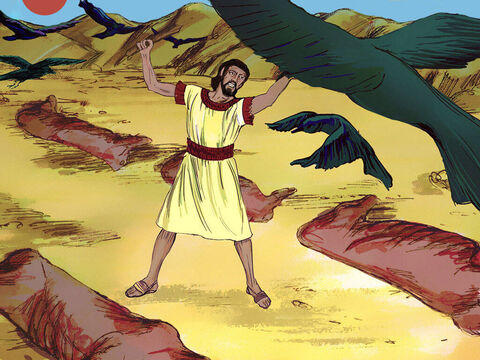
Only Abraham doesn’t initiate the covenant by walking through the blood path. He waits so long that he must drive the birds of prey away from the rotting carcasses. Then Abraham falls into a fitful and dark sleep.

Why did Abraham hesitate? Maybe he realized the significance of what God was setting up – a covenant between a fallible person and the Almighty God! Abraham was not likely worried so much about the commitment God would be making to him, but about the commitment Abraham would be making to God!

So, Abraham, perhaps, feared to enter in to the covenant. He falls into a restless sleep, and God comes to Abraham in his sleep. The “assurance” Abraham receives in his dreams is far from satisfying: God says the promise to Abraham’s descendants would not be finalized for 400 years!

Abraham would be long dead and gone.

This is where we pick up the story. This is where we get the next revelation of the kind of God the God of Abraham is. If we aren’t tracking with the story, we won’t appreciate what happens next:

Continue reading “Abraham, Isaac, the Blood Path, Christ and Him Crucified”

How Will the World Know You?

How will the world know you?

Will the world know you by your family, your ancestors and the legacy that comes after you?

Will the world know you by your wealth, your fiscal responsibility and ability to turn a profit?

Will the world know you by your great intellect, by the diplomas on your wall, the articles you have written? and the collection of books on your shelf you have read?

Will the world know you by your creativity, your command of a color palette, graceful and unique strokes of the brush and eye for design?

Will the world know you by your fame, by the number of people who know your name?

Will the world know you by your physical prowess, your ability to come through in the clutch, and your wins?

Will the world know you by your command of the English language, your artful turn of a phrase and your ability to move people with the written word?

Will the world know you by the instrument you play, the finesse of notes and rhythms, and the virtuosity with which you play your instrument?

Will the world know you by your professionalism, by your reputation for excellence in your field, and the accomplishments you have achieved?

Will the world know you by your stunning good looks, your impeccable fashion taste, and the company of beautiful people you keep?

Will the world know you by your eloquence, the depth and richness of your voice and your ability to command the attention of a crowd?

Will the world know you by your scientific mind, your understanding of technical details, and ability to apply scientific method and sound logic?

Will the world know you by your leadership, the number of people who follow you and your influence?

Will the world know you by the music you compose, the divine harmonies and intricate melodies you weave together in symphonic wonder?

Will the world know you by your politics, the platforms you have championed, and the dedication to your party allegiances?

Will the world know you by the roles you have played, the tears you have coaxed from fawning audiences, and the adoring fans you have?

Will the world know you by your architecture, by your complex end subtle designs, by the magnificence of the structures created from your drawings?

Will the world know you by your dedication, reliability and number of sick days you did not take?

How will the world know you?

In the end, we all go down to the grave, and the world is passing away. When an Ode to a Grecian Urn fades from collective memory, Jesus said we will be known as his disciples simply by our love for each other.

“Love one another. As I have loved you, so you must love one another. By this everyone will know that you are my disciples, if you love one another.

John 13:34-35

“We know that we have passed from death to life,  because we love each other.  Anyone who does not love remains in death.”

1 John 3:14

“Be devoted to one another in brotherly love.  Outdo yourselves in honoring one another.”

Romans 12:10

“Love never fails. But where there are prophecies, they will cease; where there are tongues, they will be stilled; where there is knowledge, it will pass away….” And now these three remain: faith, hope and love. But the greatest of these is love. “

1 Corinthians 13:8,13