Foreigners, Neighbors, and Citizens of God’s Kingdom in the United States of America Today

Immigration is one of the most polarizing issues for American Christians today


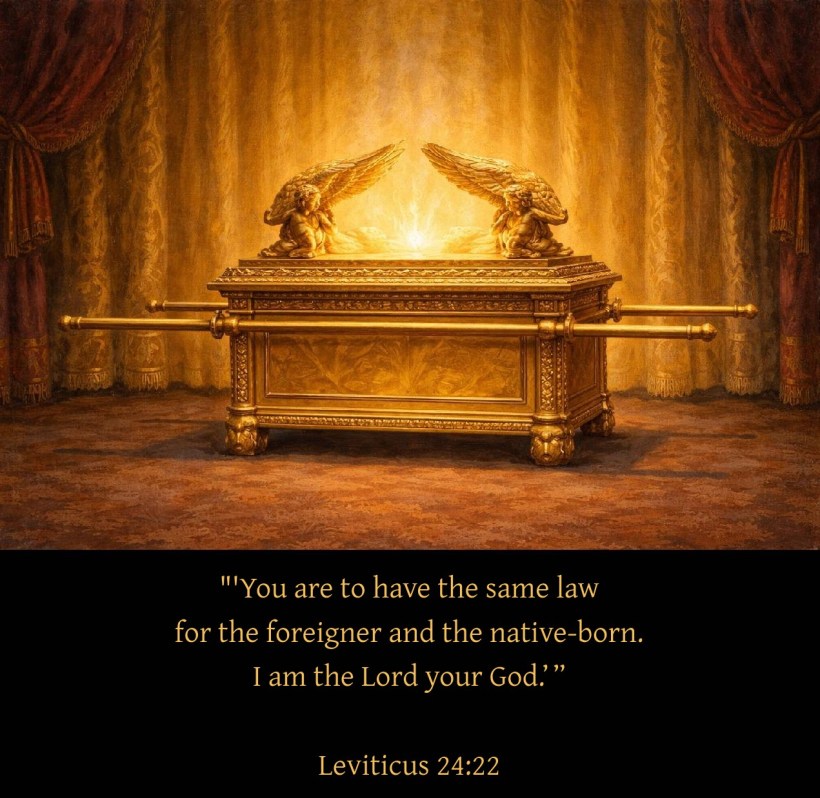
“You are to have the same law for the foreigner and the native-born.”

Leviticus 24:22


That single line, given by the Lord to Moses, is often read narrowly: foreigners are subject to the same penalties as citizens. True—but incomplete. Law is not merely punitive; it is protective. If the same law binds the foreigner, the same law also shields the foreigner. Justice, in the biblical sense, is reciprocal.

The rules that apply to foreigners are embedded in the sacred Law God gave to Moses for His people. The Law even applied specific protections to foreigners:

  • Leviticus 19:9–10 — Leave gleanings for the poor and the foreigner.
  • Leviticus 23:22 — Harvest leftovers belong to the foreigner and poor.
  • Deuteronomy 24:19–21 — Leave grain, olives, and grapes for foreigners.
  • Deuteronomy 26:12 — Tithes every third year support foreigners.

The Reciprocity Built into God’s Law

Leviticus develops this principle further. In Leviticus 25, the Lord instructs Israel that if a native-born Israelite loses his land and falls into poverty, he is to be treated as a foreigner among them. Why? Because the law already required Israel to provide for foreigners in their midst. By placing impoverished Israelites into the same category as foreigners, God establishes a profound reciprocity:


The protections of the law given to the Israelites apply to the foreigners living among them. The protections given to outsiders become the safety net for insiders when they fall.


This is not accidental. It reveals something essential about God’s character: His justice is inseparable from His mercy.

Other passages reinforce the pattern of concern for foreigners:

  • Leviticus 19:34 — “The foreigner residing among you must be treated as your native-born. Love them as yourself.”
  • Deuteronomy 1:16–17 — Judges must hear cases fairly, whether involving Israelites or foreigners.
  • Deuteronomy 10:18–19 — God “loves the foreigner residing among you, giving them food and clothing.”
  • Deuteronomy 24:17 — Do not deprive foreigners of justice.

God’s intentions are reinforced over and over:

  • Exodus 22:21 — “Do not mistreat or oppress a foreigner, for you were foreigners in Egypt.”
  • Exodus 23:9 — Do not oppress a foreigner; you know their experience
  • Leviticus 19:33–34 — Do not mistreat; love them as yourself
  • Deuteronomy 10:19 — Love the foreigner, for you were foreigners

Israel’s memory of its own foreignness was meant to inform Israel’s identity and to shape its ethics. Their past vulnerability became the foundation of their present compassion. They were never to forget who they were and to treat people as they would want to be treated.

Set Apart—But Not Set Against

God was forming a people set apart—a light to the nations (Isaiah 49:6). Yet their distinctiveness was never meant to become isolation or superiority. From the beginning, God’s promise to Abraham was expansive:


All peoples on earth will be blessed through you.

Genesis 12:3


Election was never exclusion. The chosen people existed for the sake of the unchosen. We are the benefactors of God’s expansive purpose today.

Jubilee and Land Ownership

Leviticus 25 also introduces the Year of Jubilee – a system of Law that reinforces the design and purpose of God. Under this system, land could not be owned permanently:


The land must not be sold permanently, because the land is mine and you reside in my land as foreigners and strangers.”

Leviticus 25:23


Even in the Promised Land, Israel was reminded: you are tenants, not owners.

This theme echoes throughout Scripture. Humanity has lived in exile since Eden. Abraham lived in tents (Hebrews 11:9–10), because he was waiting for a city “whose architect and builder is God.” The saints of old lived as “foreigners and strangers on earth.” (Hebrews 11:13) This is the hallmark of God’s people – their ingrained identity.

The New Testament continues the theme:

  • Philippians 3:20 — “Our citizenship is in heaven.”
  • 1 Peter 2:11 — “I urge you, as foreigners and exiles…”

The Apostle John saw in vivid detail what Abraham and the saints of old only saw from afar:


Then I saw ‘a new heaven and a new earth,’ for the first heaven and the first earth had passed away, and there was no longer any sea. I saw the Holy City, the new Jerusalem, coming down out of heaven from God.”

Revelation 21:1-2


Our true home is the New Jerusalem – where Jesus has prepared rooms for all of his people. The Kingdom of God is not of this world. The biblical story reframes our identity: no matter where we are born, God’s people live as resident aliens awaiting a better country and a City the architect and builder of which is God.

The American Tension

The United States is not ancient Israel, and the Mosaic Law is not our civil code. Yet the heart of God revealed in Scripture has not changed. The law written on stone has given way to the law written on hearts (Jeremiah 31:33), but its moral trajectory remains.

Continue reading “Foreigners, Neighbors, and Citizens of God’s Kingdom in the United States of America Today”

The Importance of Our Identity as Citizens of Heaven: Moses, Aliens, and Strangers

Our identity as Christians informs (or should inform) how we see the world


The importance of identity is not just a 21st Century trend. The significance of a person’s identity dates back to the Ancient Near Eastern culture preserved in the Bible.

Parents commonly named their children based on prominent identity markers. For instance, Isaac and Rebekah named their second born, Jacob, who was born clinging to his two brother’s ankle. Jacob (Ya’aqov in Hebrew) meant “supplanter,” “heel-catcher,” or “he who follows on the heels of.” The name became part of his identity not just literally; it corresponded with actions to acquire his older brother’s birthright from his father by manipulation and deception. (Gen. 25:26; 27:36; and Hos. 12:2-4)

God often gave people new names to go with their identity in relation to God. After a personal encounter with the Lord, God gave Jacob a new name: Israel, which meant “struggles with God,” “wrestlers with /God,” or “God prevails.” (Gen. 32)

The naming of children and God renaming people according to some key characteristic associated with their personal identity, or a new identity God gave them, is a common theme in the Bible. Groups of people were known by ancestral names, like Israelites, Amalekites, Hittites, etc. Thus, I find significance in the name Moses gave his first born child: Gershom.

Moses was the son of Hebrew parents, but he was placed in a basket in the Nile when Pharaoh ordered the killing of all male Hebrew babies. The Pharaoh’s own daughter found Moses and adopted him, though she allowed him to be nursed by a Hebrew woman who turned out to be Moses’s mother.


Moses grew up in the privilege of the Pharaoh’s house. He was educated in all the ways of Egypt, learned to read and write, and was familiar with Egyptian history, culture, religion, and philosophy. He was Hebrew by birth, but he was Egyptian by upbringing.


Moses must have known that he was Hebrew. It was probably obvious by his facial features, and he might have even been circumcised. He was schooled in Egyptian ways and thinking, but he was probably painfully aware that he was not Egyptian by birth.

One day as he observed an Egyptian beating a Hebrew man, Moses stepped in and killed the Egyptian. I believe Moses identified with the Hebrew man because of his Hebrew ethnicity. He fled into the desert in Midian for fear of punishment from the Egyptians for the murder.

In Midian, he was accepted into the family of a Midianite, married a Midian woman, and settled down there. When his wife, Zipporah, gave birth to a son, “Moses named him Gershom, saying, ‘I have become a foreigner in a foreign land.’” Exodus 2:21-22

Moses named his first son Foreigner because he identified as a foreigner himself. Despite being raised as an Egyptian in Pharaoh’s family with all the privilege associated with the royal household, Moses could not escape the fact of his Hebrew heritage. That knowledge influenced his personal identity.  That identify as an outsider – a foreigner – was reinforced in his persona when he settled in Midian to the extent that he extended that identity to his firstborn son.

I find significance in that story and in the realization that Moses identified so poignantly with being a foreigner. That same identity – of being foreign – defined the Hebrew people enslaved in Egypt. It remained with them as they wandered 40 years in the Levant wilderness, and, God sanctified that identity for the Israelites in the Mosaic Law:


“When you reap the harvest of your land, do not reap to the very edges of your field or gather the gleanings of your harvest. Do not go over your vineyard a second time or pick up the grapes that have fallen. Leave them for the poor and the foreigner. I am the Lord your God….

When a foreigner resides among you in your land, do not mistreat them. The foreigner residing among you must be treated as your native-born. Love them as yourself, for you were foreigners in Egypt. I am the Lord your God.

Leviticus 19:9-10, 33-34


The Israelites lived 430 years in Egypt by the time Moses led them out of that land. Their memories of the promised land were ancient history. Their memories would be like modern Native Americans recalling the history of the United States in 1596. European settlers at that time comprised a few thousand people at most in precarious settlements in the New World inhabited by millions of indigenous people.


The Roanoke Colony had already failed, and no English settlements remained. Some Spanish missionary and military expeditions existed in the south and west, and French and Portuguese fishing camps existed in Newfoundland. Jamestown (1607), Quebec City (1608), Plymouth (1620), and New Amsterdam (New York, 1624) were not yet established.


Some 430 years later, the Native Americans may identify as outcasts in their own country, like Israelites identified as foreigners in their “home” country of Egypt. The Israelites lived there, but they were not assimilated into Egyptian culture, and they lived there without all the benefits Egyptian privileges.

Though Moses was raised with Egyptian privileges in the royal family, he never lost his Hebrew identity. In that sense, Moses identified similarly to the way Christians are taught to identify themselves in the New Testament: as people of God who are foreigners and exiles (1 Peter 2:10-11), “foreigners and strangers on earth” (Hebrews 11:13), who are now “fellow citizens with God’s people.” (Ephesians 2:19)

For Moses, though, he probably didn’t even feel at home with his own, Hebrew people because of his upbringing. He was raised separately from them. His Hebrew features (and perhaps circumcision) reminded him of his heritage. He could not escape it, but his personal connection to those Hebrew roots was not yet intimate.

Even so, the sense of foreign identify was profound enough that Moses was compelled to come to the aid of a Hebrew stranger. Moses identified with the plight of the Israelites who lived as vulnerable foreigners in a land they could not call their own.

I and my fellow Christians should have the same profound sense of living as strangers in a foreign land in this world – if, indeed, we are citizens of heaven. This realization hits home today as I watch what is happening in the streets of American cities.

Do we identify with the aliens and strangers in our country? Or do we identify with the government that has recently adopted more oppressive and strong handed tactics to deal with immigrants in this country who are not wanted here? If you are not sure these connections belong together, bear with me awhile longer.

Continue reading “The Importance of Our Identity as Citizens of Heaven: Moses, Aliens, and Strangers”

Are We Alien and Strange Enough in Our World?

Are you looking for a heavenly country?


Aliens and strangers in our world: that is an apt definition of Christians. We are made for more than the present heavens and present earth that we live in. Though we are born of perishable seed, we have been born again of imperishable seed, and we look forward to the day when we, like the acorn, will die so that we may rise again.

I say these things as I think about the chaos, or law and order, of our times, depending upon your perspective. I see it as chaos from the perspective of the immigrants who have come to the United States for a better life. It is just law and order from the perspective of the person who defends the current immigration laws of our country.

Of course, it isn’t that simple. Slavery was once legal in our country. Is it really just law and order? Or is it something else?

Our ancestors came here for a better life. Unless, of course, our ancestors are Native American. My father’s ancestors came here in 1846. they entered a commercial port in New York City before Ellis Island existed and before there was any process in place to receive immigrants. My mother’s ancestors came here long before that.

When I was young, we celebrated the pilgrims and other sojourners who came here for a better life. Seeking a better life for ourselves and our families, our children and our children’s children was the American way. We were proud of the pioneer spirit brought people to our shores.

It’s also a bit more complicated for Christians, as we believe this world is not all there is, as I often say. Followers of Christ know that a place has been prepared for each one of us. We know that storing up treasures on this earth is a futile and fruitless endeavor at the end of our days. The only thing that ultimately matters are the treasures we store in heaven – if, indeed, we are actually people of faith.

We store our treasures in heaven by following the narrow path, by taking up our crosses and following Jesus. We do this by laying down the desires of our own flesh, and living for the love of God and the love of our neighbor.

To those of us who are clinging to the rock of this country, who are trying to defend the law and order that protects our comfort, our future, and our way of life, I say, you are clinging to the wrong thing. In fact, it really isn’t really a rock at all.

A nation is actually shifting sand. Like the sands of the great civilization of Babylon that lies today in deserted ruins, on a wind-swept dessert expanse without inhabitant. A nation is an empty and parched hope that turns to dust. People, however, have eternal value.

As I look at the way the present administration of this country is carrying out the agenda of President Donald Trump, I am saddened all the way around. I am not unpatriotic. I am not empty of all nationalistic pride, but the older I get and the more deeply I commit to Jesus, the more I identify as an alien and stranger in our world. My citizenship is not ultimately in the United States of America – or in any worldly nation. My citizenship is in heaven.

And as I turn down another stretch in this journey of my life, I am learning to be more focused on life after life, which is the life that Jesus urges us to focus on. The kingdom of God, which is not a kingdom of this world, is a foretaste of the next. That is the aim of people of faith.

By faith Abraham made his home in the promised land like a stranger in a foreign country. Isaac and Jacob did the same. They were waiting for “the city with foundations, whose architect and builder is God.” (Hebrews 11: 9-10) All the people offered to us as examples of faith in Hebrews 11 welcomed the promises of God from a distance as “welcomed them from a distance, admitting that they were “foreigners and strangers on earth” (Heb. 11:13) because they were longing for a “heavenly country” (Heb. 11:16) – not an earthly country.

So, as Christians on either side of the modern immigration issues, we cannot lose sight of our heavenly home, of that city whose architect and maker is the Lord. We longingly wait for the new heavens and the new earth that will come down and that day when the Lord, Himself, will dwell among us. That is our destiny and that is our destination.

Nations come and go. The grand monuments to our national identities will become like the Babylonian ruins, the heavens and earth will fade away, but a person who is born of imperishable seed lives forever. What, then, is a nation? Nations do not last.

We live by faith in the hope of the new Jerusalem where people from every tribe and nation and tongue will gather before the throne of the Lamb, crying, “Holy! Holy! Holy! Lord, God Almighty!” No human eye has seen nor mind conceived what is the greatness of the world that lies in store for us.

Why cling to the comforts and the privileges and the things that we can accumulate in this life when we are promised a life we cannot even imagine? Perhaps it is because we have a hard time imagining it. Yet, that is the substance of true faith – the certainty of things hoped for.

We should ask ourselves as we look at the great examples of faith God chose to parade before us in Hebrews 11 whether we would be honored to be counted among them? Or whether we think they were foolish to be tortured, jeered at, flogged and imprisoned for such a hope? They are commended for their faith in the promises of God they didn’t receive in this life.

Perhaps, the immigration issue separates sheep from goats. The laws and order of this country that wall out a field that is ripe unto harvest for the imperishable seed of the gospel are of illusory value to the person of faith. Are we willing to gain our country at the loss of our citizenship in heaven?

That is a question we all must ask ourselves. Even if we do not ask that question, though, we are all deciding which side of the wall we are on in the decisions we make daily. Are we aliens and strangers in our world? Or have we chosen the world as our portion?

How Should We Judge Our Neighbors?

Who we judge and how we judge are keys to how we will be judged.


Many things are said about judging, and confusion persists about whether Christians are to judge or not to judge. I wrestled through the seeming conundrum – to judge or not to judge – a number of years ago and came up with 8 Important Points About Judging and Judgment. I didn’t realize, then, how these principles tie into the way we should look at immigration.

In very brief summary, Jesus said, “Judge not, that you be not judged” (Matt. 7:1), and followed immediately with the statement, “For in the way you judge, you will be judged; and by your standard of measure, it will be measured to you.” (Mt. 7:2) He was not telling us not to judge; he was telling us to be careful how we judge. This is critical.

The statements in Matthew 7 cited above are the set up for the short parable of the person with a log in his eye trying to take the speck of his brother’s eye. The parable ends with Jesus telling us first to take the log out of our own eye; then we can see accurately to take the speck out of our brother’s eye.

Paul riffs on this theme Jesus preached when he said, “If we would judge ourselves, we would not be judged.” (1 Cor. 11:31 NKJV) Paul also picks up on something I missed for years in the log and speck parable. In that parable, Jesus is talking about “judging” our brother. Who we judge is just as critical as how we judge.

When I first discovered this, I realized that I and most Christians I know had it all wrong. That lightbulb went on when I read these words by the Apostle, Paul:

 “What business is it of mine to judge those outside the church? Are you not to judge those inside?”

1 corinthians 5:12

Jesus only talked about judging our brothers, and Paul makes it clear this means people in the church. We have no business judging people outside the church. “God will judge those outside.” (1 Cor. 5:13) (This is why we need to preach the gospel to them!)

Of course, when we feel compelled to judge someone else, we should always examine ourselves first. We should always be careful how we judge, because we how we judge others is how we will each be judged. We should never judge people outside the church – because Jesus came not to condemn – and neither should we; he came to save.

Notice these themes that Jesus preached:

  • We will be shown mercy as we show mercy to others (Matt. 5:7)
  • We will be forgiven as we forgive others (Matt. 6:15); and
  • We will be judged as we judge others (Matt. 7:2);

Consistent with what Jesus preached, the themes of judgment and mercy are tied together by James:

When James adds that “mercy triumphs over judgment,” he is highlighting a standard that is based on God’s character. God desires mercy and not sacrifice (Hosea 6:6); God desires mercy, which is why Jesus came to call sinners to himself (Matt. 9:13); and God desires us to be merciful as He is merciful. (Luke 6:36)


So many people view God as an angry God who is full of wrath and judgment. Nothing could be further from the truth. “The Lord is merciful and gracious, slow to anger, and abounding in steadfast love.” (Psalm 103:8) “The steadfast love of the Lord never ceases; his mercies never come to an end.” (Lamentations 3:22)


God is just because he is merciful! Biblical justice is characterized by mercy. Thus, justice without mercy is not biblical justice:

“Therefore the Lord waits to be gracious to you; therefore he will rise up to show mercy to you. For the Lord is a God of justice; blessed are all those who wait for him.” 

Isaiah 30:18

But what does this have to do with judging neighbors? Why did James ask the rhetorical question: “Who are you to judge your neighbors?” This question ripples back to the question, “Who is my neighbor?” The context in which God told us to love our neighbors is a good place to start with answers to these questions.

Continue reading “How Should We Judge Our Neighbors?”

The Backstory to the Parable of the Good Samaritan – A Lesson for These Times

“Who is my neighbor?”


The Parable of the Good Samaritan has a backstory in Hebrew Scripture I previously didn’t know, and it relates to our present times. Specifically, it relates to the issue of immigration.

The context of the parable is a question put to Jesus by an expert in the law: “What must I do to inherit eternal life?” Jesus turned the question back on the expert, asking, “What is written in the law? … How do you read it?”

It’s interesting that Jesus does this. Maybe he wanted the legal expert to think it through for himself, rather than repeat what others have told him.

The expert answered, “’Love the Lord your God with all your heart and with all your soul and with all your strength and with all your mind’; and, ‘Love your neighbor as yourself.’”

Jesus affirmed his response, and said, “Do this and you will live.”

But, the expert in the law wasn’t satisfied with that answer. He asked Jesus, “Who is my neighbor?” This is where the backstory begins. To understand the backstory, we need to know where in Scripture the law expert was pulling his answers from and what he (and Jews of his time) likely thought about them.

Continue reading “The Backstory to the Parable of the Good Samaritan – A Lesson for These Times”