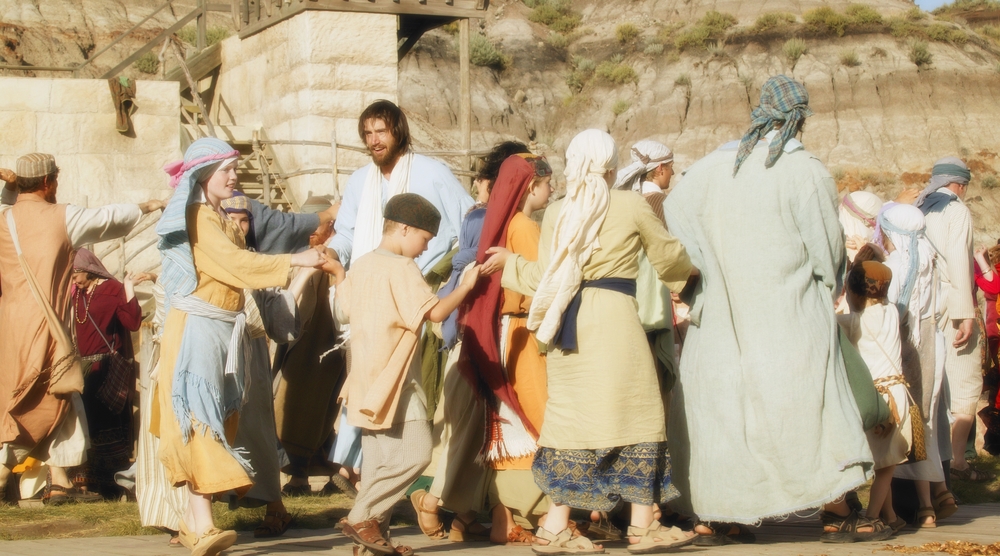
Who is My Neighbor? And Who is a Neighbor to Me? The Discomfort of Grace.

Grace is exercised among people who are not like you, who challenge you, who are uncomfortable to be around.

I have often touted the Unbelievable Podcast on Christian Premiere Radio in the UK, and I do it again here. I recommended the episode on Philip Yancey live Q&A on faith, doubt and the future of the US church: Saturday 19 March 2022. Much was discussed in the episode that I could write about, but one thing stands out above the rest to me this morning. Philip Yancey said,

“It’s easy to find a church, to gravitate toward a church, where people look like you, and smell like you, and vote like you.”

Most of us go to churches like that. It’s a human tendency to gravitate toward people with whom we have the most connections, to settle in with people with whom we have the most in common, to spend time with people most like us, but Yancey says,

“That’s not the way to exercise grace. Grace is exercised among people who are not like you, who challenge you, who are uncomfortable to be around, people who are immoral. That’s where to exercise grace.”

Such a radical statement challenges most of us, I think. I am guilty of settling into churches where I feel most comfortable, but what if God wants me to engage in a church, or in groups, or with people with whom I feel uncomfortable? Would I be open to that possibility?

Jesus often urged people to love their neighbors. When I think of my neighbors, I think of the people in my neighborhood who I know and spend time with. If you are like me, you probably think immediately of your neighbors you know, but what about your neighbors you don’t know?

Jesus knew that people tend to favor those who are like them when he told the parable of the Good Samaritan. (Luke 25:30-35) In the parable, an unidentified man is attacked by robbers, stripped of his clothes, beaten and left for dead. (Luke 25:30) Three people come along and see him lying there: a priest, a Levite, and a Samaritan.

The priest and the Levite were the people most like the man who asked the question that prompted the parable. He was an expert in the Law of Moses, a Jewish leader.

He actually began with a more esoteric question: “What must I do to inherit eternal life?” Jesus turned the question on him, asking “What is written in the Law?” (Luke 25:25-26)

When the man responded, “‘Love the Lord your God with all your heart and with all your soul and with all your strength and with all your mind’; and, ‘Love your neighbor as yourself,'”, Jesus answered anti-climatically, “You have answered correctly…. Do this and you will live.”

That might have been the end of the conversation, but the expert in the law “wanted to justify himself”. Perhaps, he wanted affirmation that he was reading the law correctly. Perhaps, he wanted Jesus to acknowledge his deep moral thinking. Perhaps, he wanted to prove his expertise in the Law. Whatever he was thinking, he asked, “[W]ho is my neighbor?” (Luke 25:29)

The man may have wanted Jesus to engage him in a deep theological discussion, but Jesus deflected the attempt with the parable. The expert in the Law wanted to make it difficult and complicated, but Jesus kept it simple.

The man is specifically identified as an “expert in the Law”, and the initial question and follow up question read to me like he was wanting a deeper, philosophical conversation with Jesus. He didn’t really want a simple, straightforward answer. He wanted to debate, but Jesus wouldn’t go there with him.

I am also relatively certain that the answer Jesus gave him was not at all what he expected. It likely cut him to the quick – both he and and the wider audience who was listening in.

Continue reading “Who is My Neighbor? And Who is a Neighbor to Me? The Discomfort of Grace.”

Tribalism and the Body of Christ: What Unifies Us, & What Separates Us is Key

We can’t avoid the conflict of differing views, but we need to be careful how we differ with people and over what we differ with them.

I have been listening to the podcast, Truth Over Tribe, beginning with the episode, How Tribalism Is Ruining Your Life, on Podbean. Check it out.

Whether you label it polarization or tribalism, I have seen people entrenching and doubling down in their political positions more than at any other time in my life. Thus, the podcast resonated loudly with me.

In writing this piece, I am not focusing on people, generally, or the state of governmental affairs. My focus here is the body of Christ and it’s witness in the world. People have always been divided. We have always had wars and fighting to prove it. The Church, however, should be different. The Church should stand a part, like a city of a hill.

Continue reading “Tribalism and the Body of Christ: What Unifies Us, & What Separates Us is Key”

Thinking Outside the Circle and Focusing on the Center: What Direction are You Moving?

If we are not challenged to rethink what we think we know from time to time, we are not likely coming into close enough contact with Jesus.

I watched the Chapelstreet church service today and listened to the sermon by Jeff Frazier in Batavia, IL. It was just what I needed to hear. Not that it tills new ground; it covers familiar ground from a new angle. It avoids the ruts of old, tired ways of thinking and finds fresh new ground (for me) from which to approach how we see Jesus.

The sermon today was inspired by Matthew 9:9-13.[i] You can read it in full at the endnote below. In summary, Jesus called Matthew from the tax booth where he was sitting to follow him, and Matthew responded by following him. That was the extent of the initial story

Then Scripture jumps to another scene: Jesus reclining at a table with “many tax collectors and sinners”. We are left to draw our own conclusions about what happened in the interim. It could be that Matthew invited all his friends, who were naturally other tax collectors and “sinners”, to met Jesus who had just connected with him.

The focus of the new scene, though, isn’t on Matthew anymore. The focus shifts to the Pharisees who ask the disciples why Jesus eats with “tax collectors and sinners”.

Before I describe how Jesus responded to them, I want to focus on the fact that the people who had a problem with Jesus were the religious people. Jesus was hanging around with all the wrong people according to the religious insiders of his day.

This is nothing new. I have written often about the Pharisees, Jesus and tax collectors and sinners. In fact, I wrote on the same subject just two weeks ago. (The Danger that Good, Upstanding, Religious People Face Today)

It isn’t a new thing to realize Jesus defied categorization; he shattered expectations and common ways of thinking. He challenged everyone he met to see the world differently, but we sometimes forget the radicalness of Jesus in our routine orthodoxy.

I dare say, if we are not challenged to rethink what we think we know from time to time, we are not likely coming into close enough contact with Jesus!

Back to the story: in First Century Judea, tax collectors were traitors and sell-outs. They were Hebrews who collected taxes for the Romans and used the authority of the Roman occupiers of the Hebrew Promised Land to accumulate wealth for themselves. They were hated by good Jews. They were outsiders in their own community.

As outsiders, they naturally associated with other outsiders (“sinners”). Thus, for Jesus to establish a relationship with Matthew – and worse than that: to “hang out” with other tax collectors and “sinners” – was scandalous. It was unthinkable!

When Jesus heard the Pharisees challenge the disciples to explain why Jesus was associating with “such people”, Jesus famously responded:

“Those who are well have no need of a physician, but those who are sick. Go and learn what this means: ‘I desire mercy, and not sacrifice.’ For I came not to call the righteous, but sinners.”

Matthew 9:12-13

This is a familiar passage to us, but I think the application of the message is sometimes lost on us today. I think we can fall into the trap of the Pharisees in our thinking without even realizing it. Thus, we need to be challenged to see things from a different angle, just as Jesus challenged the Pharisees in the first century.

Again, these are not new thoughts, but the the change of perspective (for me) comes courtesy of Paul G. Hiebert. Born to missionary parents in India, he became “arguably, the world’s leading missiological anthropologist”.[ii]

When he moved back to the west, he wrestled with questions like these: What does it mean for an illiterate, Hindu peasant to know Jesus? How much of their old life and traditions must be left behind?

Having observed missionaries in India, he concluded that the western mission movement was importing too many western traditions and thoughts. He saw the need for thinking outside the western box – like Jesus encouraged the followers of his day to think outside the box…. or rather, outside the circle, as we will see.

Continue reading “Thinking Outside the Circle and Focusing on the Center: What Direction are You Moving?”

Listening While White: Respecting the Image of God in People of Color

Jesus, himself, broke down the dividing wall that separates people.

I feel like I need to begin this with a request to “hear me out” (at the risk of appearing apologetic). I am a white, evangelical Christian. The title recognizes who I am. I realize as I wade out into these waters that they are treacherous today. Many are the rocks on which ships with good intentions have been dashed.

Should I even have to say that people of color bear the image of God? I shouldn’t have to say it, but I feel I need to say it nevertheless. Why?

That impulse, alone, signals to me that something is not quite right.

I just read that slavery is “the original sin of the United States”. It colors our past (pun very much intended). It continues to leave its imprint on the present. I have to admit to finding some truth in that statement.

Obviously, race is the subject of this article. But not just race. I am writing about Christianity, generally, and the church universal and global.

If any group ought to be able to speak with wisdom into the race issues that we continue to face, it should be the Church, right? Yet, we see as much segregation in the church as a whole as we do in society.

Spoiler alert. God has been orchestrating the entire course of human history from the beginning to this end:

“A great multitude that no one could count, from every nation, tribe, people and language, standing before the throne and before the Lamb….”

Revelations7:9

This is God’s endgame. Are we onboard with the plan?

This is the unity for which Jesus prayed for his followers. (John 17:20-23) Jesus, himself, broke down the dividing wall that separates people. (Eph. 2:14) God began working though His Holy Spirit toward His endgame soon after Jesus died and rose again, working through Paul and the disciples to break down the wall between Jew and Gentile. (See Reflection on the Unity for which Jesus Prayed: Peter & Cornelius)

We won’t participate in achieving the unity for which Jesus prayed without recognizing the big picture – the kingdom of God – and the foundation on which we all stand – Jesus. Given the purposeful prayer of Jesus for unity among his followers, disunity that exists in the Church means we have failed in some way to focus on the things that should unify us. We have allowed differences that shouldn’t matter to divide us.

If the endgame includes people “from every nation, tribe, people and language”, then we should not allow those kinds of differences, at least, to divide us. Racial matters should be a non-issue. We should be one in Christ, right?

Continue reading “Listening While White: Respecting the Image of God in People of Color”

To Be Known and to Fully Know God is the Great Purpose of Our Lives

To whom does God say, “Depart from me. I never knew you?”

Have you ever wondered who are the people to whom God may say, “I never knew you; depart from me”?[1] If you are like me, those words ring ominously. We might be tempted to gloss over them, because they are uncomfortable to consider, but there they are.

These words contrast with the verse that inspires this article, which informs the title to this blog piece. But first, I want to focus briefly on people whom God never knew. Jesus described them for us.

They are people who prayed to God, “Lord, Lord.” They are people who prophesied in God’s name. They are people who cast out demons and even did “mighty works” in God’s name. They are highly religious people, but they didn’t “do the will of the Father who is in heaven”. (Matt. 7:23)

What does that mean?

For starters, it means that religiosity is not a ticket to heaven. Public piety is not anything that impresses God; if anything, it may even be repulsive to Him.[2]

Power and influence and doing things that amaze people, even if done in God’s name, are not keys to heaven.  An eloquent speaker who can bring people to tears and repentance is not, thereby, assured of any place in God’s kingdom. The prophet and the teacher who speak the very word of God are not, by virtue of the gift of prophecy or knowledge, assured of eternity with God.

In the “Love Chapter” of the Bible (1 Corinthians 13), Paul says,

If I speak in the tongues of men and of angels, but have not love, I am a noisy gong or a clanging cymbal. And if I have prophetic powers, and understand all mysteries and all knowledge, and if I have all faith, so as to remove mountains, but have not love, I am nothing. If I give away all I have, and if I deliver up my body to be burned, but have not love, I gain nothing.”

1 Corinthians 13:1-3

These realities are at once sobering and liberating. Nothing we can “practice” or do will propel us into God’s heaven. We are saved by grace, though faith, of course (Eph. 2:8-9), but even faith that can move mountains is of no gain to us by itself.

And here is the kicker – not even sacrifice, not even the sacrifice of our own bodies, by itself gains us anything.

David knew this when he said, “For you will not delight in sacrifice, or I would give it; you will not be pleased with a burnt offering.” (Ps. 51:16)

Jesus said, “Greater love has no one than this, that someone lay down his life for his friends.” (John 15:13) Laying one’s life down might be considered a sacrifice, yes; but it done out of love it is more than merely a sacrifice. It isn’t the act itself that is important, but the motivation, the inspiration, the desire behind the act that matters.

Jesus is the ultimate example of love. When he sacrificed himself for our sakes, he didn’t do it to earn some heavenly brownie points. He gave himself for us out of love for us. He gave himself to us for our benefit. This is love, which focuses not one the benefit of the sacrifice to himself, but on the benefit for other another.

“For the letter kills, but the Spirit gives life.” (2 Cor. 3:6) Legalism and fundamentalism and dogmatism and doctrine and theology can never save a person. It doesn’t matter how much we do, or how much we know, or how accurate our understanding is when we have not love.

God, who we are to worship in spirit and truth (John 4:24), is love.[3] All the Law and the Prophets are summarized in this one statement: Love God above all things and love your neighbor as yourself. (Matt. 22:40) Thus, Paul says,

But if anyone loves[4] God, he is known by God.

1 Corinthians 8:3 ESV

This is the verse that got me thinking about these things today. If you love God, you are known by God. The people of whom God will say, “Depart from Me; I never knew you”, are people who don’t really love God. Their motivation was wrong.

Continue reading “To Be Known and to Fully Know God is the Great Purpose of Our Lives”